
Introduction
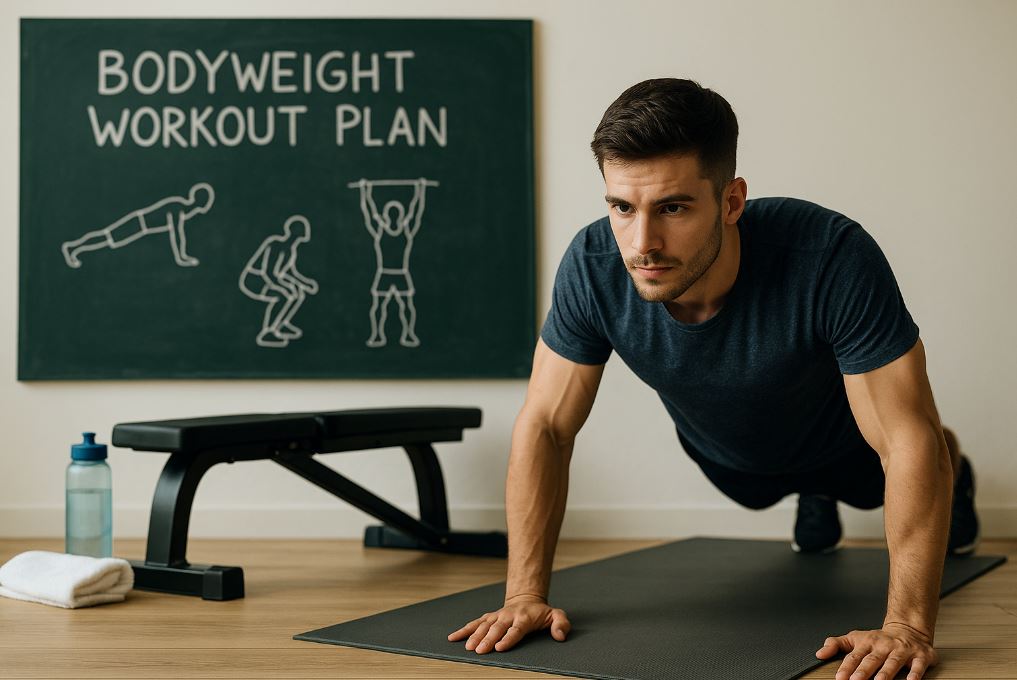
This 4-week home-based routine is perfect for anyone looking to build strength, improve endurance, and establish a solid foundation—without any fancy equipment. You’ll use your own body as resistance and occasionally leverage everyday household items (like chairs or steps) to enhance the exercises.
Bodyweight training is a highly effective method for beginners to master proper form, build foundational strength, and gain confidence in movement patterns. However, without external weights, progression can be more limited than with free-weight training. That’s why this program strategically increases the challenge through more reps, additional sets, and shorter rest periods to drive continued adaptation and results.
I designed this Bodyweight-Only Full-Body Workout Program for Beginners as a smart starting point for anyone looking to build strength and improve body control without a gym membership or expensive equipment. I fully understand that not everyone has access to barbells, dumbbells, or machines—and that’s precisely why this program exists.
My goal with this routine is to help you develop proper movement patterns, lay a firm muscular foundation, and gain the confidence needed to transition to free weights or gym-based training eventually. Think of it as your gateway into more advanced training systems—starting with nothing but your own body and determination.
About the Program
Here’s a quick overview of the Bodyweight-Only Full-Body Workout Program structure. This beginner-friendly plan requires no gym equipment and is designed to improve strength, coordination, and endurance—all from the comfort of your home.
| Parameter | Details |
|---|---|
| Training Type | Full-Body Training System |
| Level | Beginners |
| Frequency | 3 Times per Week (Monday, Wednesday, Friday) |
| Program Duration | 4 Weeks |
| Workout Duration | 45–60 Minutes |
| Primary Goal | Build Strength, Improve Endurance, Lay Foundation for Future Training |
| Training Location | Home |
| Required Equipment | None (Household items like chairs or steps may be helpful) |
| Exercise Selection | Bodyweight-Only Compound and Isolation Movements |
| Progression Model | Increased Sets, Reps, and Reduced Rest Periods |
| Fatigue Management | Moderate Intensity, Rest Days in Between Sessions |
| Beginner-Friendly | Focus on Form, Control, and Progressive Challenge |
| Warm-Up Included | Yes – Dynamic mobility drills before each session |
| Cool Down | Optional static stretching post-workout |
Weekly Training Overview
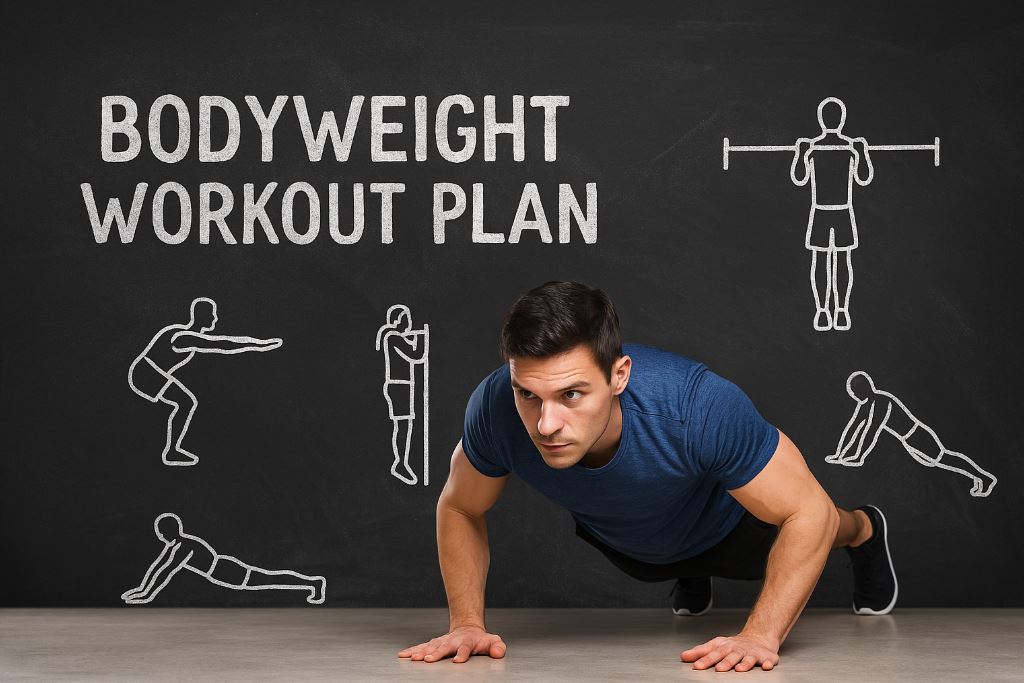
Each week follows a consistent Monday–Wednesday–Friday schedule to allow for optimal recovery between sessions. This approach gives your muscles time to adapt and grow while reinforcing full-body movement patterns three times a week—ideal for beginners.
| Day | Workout Type |
|---|---|
| Monday | Full-Body Workout |
| Tuesday | Rest or Light Activity |
| Wednesday | Full-Body Workout |
| Thursday | Rest or Light Activity |
| Friday | Full-Body Workout |
| Saturday | Rest |
| Sunday | Rest |
You can also download this complete 4-Week Bodyweight-Only Full-Body Workout Program (Home Edition) as a beautifully formatted PDF to keep on your device and follow anytime, anywhere.
Week 1 – Foundation & Familiarization
This first week focuses on learning proper form, activating major muscle groups, and building foundational strength. Since bodyweight exercises are often underestimated, my goal was to show you how effective they can be with proper structure and consistency. Let’s kick things off!
Day 1 – Monday (Week 1)
| Exercise | Primary Muscles Worked | Sets | Reps |
|---|---|---|---|
| Bodyweight Squats | Quads, Glutes, Hamstrings | 3 | 15–20 |
| Incline Push-Ups (Chair) | Chest, Triceps, Shoulders | 3 | 10–15 |
| Glute Bridges | Glutes, Hamstrings, Lower Back | 3 | 15–20 |
| Bird Dogs | Core, Lower Back, Glutes | 2 | 12 per side |
| Seated Knee Tucks (Chair) | Core | 3 | 15–20 |
Day 2 – Wednesday (Week 1)
| Exercise | Primary Muscles Worked | Sets | Reps |
|---|---|---|---|
| Step-Ups (Stairs/Chair) | Quads, Glutes, Hamstrings | 3 | 12 per leg |
| Negative Push-Ups | Chest, Triceps, Core | 3 | 6–10 (slow) |
| Wall Sits | Quads, Glutes, Core | 3 | 30–45 sec hold |
| Chair Dips | Triceps, Shoulders, Chest | 3 | 10–12 |
| Dead Bugs | Core, Hip Flexors | 3 | 10 per side |
Day 3 – Friday (Week 1)
| Exercise | Primary Muscles Worked | Sets | Reps |
|---|---|---|---|
| Bulgarian Split Squats | Quads, Glutes, Hamstrings | 3 | 8–10 per leg |
| Elevated Pike Push-Ups | Shoulders, Triceps, Chest | 3 | 8–12 |
| Glute March (Bridge Hold) | Glutes, Hamstrings, Core | 3 | 12 per leg |
| Plank | Core, Shoulders | 3 | 30–45 sec hold |
| Leg Raises | Core, Lower Abs | 3 | 15–20 |
Exercise Instructions – Week 1
| Exercise Name | Exercise Description |
|---|---|
| Bodyweight Squats | Stand with feet shoulder-width apart. Lower your body by bending your knees and pushing your hips back as if sitting in a chair. Keep your back straight and chest up. Lower until your thighs are parallel to the floor, then push through your heels to return to standing. |
| Incline Push-Ups (Chair) | Place your hands on the edge of a sturdy chair with your body in a straight line. Lower your chest toward the chair by bending your elbows, then push back up to the starting position. This variation is easier than standard push-ups and ideal for beginners. |
| Glute Bridges | Lie on your back with knees bent and feet flat on the floor. Press through your heels and squeeze your glutes to lift your hips off the ground until your body forms a straight line from shoulders to knees. Lower back down slowly and repeat. |
| Bird Dogs | Start on all fours. Extend your right arm forward and your left leg backward simultaneously, keeping your hips level. Hold for a moment, then return to starting position. Repeat on the other side. This move targets core stability and coordination. |
| Seated Knee Tucks (Chair) | Sit on the edge of a chair, lean back slightly, and grip the sides. Lift your feet off the floor and pull your knees toward your chest by contracting your abs. Slowly extend your legs back out and repeat. |
| Step-Ups (Stairs/Chair) | Place one foot on a stable surface like stairs or a chair. Press through the heel to lift your body up, bringing the opposite foot to meet it at the top. Step back down and repeat. Great for leg and glute strength. |
| Negative Push-Ups | Start in the top push-up position. Slowly lower your body to the ground over 3–5 seconds, keeping a straight line from head to heels. Once on the ground, return to the top position by any means. Focuses on strength and control. |
| Wall Sits | Lean against a wall and slide down until your knees are at 90 degrees, as if sitting on an invisible chair. Hold this position for the specified time while keeping your back flat against the wall and core engaged. |
| Chair Dips | Sit on the edge of a chair and place your hands beside your hips. Slide your body forward off the chair and bend your elbows to lower yourself down. Push back up until arms are straight. Focus on triceps and chest. |
| Dead Bugs | Lie on your back with arms extended to the ceiling and knees bent at 90 degrees. Slowly lower your right arm and left leg toward the ground while keeping your lower back flat. Return to center and alternate sides. |
| Bulgarian Split Squats | Stand a few feet in front of a chair or bench. Place one foot behind you on the chair. Lower your body into a lunge by bending the front knee, keeping your torso upright. Push back up and repeat before switching legs. |
| Elevated Pike Push-Ups | Place your feet on a raised surface like a chair and hands on the ground in a pike position. Bend your elbows to lower your head toward the floor, then push back up. Targets shoulders more than regular push-ups. |
| Glute March (Bridge Hold) | Hold a glute bridge position and alternate lifting each foot a few inches off the floor as if marching. Keep hips high and level throughout the movement. Great for glute and core endurance. |
| Plank | Rest on your forearms and toes, keeping your body in a straight line from head to heels. Engage your core and hold the position without letting your hips sag or rise. |
| Leg Raises | Lie on your back with legs extended. Keeping your lower back flat, lift your legs toward the ceiling until they form a 90-degree angle, then lower them slowly without touching the ground. Focuses on lower abs. |
Week 2 – Introducing Variety & Focus
In Week 2, we continue building foundational strength while introducing a few new exercises to enhance muscle activation and keep the training fresh. You’ll notice slight variations such as diamond push-ups for triceps and incline push-ups to emphasize the upper chest and shoulders. These progressions help activate different motor units and teach your body new movement patterns.
Let’s get to it:
Day 1 – Monday (Week 2)
| Exercise | Primary Muscle Group | Sets | Reps |
|---|---|---|---|
| Bodyweight Squats | Quads, Glutes | 3 | 15 |
| Incline Push-Ups (Chair/Bench) | Upper Chest, Shoulders | 3 | 12 |
| Glute Bridges | Glutes, Hamstrings | 3 | 15 |
| Seated Knee Tucks | Core | 3 | 15–20 |
| Diamond Push-Ups | Triceps, Chest | 2 | 10–12 |
Day 2 – Wednesday (Week 2)
| Exercise | Primary Muscle Group | Sets | Reps |
|---|---|---|---|
| Reverse Lunges | Quads, Glutes | 3 | 12/leg |
| Standard Push-Ups | Chest, Shoulders, Triceps | 3 | 12–15 |
| Glute Kickbacks | Glutes | 3 | 15/leg |
| Bird Dog | Core, Lower Back | 3 | 16 (8/side) |
| Diamond Push-Ups | Triceps, Chest | 2 | 12 |
Day 3 – Friday (Week 2)
| Exercise | Primary Muscle Group | Sets | Reps |
|---|---|---|---|
| Step-Ups (Chair or Stairs) | Quads, Glutes | 3 | 12/leg |
| Incline Push-Ups | Upper Chest, Shoulders | 3 | 10–12 |
| Glute Bridges (Feet Elevated) | Glutes, Hamstrings | 3 | 15 |
| Seated Knee Tucks | Core | 3 | 20 |
| Diamond Push-Ups | Triceps, Chest | 2 | 10–12 |
Exercise Instructions – Week 2
To avoid repetition and keep things concise, the following table includes only new exercises introduced in Week 2. For detailed instructions on previously listed movements, please refer to the Exercise Instructions – Week 1 section above.
| Exercise Name | Exercise Description |
|---|---|
| Incline Push-Ups (Chair/Bench) | Place your hands on a raised surface like a chair or low bench. Keep your body in a straight line from head to heels. Lower your chest toward the surface by bending your elbows, then press back up. This variation reduces the load, making it easier than standard push-ups. |
| Diamond Push-Ups | Start in a push-up position with your hands close together, forming a diamond shape with your thumbs and index fingers. Lower your chest toward the diamond while keeping elbows close to your sides. Push back up. Targets the triceps more intensely than regular push-ups. |
| Reverse Lunges | Stand upright and step one leg backward into a lunge position. Lower your body until both knees are at 90 degrees. Push through the front heel to return to standing. Alternate legs with each rep. Easier on the knees than forward lunges. |
| Glute Kickbacks | Start on all fours with your hands under your shoulders and knees under your hips. Extend one leg straight back and upward while squeezing the glutes. Slowly return to start and repeat on the same side before switching. Maintain a neutral spine throughout. |
| Glute Bridges (Feet Elevated) | Lie on your back with your feet elevated on a chair or step and knees bent. Press through your heels to lift your hips until your body forms a straight line from shoulders to knees. Lower down slowly. This variation increases the range of motion for greater glute activation. |
Week 3 – Smarter Bodyweight Progressions for Real Gains
In Week 3, we continue building on your progress. The training intensity increases slightly through subtle adjustments, such as extra reps, new movement variations, and enhanced core activation. By now, you should be more confident with your form and execution, so expect more challenging exercises, especially for the posterior chain and core.
Day 1 – Monday (Week 3)
| Exercise | Primary Muscles | Sets | Reps |
|---|---|---|---|
| Bulgarian Split Squats | Quads, Glutes | 3 | 10–12 (each leg) |
| Incline Push-Ups | Chest, Shoulders, Triceps | 3 | 12–15 |
| Bent-Over Towel Row | Lats, Biceps | 3 | 12–15 |
| Glute Bridges with March | Glutes, Hamstrings, Core | 3 | 12–14 |
| Hollow Body Hold | Core | 3 | 20–30 sec |
Day 2 – Wednesday (Week 3)
| Exercise | Primary Muscles | Sets | Reps |
|---|---|---|---|
| Step-Ups (use stairs/chair) | Quads, Glutes | 3 | 10–12 (each leg) |
| Diamond Push-Ups | Chest, Triceps | 3 | 10–12 |
| Superman Pull | Lower back, Glutes, Lats | 3 | 12–15 |
| Wall Sit | Quads, Core | 3 | 30–45 sec |
| Side Plank Reach-Through | Obliques, Core, Shoulders | 2 | 10 (each side) |
Day 3 – Friday (Week 3)
| Exercise | Primary Muscles | Sets | Reps |
|---|---|---|---|
| Squat Pulses | Quads, Glutes | 3 | 15–20 |
| Pike Push-Ups | Shoulders, Triceps | 3 | 10–12 |
| Door Frame Rows | Lats, Biceps | 3 | 12–15 |
| Lying Leg Raises | Core, Hip Flexors | 3 | 15–20 |
| Reverse Plank Hold | Core, Glutes, Posterior Chain | 2 | 30–45 sec |
Exercise Instructions – Week 3
| Exercise Name | Exercise Description |
|---|---|
| Bulgarian Split Squats | Stand a few feet in front of a chair or bench. Extend one leg behind you and rest the top of your foot on the bench. Lower your body until your front thigh is parallel to the ground, keeping your torso upright. Push through the front heel to return to the starting position. |
| Bent-Over Towel Row | Loop a towel around a sturdy object (like a pole or door handle) and hold both ends. Lean back and bend your knees slightly. Pull your chest toward your hands by squeezing your shoulder blades together, then return to the starting position. Great for training your back muscles at home. |
| Glute Bridges with March | Start in a glute bridge position. While holding the bridge at the top, alternate lifting one knee toward your chest while keeping the hips elevated. Keep your core engaged to prevent your hips from dropping. |
| Hollow Body Hold | Lie on your back with your arms extended overhead and legs straight. Lift your arms, shoulders, and legs off the ground to form a “hollow” shape. Keep your lower back pressed to the floor and hold the position for time. |
| Superman Pull | Lie face down with arms extended in front of you. Lift your arms, chest, and legs off the ground. While in the air, pull your elbows back as if rowing, squeezing your back muscles. Extend arms again and repeat. |
| Wall Sit | Lean against a wall with feet shoulder-width apart and slide down until your knees are at 90 degrees. Hold the position like you’re sitting on an invisible chair. Keep your back flat against the wall throughout the set. |
| Side Plank Reach-Through | Begin in a side plank. Reach your top arm under your torso, twisting slightly, then return to the starting position. Engages the obliques and adds rotational core stability to the standard side plank. |
| Squat Pulses | Lower into a squat and perform small, controlled pulses up and down at the bottom half of the movement. Stay low and maintain tension in the muscles without fully standing up between reps. |
| Pike Push-Ups | Start in a pike position (hips high, arms and legs straight). Lower your head toward the floor by bending your elbows, then press back up. This move targets the shoulders more than regular push-ups. |
| Door Frame Rows | Stand next to a door frame, grab it with both hands, and lean back. Pull your body toward the frame by bending your elbows and squeezing your shoulder blades. Great vertical pulling alternative at home. |
| Reverse Plank Hold | Sit on the floor with legs extended and hands placed slightly behind you. Press through your palms and lift your hips, forming a straight line from shoulders to heels. Engage your glutes and core while holding the position. |
Week 4 – Final Push & Peak Performance
This final week is all about consolidating your progress and pushing your limits just a bit further. While we keep the full-body structure and many core movements, you’ll see slight adjustments in volume or variations to enhance neuromuscular coordination and endurance. Think of this week as your opportunity to master control, reinforce proper technique, and finish strong.
Day 1 – Monday (week 4)
| Exercise | Primary Muscle Group | Sets | Reps |
|---|---|---|---|
| Pike Push-Ups | Shoulders, Upper Chest, Triceps | 3 | 10–12 |
| Bulgarian Split Squats (Bodyweight) | Quads, Glutes, Core | 3 | 10–12 (each leg) |
| Incline Push-Ups | Chest, Triceps, Front Shoulders | 3 | 12–15 |
| Step-Up to Knee Drive (on a stair or sturdy chair) | Quads, Glutes, Core | 2 | 12 (each leg) |
| Seated Leg Raises (on bench or floor) | Lower Abs, Hip Flexors | 3 | 15–20 |
Day 2 – Wednesday (Week 4)
| Exercise | Primary Muscle Group | Sets | Reps |
|---|---|---|---|
| Diamond Push-Ups | Triceps, Inner Chest, Front Delts | 3 | 8–10 |
| Glute Bridge Walkouts | Glutes, Hamstrings, Core | 3 | 10 |
| Towel Rows (under-door or sturdy handle) | Lats, Rear Delts, Biceps | 3 | 10–12 |
| Incline Diamond Push-Ups | Triceps, Chest | 2 | 12–15 |
| V-Ups | Core (Upper and Lower Abs) | 3 | 15–20 |
Day 3 – Friday (Week 4)
| Exercise | Primary Muscle Group | Sets | Reps |
|---|---|---|---|
| Archer Push-Ups (Assisted if needed) | Chest, Triceps, Shoulders | 3 | 8–10 |
| Wall Sit with Calf Raises | Quads, Glutes, Calves | 3 | 12–15 (raises per hold) |
| Table Inverted Rows | Back, Biceps, Rear Delts | 3 | 10–12 |
| Elevated Glute Bridge | Glutes, Hamstrings | 3 | 12–15 |
| Plank Shoulder Taps | Core, Stability Muscles | 3 | 20 taps (10 per side) |
Exercise Instructions – Week 4
| Exercise Name | Exercise Description |
|---|---|
| Step-Up to Knee Drive | Use a sturdy chair or staircase. Step up with one leg and bring the opposite knee up towards your chest as you stand tall. Lower back down and repeat on the same side. This move boosts balance, coordination, and leg drive power. |
| Glute Bridge Walkouts | Lie on your back with feet flat. Lift your hips into a glute bridge. From this position, slowly walk your heels out one step at a time, keeping your hips up. Then walk them back in. Focus on glute and hamstring engagement. |
| Incline Diamond Push-Ups | Place your hands close together in a diamond shape on an elevated surface (like a bench or low table). Perform a push-up while keeping your elbows close to your sides. This easier variation targets the triceps with less strain. |
| Archer Push-Ups (Assisted) | Start in a wide push-up stance. Shift your weight to one side, bending that elbow while keeping the other arm straight, like drawing a bow. Alternate sides. For beginners, perform from the knees or elevate hands. |
| Wall Sit with Calf Raises | Hold a wall sit position and lift your heels off the ground, performing slow calf raises while maintaining tension in your legs. Improves muscular endurance in the calves and thighs. |
| Table Inverted Rows | Lie under a sturdy table. Grab the edge with an overhand grip and pull your chest toward the table. Keep your body straight and elbows close. This mimics the horizontal row motion at home. |
| Plank Shoulder Taps | From a high plank position, tap your opposite shoulder with one hand while stabilizing your core. Alternate sides without letting your hips twist. Enhances anti-rotational strength and shoulder stability. |
Coach’s Note 🧠
While I haven’t implemented this exact program in a live, in-person setting with clients, I’ve received excellent feedback from those who followed it independently. Many beginners found it highly approachable yet surprisingly effective.
Several users told me it was the perfect stepping stone—they built foundational strength, improved control over their body, and gained the confidence they needed to transition into free weights and eventually a structured gym program.
If you’re just starting your fitness journey, this bodyweight plan can give you the head start you need—without any expensive equipment or gym memberships.
Pros & Cons of the Bodyweight-Only Full-Body Workout Program
| Pros ✅ | Cons ⚠️ |
|---|---|
| Requires no gym membership or expensive equipment — fully home-based. | Limited resistance makes it harder to progressively overload long term. |
| Ideal for beginners to build foundational strength and control. | Some muscle groups (e.g. back, biceps) are harder to isolate effectively. |
| Low risk of injury when proper form and control are emphasized. | Progress may plateau if not carefully managed with higher volume or intensity tweaks. |
| Builds strong movement patterns and neuromuscular coordination. | Lacks the variety and load intensity that external weights can offer. |
| Accessible to everyone regardless of budget or location. | Motivation may drop due to repetition and slower visible gains compared to weighted programs. |
Alternative Workout Programs for Beginners
While the Bodyweight-Only Full-Body Workout Program is a great way to kickstart your fitness journey at home, you might eventually crave more variety, resistance, or faster progress. Depending on your available equipment and personal goals, here are some structured beginner-friendly alternatives you can explore:
- Beginner Full Body Training Program for Maximum Muscle Gains (Gym-Based)
Perfect for gym-goers who want to make the most of barbells, machines, and cable stations. Focuses on progressive overload with a balanced mix of compound and isolation exercises. - Dumbbell-Only Full Body Workout for Beginners (Home Edition)
Designed for home training with adjustable dumbbells and an incline bench. It allows effective progression through weight increments and workout structure. - Barbell-Only Full Body Workout for Beginners (Home Edition)
A minimal-equipment routine using only a barbell, plates, and an adjustable bench. Great for building raw strength and practicing foundational barbell lifts at home. - Kettlebell-Only Full-Body Workout for Beginners (Home Edition)
A unique blend of strength and conditioning using just two kettlebells. Boosts functional strength, grip, and coordination. - 4-Week Beginner Free Weights Workout Program (Home or Gym)
A hybrid full-body training plan combining dumbbells and barbells. Ideal for beginners training at home or in the gym with basic free weight access. - Full-Body Resistance Band Workout Plan for Beginners (Home Edition)
Resistance bands offer scalable tension, joint-friendly loading, and an excellent transition point toward more advanced training methods.
Wondering what to do after finishing this program? Our beginner workout roadmap shows the ideal next step.
Final Thoughts
As a fitness trainer who’s worked with countless beginners, I designed this workout program with one clear goal in mind — to give you a solid foundation without the need for fancy equipment or a gym membership.
I know how overwhelming it can feel to get started, especially when resources are limited. This program removes those barriers. It helps you build strength, coordination, and confidence using just your body and everyday household items.
More importantly, it prepares you physically and mentally for the next step in your fitness journey — whether that’s free weights at home or machines in a gym setting. I encourage you to complete all four weeks with consistency and commitment. The results might surprise you.
You’ve already taken the hardest step by starting. Now keep moving forward — your stronger, fitter self is waiting.
Can I build muscle with bodyweight-only exercises?
Yes, especially as a beginner. Bodyweight workouts can effectively stimulate muscle growth through high reps, short rest intervals, and progressive overload via volume.
What if I can’t do push-ups or squats yet?
Start with modified versions like incline push-ups (hands on a surface) or wall squats. Focus on form and gradually build strength over time.
How long before I see results from a bodyweight program?
Most beginners notice visible changes in 4–6 weeks, including better endurance, strength, and muscle tone — especially with consistent effort and a balanced diet.
Can I lose weight with this bodyweight workout plan?
Yes. While the focus is on strength and muscle, bodyweight circuits can increase calorie burn and contribute to fat loss when paired with proper nutrition.
What should I eat during this 4-week bodyweight program?
Aim for a protein-rich, balanced diet. Prioritize whole foods, stay hydrated, and consider slight calorie surplus for muscle gain or deficit for fat loss.
Can I repeat this 4-week program multiple times?
Absolutely. You can repeat the plan 2–3 cycles, each time increasing volume, reducing rest time, or modifying exercises to keep progressing.
What happens after I complete the bodyweight-only plan?
You’ll be ready for more challenging routines using dumbbells, barbells, or machines. Check out our beginner gym or dumbbell programs to level up.
Is this workout plan safe for older adults or teenagers?
Yes, with proper form and modifications as needed. This plan is joint-friendly and scalable, making it ideal for various ages and fitness levels.
Do I need to stretch or warm up before workouts?
Definitely. Begin each session with 5–10 minutes of light cardio and dynamic stretching to reduce injury risk and boost performance.
Can I combine this program with cardio workouts?
Yes! Adding walking, cycling, or light jogging on rest days can improve cardiovascular fitness and enhance fat loss without interfering with recovery.
