


Introduction
Starting a structured split-training routine is a significant milestone for beginners — but timing matters. While many newcomers are eager to jump straight into more advanced splits, the most innovative long-term approach is gradual progression.
For most beginners, the optimal path looks like this:
Full-Body Training → Upper / Lower Split → Push–Pull Split → Push-Pull-Legs Split → Specialized Body-Part Splits.
This 4-Week Push-Pull-Legs Workout Routine for Beginners is designed precisely for that next step — for trainees who have already built a basic foundation and are ready to handle slightly higher training volume and more focused muscle-group sessions.
The program is performed in the gym using all available equipment and follows a structured 4-week progression model that prioritizes recovery, consistency, and sustainable muscle growth—not burnout.
What Is a Push-Pull-Legs Workout Routine?
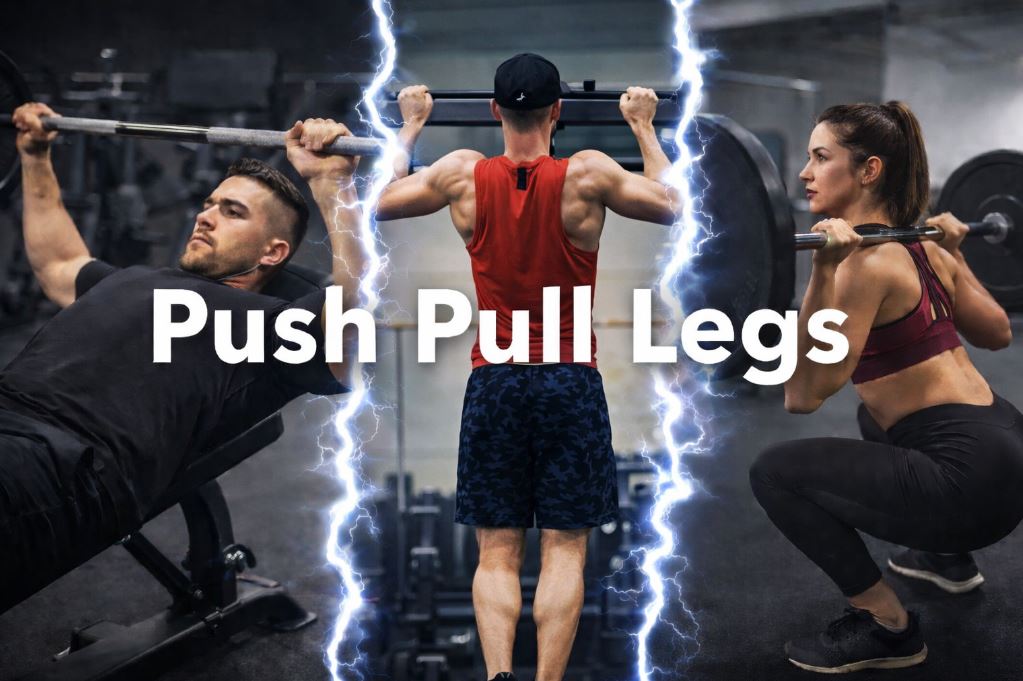
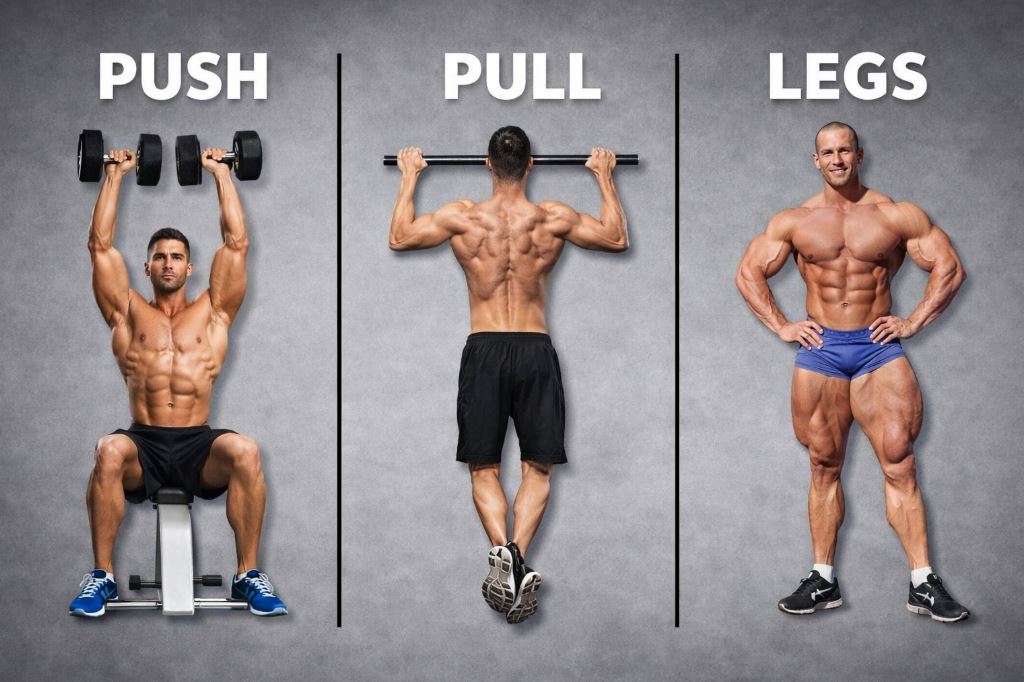
The Push-Pull-Legs (PPL) workout routine is a split-training system that organizes workouts by movement patterns rather than individual muscles.
- Push workouts target muscles involved in pressing movements (chest, shoulders, triceps)
- Pull workouts focus on pulling movements (back, biceps, rear delts)
- Leg workouts are dedicated entirely to the lower body (quads, hamstrings, glutes, calves)
This structure allows each muscle group to be trained with greater focus and volume, while still maintaining adequate recovery between sessions.
How Push-Pull Legs Differs from Upper / Lower and Push–Pull Splits
Compared to an Upper / Lower Split, Push Pull Legs offers:
- more precise muscle group targeting
- higher per-session training volume
- longer recovery windows for each muscle group
Compared to a Push–Pull Split, Push-Pull Legs:
- separates leg training into its own dedicated session
- reduces overall fatigue on upper-body days
- allows better intensity management for beginners progressing beyond basic splits
For beginners who have already completed a full-body or upper/lower phase, PPL represents a logical and structured evolution, not a sudden jump into advanced bodybuilding-style programming.
Program Structure & Key Training Parameters
Before diving into the weekly workouts, it’s essential to understand how this 4-Week Push Pull Legs Workout Routine for Beginners is structured, who it’s designed for, and what you can realistically expect from it.
This program is performed in a fully equipped gym, uses standard resistance tools (machines, barbells, dumbbells, cables), and is carefully organized to balance training volume, recovery, and progression — crucial for beginners transitioning to more advanced split routines.
Below is a clear overview of the key training parameters.
| Parameter | Details |
|---|---|
| Training Split | Push / Pull / Legs (PPL) |
| Training Level | Beginners (with basic gym experience) |
| Frequency | 3–4 Training Days per Week |
| Program Duration | 4 Weeks |
| Workout Duration | 60–75 Minutes per Session |
| Primary Goal | Muscle Growth (Hypertrophy), Volume Adaptation |
| Training Location | Gym (Full Equipment Access) |
| Equipment Used | Barbells, Dumbbells, Machines, Cables |
| Progression Model | Gradual increase in load, reps, or RPE |
| Intensity Control | RPE-based (7 → 8 across 4 weeks) |
| Rest Between Sets | 60–90 sec (compound), 45–60 sec (isolation) |
| Beginner-Friendly | Yes – volume and frequency carefully controlled |
Weekly Training Split Explained: Push / Pull / Legs Structure
To ensure proper recovery while still allowing enough training volume for each muscle group, this Push Pull Legs Workout Routine for Beginners follows a structured weekly split. Each training day has a clear purpose, making the program easy to follow, logically organized, and sustainable for beginners transitioning to more advanced split routines.
This layout allows you to train each major movement pattern with focus, while still leaving adequate rest between sessions — a key factor for beginners who are still adapting to higher training frequency.
| Day | Training Focus |
|---|---|
| Monday | Push Workout (Chest, Shoulders, Triceps) |
| Tuesday | Rest or Light Cardio / Mobility |
| Wednesday | Pull Workout (Back, Biceps, Rear Delts) |
| Thursday | Rest |
| Friday | Legs Workout (Quads, Hamstrings, Glutes, Calves) |
| Saturday | Optional Active Recovery |
| Sunday | Rest |
Coach’s Insight on Training Frequency
For beginners, 3 training days per week is the optimal balance when using a Push Pull Legs split. It provides enough stimulus for muscle growth and skill development without overwhelming recovery capacity.
As your experience and work capacity increase, this split can later be expanded to higher frequencies — but for now, simplicity and consistency win.
For your convenience, this workout program is also available as a downloadable PDF, allowing you to save it, print it, or follow it offline anytime.
Week 1 – Push / Pull / Legs (Learning the Split & Building the Base)
The first week of this Push Pull Legs Workout Routine for Beginners focuses on understanding the split itself, learning the exercise order, and building a solid technical foundation.
Volume and intensity are kept moderate, with an average RPE of around 7. The goal is not to train to failure, but to develop confidence, consistency, and proper execution across all major movement patterns.
Training frequency this week is 3 days, providing sufficient stimulus for beginners while ensuring complete recovery.
Day 1 – Push Day (Week 1)
| Exercise | Sets | Reps | RPE | Muscles Worked |
|---|---|---|---|---|
| Machine or Barbell Bench Press | 3 | 10–12 | 7 | Chest, triceps, anterior delts |
| Seated Chest Press Machine | 3 | 12–14 | 7 | Chest, triceps |
| Seated Shoulder Press Machine | 3 | 10–12 | 7 | Deltoids, triceps |
| Dumbbell Lateral Raises | 3 | 14–16 | 7 | Lateral deltoids |
| Cable Triceps Pushdown | 3 | 12–14 | 7 | Triceps |
| Assisted Dips or Bench Dips | 2 | 10–12 | 7 | Chest, triceps |
Day 2 – Pull Day (Week 1)
| Exercise | Sets | Reps | RPE | Muscles Worked |
|---|---|---|---|---|
| Lat Pulldown (Wide or Neutral Grip) | 3 | 10–12 | 7 | Lats, biceps |
| Seated Cable Row | 3 | 12–14 | 7 | Mid-back, lats |
| Chest-Supported Machine Row | 3 | 10–12 | 7 | Upper back |
| Face Pull (Cable or Machine) | 3 | 14–16 | 7 | Rear delts, upper back |
| Cable Biceps Curl | 3 | 12–14 | 7 | Biceps |
| Incline Dumbbell Curl | 2 | 12–14 | 7 | Biceps |
Day 3 – Legs Day (Week 1)
| Exercise | Sets | Reps | RPE | Muscles Worked |
|---|---|---|---|---|
| Leg Press Machine | 4 | 12–15 | 7 | Quads, glutes |
| Seated or Lying Leg Curl | 3 | 14–16 | 7 | Hamstrings |
| Hack Squat or Goblet Squat | 3 | 10–12 | 7 | Quads, glutes |
| Walking Lunges (Dumbbells) | 2–3 | 12 / leg | 7 | Quads, glutes |
| Standing Calf Raise Machine | 3 | 14–16 | 7 | Calves |
| Cable Crunch or Ab Machine | 3 | 15–20 | 7 | Abdominals |
Coach’s Note — Week 1 Coaching Guidelines
During Week 1, the priority is learning the structure of the Push / Pull / Legs split and understanding how your body responds to each session. You should consistently finish most sets with 1–3 reps left in reserve, focusing on clean technique rather than pushing to failure.
Pay attention to exercise order and recovery between sessions. Push days, pull days, and leg days will feel very different, and that’s intentional. This is your opportunity to learn what each training category actually feels like in practice.
The goal is simple: leave the gym feeling trained, not destroyed. Building familiarity and confidence now will allow you to handle higher volume and intensity in the coming weeks.
Week 2 – Building Volume Tolerance & Consistency
After completing the first week, your body should already be adapting to the new split structure and increased training frequency. In Week 2, the focus shifts toward improving volume tolerance and reinforcing consistency across all three training days.
At this stage, you’re not chasing maximum intensity or failure. Instead, the goal is to handle slightly more total work while maintaining solid technique and good recovery between sessions. Exercises remain familiar, but you may begin to notice improved control, coordination, and greater confidence with gym equipment.
If possible, gradually increase the load, add a repetition within the prescribed range, or simply improve execution quality. This steady approach allows your body to adapt without excessive fatigue and prepares you for the more demanding weeks ahead.
Day 1 – Push Day (Week 2)
| Exercise | Sets | Reps | RPE | Muscles Worked |
|---|---|---|---|---|
| Barbell or Machine Bench Press | 4 | 10–12 | 7 | Chest, triceps, anterior delts |
| Seated Dumbbell Shoulder Press | 3 | 10–12 | 7 | Shoulders, triceps |
| Incline Dumbbell Press | 3 | 10–12 | 7 | Upper chest, shoulders |
| Cable Lateral Raises | 3 | 14–16 | 7 | Lateral delts |
| Triceps Pushdown (Cable) | 3 | 12–14 | 7 | Triceps |
| Overhead Triceps Extension (Cable or DB) | 2 | 12–14 | 7 | Triceps |
Day 2 – Pull Day (Week 2)
| Exercise | Sets | Reps | RPE | Muscles Worked |
|---|---|---|---|---|
| Lat Pulldown or Assisted Pull-Ups | 4 | 10–12 | 7 | Lats, biceps |
| Seated Cable Row | 3 | 10–12 | 7 | Mid-back, rhomboids |
| Chest-Supported Dumbbell Row | 3 | 10–12 | 7 | Upper back, lats |
| Face Pulls (Cable) | 3 | 14–16 | 7 | Rear delts, upper back |
| Barbell or Dumbbell Curl | 3 | 12–14 | 7 | Biceps |
| Hammer Curl (Dumbbells or Rope) | 2 | 12–14 | 7 | Biceps, forearms |
Day 3 – Legs Day (Week 2)
| Exercise | Sets | Reps | RPE | Muscles Worked |
|---|---|---|---|---|
| Barbell Back Squat or Hack Squat | 4 | 10–12 | 7 | Quads, glutes |
| Romanian Deadlift (Barbell or DB) | 3 | 10–12 | 7 | Hamstrings, glutes |
| Leg Press | 3 | 12–14 | 7 | Quads, glutes |
| Lying or Seated Leg Curl | 3 | 12–14 | 7 | Hamstrings |
| Standing or Seated Calf Raise | 4 | 14–16 | 7 | Calves |
| Hanging Knee Raises or Cable Crunch | 3 | 15–20 | 7 | Core |
Coach’s Note — Week 2 Progression Logic
To keep the learning process smooth and effective, no new exercises are introduced in Week 2 compared to Week 1. This allows beginners to reinforce proper movement patterns, improve confidence, and train with better control.
Progression in this week comes from smarter variables rather than exercise changes:
- working closer to the upper end of the prescribed rep ranges
- slightly increased total training volume
- better execution quality, control, and movement safety
This approach ensures steady progress without overwhelming the nervous system — a key factor for long-term beginner success.
Week 3 – Progressive Overload Phase
By Week 3, your body has adapted to the Push–Pull–Legs structure and the fundamental movement patterns. This is where we begin applying progressive overload more intentionally. You should now feel more confident in the gym, more stable under load, and better able to judge your effort.
At this stage, progression comes from:
- slightly increasing the load
- working closer to the top of the rep ranges
- slowing down the eccentric phase
- improving mind–muscle connection
Target intensity moves to RPE ~7.5— challenging but still technically clean.
Day 1 – Push Day (Week 3)
| Exercise | Sets | Reps | RPE | Muscles Worked |
|---|---|---|---|---|
| Barbell or Machine Chest Press | 4 | 8–10 | 7.5 | Chest, triceps, front delts |
| Incline Dumbbell Press | 3 | 10–12 | 7.5 | Upper chest, shoulders |
| Seated Shoulder Press (Machine or DB) | 3 | 10–12 | 7.5 | Deltoids, triceps |
| Cable or Dumbbell Lateral Raises | 3 | 12–15 | 7.5 | Lateral delts |
| Cable Triceps Pushdown | 3 | 10–12 | 7.5 | Triceps |
| Overhead Triceps Extension | 2 | 12–14 | 7.5 | Triceps (long head) |
Day 2 – Pull Day (Week 3)
| Exercise | Sets | Reps | RPE | Muscles Worked |
|---|---|---|---|---|
| Lat Pulldown or Assisted Pull-Ups | 4 | 8–10 | 7.5 | Lats, biceps |
| Seated Cable Row | 3 | 10–12 | 7.5 | Mid-back, rhomboids |
| One-Arm Dumbbell Row | 3 | 10–12 | 7.5 | Lats, upper back |
| Face Pulls | 3 | 12–15 | 7.5 | Rear delts, upper back |
| Dumbbell or EZ-Bar Curl | 3 | 10–12 | 7.5 | Biceps |
| Cable Hammer Curl | 2 | 12–14 | 7.5 | Biceps, forearms |
Day 3 – Legs Day (Week 3)
| Exercise | Sets | Reps | RPE | Muscles Worked |
|---|---|---|---|---|
| Leg Press or Squat | 4 | 8–10 | 7.5 | Quads, glutes |
| Romanian Deadlift | 3 | 10–12 | 7.5 | Hamstrings, glutes |
| Walking Lunges or Split Squats | 3 | 10–12 / leg | 7.5 | Quads, glutes |
| Seated or Lying Leg Curl | 3 | 12–14 | 7.5 | Hamstrings |
| Standing or Seated Calf Raises | 4 | 12–15 | 7.5 | Calves |
| Optional Core (Plank / Crunch) | 2–3 | 30–45 sec | 7.5 | Core |
Coach’s Note — Week 3 Progressive Overload
By Week 3, your body is no longer just learning the movements — it’s ready to be challenged. This is where progressive overload becomes intentional rather than accidental. You should now feel confident enough to slightly increase the load, push closer to the upper end of the rep ranges, or improve control during the eccentric phase.
The goal is not to train to failure, but to make each set more demanding than before while maintaining clean technique. If the last few reps feel challenging but still controlled, you’re applying overload exactly the way beginners should.
Week 4 – Final Push, Pull & Legs Phase
Week 4 is the final and most demanding phase of this Push-Pull–Legs Workout Routine for Beginners. By now, you should feel confident with the split structure, exercise selection, and overall weekly rhythm. This week is about execution under higher effort, not learning anything new.
All exercises remain the same to reinforce mastery, while intensity increases to RPE 8. This means the last 1–2 reps of each set should feel challenging, but your technique must remain solid and controlled.
Day 1 – Push Day (Week 4)
| Exercise | Sets | Reps | RPE | Muscles Worked |
|---|---|---|---|---|
| Barbell or Machine Chest Press | 4 | 8–10 | 8 | Chest, triceps, shoulders |
| Incline Dumbbell Press | 3 | 10–12 | 8 | Upper chest, shoulders |
| Seated Shoulder Press (Machine or DB) | 3 | 10–12 | 8 | Deltoids, triceps |
| Cable or Dumbbell Lateral Raises | 3 | 14–16 | 8 | Lateral deltoids |
| Triceps Pushdown (Cable) | 3 | 12–14 | 8 | Triceps |
| Overhead Triceps Extension | 2 | 12–14 | 8 | Triceps |
Day 2 – Pull Day (Week 4)
| Exercise | Sets | Reps | RPE | Muscles Worked |
|---|---|---|---|---|
| Lat Pulldown or Assisted Pull-Up | 4 | 8–10 | 8 | Lats, biceps |
| Seated Cable Row | 3 | 10–12 | 8 | Mid-back, lats |
| Chest-Supported Dumbbell Row | 3 | 10–12 | 8 | Upper back |
| Face Pull (Cable) | 3 | 14–16 | 8 | Rear delts, upper back |
| EZ-Bar or Dumbbell Curl | 3 | 12–14 | 8 | Biceps |
| Hammer Curl | 2 | 12–14 | 8 | Biceps, forearms |
Day 3 – Legs Day (Week 4)
| Exercise | Sets | Reps | RPE | Muscles Worked |
|---|---|---|---|---|
| Squat or Hack Squat Machine | 4 | 8–10 | 8 | Quads, glutes |
| Romanian Deadlift | 3 | 10–12 | 8 | Hamstrings, glutes |
| Leg Press | 3 | 12–14 | 8 | Quads, glutes |
| Lying or Seated Leg Curl | 3 | 12–14 | 8 | Hamstrings |
| Standing or Seated Calf Raise | 4 | 14–16 | 8 | Calves |
| Ab Machine or Cable Crunch | 3 | 15–20 | 8 | Core |
Coach’s Note — Week 4: Peak Effort & Control
Week 4 is where everything comes together. By now, the movement patterns should feel familiar, your confidence in the gym higher, and your recovery more predictable. That’s why this final week is performed at an RPE of around 8 across all sessions.
The goal here is not to introduce new exercises, but to apply focused effort to the same movements you’ve been practicing for weeks. Strong execution, controlled tempo, and mental focus matter more than adding extra weight or volume.
If you complete this week with solid technique and consistency, you’ve successfully built the foundation needed to progress into more advanced split routines or longer training cycles.
Understanding RPE in This Program
Throughout this 4-week Push Pull Legs workout routine, you’ll see the term RPE mentioned frequently. RPE stands for Rate of Perceived Exertion and represents how hard a set feels based on your own perception of effort, not just the weight on the bar. This system is especially valuable for beginners because it teaches you to listen to your body, regulate intensity, and progress safely without needing maximal loads or advanced testing.
Instead of chasing failure on every set, RPE helps you train with intentional effort — working hard enough to stimulate progress, while still maintaining proper form and allowing recovery between sessions.
| RPE | What It Feels Like | Reps Left in Reserve (Approx.) | How It Applies in This Program |
|---|---|---|---|
| RPE 6 | Light to moderate effort | 4–5 reps left | Mainly used during warm-up or early adaptation phases |
| RPE 7 | Challenging but controlled | 3 reps left | Common in early weeks to build technique and volume tolerance |
| RPE 7.5 | Clearly demanding | 2–3 reps left | Used as progression once movements feel stable |
| RPE 8 | Hard but repeatable | 2 reps left | Target intensity in Week 4 for peak stimulus |
| RPE 9 | Very hard | 1 rep left | Generally not recommended for beginners |
| RPE 10 | Maximum effort | 0 reps left (failure) | Avoiding to reduce injury risk and fatigue |
If a set is prescribed at RPE 8, you should finish it knowing you could have performed about two more clean reps with good form. If you feel you could easily do five more reps, the load is too light. If you reach failure, it’s too heavy.
Using RPE correctly ensures this program stays effective, scalable, and beginner-safe, while still delivering real progress.
Evaluating the Push–Pull–Legs Program: Strengths & Limitations
Before committing to a Push–Pull–Legs split as a beginner, it’s essential to understand where this training structure excels and where it has natural limitations. When used at the right stage of progression, a PPL program can be highly effective — but it’s not meant to be a first stop for complete beginners.
| Pros | Cons |
|---|---|
| Clear structure and easy-to-understand split for beginners ready to move beyond full-body training. | Requires more weekly gym sessions compared to full-body or upper/lower programs. |
| Allows higher training volume per muscle group while maintaining focused sessions. | Can feel demanding for beginners with poor recovery, sleep, or nutrition habits. |
| Excellent introduction to classic bodybuilding-style split training. | Less frequent muscle stimulation compared to full-body routines. |
| Easy exercise organization based on movement patterns (push, pull, legs). | Missed sessions can disrupt weekly balance more than with simpler splits. |
| Works well in a fully equipped gym environment with access to machines and free weights. | Not ideal as a very first resistance training program for complete beginners. |
| Smooth transition step toward more advanced or specialized split routines. | Requires basic exercise familiarity to be performed safely and effectively. |
Where Push–Pull–Legs Fits in a Beginner’s Training Journey
For most beginners, a Push–Pull–Legs program should not be the first exposure to structured strength training. Before starting PPL, it’s strongly recommended to complete at least one full-body training phase and, ideally, an upper/lower split program. These earlier phases help develop fundamental movement patterns, coordination, work capacity, and recovery ability — all of which are essential for handling the higher weekly volume introduced by PPL.
Once those foundations are in place, Push–Pull–Legs becomes a logical next step. It allows beginners to gain greater focus during training for each muscle group while still allowing enough recovery between sessions. After completing a 4-week PPL cycle, trainees are usually well prepared to move on to more specialized split routines, such as muscle-group-based splits, higher-volume hypertrophy programs, or goal-specific training plans tailored to strength, physique, or performance.
If you’re unsure whether this workout routine is the right starting point, see our complete guide to the Best Workout Routines for Beginners .
Final Thoughts
The 4-Week Push Pull Legs Workout Routine for Beginners represents a significant step forward in a beginner’s training journey. By this point, you’re no longer just learning how to move — you’re learning how to organize training volume, manage fatigue, and focus more intentionally on specific muscle groups.
What makes the PPL split so valuable at this stage is balance. You get higher training volume per muscle group than full-body or upper/lower programs, while still maintaining enough recovery between sessions. Push, pull, and legs each get their own dedicated focus, which helps beginners better understand how different muscle groups work together and respond to training stress.
That said, this program is not about rushing progress. The goal over these four weeks is consistency, technical precision, and controlled overload — not maximal weights or ego lifting. If you’ve followed the structure, respected the RPE guidelines, and allowed your body to adapt week by week, you’ve built a solid foundation for more advanced split routines in the future.
Please think of this program as a bridge: it connects beginner-friendly training systems with more specialized bodybuilding or strength-focused splits. Complete it with patience and intent, and you’ll be well prepared for whatever training direction you choose next.
Is a Push Pull Legs workout routine suitable for beginners?
Yes, a Push Pull Legs workout routine can be suitable for beginners after they have completed a full-body or upper/lower training phase. It introduces more structure and volume while still allowing adequate recovery.
How many days per week should beginners train on a Push Pull Legs split?
For beginners, the optimal frequency is 3 days per week — one Push day, one Pull day, and one Legs day. This setup balances training stimulus and recovery without overwhelming the nervous system.
What is the main difference between Push Pull Legs and Upper/Lower split?
The Push Pull Legs split organizes workouts by movement patterns, while the Upper/Lower split organizes them by body regions. Push Pull Legs allows greater focus on individual muscle groups within each session.
Should beginners start with heavy weights on a Push Pull Legs program?
No. Beginners should prioritize proper technique and controlled intensity, typically training at an RPE of 6–8. Load progression should be gradual and form-driven.
Can beginners build muscle effectively with a Push Pull Legs routine?
Yes. When programmed correctly, a Push Pull Legs routine can support consistent muscle growth by providing sufficient volume, structured progression, and clear recovery windows.
Is Push Pull Legs better than full-body training for beginners?
Not initially. Full-body training is generally better for complete beginners. Push Pull Legs becomes more effective after basic movement patterns and strength foundations are established.
What equipment is needed for a beginner Push Pull Legs program?
A gym environment with access to barbells, dumbbells, machines, and cable systems is ideal. This allows exercise variety while keeping movements beginner-friendly.
What does RPE mean in a Push Pull Legs workout?
RPE stands for Rate of Perceived Exertion and measures how hard a set feels. An RPE of 8 means you could perform about 2 more reps before failure.
How long should a Push Pull Legs workout last for beginners?
Most beginner Push Pull Legs sessions should last 60 to 75 minutes, including warm-up sets and rest periods.
What should beginners do after completing a 4-week Push Pull Legs program?
After completing the program, beginners can either repeat the cycle with slightly higher loads, transition to a higher-frequency Push Pull Legs split, or move toward more specialized hypertrophy-focused training splits.
