
Introduction
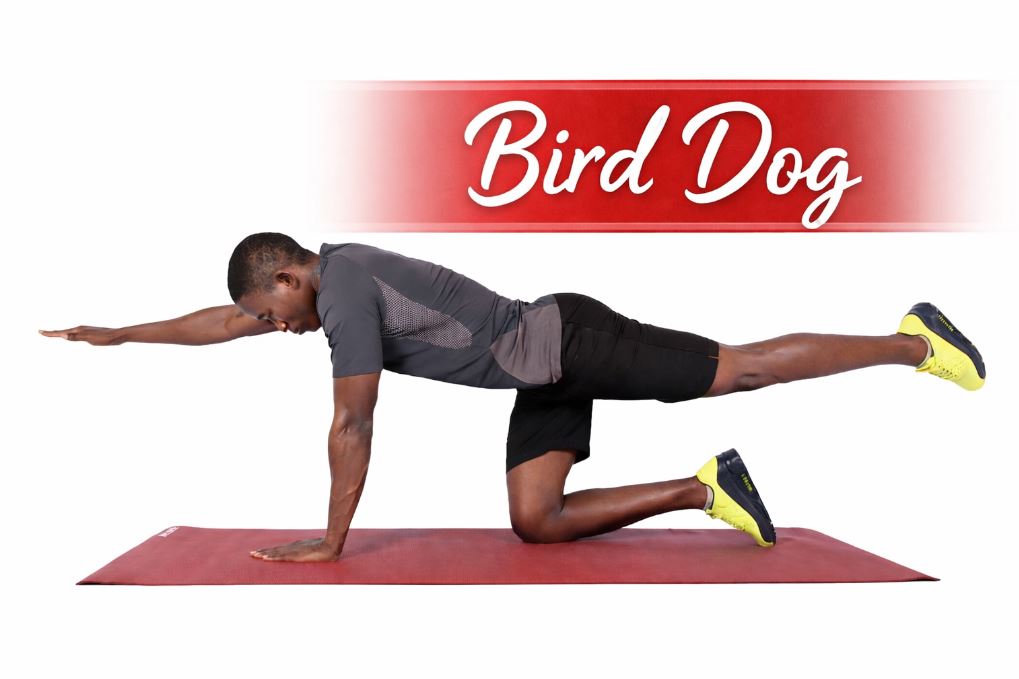
The bird dog is a fundamental core-stability exercise that improves spinal control, coordination, and anti-rotational strength. Although often underestimated for its simplicity, this movement plays a crucial role in teaching the body to stabilize the spine while the limbs move independently.
Widely used in rehabilitation, athletic preparation, and strength-training warm-ups, the bird dog helps lay the foundation for safe, efficient movement in compound lifts and everyday activities. Performed from a quadruped position — hands and knees on the floor — the exercise asks one arm and the opposite leg to extend simultaneously while the spine and pelvis stay completely still, which is a fundamentally different challenge than the dead bug performed lying on the back, even though both exercises share the same underlying anti-movement principle.
The bird dog is a classic anti-rotation exercise that trains the core to resist twisting forces. This ability is critical for protecting the spine during asymmetrical loading, running, throwing, and lifting movements. Unlike exercises that emphasize visible abdominal contraction, the bird dog builds deep, functional stability that carries over to real-world strength.
Exercise Snapshot
Muscles Worked in the Bird Dog
Primary muscles
- Transversus abdominis — provides deep spinal stabilization throughout the movement
- Multifidus — provides segmental spinal control, stabilizing individual vertebral segments as the limbs move independently
- Internal and external obliques — provide anti-rotation stability, resisting the torso’s tendency to twist as opposite-side limbs extend
Secondary muscles
- Gluteus maximus — drives hip extension as the working leg extends backward
- Shoulder stabilizers — provide upper-body control as the working arm extends forward and as the supporting arm and leg bear weight
- Spinal erectors — assist with posture maintenance throughout the hold
Antagonists
The forces that would rotate the hips or shoulders, or allow the lower back to arch or sag, are what the transversus abdominis, multifidus, and obliques actively resist throughout every repetition.
The bird dog’s weight-bearing quadrupod position is what most clearly distinguishes it from the dead bug. Because the supporting hand and knee bear the full body weight throughout the movement, the shoulder and hip stabilizers face a significantly greater demand than they would in a non-weight-bearing supine position. That added weight-bearing component is part of why the bird dog has such strong carryover to compound lifts and athletic movements that also occur from a weight-bearing stance.
How to Do a Bird Dog: Step-by-Step Form Guide
Starting position
- Start in a quadrupod position with your hands directly under your shoulders and your knees under your hips
- Keep the spine neutral from head to pelvis, avoiding excessive arching or rounding
- Brace the core lightly, as if preparing for gentle movement rather than maximal effort
- Keep the neck aligned with the spine, gaze directed toward the floor
- Distribute your weight evenly through both hands and knees before initiating movement
At this stage, the body should feel stable and balanced.
Execution
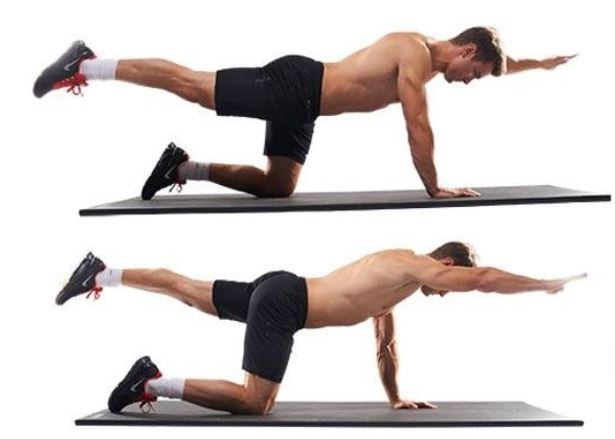
- Slowly extend one arm forward while extending the opposite leg backward
- Keep the hips and shoulders level, avoiding rotation or shifting
- Maintain a neutral spine throughout the movement
- Pause briefly at full extension to reinforce stability
- Return the limbs to the starting position with full control
- Alternate sides and repeat for the desired number of repetitions
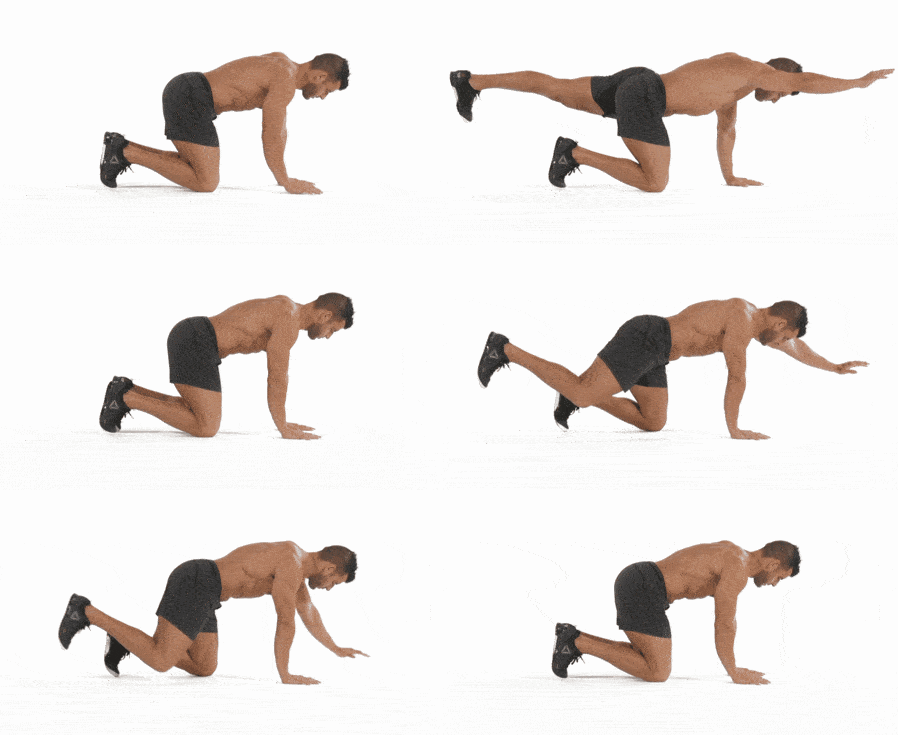
The key coaching cue: The objective is to move the limbs without allowing the torso to twist, sag, or shift. Move slowly and with intention, keeping the rib cage stacked over the pelvis throughout. Focus on stability rather than the height of limb lift — how far the arm and leg extend matters far less than whether the torso stays genuinely still while they do.
4 Common Bird Dog Mistakes (And How to Fix Them)
1. Allowing the lower back to arch
As the leg extends backward, there is a natural tendency for the lower back to arch if the core is not adequately bracing against that extension. Keep the rib cage stacked over the pelvis and maintain light core engagement throughout — if the lower back arches, reduce the height or range of the leg extension until that control is restored.
2. Rotating the hips or shoulders
Allowing either the hips or the shoulders to rotate as the opposite-side limbs extend defeats the exercise’s anti-rotation purpose. Keep the hips and shoulders level throughout — imagine balancing a glass of water on your lower back that should never tip in either direction.
3. Rushing the movement
The bird dog emphasizes slow, deliberate motion and precise control. Rushing through repetitions relies on momentum rather than genuine stabilization, undermining the exercise’s primary purpose. Move slowly and with intention through both the extension and the return.
4. Treating the exercise as a balance drill instead of a stability drill
Some trainees focus entirely on not falling over, treating the bird dog like a balance challenge rather than a deliberate anti-rotation stability exercise. While balance is part of the demand, the actual training goal is maintaining a still, neutral torso while the limbs move — focus on that stillness rather than simply avoiding a wobble.
Core Stability & Anti-Rotation Focus
The bird dog is a classic anti-rotation exercise that trains the core to resist twisting forces. This ability is critical for protecting the spine during asymmetrical loading, running, throwing, and lifting movements. Unlike exercises that emphasize visible abdominal contraction, the bird dog builds deep, functional stability that carries over to real-world strength — the same quality that protects the lower back when carrying a heavy bag on one side, throwing a ball, or changing direction quickly on a field or court.
Benefits of the Bird Dog Exercise
Improves core stability
The bird dog strengthens the deep stabilizing muscles of the core, particularly the transversus abdominis and multifidus. These muscles act as internal support for the spine, helping maintain neutral alignment during both static positions and dynamic movement. Over time, this leads to better posture and improved control during compound lifts.
Enhances anti-rotation strength
By extending the opposite arm and leg, the bird dog teaches the body to resist rotational forces acting on the torso. This anti-rotation capacity is essential for protecting the spine during asymmetrical loading, running, throwing, and any movement where the limbs move independently of the trunk.
Supports lower back health
The bird dog limits unnecessary spinal motion by reinforcing controlled movement patterns rather than by repeatedly flexing or extending the spine. This makes it particularly valuable for individuals with a history of lower back discomfort, as it builds resilience without excessive spinal loading.
Improves coordination
Coordinating opposite arm and leg movement enhances neuromuscular control and cross-body coordination. This carries over to athletic skills such as sprinting, change of direction, and efficient transfer of force between the upper and lower body.
Low joint stress
Because the exercise is performed in a controlled, quadrupod position, joint stress on the spine, hips, and shoulders remains minimal. This makes the bird dog suitable for beginners, rehabilitation settings, and active recovery days without compromising training quality.
High transfer value
The stability patterns trained in the bird dog directly support performance in major lifts like squats and deadlifts by improving trunk stiffness and positional awareness. Athletes also benefit from improved movement efficiency and reduced risk of injury during sport-specific activities.
Who Should Use the Bird Dog Exercise?
The bird dog exercise is highly adaptable and suitable for a wide range of populations and training goals. Below are the groups that benefit most from regularly including this exercise in their routine:
Beginners learning core control
The bird dog teaches fundamental core bracing and coordination without exposing the spine to high loads or excessive compression, making it an excellent entry-level core exercise.
Individuals with low back pain or a history of back issues
Because it is performed in a low-load, weight-bearing quadrupod position with minimal spinal motion, the bird dog allows controlled lumbar positioning and limits excessive shear forces on the spine compared to more dynamic core exercises.
Athletes requiring rotational and anti-rotation stability
Sports that involve sprinting, throwing, cutting, or rapid changes in direction benefit from the cross-body stabilization patterns trained by the bird dog.
Lifters looking to improve squat and deadlift mechanics
Enhanced trunk stability and improved positional awareness carry over directly to compound lifts by reducing energy leaks and compensatory movement patterns.
Rehabilitation and post-rehab phases
The controlled tempo and low external load make the bird dog a safe option during early to mid-stage rehabilitation, especially for core re-education and rebuilding confidence in spinal movement.
Anyone prioritizing movement quality over load
For trainees focusing on posture, coordination, and neuromuscular control rather than maximal strength or hypertrophy, the bird dog offers high value with minimal risk.
Who Should Be Cautious
- Anyone who cannot maintain a level pelvis, even at a reduced range of motion — if the hips rotate even with minimal limb extension, more foundational stability work may be needed first
- People with wrist or shoulder issues — the weight-bearing quadrupod position places real demand on the supporting hand and shoulder; using a fist or a closed hand on a foam pad can reduce wrist strain if needed
- People with knee sensitivity — kneeling on a hard floor for extended sets can be uncomfortable; use a mat or padded surface
How to Make It Easier or Harder
Easier
- Bent-knee bird dog — reduces lever length and makes the movement more accessible for beginners
- Reduced range of motion — extending the limbs only partway, well within the range where the torso stays genuinely still, is a valid regression
Harder
- Straight-limb bird dog — increases anti-rotation and stabilization demands by lengthening the lever arm of both extending limbs
- Weighted bird dog — using ankle or free weights adds resistance for increased difficulty
- Banded bird dog — adding external resistance via a band challenges core control further
- Static hold bird dog — holding the extended position for an extended duration increases time under tension significantly compared to the standard dynamic repetitions
Coach’s Note — Progression & Intent
The bird dog is not a maximal-strength exercise and should never be rushed or aggressively overloaded. Its primary goal is to improve spinal control and anti-rotation stability while maintaining a neutral spine.
Progression should focus on slower tempo, longer pauses, and improved control rather than adding excessive resistance. If the technique deteriorates, regress the movement rather than forcing progression.
Programming Guidelines (Sets, Reps, Tempo)
The bird dog exercise is not designed to induce maximal fatigue or muscle failure. Instead, its primary goal is improving core stability, coordination, and spinal control. Quality of execution always takes priority over volume or external load.
Recommended Sets
2–4 sets per session — this provides enough stimulus for motor learning and trunk endurance without compromising technique.
Repetitions
6–10 controlled repetitions per side — each repetition should be slow and deliberate, with full control over limb movement and spinal position.
Tempo
3–1–3 tempo (eccentric – pause – concentric) — extend the limbs over approximately 3 seconds, briefly pause in the extended position, then return slowly to the start over another 3 seconds.
Rest Periods
45–75 seconds between sets — rest should be sufficient to maintain perfect form on every repetition.
Weekly Frequency
2–4 times per week, depending on goals — bird dogs can be used in warm-ups, core-focused sessions, or as part of rehabilitation and movement quality blocks.
Bird Dog vs. Dead Bug
While both exercises target core stability, the bird dog introduces a prone, weight-bearing position, increasing demand on shoulder and hip stabilizers. The dead bug, performed supine, often allows easier spinal control, making it ideal for beginners. Together, these exercises form a complementary pair for comprehensive core training.
| Feature | Bird Dog | Dead Bug |
|---|---|---|
| Body position | Quadruped | Supine |
| Primary demand | Anti-rotation | Anti-extension |
| Limb loading | Weight-bearing | Non-weight-bearing |
| Shoulder involvement | Moderate | Minimal |
| Beginner accessibility | High | Very high |
The practical takeaway: The bird dog’s weight-bearing quadrupod position trains anti-rotation stability with meaningful shoulder and hip stabilizer involvement, while the dead bug’s supine, non-weight-bearing position offers slightly easier spinal control and is often the more accessible starting point for complete beginners. I typically introduce the dead bug first to establish the fundamental anti-extension and anti-rotation pattern, then progress to the bird dog once a trainee is ready for the added demands of weight-bearing and balance. Programmed together, the two exercises provide comprehensive coverage of supine and weight-bearing core stability training.
Exercise Variations
Bent-Knee Bird Dog
Reduces lever length and makes the movement more accessible for beginners by shortening the moment arm of both the extending arm and leg.
Straight-Limb Bird Dog
Increases anti-rotation and stabilization demands by fully extending both limbs, lengthening the lever arm, and the resulting rotational challenge to the torso.
Weighted Bird Dog
Use ankle weights or free weights for increased resistance, adding load to the extending arm, the extending leg, or both, once bodyweight technique is fully mastered.
Banded Bird Dog
Adds external resistance to further challenge core control, typically via a band anchored to the limb to resist its extension.
Static Hold Bird Dog
Holding the extended position increases time under tension considerably compared to the standard dynamic repetitions, building sustained anti-rotation endurance rather than repeated dynamic control.
Replacement Exercises (Alternatives)
If the bird dog is not appropriate, consider:
- Dead Bug
- Cable Pallof Press
- Quadruped Rock Back
- Bridge Pose
- Side Plank
- Pelvis Tilts
- Marching Plank
- Donkey Kicks
Conclusion
The bird dog is a foundational core stability exercise that emphasizes spinal control, anti-rotation strength, and coordinated movement. While it may appear simple, its effectiveness lies in precise execution and disciplined control. When integrated consistently, the bird dog supports healthier movement patterns, reduces the risk of injury, and enhances performance in both strength training and athletic activities.
For more foundational core exercises and where this one fits, see our guide to 33 core exercises. See our guides to upper ab, lower ab, and oblique exercises as well.
Key Takeaways
- The bird dog trains anti-rotation and spinal stability through a weight-bearing quadruped position, not muscle hypertrophy or maximal strength.
- Stability matters more than range of motion — keep the hips and shoulders level throughout; how far the limbs extend is secondary to how still the torso stays.
- Slow, controlled tempo is essential — a 3–1–3 tempo with 6–10 reps per side delivers far more value than rushed, momentum-driven repetitions.
- Low joint stress makes it broadly accessible — suitable for beginners, rehabilitation settings, and active recovery days alike.
- Pairs naturally with the dead bug for complementary supine and weight-bearing core stability training.
- High transfer value to compound lifts — the trunk stiffness and positional awareness trained here carry over directly to squats, deadlifts, and athletic movement.
