


Introduction
The ab wheel is one of the cheapest pieces of equipment in any home gym and one of the most underrated. A simple wheel with handles on either side, it is used to perform the rollout — an exercise that controlled EMG research has identified as one of the two most effective movements for activating the core musculature, outperforming both the traditional crunch and the bent-knee sit-up. For a piece of equipment that costs less than a single gym session, that is a remarkable return.
The rollout trains the abs, obliques, and back through a deceptively simple movement: kneeling, rolling the wheel forward until the body extends into a near-horizontal line, then pulling it back to the starting position. What that simplicity hides is a serious anti-extension challenge: as the wheel rolls forward and the body extends, the core has to prevent the lower back from arching under the combined pull of gravity and the torso’s extending lever arm. That resistance to extension, rather than the rolling motion itself, is the entire point of the exercise.
This guide covers the kneeling version of the rollout, which is the appropriate starting point and the version most trainees should master before considering the standing, feet-based variation. The standing rollout is a meaningfully harder progression that should not be attempted until the kneeling version is performed with consistently strict technique.
Exercise Quick Summary
Muscles Worked in the Ab Wheel Rollout
Primary muscles
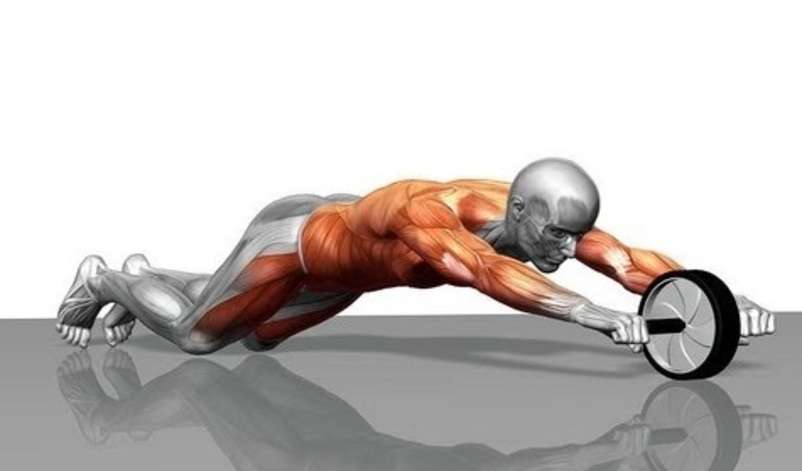
- Rectus abdominis — EMG research recorded upper rectus abdominis activation at 63% MVIC during the rollout, the highest among all exercises tested in the same study, alongside lower rectus abdominis activation at 53% MVIC
- External and internal obliques — the same research recorded external oblique activation at 46% MVIC and internal oblique at 46% MVIC during the rollout, substantial activation that places it among the top exercises tested for oblique recruitment
- Hip flexors (iliacus, iliopsoas, rectus femoris) — actively engaged throughout, particularly during the return phase as the hips and torso are pulled back toward the starting position
Secondary muscles
- Latissimus dorsi — works to stabilize the shoulder girdle and assist with controlling the extension and return of the torso
- Pectoralis major — engaged throughout to stabilize the arms and shoulders against the wheel
- Serratus anterior — assists with scapular stability during the extended position
- Teres major — contributes to shoulder stabilization throughout the movement
- Triceps brachii — works to control elbow extension as the arms reach forward with the wheel
- Transverse abdominis — braces the spine throughout to maintain the neutral position against the extending lever arm
Antagonists
The erector spinae and lumbar paraspinal muscles assist with maintaining spinal alignment, though the same EMG research that validated this exercise found lumbar paraspinal activation to be relatively low, meaning a properly performed rollout relies primarily on the abdominal wall rather than the lower back muscles to control the extension, which is precisely the safety profile that makes this exercise valuable.
As the wheel rolls back toward the starting position, you will notice the shoulders and arms working noticeably alongside the core — this is expected and reflects the genuinely full-body nature of the exercise, with the latissimus dorsi, pectorals, serratus anterior, teres major, and triceps brachii all contributing to controlling and returning the wheel.
How to Do an Ab Wheel Rollout: Step-by-Step Form Guide
Starting position
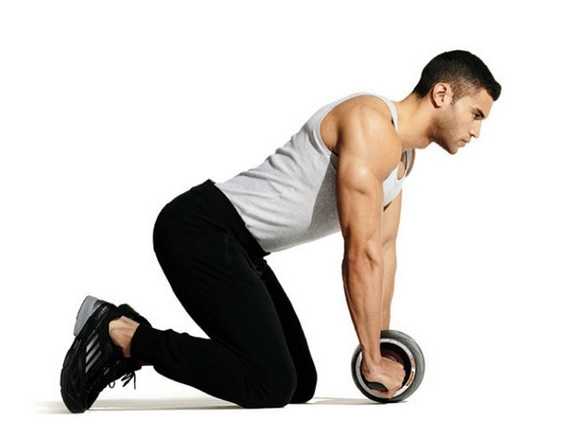
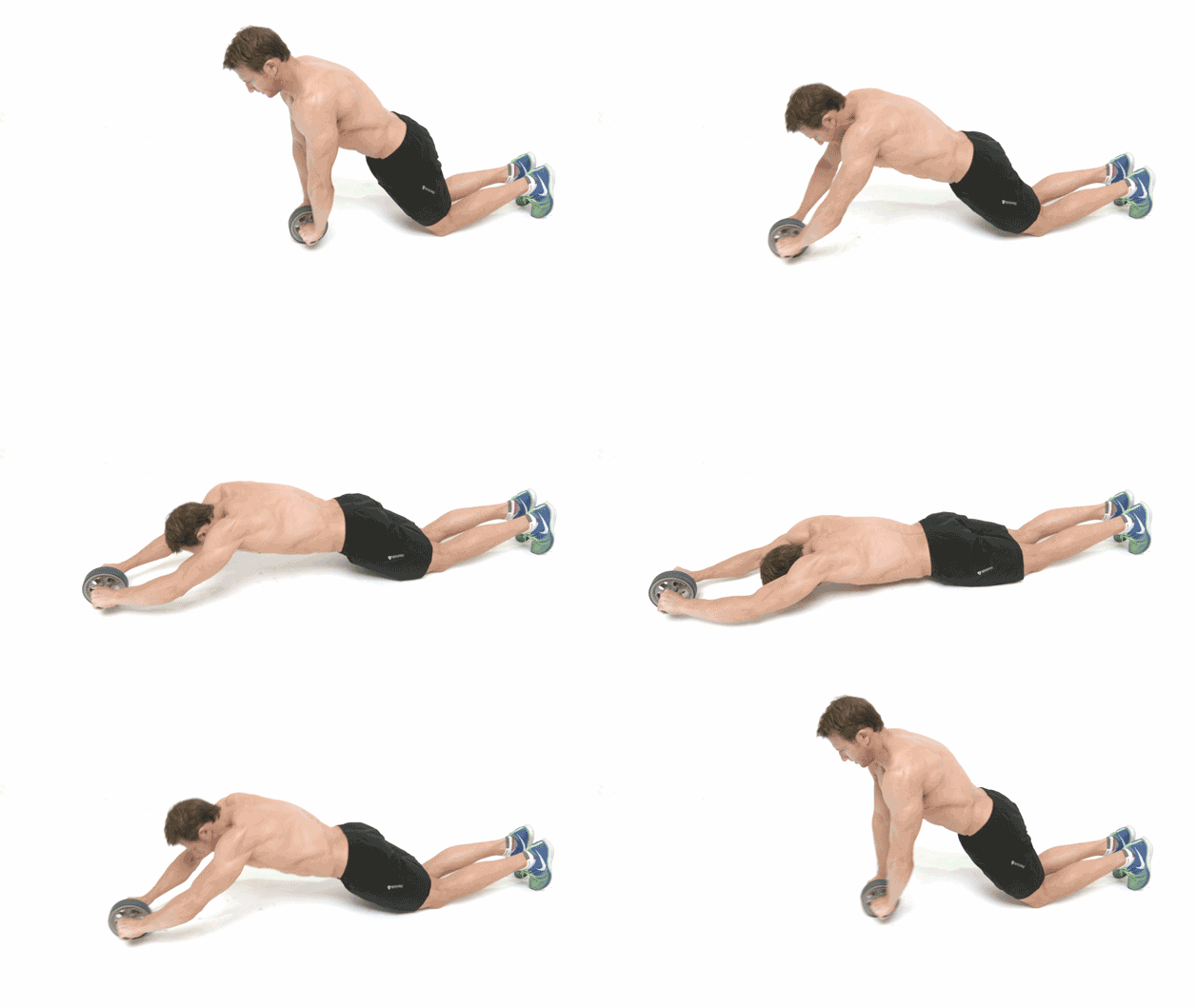
- Start on the hands and knees, then bend the torso forward to approximately a 45-degree angle with the spine in a neutral position
- Place the hands on the ab wheel directly below the chest or shoulders
- Keep the elbows straight throughout
Execution
- Extend the arms forward, allowing the torso to drop and extend until the chest is almost parallel to the floor — the upper body should form a straight line, but no part of it should touch the floor
- Pause briefly at the extended position
- Draw the arms and hips back simultaneously — the torso elevates and returns to the starting position
- Maintain perfect form through every inch of the motion — both the extension and the return
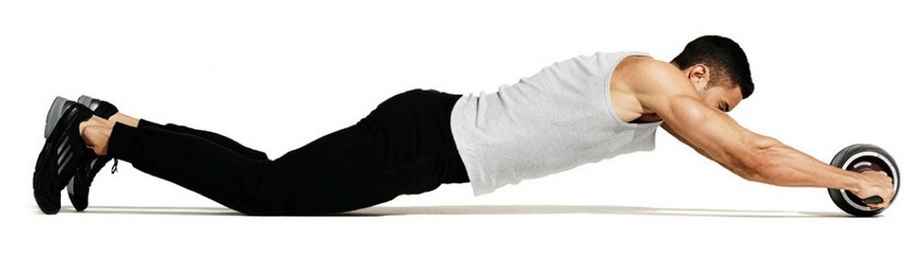
The key coaching cue: Keep your thighs, hips, and trunk in line throughout — your body should form a straight line from the knees to the shoulders for the entire movement. No arching or sagging in the lower back during the extended position, and no hips rising up into the air during the return. The knees stay stationary throughout; only the upper body and arms travel.
6 Common Ab Wheel Rollout Mistakes (And How to Fix Them)
1. Arching or sagging the lower back during extension
This is the central technical failure of the rollout. As the wheel rolls forward and the torso’s lever arm extends, the lower back tends to sag toward the floor under that load if the abs are not adequately bracing against it. Maintain a neutral spine throughout — neither rounding nor arching — and stop the extension at whatever point this neutral position can no longer be held, even if that means a shorter range of motion than intended.
2. Letting the hips rise during the return
When pulling the wheel back to the starting position, there is a tendency for the hips to pike upward rather than for the torso and hips to return together as one unit. This indicates the hip flexors and lower body are taking over from the abs. Draw the arms and hips back simultaneously, keeping the straight-line body position intact throughout the return, not just the extension.
3. Moving too quickly in either direction
The wheel can roll faster than expected, particularly on smooth or hard flooring, and a fast, uncontrolled rollout removes the deliberate core control that makes this exercise effective. Move slowly and deliberately in both directions — the slower the controlled tempo, the more time the core spends under productive tension.
4. Rolling on the wrong surface
Hard flooring, such as wood or concrete, allows the wheel to move faster and less predictably than intended, increasing both the difficulty of control and the risk of losing the position entirely. Perform this exercise on a padded or carpeted surface, and place a mat or towel under the knees to reduce friction and discomfort.
5. Rolling in a curved rather than a straight line
The wheel should travel in a perfectly straight line directly away from the body. Any lateral drift during the rollout indicates that the core is not controlling movement symmetrically and can place uneven stress on one side of the trunk.
6. Attempting the toes version before mastering the knees version
The standing, feet-based rollout is a significantly harder progression and should not be attempted until the kneeling version is performed with consistently strict technique throughout the full range of motion. If the kneeling rollout cannot be performed with a neutral spine through a near-full extension, the toes version will only amplify the same technical breakdowns.
Ab Wheel Rollouts Video Demonstration
This video shows you exactly how to perform ab wheel rollouts with perfect technique (proper form) so you can get the most from this great core-building exercise.
Benefits of the Ab Wheel Rollout
Research-validated superior core activation
Controlled EMG research found the rollout produced the highest upper rectus abdominis activation among ten exercises tested — including the traditional crunch and bent-knee sit-up — at 63% MVIC, alongside strong lower rectus abdominis and oblique activation. This places the rollout among the most evidence-supported core exercises available.
Trains the dynamic anti-extension under an actively changing lever arm
Unlike a static plank, which resists a fixed load, the rollout resists an actively increasing lever arm as the torso extends further from the base of support. That dynamic, progressively challenging resistance profile makes the rollout a more demanding anti-extension exercise than most isometric alternatives.
Inexpensive and accessible
The ab wheel is one of the least expensive pieces of resistance equipment available, making this research-validated exercise accessible for home training at minimal cost.
Full-body integration
Beyond the core, the rollout meaningfully engages the shoulders, lats, chest, and triceps, providing a genuinely integrated upper-body-and-core training stimulus in a single movement.
Scalable progression pathway
The exercise scales cleanly from a partial range of motion for beginners, through a full kneeling range, to the considerably more demanding standing version for advanced trainees — all using the same simple piece of equipment.
Who Should Use This Exercise
- Intermediate to advanced trainees who have mastered the plank and basic core stabilization exercises and are ready for a more demanding dynamic anti-extension challenge
- Anyone seeking research-validated core training with minimal equipment investment
- Trainees building toward the standing (feet) rollout — the kneeling version is the necessary foundation for that more advanced progression
- Home trainees who want an inexpensive but highly effective core tool
Who Should Be Cautious
- Beginners who have not mastered the plank — if a standard plank cannot be held with a neutral spine, the dynamic and more demanding rollout is not yet appropriate
- People with lower back pain or lumbar disc issues — the extending lever arm creates meaningful lumbar demand if the abs are not adequately controlling the movement; physiotherapy clearance is recommended before attempting this exercise with active back issues
- People with shoulder or wrist issues — the sustained weight-bearing through the arms and the controlled extension can aggravate certain shoulder and wrist conditions
How to Make It Easier or Harder
Easier
- Partial range of motion — extending only partway forward before returning reduces the lever arm and the overall demand, while strength and technique are established
- Swiss-ball rollout — replacing the wheel with a stability ball changes the starting hand position to be higher up, which generally makes the exercise somewhat more manageable for trainees not yet ready for the lower hand position of the standard wheel
Harder
- Full range of motion — extending until the chest is almost parallel to the floor, the target range for an intermediate to advanced trainee
- Ab wheel rollouts from toes — performing the same movement from a standing position with the feet rather than the knees as the base; this is a considerably more difficult variation that should not be underestimated, and trainees who cannot master it should continue performing the kneeling version rather than forcing the standing progression prematurely
- Barbell rollouts — using a loaded barbell with weight plates on each end instead of a dedicated ab wheel; this allows for a similar rolling movement pattern when a wheel is unavailable, with the added option of adjusting difficulty through plate size, which changes the height and leverage of the starting position
Ab Wheel Rollout vs. Swiss-Ball Pike
The same controlled EMG research that validated the rollout identified the Swiss-ball pike as the only other exercise matching its core activation profile, making this comparison directly supported by measured data rather than general impression.
| Ab Wheel Rollout | Swiss-Ball Pike | |
|---|---|---|
| Movement direction | The body extends away from the start | Hips rise toward the ceiling (flexion) |
| Upper rectus abdominis (EMG) | 63% MVIC | 46% MVIC |
| Lower rectus abdominis (EMG) | 53% MVIC | 55% MVIC |
| External oblique (EMG) | 46% MVIC | 84% MVIC |
| Equipment | Ab wheel | Stability ball |
| Primary core function | Anti-extension under dynamic load | Combined flexion + anti-extension |
| Best for | Maximum upper rectus abdominis activation | Maximum oblique activation |
The practical takeaway: Both exercises were shown to be superior to the traditional crunch and bent-knee sit-up in the same study, but they target different muscles. The rollout produces the highest recorded upper rectus abdominis activation of any exercise tested, while the pike produces dramatically higher external oblique activation. Rather than choosing one over the other, I program both within the same advanced core training block to cover both activation profiles — the rollout for upper rectus abdominis and dynamic anti-extension strength, the pike for maximum oblique recruitment alongside hip flexion control.
Exercise Variations
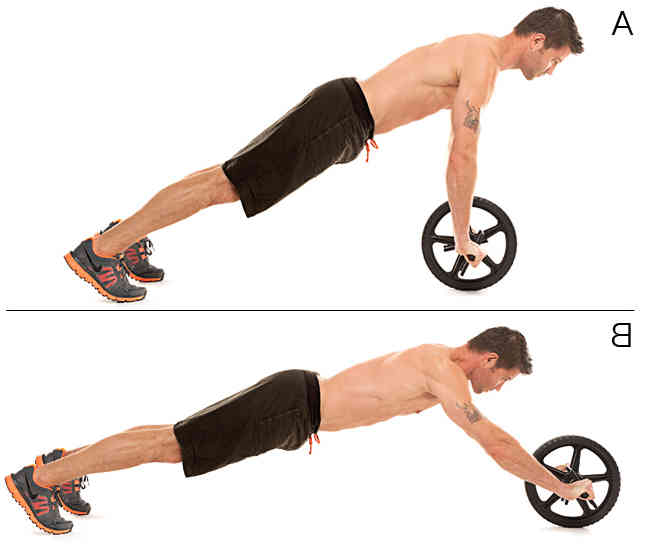
Ab Wheel Rollouts From Toes
Performing the rollout from a standing position with the feet as the base, rather than kneeling, is a significantly more challenging variation than the standard kneeling version. The increased lever arm from the longer body length involved dramatically increases the demand on the entire anterior core. This variation should not be underestimated — trainees who cannot perform it with strict technique should continue with the kneeling version rather than forcing the progression before they are ready.
Barbell Rollouts
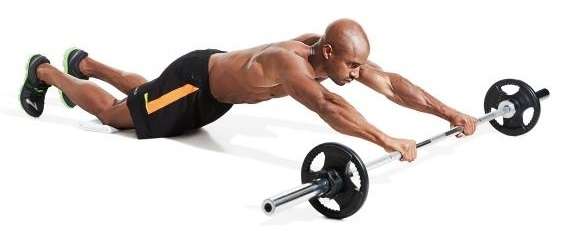
A barbell loaded with weight plates at each end can serve as a dedicated ab wheel, with the plates acting as the rolling surface. This is a practical alternative when an ab wheel is unavailable, and it offers an additional variable: the size of the plates used changes the height of the starting hand position and therefore the leverage of the exercise, allowing for some adjustment of difficulty through equipment selection alone.
Swiss-Ball Rollout
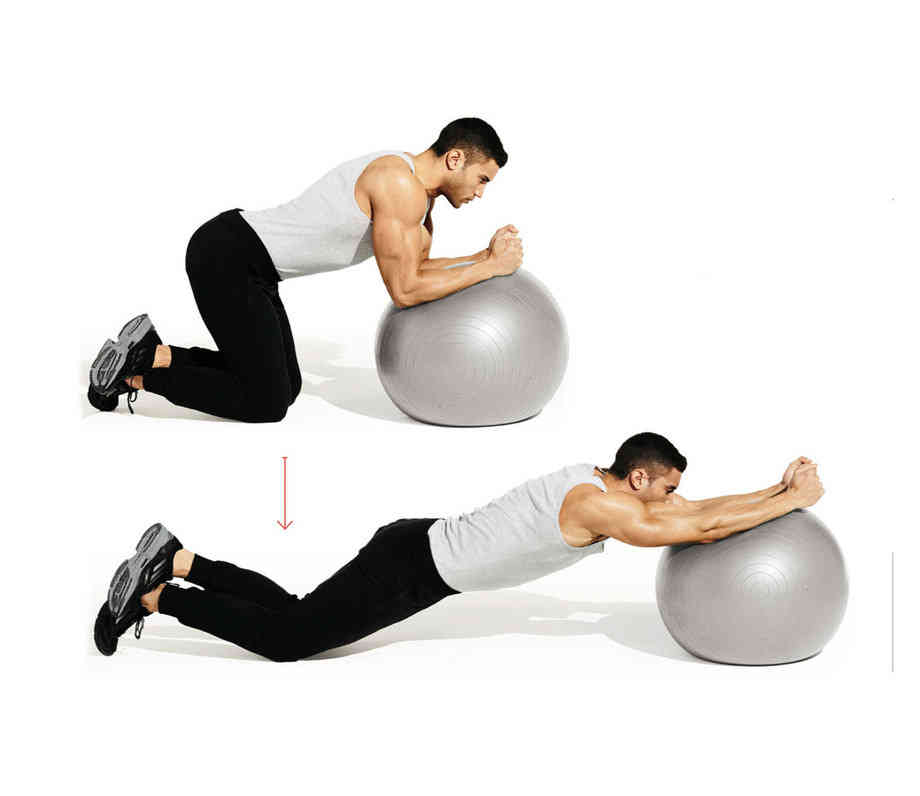
Replacing the wheel with a stability ball changes the exercise meaningfully — the hands begin higher up on the ball rather than at floor level with the wheel. This generally creates a somewhat more manageable starting position and is a reasonable variation for trainees who want the rollout movement pattern with a different equipment feel, or as a regression from the standard wheel version.
Replacement Exercises (Alternatives)
If the ab wheel rollout is too advanced or the equipment is unavailable, these exercises target similar anti-extension and core integration functions:
- Swiss-Ball Rollout
- Swiss-Ball Pike
- Swiss-Ball Jackknife
- Forearm Plank
- The Full Plank (Straight Arm Plank)
- Plank With Arm Extension
- Dragon Flag
- Hollow Body Hold Position
- Hanging Toes to Bar
- Renegade Row
How To Incorporate the Ab Wheel Rollout Into Your Workouts
- As a primary advanced core exercise — given its research-supported activation profile, the rollout is well-suited as the centerpiece of an intermediate to advanced core session
- Paired with the Swiss-ball pike — programming both exercises in the same session covers the slightly different activation profiles each one emphasizes
- Rep range: 8–12 controlled reps — quality of control through the full range matters more than rep count
- Sets: 3 working sets
- Frequency: 2–3 times per week alongside other core training
- Tempo: Two to three seconds extending forward, brief pause at the extended position, two to three seconds pulling back — never rushed
- Progression trigger: When 3 sets of 12 controlled reps with a neutral spine through a near-full kneeling range become consistently easy, extend the range further before considering the standing (toes) variation, which should only be attempted once the kneeling version is fully mastered
Conclusion
The ab wheel rollout pairs an inexpensive piece of equipment with a research-backed activation profile that few core exercises can match — measured superiority over both the crunch and the bent-knee sit-up for activating the upper rectus abdominis, the obliques, and the latissimus dorsi simultaneously.
The technique demands are real: a neutral spine maintained through an actively extending lever arm, hips and torso returning together rather than the hips piking up, a controlled tempo in both directions. Get those right, and this simple wheel delivers one of the most efficient core training stimuli available for the money invested in the equipment.
Master the kneeling version completely before considering the standing progression. The patience required to do that properly is exactly the same patience that makes this exercise effective in the first place.
For more advanced anti-extension exercises and a complete program, check out our core exercises guide. Pair it with our guides to upper ab, lower ab, and oblique exercises for a complete program.
Frequently Asked Questions
How far should a beginner roll out before returning?
There is no fixed distance — the correct range is whatever distance allows the lower back to stay in a neutral position without arching or sagging. For most beginners, this means stopping well short of the full extension where the chest approaches the floor, sometimes only rolling out 20 to 30 centimeters initially. The range should be extended gradually over weeks as core strength improves, always prioritizing a neutral spine over reaching a longer distance.
Can the ab wheel rollout hurt your lower back?
It can, if performed with the lower back arching during the extension or if the range of motion exceeds current core strength. When performed with a maintained neutral spine throughout, the exercise places relatively low demand on the lumbar paraspinal muscles according to EMG research, which is a favorable safety profile. The risk comes specifically from allowing the back to sag under load rather than from the exercise itself, which is why limiting the range of motion to whatever can be controlled with a neutral spine is the most important safety guideline.
Is the ab wheel rollout better than crunches?
Based on controlled EMG research comparing multiple exercises, the rollout produced significantly higher upper rectus abdominis activation than the traditional crunch, along with meaningfully greater oblique and latissimus dorsi engagement. This does not mean crunches have no value, but for trainees specifically seeking maximum measured abdominal activation, the research supports the rollout as the more effective option between the two.
How often should I do ab wheel rollouts?
Two to three times per week is appropriate for most trainees, allowing adequate recovery between sessions given the genuine intensity of the exercise on the core and hip flexors. Because the rollout is more demanding than many other ab exercises, training it daily is generally unnecessary and may compromise the recovery needed for continued progression in range of motion and control.
What should I do if I feel pain in my shoulders rather than my core?
Shoulder discomfort during the rollout typically indicates either an existing shoulder sensitivity being aggravated by the sustained weight-bearing position, or a technique issue such as shrugging the shoulders up toward the ears instead of keeping them depressed and stable. Check that the shoulders stay set down and back throughout the movement rather than elevating. If shoulder discomfort persists with correct technique, the exercise may not be appropriate until any underlying shoulder issue is addressed.
Do I need a special ab wheel, or will any wheel work?
A wheel specifically designed for this exercise is recommended over improvised alternatives. Purpose-built ab wheels typically have a wider, more stable wheel base, comfortable padded handles, and sometimes a single wide wheel or dual wheels for added lateral stability. Improvised substitutes like a single narrow wheel from unrelated equipment can be unstable and increase the risk of losing control during the movement, particularly for beginners still developing the necessary core control.
Why does the wheel sometimes drift to one side?
Lateral drift during the rollout usually indicates asymmetric strength or control between the two sides of the core, with one side inadvertently guiding the wheel off a straight path. Focus on consciously distributing the effort evenly between both hands and both sides of the trunk, and consider performing the movement in front of a mirror initially to visually monitor whether the wheel is traveling in a straight line.
Is it normal to feel this exercise in my hip flexors?
Yes, meaningful hip flexor activation during the rollout is expected and normal, particularly during the return phase as the hips and torso are pulled back toward the starting position. The hip flexors work alongside the abdominal muscles throughout this exercise rather than being an indication that something is being performed incorrectly. If hip flexor fatigue becomes the limiting factor before the core feels adequately worked, that is simply part of how this particular exercise distributes its demand across the front of the body.
