



The basic abdominal crunch — also known as the curl-up — is the most fundamental upper ab exercise in existence, and probably the most misunderstood. Almost everyone has done it. Far fewer have done it correctly. In my years working with clients across all fitness levels, the crunch is the exercise I correct most often — not because it is complicated, but because its simplicity can lead people to be careless in their execution.
Done right, the crunch is a highly effective isolation movement for the rectus abdominis. Done wrong — with momentum, hip flexor compensation, or a pulled neck — it is largely a waste of time that can lead to discomfort and poor movement patterns over time.
Muscles Worked in the Basic Abdominal Crunch
Primary muscle:
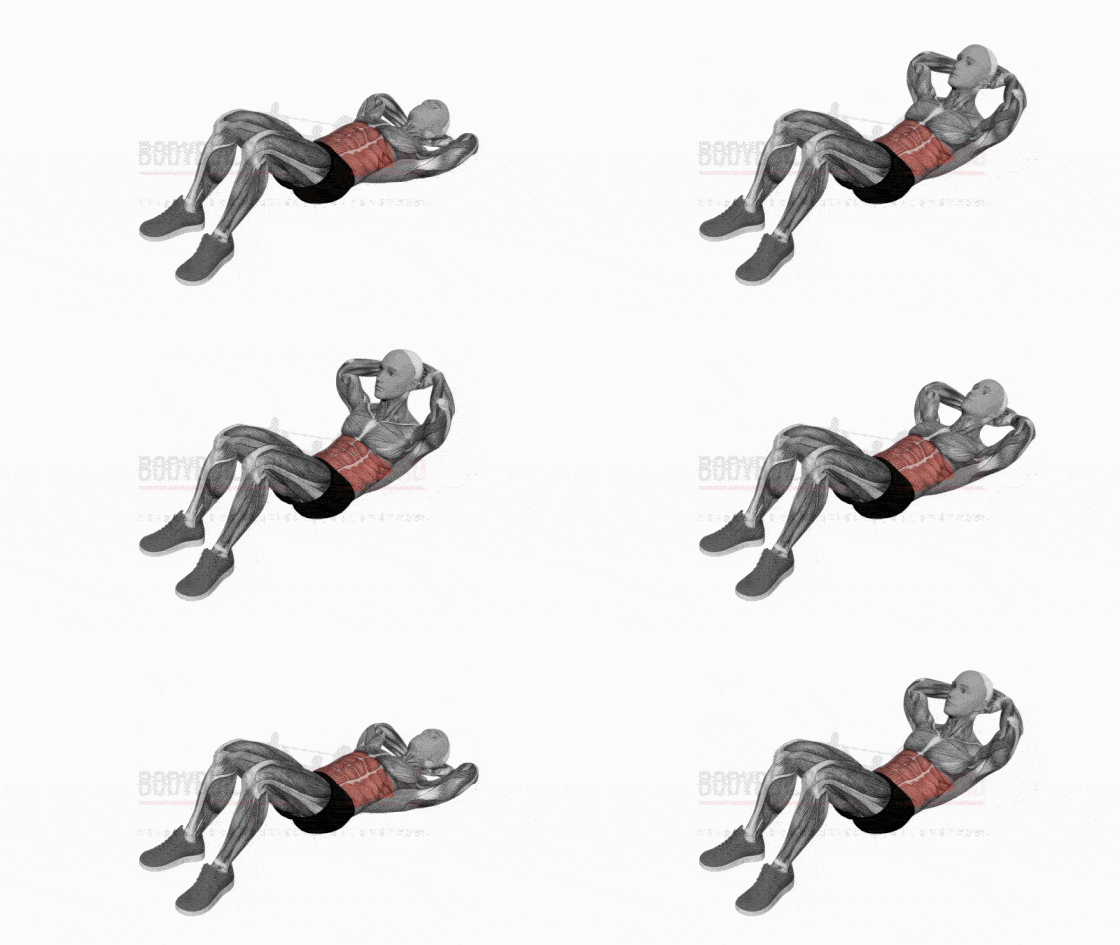
- Rectus abdominis — the entire length of the muscle is involved, but the upper portion bears the greatest load during spinal flexion from the floor. The crunch is fundamentally a movement that shortens the distance between the sternum and the pelvis.
Secondary muscles:
- External and internal obliques — assist with trunk flexion and stabilize the torso during the movement
- Transverse abdominis — braces the spine and maintains intra-abdominal pressure throughout each rep
- Pyramidalis (where present) — a small triangular muscle that assists the lower rectus abdominis
Antagonists:
- Spinal erectors lengthen under control during flexion and drive the return to the starting position
Crunch vs. Sit-Up: What Is the Difference?
These two exercises are often used interchangeably, but they are meaningfully different movements. In a sit-up, you raise your entire torso until you reach a semi-seated position — that range of motion engages the hip flexors, chest, neck, and lower back muscles alongside the abs. In a crunch, only your head and shoulders leave the floor; your lower back stays down throughout. The movement is shorter, more isolated, and more specific to the rectus abdominis.
That specificity is the crunch’s main advantage. If your goal is to isolate and strengthen the abs without loading the hip flexors or the lumbar spine, the crunch is the more targeted tool. The sit-up is not a bad exercise — it just engages more muscles simultaneously, which makes it less useful as a pure ab-isolation movement.
How To Perform the Basic Abdominal Crunch
Starting position:
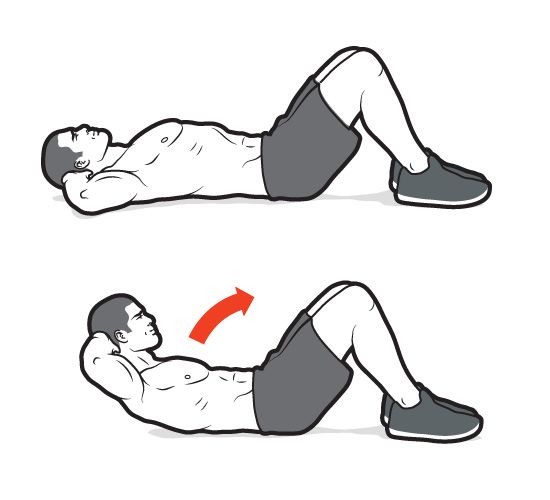
- Lie face-up on the floor with your knees bent and feet flat on the floor, close to your glutes
- Hand position options: fingers interlaced behind your head (without gripping), arms crossed over your chest, or hands at your sides — all are valid; behind the head gives the most feedback but also the most temptation to pull
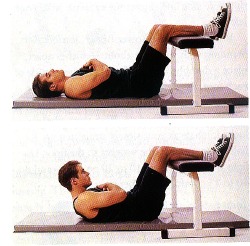
- Alternatively, rest your calves on a bench with your legs bent at 90 degrees — this flattens the lower back against the floor and removes any hip flexor involvement entirely
Execution:
- Take a breath in, then exhale as you initiate the movement
- Curl your shoulders and upper back off the floor by contracting your abs — think of bringing your sternum toward your pelvis, not your chin toward your knees
- Lift only until your mid-back leaves the floor — your lower back stays in contact with the ground throughout
- Squeeze the contraction at the top for 1–2 counts
- Slowly lower back to the starting position — do not drop; control the descent
- Stop just short of your shoulders touching the floor and begin the next rep — this keeps the tension on the abs and eliminates the temptation to bounce
The key coaching cue: The crunch is a short movement. If you are traveling far, you are probably using your hip flexors. Think small, think controlled, think squeeze.
Common Mistakes in the Basic Abdominal Crunch
1. Pulling on the neck: This is the mistake I see most often, and it puts real stress on the cervical vertebrae over time. If your hands are behind your head, they are there to support the weight of your head — not to yank it forward. The moment you feel your elbows driving inward and your neck straining, either lighten the movement or move your hands to your chest.
2. Using momentum: Fast, bouncy reps bypass the abs entirely and hand the work over to the hip flexors. I tell clients: if you can do 30 reps without stopping, you are probably not doing crunches — you are doing a hip flexor exercise with your abs along for the ride. Slow it down. Each rep should be deliberate.
3. Lifting the lower back off the floor: The moment your lower back peels off the floor, the movement has turned into a sit-up. That is not necessarily wrong — but if you are doing crunches, keep the lower back down. That boundary is what makes the crunch a crunch.
4. Extending the hips and legs: Legs should stay fixed throughout. Pushing through the heels or letting the knees drift outward shifts the load away from the abs. If your feet keep lifting, move them closer to your glutes or place them under something stable — but note that hooking feet under a pad tends to increase hip flexor recruitment.
5. Doing too many reps without progression. Here is something I bring up with almost every client who has been training for more than a few months: doing 200 crunches a day is not a progression strategy — it is a habit. The abs adapt to volume quickly. Once you can do 3 clean sets of 20, it is time to add resistance or move to a harder variation, not add more reps.
Benefits of the Basic Abdominal Crunch
No equipment required. The floor crunch is accessible anywhere — at home, in the gym, in a hotel room, or outdoors. That removes every barrier to consistently training the abs.
Low learning curve: It is the easiest ab exercise to teach. A beginner can understand the movement pattern in one or two sets, making it an ideal starting point before progressing to loaded or more complex variations.
Pure ab isolation: When performed correctly — lower back on the floor, no hip flexor compensation — the crunch isolates the rectus abdominis more cleanly than most other beginner-level ab exercises.
Foundation for all other crunch variations: Every other crunch variation — cable, machine, ball, decline — is built on the same spinal flexion pattern. Master the floor version first, and every progression becomes easier to learn.
Who Should Use This Exercise
Beginners learning to feel and isolate the abs for the first time. Before loading the abs with any resistance, a trainee should be able to perform a clean floor crunch — controlled, no neck pulling, lower back down.
People returning from injury who need a low-load, low-risk way to re-engage the core musculature. The floor crunch is about as gentle as ab training gets.
Anyone building a home workout routine without access to gym equipment. No cables, no machines, no bench required.
Trainees who want to finish a session with a high-rep burnout set. At the end of a workout, a few sets of bodyweight crunches add ab volume without adding meaningful systemic fatigue.
Who Should Be Cautious
People with neck problems. The behind-the-head hand position places the cervical spine in a vulnerable position if technique breaks down under fatigue. These clients should keep their hands on their chests or use a variation in which their necks are supported.
People with lumbar disc issues. Spinal flexion under any load — even just the weight of the torso — can aggravate certain disc pathologies. Anyone with an acute disc herniation should consult a physiotherapist before doing any crunch variation.
Advanced trainees who have outgrown bodyweight work. The floor crunch simply does not provide enough stimulus for someone who has been training seriously for years. It is not harmful, but it is not particularly productive either. Time is better spent on loaded variations.
People who already spend most of their day in a flexed posture — desk workers, cyclists, drivers. I am genuinely cautious about programming high volumes of crunch work for clients who already sit hunched forward for eight hours a day. The last thing they need is more spinal flexion. Planks, dead bugs, and anti-rotation exercises are often a smarter choice for that population.
Progressions and Regressions
Regressions (easier)
Dead bug — lying on your back, extending opposite arm and leg while keeping the lower back pressed to the floor. Builds core stability and teaches the foundational bracing pattern before adding spinal flexion.
Partial crunch — same movement but with an even shorter range, for clients who cannot yet maintain lower back contact with the floor during a full crunch.
Progressions (harder)
Weighted crunch — hold a weight plate on your chest. Simple, effective, and the most direct way to add progressive overload to the floor crunch.
Exercise ball crunch — the unstable surface demands more stabilization, and the curved surface allows a greater range of spinal extension at the start of each rep, which increases the stretch on the rectus abdominis.
Kneeling cable crunch — removes bodyweight limitations entirely and allows precise load management. The logical destination for trainees who have maxed out bodyweight crunch variations.
Basic Abdominal Crunch vs. Sit-Up
Both exercises work the rectus abdominis, but they differ significantly in range of motion, muscle recruitment, and who they are best suited for.
| Basic Abdominal Crunch | Sit-Up | |
|---|---|---|
| Range of motion | Short — shoulders only | Full — torso to semi-seated |
| Lower back involvement | Minimal | Moderate to high |
| Hip flexor involvement | Minimal | Significant |
| Ab isolation | High | Moderate |
| Difficulty | Lower | Higher |
| Best for | Ab isolation, beginners, rehab | Overall core strength, athletes |
| Equipment needed | None | None (or decline bench) |
The practical takeaway: If your goal is pure ab isolation, the crunch is the better tool. If you want a more demanding, full-range movement that also builds hip flexor strength and overall core endurance, the sit-up earns its place. I use both in programming — they are not competitors; they are complements.
Exercise Variations
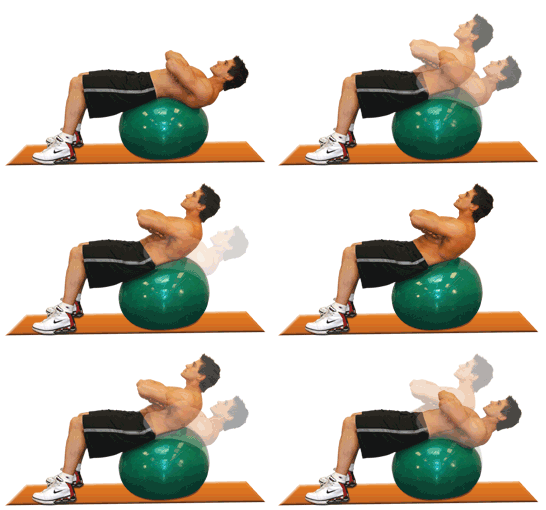
Exercise ball crunch: Performing the crunch on an exercise ball changes the movement in two important ways: the unstable surface activates the stabilizing muscles to a greater degree, and the curved surface of the ball allows you to extend further back at the start of each rep, giving the rectus abdominis a fuller stretch before each contraction. This makes it both more demanding and more effective than the flat-floor version for trainees ready for the next step.
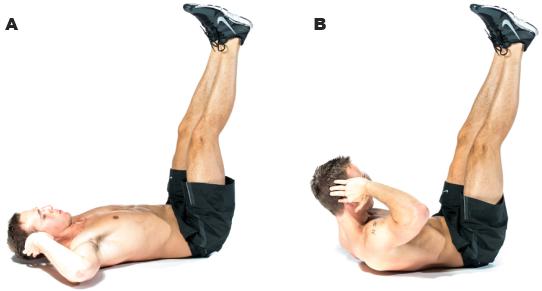
Vertical leg crunch: In this variation, you extend your legs straight up toward the ceiling before crunching. Raising the legs eliminates any temptation to use the hip flexors and forces the abs to work without any compensatory assistance. It also slightly shifts the emphasis toward the lower portion of the rectus abdominis while still keeping the upper abs as the primary mover. A good choice when you want to make the standard crunch harder without adding equipment.
Crunches with legs on a bench (legs-supported crunch): Resting your calves on a flat bench with your legs at 90 degrees completely flattens the lumbar spine against the floor. This is the cleanest possible setup for pure upper ab isolation — there is no way to recruit the hip flexors, no lumbar arch to compensate with, and no foot placement to fiddle with. I frequently use this variation with clients who tend to arch their lower back during standard crunches.
Replacement Exercises (Alternatives)
If the basic crunch is not the right fit — whether due to equipment preference, injury limitations, or training level — these exercises target the same muscle group:
- Kneeling Cable Crunch
- Machine Crunch
- Decline Bench Sit-Ups
- Classic Floor Sit-Up
- Vertical Leg Crunch
- Modified V-Sit
- Exercise Ball Crunch
- V-Ups
- Decline Crunch
Programming Tips
Rep range: 15–20 reps for bodyweight, 10–15 reps if adding load (weight plate on chest). The crunch is a low-load movement by nature — high reps with perfect form beat low reps with momentum every time.
Sets: 3–4 working sets. More than that rarely adds meaningful stimulus and risks reinforcing sloppy technique as fatigue sets in.
Frequency: 2–3 times per week. Like all direct ab work, recovery is quick — but more is not always better.
Where in the session: At the end of the workout, after compound movements. There is no good reason to pre-fatigue the core before squats, deadlifts, or any overhead work.
Progression trigger: Once you can complete 4 clean sets of 20 reps with full control and no technique breakdown, it is time to add resistance or move to a harder variation — not add more sets.
A note on volume: I want to address something I see constantly in gym culture — the obsession with crunch volume. Hundreds of crunches per session are not a training strategy; they are a superstition. The abs respond to progressive overload and quality stimulus, not endless repetition of a movement your body adapted to months ago.
Conclusion
The basic abdominal crunch is the starting point for almost every client I work with for direct ab training. Not because it is the best ab exercise — it is not — but because it teaches the fundamental pattern that every other crunch variation is built on. Get this right, and every progression becomes easier to execute.
The irony is that most people who have been training for years still do not do it correctly. They rush through reps, pull on their necks, let their lower backs arch, and wonder why their abs never seem to develop. The answer is almost always the same: the movement is not being performed with the muscle it is supposed to train.
Slow it down. Feel the contraction. Progress deliberately. And once bodyweight crunches become easy — move on. That is the point.
The basic crunch is the foundation of upper ab training and the logical starting point in any list of effective upper ab exercises — check out the full guide to see where to go from here. Pair this with our guides to lower ab, oblique, and core training for a complete program.
Frequently Asked Questions
How is the basic abdominal crunch different from a sit-up?
The crunch involves only the upper portion of the movement — lifting the shoulders and upper back off the floor while keeping the lower back in contact with the ground throughout. The sit-up takes the torso through a full range of motion to a semi-seated position, which brings the hip flexors in as primary movers past approximately 30 to 40 degrees of trunk flexion. The crunch is a more isolated ab exercise; the sit-up is a more demanding, multi-muscle movement.
Why do I feel the crunch in my neck instead of my abs?
Almost always because of one of two things: pulling on the neck with the hands, or leading with the chin rather than the sternum. If your hands are behind your head and your elbows are closing inward as you crunch up, your neck is doing work it should not be doing. Move your hands to your chest, keep the chin tucked with a fist’s distance between chin and chest, and focus on driving the sternum toward the pelvis rather than the head toward the knees.
Is it better to do crunches on a mat or directly on the floor?
A thin mat is preferable for comfort and for protecting the thoracic vertebrae during the return phase. A very thick or soft mat, however, can actually compromise the exercise — if the surface is too cushioned, the lower back sinks into it and you lose the stable base needed to keep the lumbar spine pressed firmly against the surface throughout the set. A standard yoga mat or exercise mat strikes the right balance.
How many crunches should I do per session?
Three to four sets of 15 to 20 reps is sufficient for most trainees. Beyond that, additional sets produce diminishing returns — the abs adapt to volume quickly and more reps of the same movement rarely add meaningful stimulus once the body has adjusted. If you can comfortably exceed 20 clean reps per set, the exercise has become too easy. The correct response is to add resistance or progress to a harder variation, not to keep accumulating reps.
Does foot position matter during the basic crunch?
Yes. Feet flat on the floor with knees bent at approximately 90 degrees is the standard position — it keeps the hip flexors relaxed and puts the pelvis in a neutral position. Moving the feet closer to the glutes flattens the lower back against the floor more effectively, which improves ab isolation. Hooking the feet under something increases hip flexor involvement and partially defeats the purpose of choosing a crunch over a sit-up.
Can I do crunches every day?
Not productively. The rectus abdominis requires 48 hours of recovery between sessions to adapt and grow stronger, just like any other skeletal muscle. Daily crunch training at meaningful intensity accumulates fatigue faster than the muscle can recover. Two to three sessions per week is the effective range. If you want to train abs more frequently, alternate between upper ab exercises one day and lower ab or anti-flexion core work the next — that way no single muscle group is trained on consecutive days.
What is the correct breathing pattern for crunches?
Exhale as you crunch up — during the concentric phase when the abs are contracting. Inhale as you lower back down — during the eccentric phase. Exhaling during contraction facilitates deeper abdominal engagement and helps maintain intra-abdominal pressure at the right moment. Avoid holding your breath throughout the set, which increases blood pressure unnecessarily and reduces the quality of the contraction.
Are crunches bad for the spine?
Repeated spinal flexion under load has been the subject of considerable debate in exercise science, largely driven by research from Dr. Stuart McGill showing that high volumes of loaded flexion can contribute to disc stress over time. For healthy individuals performing bodyweight crunches with correct technique and reasonable volume, the risk is low. The concern is more relevant for high-volume loaded variations or for individuals with pre-existing lumbar pathology. Balancing crunch work with spinal extension and anti-flexion exercises reduces cumulative stress on the lumbar spine.
Should I feel a burn during crunches or is that a sign of poor technique?
A burning sensation in the abdominal muscles during a set of crunches is normal and indicates metabolic fatigue in the rectus abdominis — a sign the muscle is working. The burn should be felt in the abs, not the neck, hip flexors, or lower back. If the burning sensation is elsewhere, technique is breaking down. If you feel nothing at all in the abs, the movement is either too easy, too fast, or compensated by other muscles.
At what point should I stop doing basic crunches and move to a harder exercise?
When you can consistently complete 4 sets of 20 clean reps with full control, no neck tension, lower back pressed to the floor throughout, and a deliberate pause at the top of each rep — the basic crunch has served its purpose. The next logical steps are the vertical leg crunch, the exercise ball crunch, or adding a weight plate to the chest. Continuing to accumulate more bodyweight crunch reps beyond that point produces minimal additional stimulus.
