



Most people spend years training calves, quads, hamstrings, and glutes while completely neglecting the muscles on the front of the lower leg. Yet the tibialis anterior plays a critical role in ankle stability, foot control, dorsiflexion strength, and overall lower-leg function.
That imbalance becomes especially obvious in runners, athletes, and gym lifters who experience:
- Shin splints
- Weak ankle stability
- Lower-leg fatigue
- Poor dorsiflexion control
- Tight, overworked calves
And honestly, can you really remember the last time you intentionally trained your shin muscles?
As a coach, I often see people dedicate enormous attention to calf development while completely ignoring the tibialis anterior. Over time, that imbalance may contribute to lower-leg discomfort, inefficient movement mechanics, and reduced ankle control.
The good news is that shin muscles respond very well to direct training.
In this guide, you will learn the best tibialis anterior exercises for:
- Beginners
- Athletes
- Runners
- Home workouts
- Strength training
- Lower-leg balance
- Injury prevention
We will cover:
- Bodyweight exercises
- Resistance band variations
- Dumbbell and weight plate exercises
- Cable exercises
- Tib bar training
- Advanced unilateral variations
What Is the Tibialis Anterior Muscle?

The tibialis anterior is the large muscle located on the front portion of the shin.
Its primary functions include:
- Ankle dorsiflexion
- Foot control during walking and running
- Deceleration support
- Lower-leg stabilization
In simple terms, this muscle helps pull the toes upward toward the shin.
Every time you:
- Walk
- Run
- Sprint
- Jump
- Climb stairs
the tibialis anterior becomes active.
Despite its importance, it remains one of the most neglected muscles in most workout programs.
Why Training the Tibialis Anterior Matters
Strong shin muscles are not just important for aesthetics. They also play a major role in:
- Athletic performance
- Lower-leg balance
- Running mechanics
- Ankle stability
- Movement efficiency
Proper tibialis training may help:
- Improve dorsiflexion strength
- Reduce muscular imbalances
- Improve ankle control
- Support lower-leg endurance
- Reduce excessive calf dominance
As a coach, I often notice that people with chronically tight calves frequently have extremely weak tibialis anterior muscles.
Quick Comparison Table of the Best Tibialis Anterior Exercises
| Exercise | Best For | Difficulty | Equipment |
|---|---|---|---|
| Wall Tibialis Raise | Beginners | Easy | None |
| Standing Tibialis Raise | Basic bodyweight training | Easy | None |
| Single-Leg Wall Tibialis Raise | Unilateral stability | Moderate | None |
| Resistance Band Tibialis Raise | Home workouts | Easy | Resistance band |
| Seated Dumbbell Tibialis Raise | Simple weighted training | Moderate | Dumbbell |
| Weight Plate Toe Raise | Progressive overload | Moderate | Weight plate |
| Cable Tibialis Raise | Constant tension | Moderate | Cable machine |
| Tib Bar Raise | Advanced loading | Moderate–Hard | Tib bar |
| Heel Walk Exercise | Functional endurance | Easy | None |
| DARD Tibialis Raise | Specialized training | Hard | DARD device |
10 Best Tibialis Anterior Exercises
1. Wall Tibialis Raise
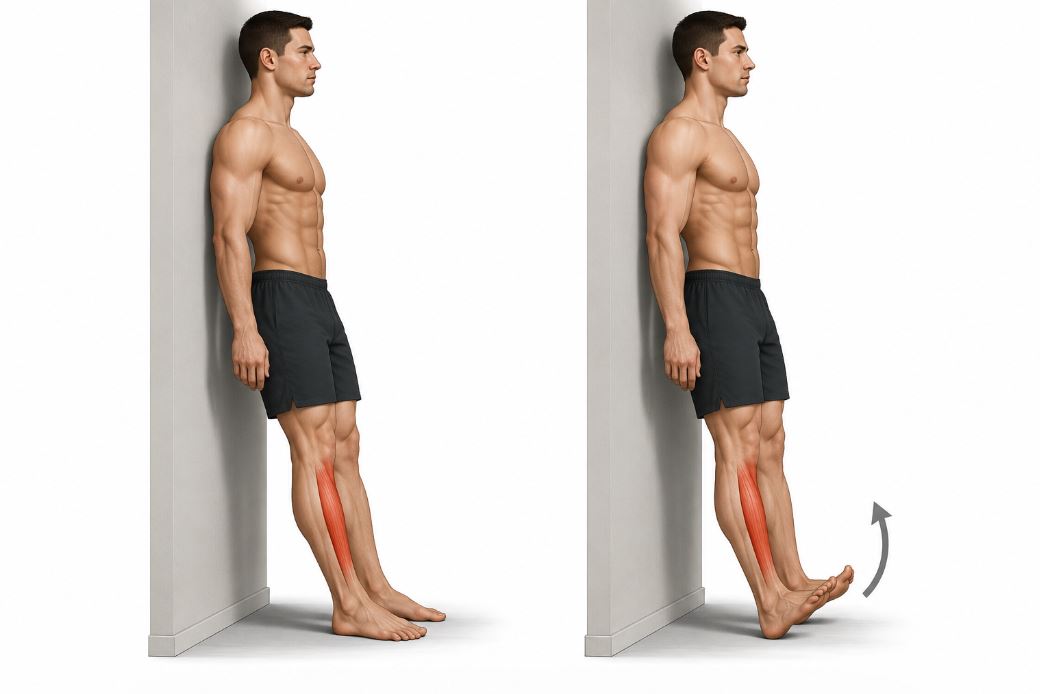
The wall tibialis raise is one of the best beginner-friendly shin exercises because it requires no equipment while still providing excellent tibialis activation.
The exercise is performed by leaning against a wall with the heels planted on the floor while repeatedly lifting the toes upward toward the shins. The body stays slightly leaned back against the wall to increase resistance on the tibialis anterior throughout the movement.
Benefits include:
- Simple setup
- Excellent beginner exercise
- Great shin burn
- Improved dorsiflexion endurance
This is often the first exercise I recommend to people who have never trained the tibialis anterior directly before.
Read the full Wall Tibialis Raise guide.
2. Standing Tibialis Raise
The standing tibialis raise is a simple bodyweight variation that improves ankle control and lower-leg endurance.
Unlike the wall version, this exercise places slightly greater demands on balance and stabilization. The movement is performed by standing upright and lifting the toes upward while keeping the heels in contact with the floor.

Benefits include:
- Functional movement pattern
- Easy setup
- Beginner-friendly
- Useful warm-up exercise
This variation works especially well for people who want a simple bodyweight shin exercise without needing equipment.
Read the full Standing Tibialis Raise guide.
3. Single-Leg Wall Tibialis Raise
The single-leg wall tibialis raise increases the challenge by forcing one side to work independently.
This exercise is performed similarly to the standard wall tibialis raise, except only one leg performs the dorsiflexion movement while the opposite foot remains elevated slightly off the floor. This increases unilateral loading and the demands on ankle stability.

This is an excellent exercise for:
- Fixing left-right imbalances
- Improving ankle control
- Increasing unilateral stability
As a coach, I often see athletes discover significant side-to-side weaknesses when they first try this exercise.
Read the full Single-Leg Wall Tibialis Raise guide.
4. Resistance Band Tibialis Raise
Resistance bands create variable resistance that increases as the foot moves upward.
This variation is especially useful for:
- Home workouts
- Travel workouts
- Rehab-style training
- Controlled tibialis activation
The exercise is performed by attaching a resistance band to the foot and pulling the toes upward against the band’s tension while maintaining controlled ankle movement.

Benefits include:
- Portable setup
- Adjustable resistance
- Beginner-friendly progression
- Excellent muscle control
Read the full Resistance Band Tibialis Raise guide.
5. Seated Dumbbell Tibialis Raise
This exercise uses a dumbbell placed across the feet to create direct resistance during dorsiflexion.
It is one of the simplest weighted tibialis exercises available. The movement is performed while seated with the heels supported on the floor as the toes lift the dumbbell upward through ankle dorsiflexion.

Benefits include:
- Minimal equipment
- Home gym friendly
- Direct tibialis loading
- Easy progression
Most people are surprised by how difficult this exercise feels, even with relatively light weights.
Read the full Seated Dumbbell Tibialis Raise guide.
6. Weight Plate Toe Raise
The weight plate toe raise is a highly effective progression from bodyweight shin exercises.
When a weight plate is placed across the feet, the tibialis anterior experiences significantly greater resistance. The movement is performed by lifting the toes upward while keeping the heels planted and the weight plate balanced across the feet.

Benefits include:
- Progressive overload
- Simple setup
- Excellent lower-leg burn
- Home gym accessibility
This variation works very well for intermediate trainees.
Read the full Weight Plate Toe Raise guide.
7. Cable Tibialis Raise
The cable tibialis raise provides smooth, continuous resistance throughout the movement.
This makes it one of the best machine-based tibialis exercises for controlled loading and unilateral work. The exercise is typically performed with a low cable pulley attached to the foot, while the toes pull upward against the cable’s resistance.

Benefits include:
- Constant tension
- Adjustable resistance
- Excellent muscle control
- Unilateral precision
As a coach, I especially like this exercise for athletes and intermediate lifters.
Read the full Cable Tibialis Raise guide.
8. Tib Bar Raise
The tib bar raise has become extremely popular in modern athletic performance training.
This variation allows heavy progressive loading using a specialized tib bar attachment. The exercise is performed by attaching the tib bar to the feet and lifting the toes upward repeatedly through controlled dorsiflexion.

Benefits include:
- Serious progressive overload
- Strong tibialis contractions
- Athletic carryover
- Advanced lower-leg training
This is one of the best exercises for building stronger shin muscles in the long term.
Read the full Tib Bar Raise guide.
9. Heel Walk Exercise
Heel walks are a functional bodyweight exercise that strengthens the tibialis anterior while also improving coordination and lower-leg endurance.
The movement involves walking on the heels while keeping the toes elevated off the ground throughout the exercise. This creates continuous tibialis anterior activation during movement.

Benefits include:
- Functional conditioning
- Athletic warm-up potential
- Improved dorsiflexion endurance
- Beginner-friendly execution
This exercise works especially well as a warm-up or conditioning drill.
Read the full Heel Walk Exercise guide.
10. DARD Tibialis Raise
The DARD tibialis raise uses a Dynamic Axial Resistance Device to create direct dorsiflexion resistance.
This is one of the more specialized tibialis training variations and is commonly associated with older-school athletic training systems. The exercise is performed by using the DARD device to apply resistance while lifting the toes upward through controlled ankle dorsiflexion.

Benefits include:
- Direct tibialis isolation
- Advanced loading
- Specialized lower-leg training
- Strong contractions
Although niche, it remains a highly effective shin exercise.
Read the full DARD Tibialis Raise guide.
Best Tibialis Exercises for Beginners
When people first start training the tibialis anterior, the biggest mistake is usually doing too much too soon. Because the shin muscles are often undertrained for years, even simple dorsiflexion exercises can initially cause intense fatigue and soreness.
As a coach, I usually recommend starting with bodyweight and light-resistance exercises before progressing toward heavier loading methods like tib bars or cable machines.
The best beginner tibialis exercises are usually:
- Easy to learn
- Joint-friendly
- Low equipment
- Simple to progress
Best Beginner Exercises
Wall Tibialis Raise
This is probably the best overall beginner exercise because it:
- Requires no equipment
- Is easy to control
- Creates excellent tibialis activation
- Allows high reps safely
Heel Walk Exercise
Heel walks work very well for:
- Coordination
- Warm-ups
- Basic endurance
- Movement awareness
They are simple but surprisingly effective.
Resistance Band Tibialis Raise
Resistance bands allow gradual progression while maintaining smooth resistance.
This variation works especially well for:
- Home workouts
- Rehab-style training
- Controlled learning
Standing Tibialis Raise
This is another simple bodyweight option that helps beginners learn dorsiflexion mechanics without complicated setups.
Best Weighted Tibialis Exercises
Once bodyweight exercises become too easy, adding external resistance usually becomes necessary for continued progression.
Weighted tibialis exercises help:
- Increase strength
- Improve muscular endurance
- Build stronger shin muscles
- Develop better lower-leg balance
Best Weighted Variations
Tib Bar Raise
The tib bar raise is one of the best exercises for long-term progressive overload.
This variation is especially useful for:
- Athletes
- Intermediate lifters
- Advanced tibialis training
Cable Tibialis Raise
The cable machine provides:
- Constant tension
- Adjustable loading
- Smooth resistance
This is one of my favorite machine-based tibialis exercises.
Weight Plate Toe Raise
A very practical home gym option.
Benefits include:
- Simple setup
- Adjustable resistance
- Excellent tibialis fatigue
- Minimal equipment
Seated Dumbbell Tibialis Raise
This variation offers direct loading using basic gym equipment.
It is excellent for:
- Home gyms
- Beginner-to-intermediate trainees
- Controlled progression
Best Tibialis Exercises for Runners & Athletes
Athletes and runners place enormous repetitive stress on the lower legs.
Strong tibialis anterior muscles may help improve:
- Ankle stability
- Foot control
- Deceleration mechanics
- Running efficiency
- Lower-leg endurance
As a coach, I often notice that runners with chronic shin discomfort frequently have weak dorsiflexors and extremely dominant calves.
Best Exercises for Athletes
Tib Bar Raise
Excellent for:
- Strength development
- Athletic carryover
- Lower-leg durability
Single-Leg Wall Tibialis Raise
Very useful for:
- Unilateral stability
- Balance
- Coordination
- Side-to-side comparisons
Heel Walk Exercise
Great for:
- Warm-ups
- Athletic conditioning
- Movement preparation
Cable Tibialis Raise
Excellent for:
- Controlled loading
- Ankle control
- Smooth resistance
- Unilateral work
Common Tibialis Training Mistakes
Even though tibialis exercises look simple, poor execution can significantly reduce their effectiveness.
Using Too Much Weight
The tibialis anterior is usually much weaker than people expect.
Going too heavy too early often leads to:
- Poor range of motion
- Momentum
- Reduced control
Incomplete Dorsiflexion
Many people barely move through the available range.
The goal should be controlled ankle dorsiflexion with strong top contractions.
Moving Too Fast
Fast reps often reduce muscular tension.
Controlled repetitions usually work much better for tibialis activation.
Neglecting Unilateral Work
Bilateral exercises may hide muscular imbalances.
Single-leg work often reveals weaknesses that would otherwise go unnoticed.
Only Training Calves
Many lifters spend years training calves while ignoring the muscles on the front of the lower leg entirely.
Balanced lower-leg development matters.
How Often Should You Train the Tibialis Anterior?
The tibialis anterior generally responds well to moderate training frequency because it is relatively small and often accustomed to regular low-level activity during walking and daily movement.
Most people do very well with:
- 2–4 weekly sessions
- Moderate volume
- Controlled tempo
- Progressive overload
Beginners should start conservatively because direct shin training can cause significant initial soreness.
As a coach, I usually recommend:
- Starting with 2 sessions weekly
- Focusing on clean technique
- Gradually increasing volume
Consistency matters much more than excessive loading.
Sample Tibialis Workout Routine
Use these sample routines based on your current training level. Start conservatively, focus on controlled reps, and increase volume gradually as your shin muscles adapt.
| Routine | Exercise | Sets & Reps | Frequency |
|---|---|---|---|
| Beginner | Wall Tibialis Raise | 2–3 sets × 15–20 reps | 2–3× weekly |
| Heel Walk Exercise | 2 rounds × 20–30 sec | ||
| Resistance Band Tibialis Raise | 2–3 sets × 12–15 reps | ||
| Intermediate | Weight Plate Toe Raise | 3 sets × 12–15 reps | 2–4× weekly |
| Single-Leg Wall Tibialis Raise | 2–3 sets × 10–12 reps per leg | ||
| Cable Tibialis Raise | 3 sets × 12–15 reps | ||
| Advanced | Tib Bar Raise | 4 sets × 10–15 reps | 2–4× weekly |
| Cable Tibialis Raise | 3 sets × 12–15 reps | ||
| Heel Walk Exercise | 2 rounds × 30–45 sec | ||
| Single-Leg Wall Tibialis Raise | 2 sets × 12 reps per leg |
Final Thoughts
The tibialis anterior is one of the most overlooked muscles in modern fitness training, yet it plays an essential role in ankle stability, foot control, dorsiflexion strength, and overall lower-leg function. Whether you are a runner, athlete, bodybuilder, or simply someone looking to improve lower-leg balance, strengthening the shin muscles can be extremely valuable.
As a coach, I often see people spend years focusing heavily on calves while completely neglecting the muscles on the front of the lower leg. Over time, that imbalance may contribute to poor ankle control, lower-leg fatigue, reduced movement efficiency, and excessive stress on surrounding structures.
The good news is that tibialis training does not need to be complicated. Simple bodyweight exercises like wall tibialis raises and heel walks can be highly effective for beginners, while weighted variations such as tib bar raises, cable tibialis raises, and weight plate toe raises allow long-term progression for more advanced trainees.
The key is consistency, controlled execution, and gradual progression. Even a few focused sessions each week may significantly improve shin strength, ankle stability, lower-leg endurance, and overall movement quality.
And honestly, once most people begin training the tibialis anterior consistently, they quickly realize just how neglected — and how important — these muscles really are.
Frequently Asked Questions
Can strong tibialis anterior muscles improve squat depth?
Stronger tibialis anterior muscles may improve ankle dorsiflexion control, which can contribute to better squat mechanics and more comfortable deep knee flexion for some lifters.
Why do most people neglect tibialis anterior training?
Most gym programs heavily emphasize calves, quads, and hamstrings while completely ignoring the muscles on the front of the lower leg. Many people simply do not realize the tibialis anterior can be trained directly.
Are tibialis exercises useful for people who do not run?
Yes. Tibialis anterior training may benefit lifters, athletes, and general fitness enthusiasts by improving ankle stability, lower-leg balance, and overall movement control.
Should tibialis exercises be performed before or after calf training?
Most people perform tibialis exercises after calf training or at the end of lower-body workouts. However, lighter tibialis work can also function well as part of a warm-up routine.
Do tibialis exercises help create more balanced lower legs visually?
Developing the muscles on the front of the shin may improve the overall visual balance of the lower legs, especially in athletes and physique-focused trainees.
Are bodyweight tibialis exercises enough for muscle growth?
Bodyweight exercises can work very well initially, especially for beginners. However, many intermediate and advanced trainees eventually benefit from weighted progressions such as tib bar raises, cable raises, or weight plate toe raises.
Which tibialis exercise creates the strongest muscle contraction?
This varies between individuals, but many people report very strong contractions during tib bar raises, cable tibialis raises, and wall tibialis raises with slow tempo execution.
Can weak tibialis anterior muscles affect athletic performance?
Weak dorsiflexors may reduce ankle control and lower-leg efficiency during sprinting, jumping, deceleration, and rapid direction changes.
How quickly do shin muscles fatigue during training?
Because the tibialis anterior is often undertrained, many people experience significant fatigue and burning sensations even during relatively light sets and moderate rep ranges.
What is the biggest mistake beginners make during tibialis training?
One of the most common mistakes is using momentum instead of controlled dorsiflexion. Slow, deliberate reps with full range of motion generally produce better tibialis activation.
