



Introduction
The bicycle crunch has been one of the most studied bodyweight ab exercises in fitness research — and consistently ranks among the highest in oblique and rectus abdominis activation in EMG studies. That scientific credibility is earned. The combination of spinal flexion, trunk rotation, and alternating hip flexion places simultaneous demands on the rectus abdominis and obliques that few floor-based exercises can replicate without equipment.
Also known as the bicycle, oblique bicycle, bicycle maneuver, or bicycle movement, this exercise requires a balance of strength and coordination, making it genuinely challenging when performed correctly. The key phrase there is “when performed correctly” — because the bicycle crunch performed incorrectly, which is how the vast majority of people do it, is a neck strain waiting to happen that provides minimal oblique stimulus and even less rectus abdominis development.
The most common version I see in gyms involves fast, jerky elbow-to-knee swinging with the lower back bouncing off the floor and the neck doing most of the work. That version has very little in common with what makes the bicycle crunch effective. Slow it down, keep the lower back pressed into the floor, and drive with the shoulder rather than the elbow — that version is a genuinely demanding oblique exercise that deserves its reputation.
Exercise Snapshot
Muscles Worked in the Bicycle Crunch
Primary muscles
- Rectus abdominis — drives the spinal flexion component of the movement as the torso rises off the floor; consistently shows high activation in EMG research on ab exercises, making the bicycle crunch one of the more effective rectus abdominis exercises available without equipment
- External obliques — work concentrically on the side rotating toward the opposite knee; the external oblique on the right side and the internal oblique on the left side work together to rotate the torso to the left, and vice versa
- Internal obliques — work in concert with the external obliques throughout the rotation
Secondary muscles
- Transverse abdominis — braces the spine and maintains intra-abdominal pressure throughout the continuous movement
- Rectus femoris — active during the hip flexion phase of each knee draw
- Tensor fasciae latae — assists with hip flexion during the alternating leg movement
Antagonists
Spinal erectors lengthen under control during the flexion and rotation phases and assist with controlled return between alternating reps.
The bicycle crunch is one of the few floor exercises that simultaneously load the upper and lower portions of the rectus abdominis, as well as the obliques — the upper portion through the torso rising off the floor, and the lower portion through alternating hip flexion of the pedaling legs. That comprehensive anterior core recruitment is one of the primary reasons it consistently performs well in research.
How to Do a Bicycle Crunch: Step-by-Step Form Guide
Starting position
- Lie flat on your back with the lower back pressed firmly into the floor
- Place both hands lightly behind the head or over the ears — fingers interlaced but not gripping; the hands support the head, they do not pull it
- Bend both knees to approximately 90 degrees, shins parallel to the ceiling, thighs perpendicular to the floor
- Lift the shoulders off the floor approximately 30 degrees — this elevation is maintained throughout the entire set

Execution
- Simultaneously draw the left knee toward the chest and rotate the right shoulder toward it — the right elbow drives toward the left knee as the left knee drives toward the right elbow
- At the same time, extend the right leg out straight at a comfortable angle — not so low that the lower back arches, not so high that the movement loses its challenge
- Without relaxing the torso or returning the shoulders to the floor, immediately reverse — draw the right knee in while extending the left leg and rotating the left shoulder toward the right knee
- Continue in this alternating pedaling motion, keeping the movement slow and controlled throughout
- Keep the lower back and pelvis as still as possible — only the upper torso rotates; the hips stay grounded
- The closer the elbow approaches the opposite knee, the greater the oblique contraction — prioritize the quality of rotation over the speed of alternation
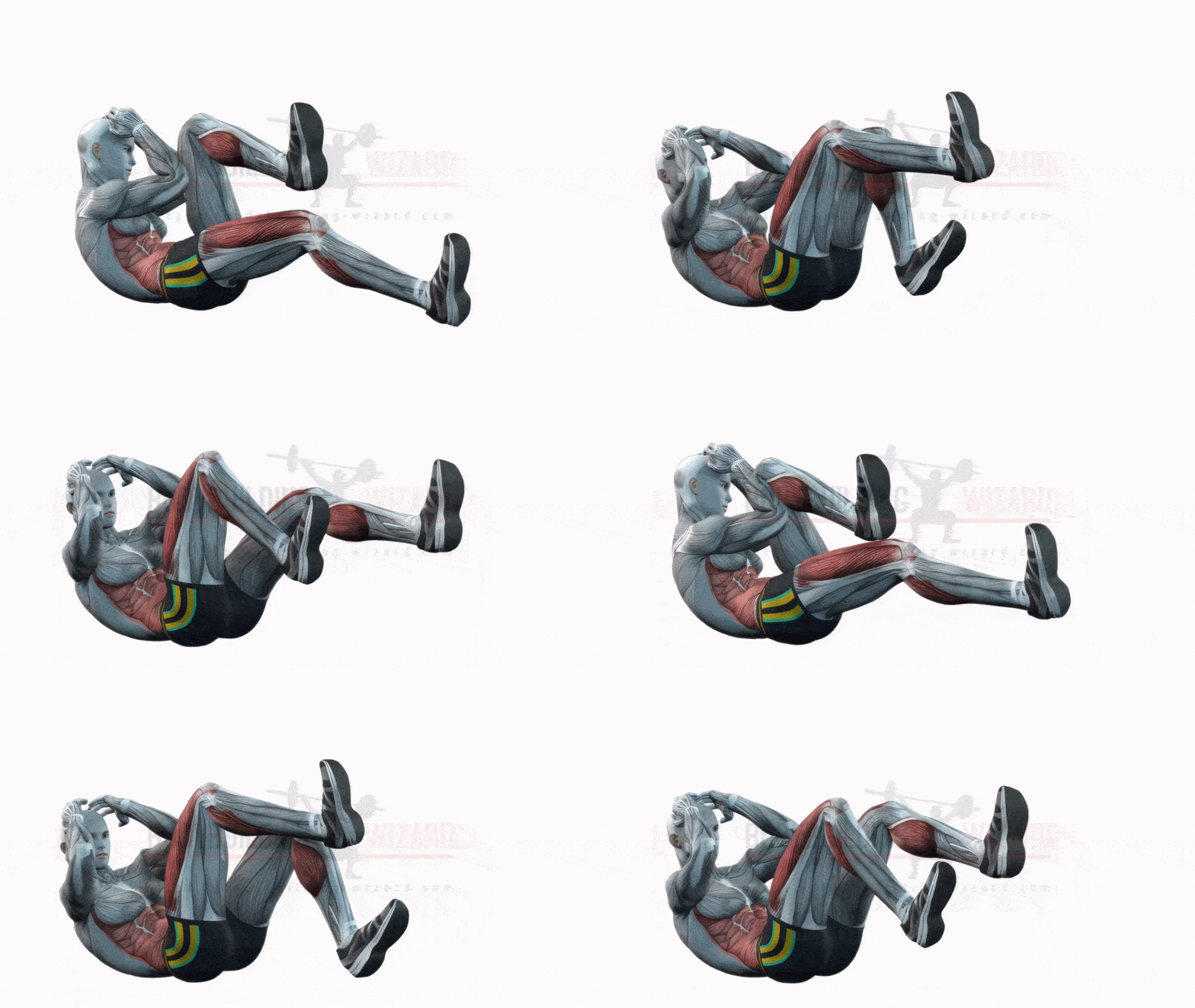
The key coaching cue: Drive with the shoulder, not the elbow. The elbow is attached to the shoulder — if the shoulder is rotating toward the opposite knee, the elbow follows. If only the elbow is reaching while the shoulder stays back, the rotation is coming from the arm rather than the trunk, and the obliques are not generating it. Roll up the spine by bringing the shoulder up and across on each alternating rep.
6 Common Bicycle Crunch Mistakes (And How to Fix Them)
1. Moving too fast
This is the mistake that makes the bicycle crunch ineffective for most trainees who perform it. Fast pedaling means momentum drives the alternating rotation — the obliques switch on briefly and off immediately as the next rep swings through. Slow down to at least two seconds per side. At that pace, the obliques have to generate and sustain the rotation rather than receiving it as a passenger on a momentum swing.
2. Pulling on the neck
The hands are behind the head or ears for support — not to pull the head forward and create the illusion of a deeper crunch. Neck pulling creates cervical spine stress and actually reduces oblique activation by shifting the effort from the core to the neck flexors. Keep a fist-width of space between the chin and the chest throughout. If the neck consistently fatigues before the abs, the hands are too involved.
3. Allowing the lower back to arch
When the extended leg drops too low toward the floor, the hip flexors pull the lumbar spine into extension, arching the lower back off the mat. Lumbar extension poses a significant risk of injury during rotational exercises. Keep the extended leg high enough that the lower back stays pressed into the floor at all times. If maintaining lower back contact requires keeping the leg at 45 degrees rather than near horizontal, then that is the correct range of motion for now.
4. Rotating from the elbow rather than the shoulder
The same distinction as in the crossover crunch — if only the elbow is moving toward the opposite knee while the shoulder stays back, the obliques are not producing the rotation. The shoulder must travel across the midline toward the opposite knee. Think of the shoulder blade lifting off the floor on the rotating side, not just the elbow poking across.
5. Not keeping the elbows wide
Allowing the elbows to come together in front of the face reduces the rotation range and creates a forward crunch pattern rather than a rotational one. Keep the elbows wide apart — pointing laterally — throughout the movement. Wide elbows reinforce the rotational pattern and make it harder to compensate with a forward crunch instead of a genuine trunk rotation.
6. Lifting the hips
If the hips lift off the floor or rock during the alternating leg movement, the hip flexors dominate the exercise, and the core stabilization that makes the bicycle crunch valuable is lost. Press the lower back firmly into the floor, keeping the hips heavy and still throughout the entire set.
Benefits of the Bicycle Crunch
Research-backed high oblique and rectus abdominis activation
The bicycle crunch has been validated in ACE-commissioned EMG research as one of the most effective abdominal exercises available — ranking at or near the top for both rectus abdominis and oblique activation compared to 13 other common ab exercises. That research backing distinguishes it from exercises whose reputations outpace their actual muscle-activation data.
Simultaneous training of multiple core functions
The bicycle crunch trains trunk flexion, trunk rotation, and hip flexion simultaneously — three core functions that most exercises address individually. That combination creates a comprehensive anterior core stimulus in a single movement pattern, making it one of the most time-efficient bodyweight core exercises available.
No equipment required
A mat is all that is needed. The bicycle crunch is highly effective as a home-based oblique and ab exercise and requires no equipment.
Continuous bilateral training
Unlike single-side exercises that train one oblique at a time, the bicycle crunch trains both obliques in a continuous alternating fashion within the same set — keeping both sides under sustained stimulus throughout.
Scalable difficulty
The pace, the range of leg extension, and the degree of trunk rotation are all adjustable variables that allow the exercise to be scaled from beginner-accessible to genuinely demanding without any changes to the equipment.
Who Should Use This Exercise
- Intermediate trainees who have mastered standard floor crunches and lateral crunches and are ready for a combined flexion-rotation exercise with simultaneous leg movement
- Athletes in rotational sports who need combined flexion-rotation core strength with bilateral training carryover
- Trainees building a bodyweight core program who want a single exercise that addresses rectus abdominis, obliques, and hip flexors simultaneously
- Anyone who has plateaued on standard crunches and needs a more demanding bodyweight alternative that does not require equipment
Who Should Be Cautious
- People with lower back issues — the combination of spinal flexion, rotation, and alternating hip flexion creates significant demand on the lumbar structures; anyone with active disc pathology should get physiotherapy clearance before programming this exercise
- People with neck problems — the sustained elevated head position combined with the rotational reach creates cervical demand; keep the hands at the temples rather than behind the head and reduce the rotation range if neck discomfort occurs
- Beginners who have not yet established core control — the bicycle crunch requires enough baseline core strength to maintain lower back contact with the floor through continuous alternating movement; if the lower back consistently arches, master the standard crunch and reverse crunch first
How to Make It Easier or Harder
Easier
- Higher leg extension angle — keeping the extended leg at 60 to 70 degrees rather than near-horizontal reduces the hip flexor demand and makes lower back contact easier to maintain
- Slower alternating pace — a deliberate tempo with a pause at each rotation peak makes the coordination demand more manageable while ensuring the obliques are generating the movement
- Reduced range of motion — rotating to 75 percent of the full range while maintaining strict lower back contact is more productive than a full range with compensated technique
Harder
- Lower leg extension angle — extending the leg closer to the floor increases the hip flexor demand and requires greater core stability to maintain lower back contact
- Extended pause at rotation peak — holding each elbow-to-knee position for two to three seconds dramatically increases time under tension on the obliques
- Weighted bicycle crunch — holding a light weight plate behind the head increases the resistance on the spinal flexion component; even a small weight significantly changes the exercise
Bicycle Crunch vs. Russian Twist
Both exercises train the obliques through trunk rotation without equipment, but the movement patterns, body positions, and muscles involved differ significantly.
| Bicycle Crunch | Russian Twist | |
|---|---|---|
| Body position | Supine — lying on back | Seated — torso reclined |
| Leg movement | Alternating pedaling | Fixed or elevated |
| Rotation pattern | Elbow to opposite knee | Torso rotating side to side |
| Rectus abdominis | High — flexion throughout | Moderate — isometric in seated position |
| Hip flexor demand | High — continuous leg movement | Moderate — legs elevated or fixed |
| Difficulty | Intermediate | Intermediate |
| Equipment needed | None | None (or medicine ball) |
| Best for | Combined flexion-rotation, rectus + oblique | Pure rotational oblique training |
The practical takeaway: The bicycle crunch is the more comprehensive exercise — it trains the rectus abdominis and obliques simultaneously through combined flexion and rotation, with the added hip-flexor demand of the alternating-leg movement. The Russian twist is the more isolated rotational exercise — the torso rotates side to side with less involvement of the torso and more focus on pure rotational oblique strength. I program both: the bicycle crunch as the primary combined core movement and the Russian twist when I specifically want to emphasize rotational oblique training without the rectus abdominis component.
Exercise Variations
Slow Bicycle Crunch
The standard bicycle crunch performed at a deliberately slow tempo — three to four seconds per side with a two-second hold at each rotation peak. This is not a separate exercise so much as the correct way to perform the standard version, but naming it explicitly as a variation helps trainees who have only ever performed fast bicycle crunches understand what they are actually aiming for. The slow version is significantly harder than the fast version and produces substantially more oblique stimulus per rep.
Weighted Bicycle Crunch
Hold a lightweight plate behind the head with both hands — or grip a small medicine ball at chest level — and perform the standard bicycle crunch movement. The added weight increases the resistance on the spinal flexion component of each rep. Start with a very lightweight — 2 to 3 kilograms — as even a small addition can change the exercise considerably, given the sustained elevated position throughout the set.
Extended Leg Bicycle Crunch
Keep the extended leg closer to the floor — within 10 to 15 centimeters of the mat — throughout the alternating movement. The lower extension angle significantly increases hip flexor demand and requires substantially greater core stability to maintain contact with the floor. Reserve this variation for trainees who have fully mastered the standard version and maintain consistent lower-back contact.
Replacement Exercises (Alternatives)
If the bicycle crunch is not the right fit for your current training level or situation, these exercises target the same primary muscle group:
- Crossover Crunch
- Lateral Crunch
- Heel Touches
- Russian Twist – Oblique Trunk Rotation
- Hip Crossover
- Twisting Cable Crunch
- Standing Cable Oblique Crunch
- Dumbbell Side Bend
- Decline Twisting Sit-Up
- Broomstick Twist
- Hanging Oblique Knee Raise (Hanging Oblique Crunch)
- Roman Chair Side Bend
- Rotary Torso Machine
- Seated Rotary Torso Machine
- Landmine 180s
- Hanging Windshield Wiper
- Side Jackknife: Double Leg Double Side Jackknife
How To Incorporate the Bicycle Crunch Into Your Workouts
- As a primary combined core exercise — the bicycle crunch trains rectus abdominis and obliques simultaneously, making it efficient as the main bodyweight core movement when time is limited
- After heavier loaded core work — program after cable crunches or machine work when the primary loaded stimulus is complete; the bicycle crunch adds bodyweight volume without the recovery demands of loaded exercises
- In a bodyweight core circuit — pairs naturally with reverse crunches, planks, and hip crossovers for a complete no-equipment core session
- Rep range: 15–20 reps per side — count each side separately; at a controlled tempo, 15 reps per side is a genuinely demanding set
- Sets: 3–4 working sets
- Frequency: 2–3 times per week alongside other core training
- Tempo: Two seconds per side minimum — never fast; the oblique activation research that makes this exercise credible was conducted at controlled tempos, not at the pace most gym trainees use
- Progression trigger: When 4 sets of 20 controlled reps per side with consistent lower back contact, no neck pulling, and genuine shoulder rotation become easy — add an extended pause at each peak or progress to the weighted variation
Conclusion
The bicycle crunch is one of the best-validated bodyweight core exercises available — and one of the most consistently performed in ways that undermine that validation. Fast, sloppy bicycle crunches with a bouncing lower back and a pulled neck are a common gym sight and a largely ineffective core exercise.
Slow it down. Drive with the shoulder. Keep the lower back on the floor. Hold the peak rotation for a beat before reversing. Done that way, the bicycle crunch delivers what the research says it should — high oblique and rectus abdominis activation in a single bodyweight movement that needs nothing but floor space and the willingness to do it correctly.
That willingness is rarer than it should be. Make it your advantage.
For the complete picture of oblique training, see our guide to top oblique exercises for a stronger core. Want a complete training plan for your entire midsection? See our guides to upper ab exercises, lower ab exercises, and core exercises.
Frequently Asked Questions
How many bicycle crunches should I do per day?
Daily bicycle crunches are unnecessary and counterproductive for strength development — the obliques and rectus abdominis need recovery time between sessions. Two to three sessions per week of 3 to 4 sets of 15 to 20 controlled reps per side is more productive than daily high-volume sets. Quality and recovery matter more than daily accumulation.
Do bicycle crunches work the lower abs?
Partially — the alternating hip flexion of the pedaling legs recruits the lower rectus abdominis and hip flexors more than a standard crunch does. However, the bicycle crunch is not a dedicated lower ab exercise. For direct lower ab training, reverse crunches, hanging knee raises, and lying leg raises are more targeted. The bicycle crunch is better described as a complete anterior core exercise than a lower ab specialist.
Is the bicycle crunch safe for people with back pain?
It depends entirely on the type and severity of the back issue. The combined flexion and rotation pattern is one of the movement combinations most associated with lumbar disc stress. Anyone with diagnosed disc pathology, stenosis, or active lower back pain should get physiotherapy clearance before attempting this exercise. For general muscular lower back tightness without pathology, the exercise is often fine if the lower back stays pressed into the floor throughout.
Which study showed the bicycle crunch is one of the best ab exercises?
The most cited research is a study commissioned by the American Council on Exercise in which Peter Francis at San Diego State University used EMG to compare 13 common ab exercises. The bicycle crunch ranked first for rectus abdominis activation and second for oblique activation. The full study is available on the ACE website. Worth noting: EMG measures muscle activation, not long-term hypertrophy outcomes — so high activation is a useful indicator but not the complete picture.
Can I do bicycle crunches during pregnancy?
From the second trimester onward, supine exercises are generally not recommended due to the pressure the uterus places on the vena cava in the lying-on-back position. The bicycle crunch falls into this category. In the first trimester, women who were already performing this exercise before pregnancy may be able to continue with individual medical guidance. Always consult an obstetrician or certified prenatal fitness specialist before making that decision.
Reviewed by a Women’s Strength Specialist: The training recommendations and educational content presented in this article were reviewed by Kelley V., MPH, MS, CSCS, ACE Health Coach , whose expertise includes women’s strength training, hormonal health, and long-term athletic development.
