



Overview (Why This Exercise Exists)
Cable internal rotation is a fundamental rotator cuff exercise that targets the subscapularis—the primary muscle responsible for internally rotating the shoulder and stabilizing the humeral head within the joint. While external rotation exercises often receive more attention in shoulder health programs, internal rotation plays an equally important role in maintaining balanced and functional shoulder mechanics.
This exercise uses a cable machine to provide consistent horizontal resistance, allowing for smooth, controlled loading during internal rotation. Unlike dumbbells, which rely on gravity and require specific positioning, cables maintain tension throughout the entire range of motion, making them ideal for isolating the rotator cuff in a standing position.
One of the key functions of the subscapularis is to counterbalance the external rotators and help keep the shoulder joint stable during pressing, pulling, and overhead movements. However, in many lifters, internal rotators are already heavily involved in compound exercises such as bench presses, rows, and pull-ups. For this reason, cable internal rotation should be used strategically—to improve control and coordination rather than simply adding more strength to already dominant muscle groups.
As a coach working with lifters and athletes, I typically program cable internal rotation as a controlled accessory or corrective movement rather than a primary focus. When used properly, it enhances shoulder stability, supports balanced muscle development, and helps reduce the risk of long-term joint dysfunction.
Equipment Needed
To perform cable internal rotation correctly, you need minimal equipment, but proper setup is essential to ensure the rotator cuff is effectively targeted. The cable machine provides consistent horizontal resistance, which makes it ideal for this type of movement.
Required equipment:
Optional (recommended):
The towel helps maintain proper arm positioning by keeping the elbow slightly away from the body, thereby improving subscapularis activation and reducing compensation from larger muscle groups.
Unlike dumbbell variations, cable internal rotation can be performed standing because the resistance comes from the cable rather than gravity. This allows for continuous tension throughout the entire range of motion, making the exercise more controlled and consistent.
Key insight: The cable setup ensures the rotator cuff is under tension from start to finish—something difficult to achieve with free weights in a standing position.
Step-by-Step Instructions for the Cable Internal Rotation
Correctly executing internal cable rotation requires strict control and proper alignment of the arm and torso. Because this is a precision-based movement targeting the rotator cuff, the goal is to isolate the shoulder joint while minimizing assistance from larger muscles.
A. Starting Position (Setup)
Proper setup ensures that the internal rotators are effectively engaged throughout the movement.
Key cue: Your elbow stays fixed against your side—this isolates the internal rotators.

B. Movement (Execution)
The movement should be smooth, controlled, and driven entirely by shoulder rotation.
Movement analogy: Imagine your shoulder acting as a hinge, with your forearm swinging across your body like a gate.
Tempo recommendation: 2–3 seconds inward rotation, 2–3 seconds controlled return
For long-term shoulder health, it’s important to include a variety of rotator cuff exercises that improve stability and reduce injury risk.
Resistance Curve Insight
Cable internal rotation provides a relatively consistent resistance profile throughout the entire movement, which is one of its main advantages over free-weight variations.
Because the cable applies horizontal tension, the rotator cuff—specifically the subscapularis—remains under load from the starting position all the way to the end of the range of motion. Unlike dumbbells, which rely on gravity and joint angles for resistance, the cable maintains a steady tension as the forearm rotates inward across the body.
The greatest challenge typically occurs in the mid-range of the movement, where the moment arm is most favorable, and the internal rotators must work hardest to control the position of the humeral head. Toward the end range, the resistance remains present, helping reinforce stability and control rather than allowing the muscle to “switch off.”
Practical takeaway: The consistent tension provided by the cable makes this exercise ideal for controlled strengthening of the internal rotators and improving shoulder stability across the entire range of motion.
Muscles Worked in Cable Internal Rotation
Cable internal rotation is a targeted isolation exercise that primarily strengthens the internal rotators of the shoulder, with a strong emphasis on the subscapularis. Although the movement appears simple, it plays an important role in maintaining shoulder stability and balanced joint mechanics.
Primary Muscles
These muscles are directly responsible for internal rotation of the shoulder.
Secondary Muscles
These muscles assist the movement, especially as resistance increases.
Stabilizers
These muscles help maintain proper alignment and control during the movement.
Antagonists
These muscles perform the opposite movement (external rotation) and should be balanced with internal rotators.
Key insight: Although internal rotators are often already strong from compound exercises, targeted training can improve control and coordination—especially when paired with external rotation work.
Common Mistakes
Cable internal rotation is a subtle, technique-driven movement, and small errors can quickly shift the load away from the rotator cuff. Because the internal rotators are often already strong, poor execution usually leads to excessive compensation rather than effective isolation.
Key takeaway: If the movement feels like a full-body effort or heavy pull, you’re likely compensating. Proper internal rotation of the cable should feel controlled, precise, and localized in the shoulder.
Performance Tips (Coach’s Cues)
Cable internal rotation is all about control and precision. Because the internal rotators are already involved in many compound movements, the goal here is not to overload them, but to improve coordination, stability, and joint function.
Coach’s insight: As a coach working with lifters and athletes, I rarely program this exercise for strength. Instead, I use it to restore balance and control—especially in lifters who overtrain pressing movements and need better shoulder stability.
Video Demonstration — Proper Cable Internal Rotation Technique
Watching a proper demonstration is especially important for cable internal rotation because the movement is subtle and easy to mistake for a pulling exercise rather than a true rotational one.
In a correct execution, you should notice:
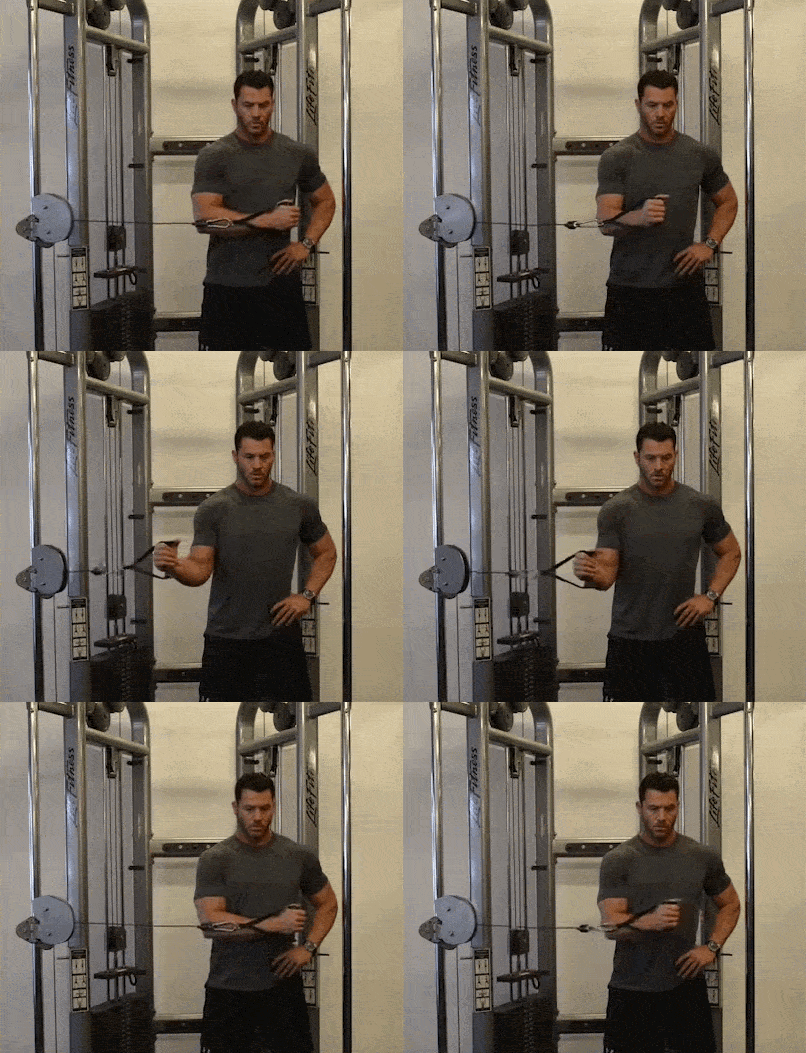
Pay close attention to how the motion occurs only at the shoulder joint. There should be no torso rotation, no lifting of the upper arm, and no use of momentum. The cable should move in a smooth, controlled arc across the front of the body.
What to look for: If the movement looks small, controlled, and precise—with minimal weight and no body movement—that’s a sign of proper technique. If it looks like a pulling motion or involves the whole body, it is being performed incorrectly.
Exercise Variations & Alternatives for the Cable Internal Rotation
If you want to adjust the cable’s internal rotation based on equipment, comfort, or training goals, there are several effective variations and alternatives. While all of them target the internal rotators of the shoulder, they differ in resistance profile and execution.
1) Seated Cable Internal Rotation

How to perform:
Why it works:
The seated position reduces body movement and makes it easier to maintain strict form, which is ideal for beginners or rehab settings.
2) Band Internal Rotation
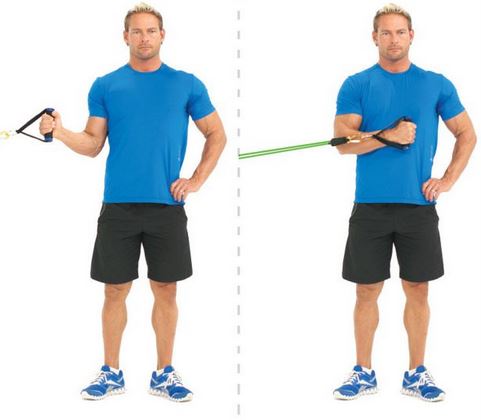
How to perform:
Why it works:
Bands provide variable resistance and are great for warm-ups, high-rep work, or home workouts.
3) Dumbbell Internal Rotation (Side-Lying or Bench-Supported)


How to perform:
Why it works:
Dumbbells rely on gravity and require specific positioning, but they can be effective when performed correctly in a supported position.
4) Cable Internal Rotation at Different Angles
How to perform:
Why it works:
Changing the angle slightly alters the resistance curve and can help target the rotator cuff from different positions.
Key insight: Cable variations provide the most consistent tension, while bands and dumbbells offer flexibility. The key is maintaining strict control and proper shoulder rotation regardless of the setup.
Key Benefits of the Cable Internal Rotation
Cable internal rotation is a highly effective exercise for improving shoulder function, stability, and coordination. While internal rotators are often already strong, this movement plays an important role in refining control and maintaining balanced shoulder mechanics.
Key insight: This exercise is not about building more strength in already dominant muscles—it’s about improving how those muscles function within the shoulder joint.
Who Should Use This Exercise?
Cable internal rotation is a specialized exercise that can benefit a wide range of individuals, but it is most effective when used strategically. Because the internal rotators are often already well-developed, this movement is best used to improve control, balance, and shoulder function rather than simply adding more strength.
Key takeaway: Cable internal rotation is most effective when used as a corrective or supportive exercise—not as a primary strength movement.
Cable Internal Rotation vs Cable External Rotation
To fully understand the role of cable internal rotation, it’s essential to compare it with its opposite movement—external rotation. These two functions work together to maintain shoulder balance, stability, and long-term joint health.
| Criteria | Cable Internal Rotation | Cable External Rotation |
|---|---|---|
| Primary function | Internal rotation of the shoulder | External rotation of the shoulder |
| Main muscles | Subscapularis | Infraspinatus, teres minor |
| Role in training | Control and coordination | Stability and injury prevention |
| Typical strength level | Usually strong/dominant | Often weak/underdeveloped |
| Injury prevention value | Moderate | Very high |
| Common issue | Overuse/dominance | Weakness/neglect |
| Application | Corrective / accessory work | Warm-up, prehab, rehab |
| Resistance profile | Constant (cable) | Constant (cable) |
| Importance for shoulder health | Important | Critical |
Conclusion: Both internal and external rotation are essential for proper shoulder function, but they do not carry equal importance in most training programs. Internal rotators are heavily involved in common exercises like bench presses, rows, and pull-ups, so they are often already well developed.
External rotators, on the other hand, are frequently undertrained, making them a critical focus for injury prevention and shoulder stability. This is why most programs place greater emphasis on external rotation.
However, internal rotation of the cable still plays an important role—especially when used to improve control, coordination, and balance within the shoulder joint. It should not be neglected, but it also should not dominate your rotator cuff training.
Practical takeaway: Train both movements, but prioritize external rotation. Use cable internal rotation strategically to maintain balance and refine shoulder function.
As a coach working with lifters and athletes, I treat cable internal rotation as a precision exercise rather than a muscle-building movement. Most people already get plenty of internal rotation work from pressing, pulling, and upper-body volume in general, so the goal here is usually not to make the internal rotators “stronger” in a brute-force sense, but to make them more coordinated and better integrated within the shoulder joint.
The biggest mistake I see is using too much weight and turning the exercise into a sloppy pulling motion. That completely defeats the purpose. Keep the elbow pinned to your side, move slowly, and focus on smooth shoulder rotation. When performed with control, this exercise can help restore balance and improve how the shoulder functions under heavier training loads.
Where This Exercise Fits in a Workout
Cable internal rotation is not a primary strength exercise, but a corrective and supportive movement aimed at improving shoulder control and balance. Because the internal rotators are already heavily involved in most upper-body training, this exercise should be used strategically rather than excessively.
As a Warm-Up (Selective Use)
In some cases, it can be used before training to activate the internal rotators—especially if there is a specific imbalance or coordination issue.
Best used when: internal rotation feels weak or poorly controlled
As a Prehab / Corrective Exercise (Most Recommended)
This is the most common and effective use. It helps restore balance and improve shoulder function.
Ideal for: balancing rotator cuff function and improving joint stability
Between Sets of Upper-Body Exercises
Can be performed between sets of pressing or pulling movements to reinforce shoulder control without adding fatigue.
Useful for maintaining shoulder positioning during heavy training
As a Finisher (Accessory Work)
Can be used at the end of a workout to enhance control and coordination.
Important Guidelines
Practical takeaway: Cable internal rotation works best as a corrective and supportive tool—used to refine shoulder function rather than build maximal strength.
Conclusion
Cable internal rotation is a valuable rotator cuff exercise that focuses on improving control, coordination, and stability of the shoulder joint. Targeting the subscapularis with consistent cable tension helps reinforce proper movement mechanics and supports balanced shoulder function.
While internal rotators are often well developed through compound movements, this exercise plays an important role in refining their function—especially when combined with external-rotation training. When used correctly, it can enhance joint stability, reduce compensations, and contribute to long-term shoulder health.
Because it uses light resistance and produces minimal fatigue, cable internal rotation can be easily integrated into warm-ups, corrective routines, or accessory work without interfering with primary training.
Final takeaway: Cable internal rotation is most effective when used with intention—not to build more strength in already dominant muscles, but to improve control and maintain balance within the shoulder joint.
