



Introduction
The cable leg curl is an underrated yet highly effective hamstring isolation exercise that targets knee flexion using constant cable resistance rather than a fixed machine path. Unlike seated, standing, or lying leg curl machines that stabilize the body for you, the cable variation requires significantly more balance, coordination, and muscular control throughout the movement.
Because the pulley system does not lock the body into a fixed position, the cable leg curl forces the hamstrings to work while the core and stabilizing muscles help maintain posture and alignment. This added stabilization demand often creates a stronger mind–muscle connection and can make relatively light weights feel surprisingly challenging.
The standing cable leg curl is the most common variation and is typically performed one leg at a time using an ankle attachment connected to a low pulley. However, cable leg curls can also be performed lying on a bench, which increases stability and allows greater focus on pure hamstring contraction.
One of the biggest advantages of the cable leg curl is the constant tension created by the pulley system. Unlike some machine-based variations where resistance changes significantly throughout the range of motion, the cable setup keeps continuous tension on the hamstrings during both the concentric and eccentric phases of the exercise.
Required Equipment
To perform the cable leg curl correctly, you need:
- Cable pulley machine
- Ankle attachment or cuff
- Stable support surface or machine handle
- Optional exercise bench for lying variations
Proper cable height and attachment positioning are important for maintaining smooth resistance and avoiding awkward pulling angles during the exercise. In most setups, the pulley should remain close to floor level so the resistance line follows the natural path of knee flexion.
Compared to machine leg curls, cable leg curls require greater stabilization because the body is not locked into a fixed path. This increases coordination demands and forces the hamstrings to work alongside the core and stabilizing musculature to maintain proper posture and balance.
Other Names for the Cable Leg Curl
This exercise may also be referred to as:
- Standing Cable Leg Curl
- Cable Hamstring Curl
- Single-Leg Cable Curl
- Cable Knee Curl
- Low Pulley Leg Curl
Although the terminology varies slightly, all versions involve knee flexion against cable resistance, performed in either a standing or lying position.
How to Perform the Cable Leg Curl
Starting Position (Setup)
Proper setup is important because the cable leg curl requires both hamstring activation and full-body stabilization throughout the movement.
- Attach an ankle cuff to one leg just above the ankle.
- Connect the cuff to a low cable pulley.
- Stand facing the machine or slightly angled to its side.
- Hold onto the machine or another stable object for balance.
- Keep the working knee slightly in front of the standing leg.
- Maintain an upright posture with the core braced.
Some lifters prefer to stand on a small platform with the non-working leg to allow a greater range of motion during the lowering phase.
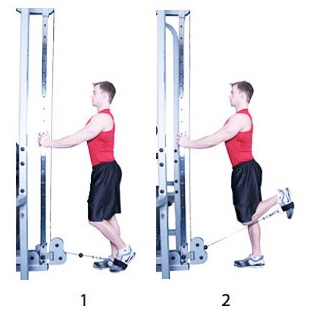
Execution (Movement Phase)
- Initiate the movement by contracting the hamstrings.
- Curl the heel upward toward the glutes in a controlled arc.
- Keep the hips stable and avoid swinging the leg.
- Squeeze the hamstrings hard at peak contraction for 1 second.
- Slowly lower the weight back to the starting position over 3–4 seconds.
- Maintain constant tension without letting the cable fully slacken.
The movement should remain smooth and controlled throughout the entire range of motion.

Technique Optimization Tips for the Cable Leg Curl
Because the body is not stabilized by a machine pad or seat, small technical details greatly influence exercise quality.
- Keep the hips square and stable throughout the movement.
- Avoid swinging or using momentum.
- Control the eccentric phase slowly.
- Keep the torso upright or only slightly leaned forward.
- Point the knee downward during the curl.
- Maintain tension instead of resting between repetitions.
- Focus on hamstring contraction rather than simply moving the cable.
A highly effective cue is: “Pull the heel toward the glute while keeping the hips still.”
Mechanical Resistance Analysis
One of the biggest advantages of the cable leg curl is the constant tension created by the pulley system. Unlike some machine-based leg curls, where resistance may drop off at certain portions of the range of motion, the cable maintains relatively continuous tension on the hamstrings throughout both the concentric and eccentric phases.
Because the exercise is usually performed standing and unilaterally, the cable leg curl also demands greater core, hip, and standing-leg stabilization than seated or lying machine variations. This often improves neuromuscular coordination and mind–muscle connection while making lighter loads feel more challenging.
The movement primarily trains the hamstrings through knee flexion, but balance and postural control also become important components of the exercise. For this reason, cable leg curls are often excellent for improving unilateral control and muscular coordination in addition to hamstring hypertrophy.
Common Mistakes
Although the cable leg curl uses relatively light resistance compared to compound hamstring exercises, poor technique can still reduce hamstring activation and compromise movement quality.
- Swinging the leg using momentum
- Excessive hip movement during the curl
- Leaning too far forward or backward
- Allowing the cable to lose tension between reps
- Performing fast, uncontrolled eccentrics
- Using excessive weight and shortening the range of motion
- Letting the knee flare outward excessively
One of the biggest mistakes is turning the exercise into a full-leg swinging movement instead of a strict knee-flexion exercise controlled by the hamstrings.
Muscles Involved in the Cable Leg Curl
Understanding muscle recruitment helps improve exercise precision and programming decisions.
MAIN MUSCLES:
Hamstrings (biceps femoris, semitendinosus, semimembranosus)
SECONDARY MUSCLES:
Gastrocnemius, gracilis, sartorius
ASSISTING MUSCLES:
Popliteus, core stabilizers, gluteus medius
ANTAGONISTS:
Cable Leg Curl Pros and Cons
The cable leg curl is an excellent alternative to machine-based hamstring curls because it combines constant tension with greater demands for stabilization and unilateral control.
Advantages
- Constant tension throughout the movement
The cable pulley maintains continuous resistance during both the lifting and lowering phases. - Excellent unilateral hamstring training
Training one leg at a time helps improve muscular balance and coordination. - Improved stabilization and control
The standing setup increases the demands on core and hip stabilization compared to fixed machines. - Versatile exercise setup
Cable leg curls can be performed standing or lying down, depending on the available equipment and training goals. - Joint-friendly resistance profile
Many lifters find cable resistance smoother and more comfortable than some machine designs.
Potential Drawbacks
Despite its benefits, the cable leg curl also has limitations.
- Balance can become a limiting factor
Poor stability may reduce the ability to focus fully on the hamstrings. - Less loading potential than machine variations
Most lifters cannot use as much resistance as during seated or lying leg curls. - Setup takes longer
Adjusting ankle attachments and cable positioning can be inconvenient in busy gyms. - Easy to lose strict form
Momentum and hip movement can quickly reduce hamstring isolation if technique deteriorates.
Many lifters underestimate how effective cable exercises can be for hamstring development simply because the weights are lighter than machine or barbell movements. In reality, constant tension and unilateral control often create a surprisingly intense contraction stimulus.
As a coach working with athletes and physique-focused clients, I’ve found that cable leg curls are especially valuable for improving hamstring awareness, reducing muscular imbalances, and adding high-quality isolation work without excessive lower-back fatigue.
Cable Leg Curl Variations
Small changes in body position, setup, or execution style can significantly alter the feel of the movement and overall training emphasis. Strategically rotating variations may also help improve long-term hamstring development and reduce monotony in training.
Lying Cable Leg Curl
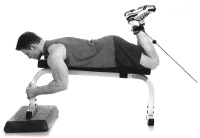
The lying cable leg curl increases body stability and allows greater focus on pure hamstring contraction. Many lifters find it easier to maintain strict form in this variation compared to the standing version.
Resistance Band Leg Curl
Resistance bands create accommodating resistance that becomes harder near peak contraction. This variation works well for home workouts and rehabilitation settings.

Standing Machine Leg Curl
The machine version provides greater external stability and usually allows heavier loading. Compared to cable curls, it requires less balance and coordination.

Nordic Hamstring Curl
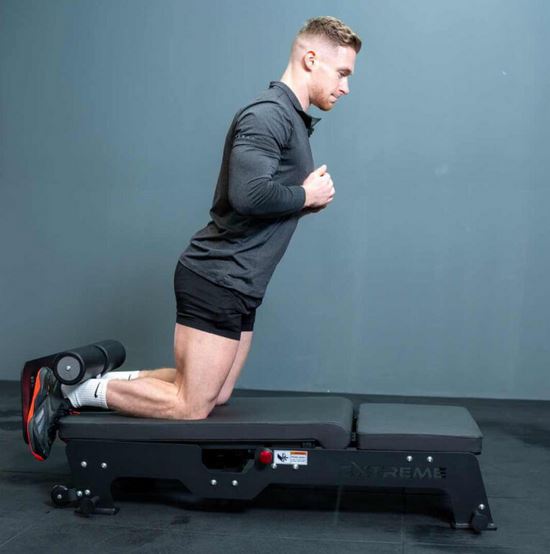
The Nordic hamstring curl is an advanced eccentric-focused exercise known for its exceptional hamstring-strengthening and injury-prevention benefits.
Alternative Exercises for Hamstring Development
Although the cable leg curl is highly effective for hamstring isolation and constant tension, combining it with both machine and hip-dominant exercises usually produces more complete posterior-chain development.
Lying Leg Curl (Machine)
The lying leg curl trains both hamstrings simultaneously in a stable prone position and often allows heavier loading than cable variations.

Seated Leg Curl
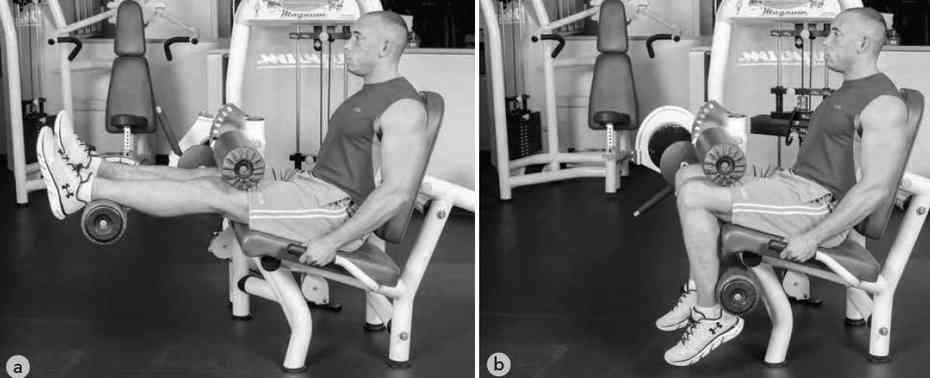
The seated leg curl places the hamstrings under greater stretch due to hip flexion and is especially effective for hypertrophy-focused training.
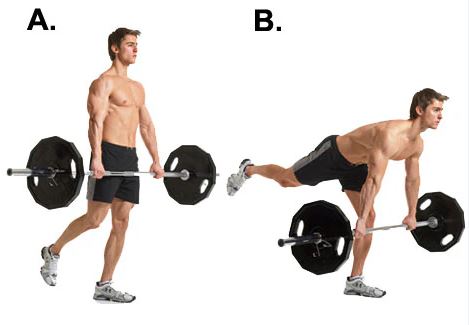
Single-Leg Romanian Deadlift
The single-leg Romanian deadlift simultaneously improves hamstring strength, balance, hip stability, and posterior-chain coordination.
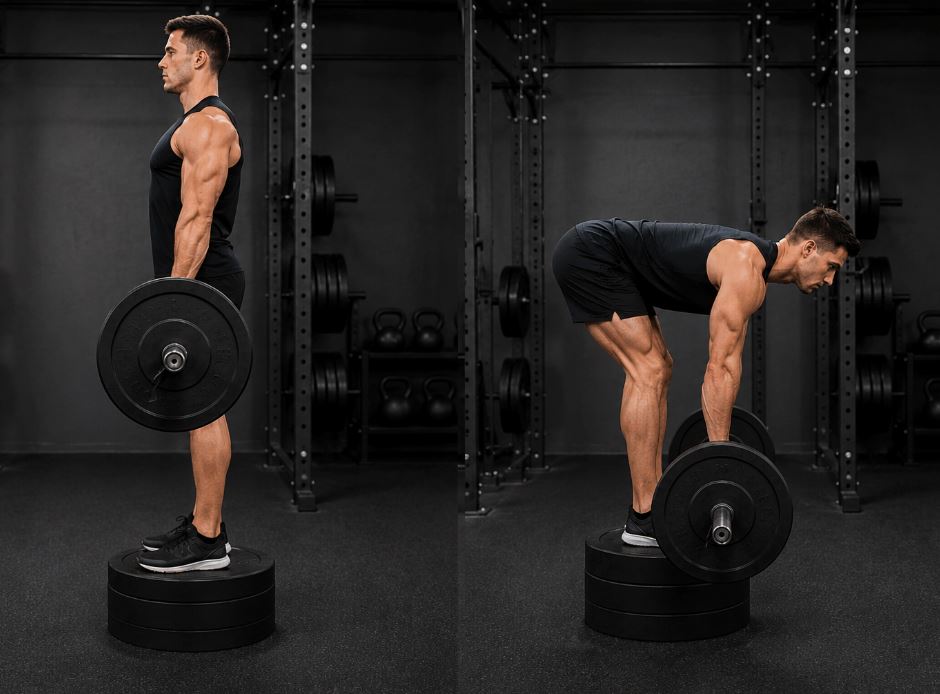
Stiff-Leg Deadlift
The stiff-leg deadlift places heavy emphasis on the hamstrings through loaded hip hinging and intense stretch-tension, making it one of the best posterior-chain mass builders.
Cable Leg Curl vs Standing Leg Curl Machine
Both exercises are excellent unilateral hamstring isolation movements, but the type of resistance and stabilization demands create important differences in muscle recruitment and overall exercise feel. Understanding these distinctions helps you choose the best option based on your goals, experience level, and available equipment.
Conclusion: Both exercises are highly effective for unilateral hamstring training. The cable leg curl offers greater constant tension and stabilization demands, while the standing leg curl machine provides more external support and generally allows stricter isolation with heavier loading.
Why Constant Tension Feels Different With Cable Exercises
One reason many lifters enjoy cable-based exercises is the unique resistance profile created by the pulley system. Unlike some machine-based movements where tension may decrease during certain portions of the range of motion, cables maintain relatively continuous resistance throughout both the lifting and lowering phases.
This constant tension often leads to greater muscular fatigue and prolonged time under tension, especially during higher-repetition hypertrophy-focused sets. In the cable leg curl, the hamstrings rarely get a chance to fully “rest” during the movement, which can produce a very intense contraction sensation despite using lighter absolute loads.
At the same time, the lack of external stabilization forces the body to work harder to maintain posture and alignment. This combination of constant tension and stabilization demand is one of the main reasons cable leg curls feel so different from traditional machine-based hamstring exercises.
Final Thoughts
The cable leg curl is an underrated yet highly effective hamstring isolation exercise that combines constant tension, unilateral control, and increased stabilization demands into a single versatile movement.
When performed with strict technique, controlled eccentric contractions, and stable posture, the cable leg curl is an excellent tool for improving hamstring hypertrophy, muscular balance, and mind–muscle connection without excessive spinal loading.
Why do cable leg curls often feel harder than machine leg curls despite using less weight?
Cable exercises create continuous tension throughout the movement while also requiring stabilization from the core and standing leg. Because the body is not fixed in place, even relatively light loads can feel significantly more demanding.
Are cable leg curls good for improving balance and coordination?
Yes. Unlike seated or lying machine curls, cable leg curls force the body to stabilize dynamically during unilateral movement. This improves coordination, postural control, and lower-body stability alongside hamstring development.
Why do cable leg curls create such a strong hamstring contraction?
The pulley system maintains tension during both the concentric and eccentric phases, meaning the hamstrings rarely get a chance to fully relax during the set. This prolonged tension often creates an intense contraction and “pump” sensation.
Should cable leg curls be performed barefoot or with shoes?
For most people, stable flat shoes are ideal because they improve balance and lower-body alignment. Some advanced lifters prefer barefoot training for greater foot stability and proprioception, but only if gym rules and foot mechanics allow it safely.
Is the cable leg curl useful for rehabilitation training?
In many cases, yes. Because resistance is adjustable and relatively joint-friendly, cable leg curls can work well for controlled hamstring strengthening and unilateral retraining during certain rehabilitation phases when approved by a qualified professional.
Why does the standing leg sometimes fatigue before the working hamstring?
The standing leg and hip stabilizers must work continuously to maintain posture and balance. If those muscles are weak or fatigued, stabilization may become the limiting factor before the working hamstring fully fatigues.
Can cable leg curls replace machine leg curls completely?
They can be highly effective, but ideally both should be used strategically. Machine curls allow greater stability and often heavier loading, while cable curls provide constant tension and improved stabilization demands.
Are cable leg curls better for athletes than bodybuilders?
Not necessarily better, but often very useful. Athletes may benefit more from the added balance, coordination, and unilateral stability demands, while bodybuilders may prefer machine variations when maximum isolation and loading are the priority.
