


Introduction
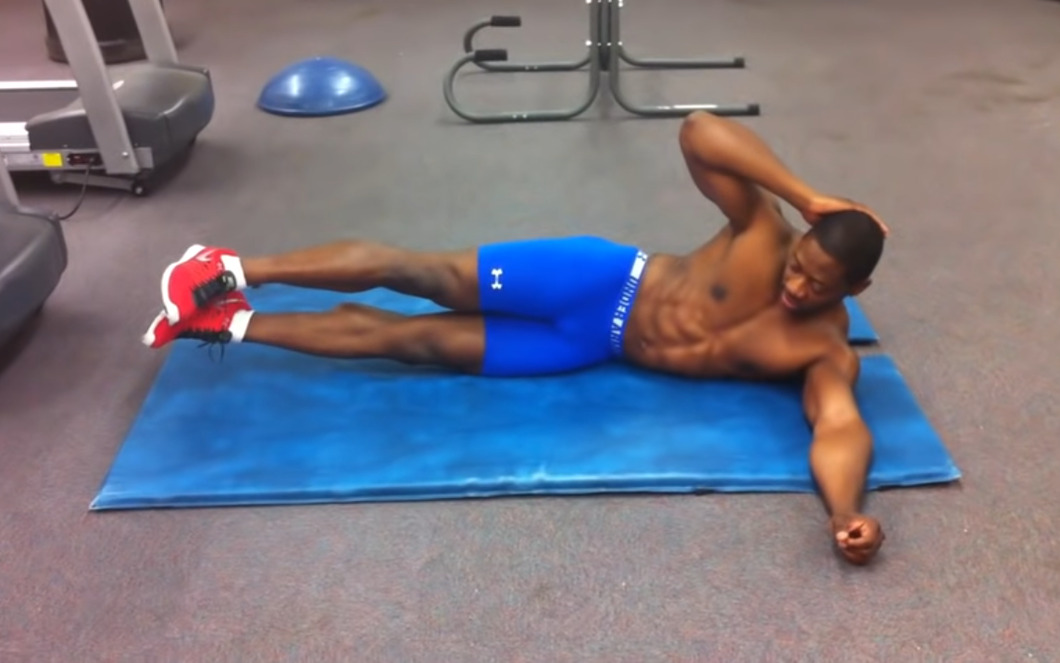
The double-side jackknife is the more demanding version of the lateral crunch — and the difference between the two exercises is exactly one thing: the legs. In a lateral crunch, you raise the head and shoulders a few inches off the floor while the legs stay on the ground. In the double-side jackknife, both the torso and the legs rise simultaneously toward each other, like the closing of a jackknife. That simultaneous movement from both ends dramatically increases the oblique demand and creates a contraction that the lateral crunch, for all its value, simply cannot replicate.
The exercise requires no equipment beyond a mat and enough floor space to lie on your side. It is one of the more underrated oblique exercises in bodyweight training — effective enough to genuinely challenge intermediate and advanced trainees, accessible enough to do anywhere, and specific enough to target the obliques in a way most rotational exercises do not.
One important clarification from the start: when the old name “double leg side jackknife” appears, it refers to the same exercise. The “double” refers to both legs rising together — distinguishing it from the single-leg side jackknife, which is a regression where only one leg rises to meet the torso. Both versions are covered in the Exercise Variations section.
Exercise ID Card
Muscles Worked in the Double-Side Jackknife
Primary muscles
- External obliques — contract concentrically to drive the lateral trunk flexion that raises the torso toward the legs; on the working side, the external obliques are the primary driver of the closing movement
- Internal obliques — work alongside the external obliques throughout the lateral flexion; the internal obliques on the working side assist with the torso rise and maintain the lateral plane of movement
Secondary muscles
- Rectus abdominis — stabilizes the anterior trunk throughout the movement and assists with maintaining the elevated position at the top
- Quadratus lumborum — assists with the lateral flexion component, particularly during the torso rise phase
- Hip abductors — assist with lifting both legs off the floor during the simultaneous leg rise
- Muscles along the spinal column — provide stabilization against the lateral load throughout the movement
Antagonists
The same muscles on the opposite side of the body — obliques, quadratus lumborum, and lateral stabilizers — lengthen under control as the torso and legs close toward each other and contract to control the return to the starting position.
One practical point: lying on the left side targets the right obliques, and lying on the right targets the left. This reversal is counterintuitive to many trainees and is worth confirming with a hand placed on the working oblique during the first few reps — the muscles that harden under the hand as the torso rises are the muscles being trained.
How to Do a Double-Side Jackknife: Step-by-Step Form Guide
Starting position
- Lie on your left hip on a mat with legs together and fully extended — body in a straight lateral line from head to feet
- Place the left elbow against the body for support — forearm on the floor, providing a stable base
- Place the right hand behind the ear or on the side of the head — not pulling the neck; the hand simply supports the head position
- The body should be in complete lateral alignment — no forward or backward lean

Execution
- Simultaneously contract the obliques to raise both legs off the floor and bring the torso upward — both ends moving toward each other at the same time
- Keep the legs together throughout the lift — they rise as a unit, not separately
- Aim to reduce the space between the ribs and the hips — that closing of the lateral space is the oblique contraction; the movement is not large, typically four to six inches of lift on each end
- At the top, hold for one to two seconds — feel the oblique contracted maximally on the working side
- Lower both the legs and the torso under control simultaneously — do not drop either end
- Stop just short of the legs and shoulder touching the floor and repeat without a full reset between reps
- Complete all reps on one side before rolling to the other side and repeating
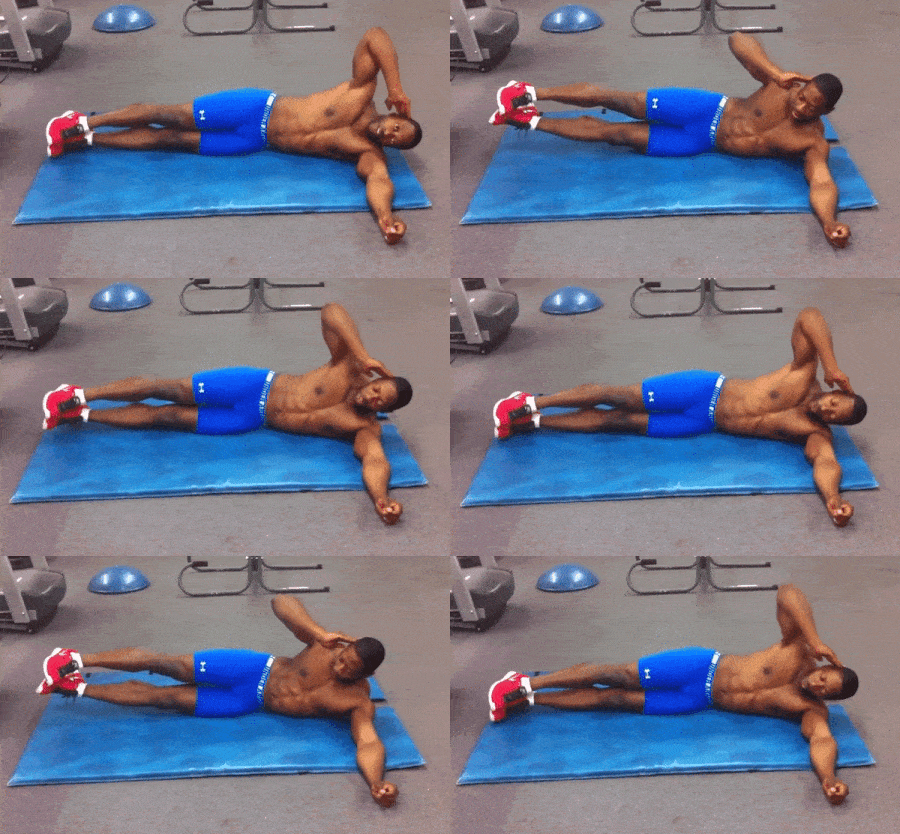
The key coaching cue: Think of the ribs and the hips closing toward each other — not the head reaching up or the feet kicking. The movement comes from the obliques shortening the lateral space between the lower ribs and the hip. If only the head moves or only the legs move, the exercise breaks into two separate half-movements rather than the single integrated contraction that makes it effective.
5 Common Double-Side Jackknife Mistakes (And How to Fix Them)
1. Moving the torso and legs sequentially rather than simultaneously
The defining characteristic of the double-side jackknife — the feature that distinguishes it from the lateral crunch — is the simultaneous movement from both ends. When the torso rises first, and the legs follow, or the legs lift first, and the torso follows, the exercise loses its jackknife mechanics and becomes two separate partial movements. Both ends must initiate and reach the top position simultaneously. Think of the body as a book closing from both covers simultaneously rather than one cover folding over the other.
2. Moving only the head rather than the torso
The entire upper body should lift off the floor — not just the head nodding upward. The shoulder, the ribs, and the lateral torso all need to rise as the oblique contracts and closes the lateral space. If only the head is moving, the obliques are not generating the movement. Place the hand behind the ear rather than behind the head to reduce the temptation to pull the head, and focus on lifting the shoulder.
3. Allowing the legs to separate
Keeping the legs together throughout the movement maintains the lever arm and keeps the hip abductor demand honest. When the legs separate or the top leg rises independently, the oblique demand changes and the integrated closing mechanics are lost. Consciously press the ankles together from the first rep to the last.
4. Going for range rather than contraction quality
More than four to six inches of lift from either end does not increase the oblique stimulus — it typically just increases the hip flexor involvement and the momentum. The focus should be on getting the oblique contraction right: ribs toward hip, simultaneous, controlled. A small, perfect movement produces more oblique development than a large, sloppy one.
5. Pulling on the neck with the upper hand
The hand behind the ear or head is purely for support — it should not pull the head upward or toward the working side. Neck pulling creates cervical stress and reduces the oblique activation by shifting effort from the core to the neck flexors. Keep the hand light and passive throughout every rep.
Benefits of the Double-Side Jackknife
More complete oblique contraction than the lateral crunch
The simultaneous torso and leg rise creates a closing movement that contracts the obliques from both ends simultaneously — the torso-side contraction and the leg-side contraction working together. That bilateral closing creates a more complete and more intense oblique contraction than the one-directional torso rise of the lateral crunch.
No equipment required
A mat is the only requirement. The double-side jackknife is one of the more demanding bodyweight oblique exercises available for home training, travel, or any environment where gym equipment is unavailable.
Teaches the obliques to work from both ends
Most oblique exercises train the muscles by moving the torso toward fixed legs or rotating the torso against fixed legs. The double-side jackknife trains the obliques to close the body from a lateral position — a motor pattern that complements rotational and pure lateral flexion training.
Scalable within a limited equipment context
The progression from the single-leg version to the double-leg version to the incline board version provides meaningful difficulty without added weight or equipment, making it a practical choice for trainees without gym access.
Who Should Use This Exercise
- Intermediate trainees who have mastered the lateral crunch and want a more demanding bodyweight oblique alternative before moving to cable or Roman chair variations
- Trainees who train at home without equipment and need a genuine oblique challenge beyond the lateral crunch
- Anyone looking for a unilateral oblique exercise that trains each side independently through a closing jackknife pattern
- Trainees building a complete bodyweight core program who want oblique exercise variety without equipment
Who Should Be Cautious
- People with lower back pain or hip issues — the simultaneous leg lift places lateral load on the lumbar spine and hip structures; reduce the range of motion or use the single-leg version if discomfort occurs
- People with neck sensitivity — the side-lying position with the hand behind the head creates cervical demand; use a rolled towel under the head and keep the upper hand completely passive
- Beginners who have not yet mastered the lateral crunch — the simultaneous movement from both ends requires more coordination and oblique strength than the lateral crunch; master the single-direction version first
How to Make It Easier or Harder
Easier
- Single-leg side jackknife — raise only the top leg toward the rising torso rather than both legs together; the shortened lever arm and reduced weight make this significantly more manageable while preserving the jackknife closing pattern
- Lateral crunch — the pure torso-only version of this exercise with no leg rise; the appropriate starting point before adding the simultaneous leg movement
Harder
- Extended hold at top — holding the fully closed position for three to five seconds significantly increases time under tension; one of the most effective ways to increase the oblique demand without adding equipment
- Incline board variation — performing the exercise on an incline board with the head at the higher end increases the gravitational demand on the torso rise component; hold the board with the free hand for support
- Ankle weights — fastening light ankle weights adds external resistance to the leg rise component; even a small weight changes the exercise noticeably given the lever arm of both legs
Double-Side Jackknife vs. Lateral Crunch
Both exercises are performed side-lying without equipment and target the obliques through lateral spinal flexion, but the movement pattern and the oblique demand differ in one fundamental way.
| Double-Side Jackknife | Lateral Crunch | |
|---|---|---|
| What moves | Torso AND legs — simultaneously | Torso only — legs stay on floor |
| Oblique contraction | Both ends close toward each other | One-directional torso rise |
| Leg demand | Moderate — both legs lift | None |
| Difficulty | Intermediate | Beginner |
| Equipment needed | None | None |
| Range of motion | Small — 4 to 6 inches each end | Small — 2 to 4 inches |
| Best for | More complete oblique contraction | Learning oblique isolation |
The practical takeaway: The lateral crunch is the starting point — it teaches the oblique contraction pattern and the lateral plane of movement without the coordination demand of the simultaneous leg rise. The double-sided jackknife is the direct progression — same movement plane, same oblique target, but both ends closing simultaneously for a more complete contraction. I use the lateral crunch as the entry point and move clients to the double-sided jackknife once they can consistently control it with genuine oblique contraction rather than head nodding.
Exercise Variations
Single-Leg Side Jackknife
The same side-lying position, but only the top leg rises to meet the torso rather than both legs together. The single-leg version is significantly easier because the shorter lever of one leg and the reduced weight make the simultaneous closing movement more manageable. It is the primary regression for trainees who cannot control the double-leg version and the appropriate starting point for anyone new to the jackknife pattern. Once the single-leg version is consistently controlled with a genuine oblique contraction and a two-second hold at the top, the double-leg version is the natural progression.

Incline Board Side Jackknife
Perform the double-sided jackknife while lying on an incline board, with the head at the higher end, holding the board with the free hand for support. The inclined position increases the gravitational demand on the torso rise component — the obliques must work against the added resistance of the incline to raise the torso. A meaningful progression that increases difficulty without added weight and without changing the fundamental movement pattern.
Double-Side Jackknife with Ankle Weights
Fasten light ankle weights — 1 to 2 kilograms — before performing the standard double-side jackknife. The added weight at the end of the leg lever increases the demand on the obliques and hip abductors throughout the simultaneous rise. Start conservatively — even a small ankle weight noticeably changes the exercise, given the lever arm of both legs rising together. Only add weight once the bodyweight version produces a consistent oblique contraction with a controlled descent on every rep.

Replacement Exercises (Alternatives)
If the double-side jackknife is not the right fit, these exercises target the same primary muscle group:
- Lateral Crunch
- Heel Touches
- Hip Crossover
- Dumbbell Side Bend
- Roman Chair Side Bend
- Hanging Oblique Knee Raise (Hanging Oblique Crunch)
- Standing Cable Oblique Crunch
- Twisting Cable Crunch
- Cross-Over Crunch
- Bicycle Crunch
- Russian Twist – Oblique Trunk Rotation
- Broomstick Twist
- Rotary Torso Machine
- Seated Rotary Torso Machine
- Decline Twisting Sit-Up
- Landmine 180s
- Hanging Windshield Wiper
How To Incorporate the Double-Side Jackknife Into Your Workouts
- At the end of a core session — like the lateral crunch, the double-side jackknife is best placed after heavier rectus abdominis work; prioritize the rectus abdominis first when you are freshest and finish with the obliques
- Supersetting with a rotational exercise — pair with a Russian twist or hip crossover for complete oblique coverage — lateral flexion and rotation trained back to back in one efficient pairing
- In a bodyweight home training circuit — pairs well with reverse crunches, standard crunches, and hip crossovers for a complete no-equipment core session
- Rep range: 12–20 reps per side — the simultaneous movement and the hold at the top respond well to moderate rep ranges; prioritize quality of contraction over accumulating reps
- Sets: 3–4 working sets per side
- Frequency: 2–3 times per week alongside other core training
- Tempo: Two seconds up with simultaneous torso and leg rise, one to two second hold at the top, two to three seconds lowering — the hold at the top is particularly important for this exercise; it confirms the full range has been achieved and maximizes the oblique contraction
- Priority note: Do not begin your ab routine with the double-side jackknife — train the rectus abdominis first, finish with the obliques
- Progression trigger: When 4 sets of 20 controlled reps per side with simultaneous movement, consistent oblique contraction, and a two-second hold become easy — add ankle weights, progress to the incline board variation, or extend the hold to three to four seconds
Conclusion
The double-side jackknife is a simple upgrade to the lateral crunch that most trainees overlook. Adding the simultaneous leg rise — turning a one-directional torso movement into a two-directional closing movement — meaningfully increases the oblique demand without adding any equipment, changing the setup, or requiring a more complex movement pattern.
The key is getting both ends moving at the same time. The moment they move sequentially rather than simultaneously, the jackknife mechanics are lost, and the exercise reverts to a lateral crunch with a disconnected leg lift. Both ends together, both ends arriving at the top at the same time, both ends lowering together. That synchronization is what makes this exercise what it is supposed to be.
If the lateral crunch is part of your core program and you have never tried the double-sided jackknife, add it to your next session. The upgrade is immediate, the equipment requirement is zero, and the oblique response — when the movement is done correctly — will make you wonder why you waited.
For a complete oblique training program, see our guide to the best oblique exercises for definition. See our companion guides to upper ab, lower ab, and core exercises for the complete training picture.
Reviewed by a Fitness Professional: The exercise technique, muscles worked, and training recommendations presented in this guide were reviewed by Tomislav G., Certified Fitness Instructor , who specializes in personalized training, injury recovery, and human anatomy.
