



Introduction
Well-developed shoulders are not built by pressing alone. In my experience, the dumbbell front raise can be a useful accessory exercise for targeting the anterior deltoids more directly, especially when the goal is to improve shoulder detail, control, and mind-muscle connection rather than simply move the heaviest weight possible.
The dumbbell front raise is a shoulder isolation exercise that involves lifting one or two dumbbells forward in front of the body until the arms reach roughly shoulder height. Because the movement is simple and easy to learn, it is often used by beginners, but it can also be valuable for advanced lifters who want to add more direct front delt work to their programs.
That said, I always like to be honest about where this exercise fits. If you already do a lot of pressing—such as bench presses, incline presses, push-ups, and shoulder presses—your front delts are probably already getting substantial stimulation. For that reason, I see the dumbbell front raise less as a “must-do” mass builder and more as a strategic isolation tool that can be useful in the right context.
Alternative Names for the Dumbbell Front Raise
This exercise is commonly used across different training programs, which is why you’ll often see it referred to by several slightly different names. Understanding these variations can help you recognize the movement regardless of how it’s labeled.
- Dumbbell front raise
- Front raise (dumbbells)
- Dumbbell shoulder front raise
- Anterior delt raise
- Front deltoid raise
- Alternating dumbbell front raise
- Seated dumbbell front raise
In practice, all of these names describe the same basic movement pattern. The main differences depend on whether the exercise is performed seated or standing and whether the arms are raised simultaneously or alternately.
Equipment Needed for the Dumbbell Front Raise
One of the reasons I like the dumbbell front raise as an accessory movement is its simplicity. You don’t need much equipment, which makes it easy to include in almost any training environment.
- Dumbbells – allow for natural movement and independent arm control, making the exercise more joint-friendly
Optional (but useful):
- Flat floor surface or stable stance – helps maintain balance and proper posture
- Wall support – can be used to prevent leaning back and eliminate momentum
- Adjustable bench (seated version) – useful if you want to reduce lower-body involvement and focus purely on the shoulders
From my experience, using a wall for support is one of the simplest ways to instantly improve form. It removes the ability to cheat with body momentum and forces the shoulders to do the actual work.
How to Perform the Dumbbell Front Raise with Proper Form
Proper execution is what makes the dumbbell front raise effective, rather than just a wasted movement driven by momentum. In my experience, this is one of those exercises where lighter weight and strict control will always outperform heavy, sloppy reps.
Starting Position (Setup)
A good setup ensures that the movement stays focused on the anterior deltoids instead of turning into a full-body swing.
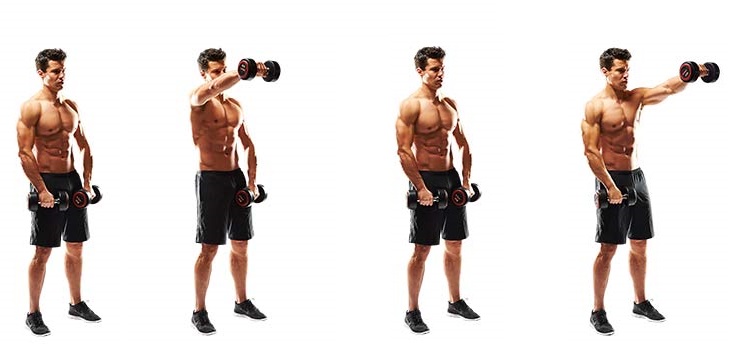
- Stand upright with your feet about hip-width apart and knees slightly bent
- Hold a pair of dumbbells in front of your thighs with a pronated (palms down) or neutral grip
- Keep your chest up, shoulders back and down, and spine in a neutral position
- Let the dumbbells hang naturally in front of your body
- Brace your core to prevent any backward leaning
Movement (Execution)
The goal is to raise the weights in a controlled manner using your shoulders—not momentum.
- Raise one or both dumbbells forward in front of your body
- Keep your elbows slightly bent and fixed throughout the movement
- Lift the weights until your arms reach approximately shoulder height (parallel to the floor)
- Pause briefly at the top to reinforce control
- Lower the dumbbells slowly back to the starting position
- Avoid swinging, jerking, or using your lower back to initiate the lift
From a coaching standpoint, the biggest mistake I see is lifters trying to turn this into a strength exercise. The dumbbell front raise is about control, positioning, and tension—not how much weight you can lift.
Video Demonstration & Proper Form Breakdown
Watching a proper demonstration is one of the easiest ways to understand how the dumbbell front raise should look in real time, especially for controlling the movement, avoiding momentum, and maintaining consistent shoulder tension throughout the lift.
Muscles Worked in the Dumbbell Front Raise
Understanding which muscles are involved in the dumbbell front raise helps you focus on proper execution and avoid turning the exercise into a momentum-based movement. In my experience, this exercise is much more effective when you consciously direct tension into the front delts rather than simply lifting the weights.
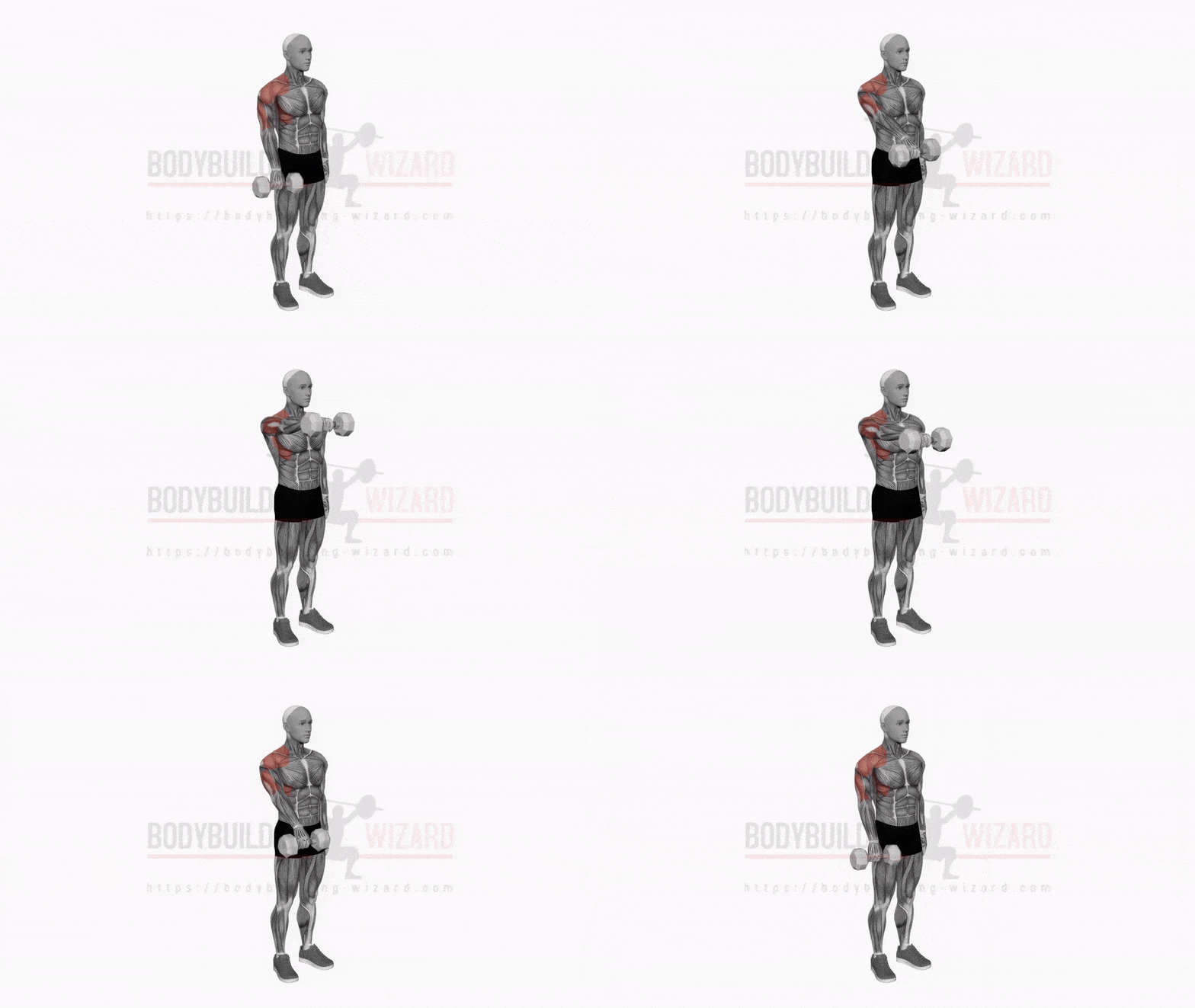
- Primary muscles: anterior deltoids (front delts)
- Secondary muscles: clavicular head of pectoralis major (upper chest), lateral deltoids, serratus anterior
- Stabilizing muscles: upper trapezius, levator scapulae, wrist extensors, core
- Antagonist muscles: latissimus dorsi, posterior deltoids, biceps brachii
How the Dumbbell Front Raise Works: Biomechanics & Mechanics
Understanding the biomechanics of the dumbbell front raise is essential if you want to target the anterior deltoids rather than just swinging the weight. In my experience, this is one of the most commonly misunderstood movements because it looks simple but is often performed incorrectly.
At its core, the movement is based on shoulder flexion, where the arm is raised forward in front of the body while the elbow remains relatively fixed. Because this is a single-joint exercise, the anterior deltoid should be doing the majority of the work throughout the entire range of motion.
Key Biomechanical Actions
- Shoulder joint movement – flexion driven primarily by the anterior deltoid
- Elbow joint movement – minimal, with a slight bend maintained throughout the lift
- Scapular movement – controlled upward rotation and stabilization of the shoulder blades
- Core stabilization – prevents backward leaning and compensatory movement
Range of Motion & Tension
The effectiveness of this exercise depends heavily on controlling the range of motion and maintaining tension on the deltoids.
- In the bottom position, the anterior delts are under minimal tension
- Through the mid-range, the deltoids take over and produce most of the force
- At shoulder height (parallel), tension is at its highest due to the lever arm
- Raising the dumbbells above shoulder height often shifts tension away from the delts and reduces efficiency
Why Momentum Kills This Exercise
One of the biggest biomechanical issues I see is lifters relying on momentum rather than muscle.
- Swinging the weight reduces the load on the deltoids
- Leaning back shifts the stress to the lower back
- Fast reps eliminate time under tension
From a coaching perspective, the dumbbell front raise is one of the clearest examples of an exercise where less weight and more control will always produce better results than lifting heavier with poor mechanics.
Technique Optimization Tips
Small technical adjustments can make a huge difference in how effective the dumbbell front raise is. In my experience, this exercise is all about precision—if you clean up these details, you’ll immediately feel more tension in the anterior deltoids.
- Keep your torso completely still. Any backward lean shifts the load away from the shoulders and into the lower back.
- Use a slight bend in the elbows and keep them fixed. Changing the elbow angle changes the movement.
- Raise the dumbbells only to shoulder height. Going higher usually reduces tension on the front delts.
- Control the eccentric (lowering phase). Lowering slowly increases time under tension and improves muscle activation.
- Avoid using momentum. If you have to swing the weight, it’s too heavy.
- Keep your shoulders down and back. This prevents excessive trap involvement.
- Lift with your shoulders, not your hands. Focus on initiating the movement from the deltoids.
- Use lighter weight than you think you need. This exercise is about control and feel, not load.
From what I see in the gym, lifters who apply these cues immediately notice better muscle engagement—and often realize they’ve been using far too much weight all along.
Technical Emphasis & Targeting Adjustments
Small changes in technique can noticeably alter how the dumbbell front raise feels and which structures contribute more to the movement. In my experience, this is especially important with front raises because minor adjustments can quickly turn a clean front-delt isolation exercise into a trap-dominant or momentum-driven lift.
- Pronated grip (palms down). Usually creates a classic front raise feel and strongly targets the anterior deltoids.
- Neutral grip (thumbs up). Often feels more natural on the shoulders and may reduce joint discomfort for some lifters.
- Alternating reps. Can reduce momentum, improve control, and make it easier to focus on one side at a time.
- Simultaneous reps. Increase overall tension and make the set more demanding, but also make cheating more tempting.
- Wall-supported front raises. Great for eliminating body swing and forcing stricter anterior delt isolation.
- Seated front raises. Reduce lower-body assistance and make it harder to use momentum.
- Lifting only to shoulder height. Keeps tension where it is usually most productive and avoids unnecessary motion above parallel.
- Slightly slower tempo. Improves mind-muscle connection and increases time under tension.
- One dumbbell held with both hands. Can feel more stable for beginners and may make the movement easier to learn.
From a coaching standpoint, the best adjustment is often the simplest one: choose the version that lets you feel the front delts working hardest without swinging, shrugging, or leaning back.
Dumbbell Front Raise Pros and Cons
Like most isolation exercises, the dumbbell front raise has a specific purpose within a training program. In my experience, it can be very effective when used correctly—but also unnecessary or even redundant if misapplied.
Key Benefits
- Excellent anterior deltoid isolation. Directly targets the front delts with minimal involvement from other muscle groups.
- Simple and accessible. Requires only dumbbells and can be performed almost anywhere.
- Great for improving mind-muscle connection. Helps you learn how to actively engage the front delts.
- Joint-friendly when done correctly. Allows for controlled movement and adjustable grip positions.
- Useful for correcting weak points. Can help bring up lagging front delts in certain cases.
Potential Downsides
- Limited muscle-building potential. Compared to pressing exercises, it does not provide a strong overall hypertrophy stimulus.
- Often redundant. Front delts are already heavily trained during pressing movements like the bench press and shoulder press.
- Easy to perform incorrectly. Many lifters rely on momentum, which reduces their effectiveness.
- Can overemphasize the front delts. It may contribute to muscular imbalances if the lateral and rear delts are neglected.
- Lower loading capacity. Requires lighter weights to maintain proper form and control.
From a coaching perspective, I rarely treat the dumbbell front raise as a primary shoulder builder. Instead, I see it as a targeted accessory exercise that has its place—but only when it truly adds value to your program.
One thing I always like to point out to my clients is that the front delts are already heavily involved in most pressing movements. Exercises like the bench press, incline press, push-ups, and shoulder presses all place a significant load on this part of the shoulder.
Because of that, adding the dumbbell front raise on top of an already press-heavy program can often be unnecessary. In many cases, you’ll get better overall shoulder development by focusing more on the lateral and rear deltoids, which are usually undertrained compared to the front.
Dumbbell Front Raise Variations
Introducing variations of the dumbbell front raise is a good way to change the movement’s feel, improve control, and reduce the urge to cheat. In my experience, these variations are less about “confusing the muscle” and more about finding the version that best matches your structure, comfort, and training goal.
Alternating Dumbbell Front Raise
This variation is performed one arm at a time, which often makes the movement easier to control. I like it for lifters who tend to swing both dumbbells together, because alternating reps can reduce momentum and improve mind-muscle connection.
Simultaneous Dumbbell Front Raise
In this version, both dumbbells are raised at the same time. It creates greater overall tension and makes the set feel more demanding, but it also increases the temptation to lean back and rely on momentum.

Neutral-Grip Dumbbell Front Raise
This variation is performed with the thumbs pointing upward rather than palms facing down. Many lifters find it more natural and more comfortable on the shoulder joint, especially if the standard pronated grip feels awkward.
Pronated-Grip Dumbbell Front Raise
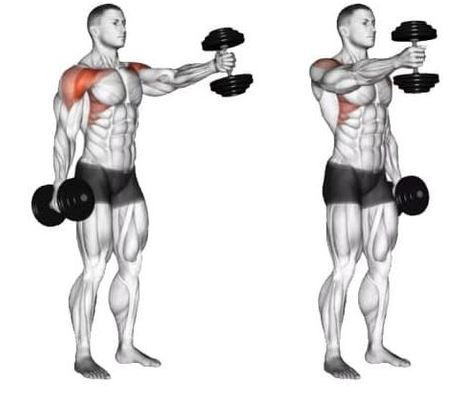
This is the classic version (explained in this exercise guide) most people picture when they think of a front raise. With the palms facing down, it gives the movement a very direct anterior delt feel and is one of the most commonly used variations.
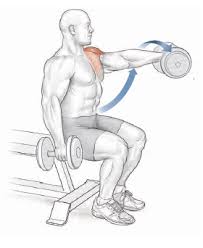
Seated Dumbbell Front Raise
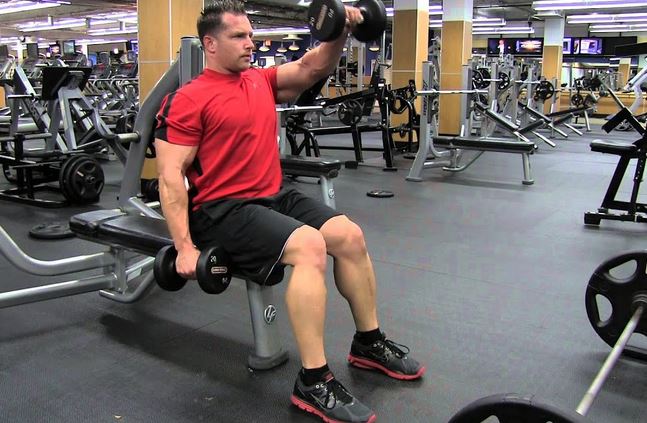
Performing the exercise seated reduces lower-body involvement and makes it harder to use momentum. I often recommend this version to lifters who struggle to stay strict when doing the standing variation.
Variable-Grip Dumbbell Front Raise
Begin with a neutral grip (thumb forward), then rotate the dumbbell through 90 degrees during the lift so that your grip is pronated (palm down) at the top of the movement. We prefer this variation to starting with an overhand grip in front of the upper legs.
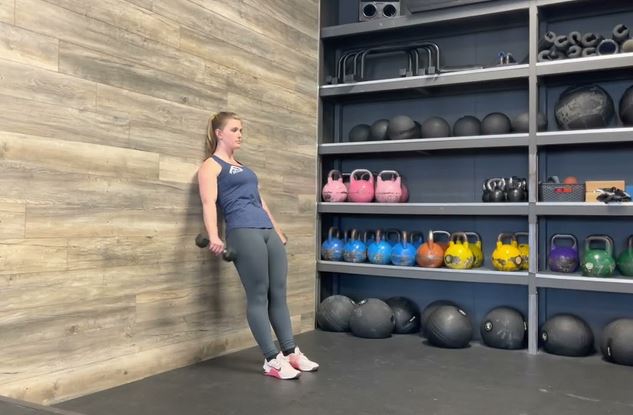
Wall-Supported Dumbbell Front Raise
This variation is performed with your back lightly supported against a wall to prevent leaning back. It’s one of the best options for strict front delt isolation because it eliminates many common cheating patterns.
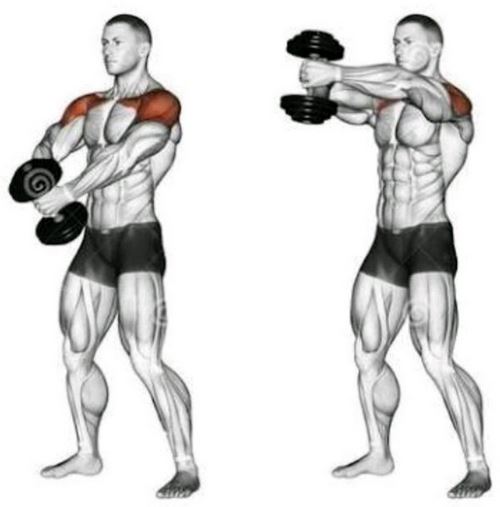
Two-Hands-One-Dumbbell Front Raise
In this version, you hold a single dumbbell with both hands and raise it in front of the body. It can feel more stable for beginners and may be a useful teaching variation when someone is still learning the movement pattern.
Replacement Exercises (Substitutes)
If the dumbbell front raise doesn’t fit your program or you’re looking for alternatives, there are several effective exercises that can target the anterior deltoids or provide a similar movement pattern. In our extensive front delt exercise database, you’ll find multiple options depending on your goals and available equipment.
- Barbell front raise
- Plate front raise
- Cable front raise
- Resistance band front raise
- Prone incline barbell front raise
- Prone incline dumbbell front raise
- Incline bench front raise
- Landmine press
- Machine shoulder press
- Dumbbell shoulder press
- Barbell shoulder press
This exercise is just one piece of the puzzle—see our full breakdown of the best front delt exercises to learn how to train your shoulders more effectively.
Where This Exercise Fits in a Workout
The dumbbell front raise is not a primary mass-building exercise, but it can still play a useful role when placed correctly in your training program. In my experience, this is one of those movements that works best as a targeted accessory, not the main lift.
- As a finishing exercise (end of the workout).
This is where it fits best. After compound movements like presses, you can use front raises to add extra volume and create a strong burn in the anterior delts. - After pressing movements.
It can be used to further fatigue the front delts after exercises like the bench press or shoulder press—if additional front delt work is actually needed. - In lighter, higher-rep sets.
This exercise responds best to controlled reps in the 10–15 (or even 15–20) range, where you can maintain strict form and consistent tension. - As a corrective or isolation-focused movement.
If you have a specific reason to bring up your front delts or improve control, you can include it more intentionally in your program.
From a coaching perspective, I don’t treat the dumbbell front raise as a must-have exercise. I use it selectively—when it genuinely adds value to a program, helps improve front delt control, or gives a lifter a bit of extra targeted work they actually need, not just because it exists.
Dumbbell Front Raise vs. Dumbbell Shoulder Press
Both the dumbbell front raise and the dumbbell shoulder press target the anterior deltoids, but they serve very different purposes in a training program. In my experience, understanding this difference is key to avoiding unnecessary volume and building more balanced shoulders.
| Training Factor | Dumbbell Front Raise | Dumbbell Shoulder Press |
|---|---|---|
| Exercise Type | Isolation | Compound |
| Primary Focus | Anterior deltoid | Anterior + lateral deltoids |
| Muscle Involvement | Low (single joint) | High (multi-joint) |
| Load Potential | Low | Moderate to high |
| Hypertrophy Stimulus | Limited | Strong |
| Functional Strength | Minimal | High |
| Stability Demand | Low | Moderate |
| Best Use | Isolation/accessory work | Main shoulder builder |
Conclusion: In most cases, the dumbbell shoulder press should be your primary choice for building shoulder size and strength, as it provides a much stronger overall stimulus. The dumbbell front raise is best used as a supplemental exercise—mainly when you have a specific reason to target the anterior deltoids more directly or improve control.
Final Thoughts
The dumbbell front raise is one of those exercises that looks simple on the surface, but its real value depends entirely on how and when you use it. In my experience, it’s not a “must-have” movement for building shoulder mass—but it can be a very effective tool when applied with intention.
What matters most is understanding its role. This is not a heavy compound lift designed to build maximum strength. Instead, it’s a precision-based isolation exercise that works best when performed with control, proper positioning, and a clear focus on the anterior deltoids.
I always encourage lifters to think critically about their program. If your training already includes plenty of pressing movements, your front delts are likely getting more than enough stimulation. In that case, adding front raises might not give you much additional benefit—and your time may be better spent developing the lateral and rear deltoids, which are often neglected.
That said, when used strategically—whether to improve control, bring up a specific weakness, or simply add variety—the dumbbell front raise can still be a valuable addition to a well-structured shoulder workout.
Can I use the dumbbell front raise to build bigger shoulders?
Not effectively on its own. While the dumbbell front raise targets the anterior deltoids, most shoulder size comes from compound movements like presses. Front raises are better used as a finishing or accessory exercise.
Is it better to raise one arm at a time or both together?
Both options work, but alternating reps often improve control and reduce momentum. Raising both arms together can feel more challenging but also makes it easier to cheat if the weight is too heavy.
Should I lift the dumbbells above shoulder height?
In most cases, no. Lifting beyond shoulder height often reduces tension on the anterior deltoids and shifts the movement away from its primary purpose. Stopping at shoulder level is usually more effective.
Can the dumbbell front raise help with shoulder injuries?
It can help improve control and strength in the anterior deltoids when used carefully with light weights. However, if you already have shoulder pain, it’s important to adjust technique or consult a professional before including it.
What weight should I use for dumbbell front raises?
You should use a weight that allows strict control without swinging or leaning back. For most lifters, this is much lighter than they initially expect—often in the moderate to light range.
Why do I feel this exercise more in my traps than shoulders?
This usually happens when the shoulders shrug upward during the lift. Keeping your shoulders down and focusing on controlled movement helps shift tension back to the anterior deltoids.
Is the dumbbell front raise necessary for beginners?
Not always. Beginners often get enough front delt stimulation from pressing exercises alone. Front raises can be added later if there is a specific need for additional isolation work.
Can I do dumbbell front raises every workout?
It’s generally not necessary. Since the front delts recover relatively quickly but are also used in many other exercises, 1–2 times per week is usually more than enough.
