



Overview (Why This Exercise Exists)
Flat bench dumbbell flyes are a classic chest-isolation (single-joint) exercise that emphasizes horizontal shoulder adduction, allowing the pectoralis major to do most of the work with minimal assistance from the triceps. Unlike pressing movements, which involve elbow extension and multiple muscle groups, flyes isolate the chest by keeping the elbow angle relatively fixed while the arms move in a wide arc.
Because the exercise places the chest muscles under a deep stretch at the bottom position, it provides a powerful stimulus for hypertrophy when performed with proper control and moderate loading. For this reason, flat dumbbell flyes are commonly used as a finishing or accessory movement following heavy pressing exercises to maximize chest fiber recruitment and improve mind–muscle connection.
When executed correctly with appropriate resistance, the movement enhances chest definition, improves muscle symmetry, and contributes to balanced upper-body development while maintaining a relatively low cost of systemic fatigue compared to heavy compound pressing.
Equipment Needed
- Flat bench
- Pair of dumbbells
Step-by-Step Instructions for the Flat Bench Dumbbell Flyes
Executing flat bench dumbbell flyes with controlled mechanics and stable shoulder positioning is essential for maximizing chest activation while minimizing shoulder joint stress. Follow the step-by-step instructions below to ensure proper technique and optimal muscle recruitment.
A. Starting Position (Setup)
Proper setup determines shoulder safety and movement efficiency.
- Lie flat on a bench with feet firmly planted on the floor.
- Your head, back, and buttocks are in contact with the bench.
- Hold dumbbells above the chest with arms extended (palms facing each other).
- Maintain a slight bend in the elbows.
- Retract the shoulder blades and keep the chest elevated.
- Position palms facing each other.
Key cue: Maintain the same elbow angle throughout the entire set.

B. Movement (Execution)
The goal is controlled chest-driven arm movement rather than pressing.
- Inhale and brace the core.
- Lower the dumbbells outward in a wide arc until a deep chest stretch is achieved.
- Keep elbows slightly bent and fixed in position.
- Bring the dumbbells back together by hugging them.
- To keep the tension on the muscles, do not touch the dumbbells together at the top.
- Exhale as the arms return to the top position.
- Avoid allowing the dumbbells to collide at the top.
Tempo recommendation: 2–3 seconds down, controlled return.
Resistance Curve Insight
Because resistance is highest in the stretched position and decreases toward the top, dumbbell flyes uniquely emphasize stretch-mediated hypertrophy, making them an ideal complement to pressing movements that overload the mid-range.
Muscles Worked
Flat and decline dumbbell flyes are great for building the outer chest and for carving that clean line that separates the chest from the torso. Understanding which muscle groups are involved in the flat bench dumbbell fly helps explain why this exercise is particularly effective for chest isolation, while still requiring several stabilizing muscles to control the movement safely and efficiently.
Primary muscles
Secondary muscles
Stabilizers
- Biceps brachii (stabilization role)
- Coracobrachialis
- subscapularis
- Core musculature
- Scapular stabilizers
Common Mistakes
Even though dumbbell flyes use moderate loads, improper execution can significantly increase shoulder stress and reduce chest activation.
- Using excessive weight
- Allowing elbows to bend excessively (turning movement into a press)
- Lowering weights too quickly
- Allowing shoulders to roll forward
- Losing upper-back tightness
Performance Tips (Coach’s Cues)
Small technical refinements can dramatically improve chest isolation and safety during movement.
- Use moderate weights, as excessive loading can increase shoulder and elbow strain and reduce movement control.
- Keep the elbows slightly bent at all times and maintain the same (fixed) elbow angle throughout the entire repetition.
- Lower the dumbbells slowly in a controlled semi-circular arc, ensuring the movement originates from the shoulder joint rather than elbow flexion.
- Avoid bending the elbows excessively (toward 90°), as this turns the movement into a pressing exercise and reduces chest isolation.
- Perform the lifting phase using a wide “hugging” motion, focusing on bringing the upper arms together rather than pressing the weights upward.
- Actively squeeze the chest muscles at the top without allowing the dumbbells to collide.
- Do not lower the arms excessively below bench level, as this may place unnecessary stress on the shoulder structures if mobility or control is insufficient.
- Keep the elbows positioned outward at a natural hugging angle to maintain optimal engagement of the chest fibers throughout the movement.
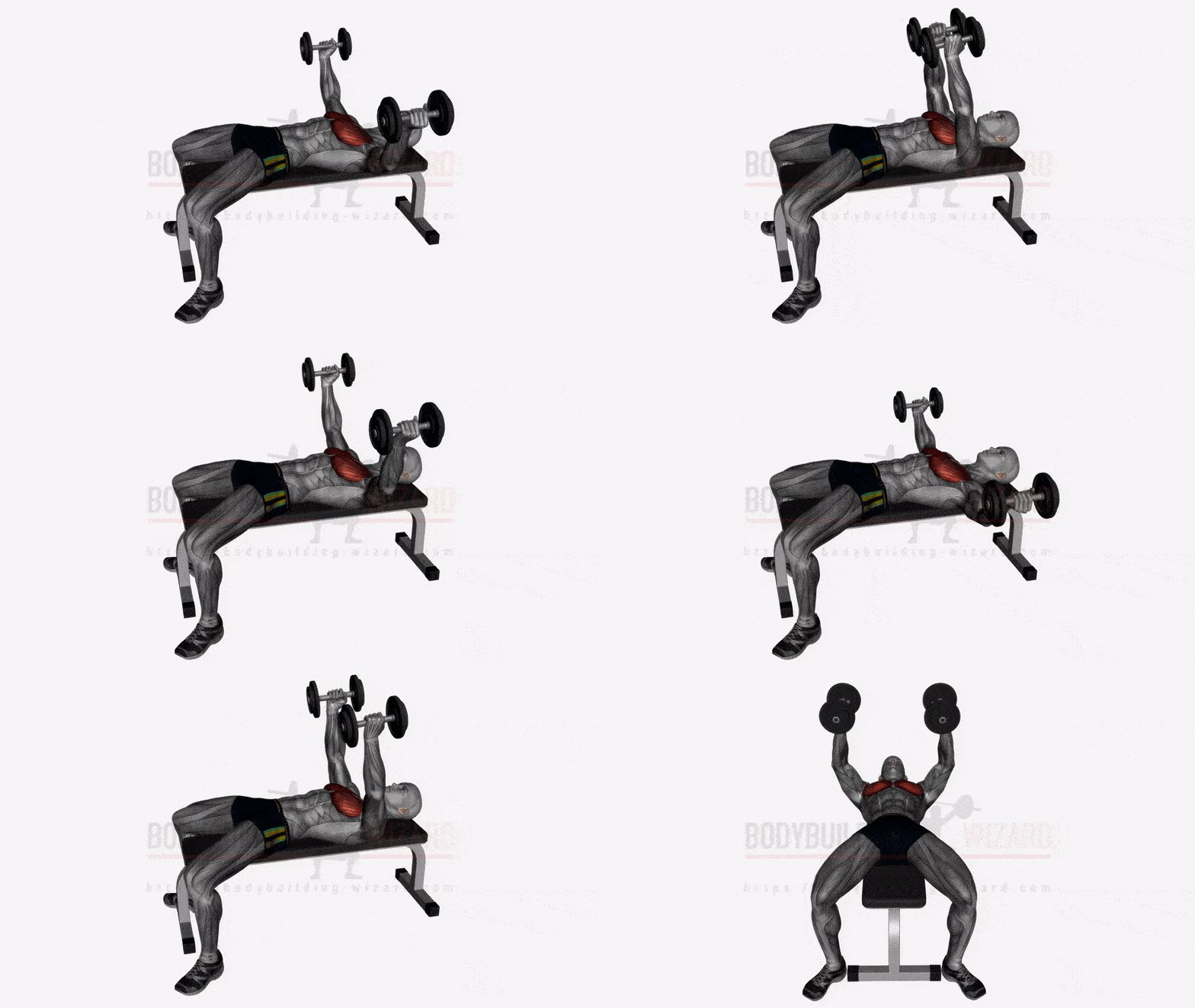
Video Demonstration — Proper Flat Bench Dumbbell Fly Technique
Watching a proper demonstration helps reinforce the correct arm path, shoulder positioning, and controlled tempo required to safely perform the flat-bench dumbbell fly while maintaining continuous chest tension throughout the range of motion.
Exercise Variations
If you want a bit more variety in your chest training, there are several fly variations you can use that keep the same basic movement but slightly change the feel, tension, and difficulty of the exercise.
1) Flat Bench Cable Flyes

How to perform:
- Place a flat bench between two cable stations set at the lowest pulley position.
- Lie on the bench so that your shoulders roughly align with the pulleys.
- Hold the cable handles with arms extended outward and elbows slightly bent.
- Bring the handles together above the chest using a controlled hugging motion.
- Pause briefly at the top, then slowly return to the stretched position.
Why it works:
Cables provide constant resistance throughout the range of motion, maintaining consistent chest tension and improving muscle activation. This is not the case with dumbbells: the tension is very high in the stretched position (when the dumbbells are even with the top of the bench), but as you bring the weights up, the resistance decreases dramatically.
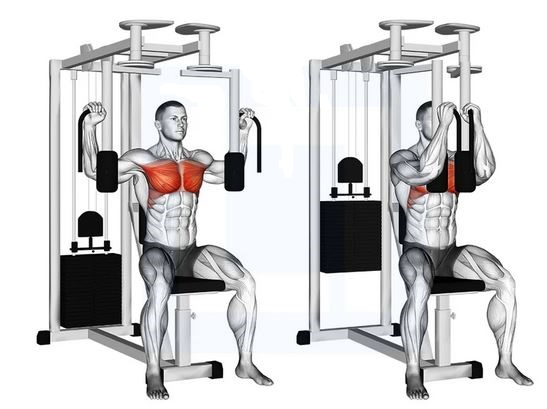
2) Pec-Deck Machine Flyes
How to perform:
- Sit on the pec-deck machine and position your back firmly against the pad.
- Place your arms behind the pads with elbows bent at approximately 90 degrees.
- Keep the forearms vertical and aligned with the pads.
- Bring the pads together in front of the chest using a controlled hugging motion.
- Slowly return to the starting position while maintaining tension in the chest.
Why it works:
Provides a guided movement path that improves stability and allows consistent chest isolation, making it especially useful for beginners or controlled hypertrophy training.
3) Stability Ball Dumbbell Flyes

How to perform:
- Lie with your upper back supported on a stability ball while keeping your hips elevated and your feet flat on the floor.
- Hold dumbbells above the chest with elbows slightly bent and palms facing each other.
- Lower the dumbbells outward in a wide arc until a controlled chest stretch is achieved.
- Bring the dumbbells back together above the chest using a hugging motion while maintaining core stability.
Why it works:
Provides core stabilization while maintaining the chest-isolation benefits of the traditional dumbbell fly.
Alternative / Replacement Exercises
Flat bench dumbbell flyes, together with the variations described in this article, represent the primary isolation exercises specifically targeting the middle chest (sternal portion of the pectoralis major). While the middle chest can also be effectively trained using various pressing movements, those exercises are classified as compound movements because they involve significant assistance from the triceps and shoulders and therefore do not provide the same level of direct chest isolation.
For a complete overview of available training options, including both isolation and compound movements that emphasize the mid-chest region, explore our middle chest exercise database.
- Standard push-ups
- Push-ups between two chairs
- Flat bench barbell press
- Flat bench dumbbell press
- Smith-machine bench press
- Seated machine chest press
- Machine bench press
- Hammer strength bench press
Key Benefits of the Flat Bench Dumbbell Flyes
When performed correctly, flat dumbbell flyes offer several advantages for hypertrophy compared to pressing exercises.
- Superior chest isolation
Minimizes triceps involvement, allowing greater pectoral focus. - Enhanced stretch-mediated hypertrophy
Deep bottom-position stretch stimulates muscle growth mechanisms. - Improved mind–muscle connection
Helps lifters develop better awareness of chest activation. - Excellent finishing movement for chest training
Adds targeted hypertrophy stimulus after heavy pressing exercises. - Improved muscular symmetry
Independent arm movement helps balance left-right development.
Who Should Use This Exercise?
- Bodybuilders seeking maximum chest isolation
- Lifters improving mind–muscle connection
- Intermediate and advanced trainees
- Individuals adding finishing volume to chest sessions
- Athletes who are improving chest mobility and flexibility
Dumbbell Flyes vs Bench Press
| Criteria | Dumbbell Flyes | Bench Press |
|---|---|---|
| Movement type | Isolation | Compound |
| Load potential | Moderate | High |
| Triceps involvement | Low | High |
| Stretch stimulus | Very high | Moderate |
| Strength development | Moderate | High |
If the bench press is your main chest-building “heavy machinery,” then dumbbell flyes are the precision finishing tool that shapes the final details. Presses build raw strength and size, while flyes step in at the end of the workout to stretch, isolate, and fully exhaust the chest fibers that heavy compound lifts sometimes leave behind. In practice, the smartest approach isn’t choosing one over the other—it’s letting them work together, with presses laying the foundation and flyes delivering the finishing touch.
In coaching practice, dumbbell flyes are one of the most effective chest-finishing exercises when the goal is maximizing muscle fiber recruitment rather than lifting heavy loads. The deep stretch component provides a powerful hypertrophy signal that pressing exercises alone often cannot fully replicate.
The key to long-term shoulder health is using moderate weights, maintaining stable shoulder positioning, and focusing on controlled tempo rather than maximum resistance.
Where This Exercise Fits in a Workout
Perform flat bench dumbbell flyes for 3–4 sets of 10–20 repetitions, typically after compound chest exercises to maximize hypertrophy and chest-isolation stimulus. Because of their strong stretch component and isolation-focused mechanics, this exercise is especially effective when placed at the very end of a chest workout, where it can serve as a finishing movement to fully fatigue the pectoral muscles after heavier pressing exercises. You should never start your chest training with this exercise.
Conclusion
Flat bench dumbbell flyes remain one of the most valuable isolation movements for developing complete chest musculature. By emphasizing stretch-mediated tension, controlled movement mechanics, and focused muscle activation, the exercise serves as an essential complement to heavy pressing movements in any well-designed chest training program. Once again, this is definitely not an exercise for heavy weights.
What muscles do flat bench dumbbell flyes primarily work?
Flat bench dumbbell flyes primarily target the pectoralis major, with secondary involvement from the anterior deltoids and stabilizing muscles of the shoulders.
Are dumbbell flyes good for building chest muscle?
Yes, dumbbell flyes are highly effective for chest hypertrophy because they place the pectoral muscles under a deep stretch and emphasize isolation.
Should dumbbell flyes be performed before or after bench press?
They are typically performed after compound pressing exercises as a finishing movement to fully fatigue the chest muscles.
How much weight should I use for dumbbell flyes?
Moderate weights are recommended, allowing controlled movement and proper form rather than heavy loading.
What is the correct elbow position during dumbbell flyes?
Elbows should remain slightly bent throughout the entire movement, maintaining the same angle during both the lowering and lifting phases.
Are flat bench dumbbell flyes safe for the shoulders?
When performed with proper control, moderate weights, and stable shoulder positioning, the exercise is generally safe for most trainees.
How many repetitions should I perform for chest hypertrophy?
Most lifters benefit from performing 3–4 sets of 10–20 repetitions to maximize chest isolation and muscle growth.
What is the difference between dumbbell flyes and bench press?
Dumbbell flyes are an isolation exercise focusing on chest activation, while the bench press is a compound movement involving the chest, triceps, and shoulders.
Can beginners perform flat bench dumbbell flyes?
Yes, beginners can perform the exercise using lighter weights while focusing on technique and controlled range of motion.
How can I increase the difficulty of dumbbell flyes?
Difficulty can be increased by slowing the tempo, increasing repetitions, or using cables to maintain constant tension throughout the movement.
