

Introduction
The full-body training system is one of the oldest and most effective strength-training systems, yet it is often misunderstood or underestimated. While many lifters quickly jump to complex split routines, full-body training remains a powerful, evidence-based approach for building strength, muscle, and consistency—especially in the early stages of a training journey.
When applied correctly, full-body training offers a balance of frequency, recovery, and total workload that few other systems can match.
📘 What Is Full-Body Training?
Full-body training refers to a training system in which all major muscle groups are trained within a single workout.
In a typical full-body session, this includes the chest, back, shoulders, quadriceps, hamstrings, glutes, arms, calves, and core, all trained within the same workout rather than being split across separate training days.
Instead of dedicating an entire session to one muscle group, full-body training distributes training volume across the entire body, allowing each muscle group to be stimulated multiple times per week while keeping fatigue controlled and recovery manageable.
Key Characteristics of Full-Body Training
- Each workout targets the entire body
- Usually 1–2 exercises per muscle group
- Total volume per muscle group is moderate
- Higher training frequency (typically 2–3× per week)
- Emphasis on compound movements
This structure allows for frequent stimulation without excessive local fatigue, making recovery more manageable.
Advantages of Full-Body Training
One of the greatest strengths of full-body training is its efficiency, adaptability, and long-term sustainability. By distributing training volume throughout the body in each session, this system creates a powerful balance between stimulus and recovery that is difficult to achieve with more fragmented training splits.
#1 Higher Training Frequency and Faster Skill Acquisition
In full-body training, each muscle group is typically stimulated two to three times per week, which provides frequent exposure to key movement patterns.
This higher frequency:
- accelerates neuromuscular adaptation;
- improves coordination and motor learning;
- reinforces proper technique through repetition;
Rather than waiting an entire week to repeat an exercise, lifters regularly practice foundational movements, which leads to faster improvements in strength and control—especially in compound lifts.
#2 Efficient Use of Training Time
Full-body training is highly time-efficient, making it ideal for individuals with limited availability for weekly training.
Instead of requiring five or six separate training days, full-body programs can deliver meaningful results with two to three well-structured sessions per week. This efficiency reduces scheduling stress and increases long-term adherence, which is often more critical than perfect programming.
Consistency, not complexity, is the actual driver of progress.
#3 Strong Systemic and Metabolic Training Effect
Because full-body workouts engage a large portion of total muscle mass in a single session, they create a strong systemic training stimulus.
Training multiple large muscle groups together:
- increases total energy expenditure;
- elevates post-workout metabolic rate;
- enhances overall conditioning;
This makes full-body training particularly effective for individuals whose goals include fat loss, body recomposition, or improving general fitness while also gaining strength.
#4 Balanced Muscle Development and Reduced Weak Links
By training the entire body in every session, full-body training promotes balanced muscular development.
No single muscle group is excessively prioritized while others are neglected, which helps:
- reduce strength imbalances;
- improve joint stability;
- lower the risk of overuse injuries;
This balanced approach is especially valuable in the early stages of training, where foundational strength and symmetry should take priority.
#5 Excellent Foundation for Long-Term Strength Development
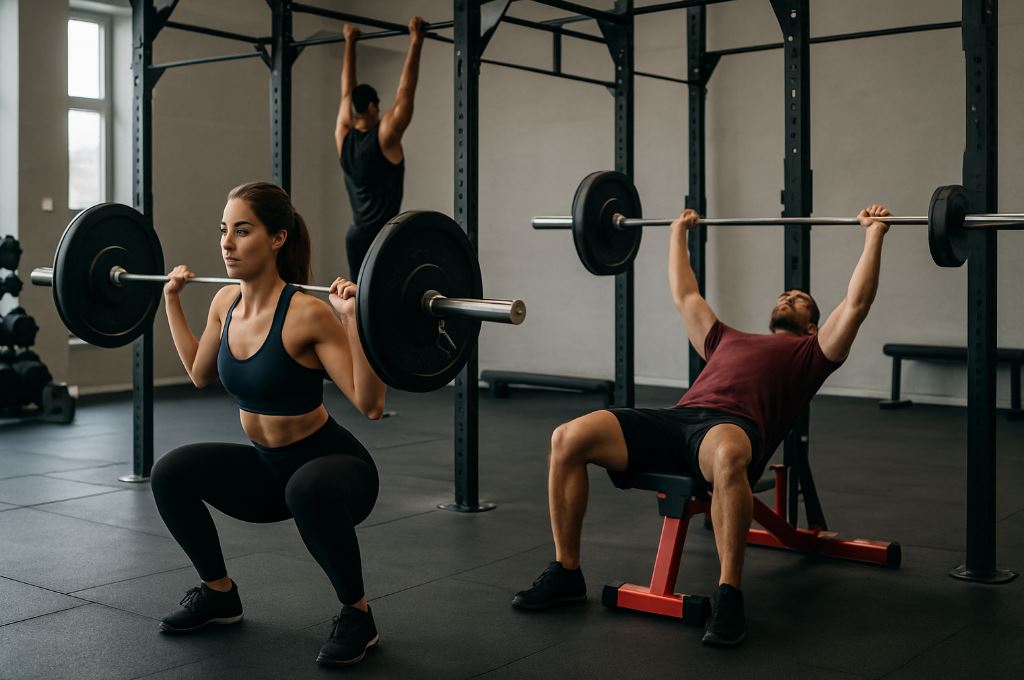
Full-body training emphasizes frequent exposure to fundamental compound lifts, such as squats, presses, rows, and hinges.
Repeated practice of these movements:
- builds technical proficiency;
- strengthens connective tissue gradually;
- establishes a solid base for future specialization;
For this reason, full-body training is often used not only by beginners but also during deload phases, return-to-training periods, and off-season blocks for more advanced lifters.
Disadvantages and Limitations of Full-Body Training
Despite its many advantages, full-body training is not universally optimal for every goal, training phase, or individual. Understanding its limitations is essential for applying this system intelligently and knowing when alternative approaches may be more appropriate.
#1 Limited Volume per Muscle Group
Because full-body workouts must distribute training stress throughout the body, the volume allocated to each muscle group is inherently limited.
While this is sufficient for beginners and intermediate lifters, it may become a constraint for advanced athletes who require higher weekly volume to continue stimulating hypertrophy in specific muscles. When a muscle needs targeted overload—such as bringing up a lagging body part—full-body training may not allow enough focused work within a single session.
This limitation becomes more pronounced as training experience and adaptive resistance increase.
#2 Longer and More Demanding Individual Workouts
As exercise selection expands to encompass all major movement patterns, full-body workouts can become more extended and more systemically demanding.
Well-designed sessions often require:
- extended warm-up periods;
- multiple compound lifts;
- careful fatigue management;
For some lifters, especially those training after long workdays or with limited recovery capacity, this can lead to reduced training quality toward the end of the workout. In such cases, splitting volume across multiple days may improve focus and performance.
#3 Less Suitable for Advanced Specialization Phases
Full-body training is generally not ideal during specialization phases, where the primary goal is to maximize the development of one or two specific muscle groups.
Advanced bodybuilders often benefit from:
- higher per-session volume;
- multiple exercise variations for the same muscle;
- greater local fatigue accumulation;
These demands are challenging to meet within a full-body structure without compromising recovery or overall training balance. For this reason, many advanced lifters reserve full-body training for off-season blocks, deload phases, or transitions between more specialized splits.
#4 Higher Recovery Demands on the Whole System
Although volume per muscle group is moderate, training the entire body in one session places greater cumulative stress on the nervous system and connective tissues.
If recovery variables such as sleep, nutrition, and stress management are not adequately addressed, this systemic fatigue can accumulate over time. Without proper load management, training frequency may need to be reduced to maintain performance and prevent burnout.
Coach’s Perspective
These limitations do not make full-body training inferior—they simply define where it fits best within long-term program design.
When used at the right time, with appropriate volume and frequency, full-body training remains a highly effective tool. The key is recognizing when to apply it—and when to transition to a different training structure as goals and experience evolve.
Who Should Use Full-Body Training?
Full-body training is particularly well-suited for:
- Beginners in strength training
Individuals who are new to resistance training benefit from frequent exposure to fundamental movement patterns, which accelerates neuromuscular learning and builds a strong technical foundation. - Lifters returning after a long break
After time away from training, full-body workouts allow for a gradual reintroduction of volume and intensity while minimizing excessive soreness and recovery issues. - Individuals who can train only 2–3 times per week
Full-body training ensures that all major muscle groups are regularly stimulated, even with a limited number of weekly sessions. - Those prioritizing general strength, muscle balance, and fat loss
By engaging a large amount of muscle mass each session, full-body training supports balanced development, higher energy expenditure, and sustainable progress.
Overall, a full-body training system provides a clear structure without unnecessary complexity, making it a practical and effective choice for a wide range of lifters.
Who Should Avoid or Modify Full-Body Training?
While a full-body training system is highly effective, it may require modification or alternative structures for specific individuals:
- Advanced lifters in specialization phases
Lifters focusing on bringing up one or two lagging muscle groups often require higher per-session volume and targeted isolation work than full-body training typically allows. - Athletes with very high sport-specific training loads
When strength training must support demanding sport practices or competitions, full-body sessions may create excessive systemic fatigue and interfere with recovery. - Individuals with limited recovery capacity
Poor sleep, high stress levels, or insufficient nutrition can make frequent full-body loading difficult to sustain without a decline in performance. - Lifters with chronic joint or injury-related limitations
Training the entire body every session may aggravate existing issues unless exercise selection, volume, and frequency are carefully adjusted.
In these cases, full-body training is not necessarily inappropriate—but it often works best when modified, periodized, or used in shorter training blocks rather than as a long-term, year-round structure.
Coach’s Note: When and How to Modify Full-Body Training
Full-body training does not have to be an all-or-nothing approach. In many cases, small adjustments in volume, exercise selection, or frequency are enough to keep it effective and sustainable.
Common modifications include reducing training frequency to two sessions per week, rotating exercises between workouts, or slightly increasing volume for priority muscle groups. When applied strategically, these adjustments allow lifters to continue benefiting from full-body training without exceeding their recovery capacity.
Why Full-Body Training Is Ideal for Beginners
For beginners, the most critical early adaptations occur in the nervous system, not in muscle size.
Early strength gains come primarily from:
- improved motor unit recruitment;
- better coordination;
- increased neural efficiency;
Full-body training allows beginners to repeat key movements frequently, accelerating learning and reinforcing proper technique. Using the same core exercises across sessions enhances motor pattern development and builds confidence under load.
This makes full-body training one of the safest and most effective ways to start a bodybuilding journey.
Training Frequency, Exercise Selection, Sets & Reps
A typical full-body training structure looks like this:
Frequency
- 2–3 sessions per week (most commonly 3)
Exercise Selection
- Prioritize compound movements
- 5–8 total exercises per session
- Balanced push, pull, and lower-body patterns
Sets & Repetitions
- 2–4 sets per exercise
- 6–12 reps for most movements
- Beginners benefit from moderate loads and clean technique
Recovery between sessions is crucial—training quality always outweighs quantity.
Example Full-Body Training Programs for Beginners
To help beginners apply a full-body training system in real-world conditions, we have created several structured programs tailored to different equipment setups and training environments. Each program follows the same foundational principles while adapting exercise selection to what is realistically available, making it easier to start training with confidence and consistency.
- Beginner Full Body Training Program for Maximum Muscle Gains (Gym-Based)
A well-rounded introduction to full-body training using both free weights and machines, designed for beginners with full gym access who want to build muscle and learn proper lifting mechanics. - Beginner Machine-Only Full Body Workout Program (Gym Edition)
A beginner-friendly program that relies exclusively on resistance machines, ideal for individuals new to the gym and seeking a controlled, joint-friendly way to learn movement patterns and build initial strength. - Dumbbell-Only Full Body Workout for Beginners (Home Edition)
An effective home-based program built around adjustable dumbbells and a bench, ideal for beginners seeking simplicity, flexibility, and progressive overload without gym equipment. - Barbell-Only Full Body Workout for Beginners (Home Edition)
A structured program for those who own a barbell, weight plates, and a bench, focusing on fundamental compound lifts and long-term strength progression at home. - Kettlebell-Only Full Body Workout for Beginners (Home Edition)
A dynamic full-body routine centered around one or two kettlebells, combining strength development, coordination, and conditioning in a minimalist setup. - 4-Week Beginner Free-Weights Workout Program (Home or Gym)
A time-based program that blends barbells and dumbbells to develop hypertrophy, movement efficiency, and foundational strength over a clear four-week progression. - 4-Week Bodyweight-Only Full Body Workout Program (Home Edition)
A fully equipment-free approach that uses bodyweight exercises to build strength, mobility, and muscular endurance, making it ideal for beginners training at home or while traveling.
Together, these programs allow beginners to start their full-body training journey with a plan that matches their equipment, environment, and comfort level—without compromising training quality or long-term progress.
Coach’s Experience with Full-Body Training
In my work with beginners, full-body training has consistently proven to be one of the most effective and reliable ways to introduce people to strength training. It provides structure without overwhelming them and allows steady progress from the very first weeks.
Most beginners respond very positively to this system because they feel engaged in every workout. Training the entire body creates a strong sense of accomplishment, while frequent repetition of key exercises builds confidence and technical awareness.
Over time, I have found that beginners who start with full-body training develop better movement quality, more balanced strength, and fewer early setbacks compared to those who jump into complex split routines too soon. For many, it lays the foundation for long-term consistency and enjoyment of training.
Conclusion
Full-body training system remains one of the most effective and practical training systems available. By balancing frequency, recovery, and workload, it provides an ideal framework for beginners and a valuable tool for experienced lifters during specific phases.
When applied with intention, full-body training builds strength, muscle, and long-term training habits—making it a powerful foundation for any bodybuilding journey.
Key Takeaways
- Full-body training targets all major muscle groups within a single workout.
- Higher training frequency supports faster skill acquisition and technical consistency.
- This training system is especially effective for beginners and time-limited lifters.
- Balanced volume distribution helps reduce muscular imbalances and overuse issues.
- Proper exercise selection and recovery management are essential for long-term progress.
- Full-body training can be modified or cycled as training experience and goals evolve.
How long should beginners follow a full-body training program?
Most beginners can follow full-body training effectively for 3 to 6 months. This timeframe allows enough repetition to build technique, strength, and confidence before transitioning to more specialized splits if desired.
Can full-body training be combined with cardio?
Yes. Light to moderate cardio can be added on non-training days or after strength sessions, as long as it does not interfere with recovery or strength performance.
Is muscle soreness a problem with full-body training?
Mild soreness is normal, especially in the early weeks. However, well-designed full-body programs manage volume carefully, which usually results in less extreme soreness than high-volume split routines.
Does full-body training work for skinny beginners?
Yes. Full-body training is particularly effective for skinny beginners because frequent compound lifting improves neuromuscular efficiency and supports steady strength and muscle gains when combined with adequate nutrition.
Should beginners increase weight or repetitions first?
Beginners should usually prioritize increasing repetitions within a target range before adding weight. This helps reinforce proper technique while progressing safely.
Can full-body training improve posture and movement quality?
Yes. Training the entire body regularly helps strengthen underused muscles, improve coordination, and promote balanced development, which can positively influence posture and movement patterns.
Is full-body training suitable for women?
Absolutely. Full-body training is an excellent option for women because it supports strength development, muscle tone, and overall fitness without requiring excessive gym time or overly complex routines.
What happens if a beginner misses a workout?
Missing an occasional session is not a major issue. Full-body training is forgiving because each workout trains the entire body, reducing the negative impact of missed days compared to split routines.
Can full-body training be done with minimal equipment?
Yes. Full-body training can be adapted to almost any environment, including home setups using dumbbells, kettlebells, resistance bands, or bodyweight exercises.
When should a beginner move on from full-body training?
A beginner may consider transitioning when progress slows significantly, recovery becomes limiting, or when specific muscle groups require more targeted volume. This transition should be gradual rather than abrupt.
