



Introduction
The hanging windshield wiper is one of the most demanding core exercises. It is not an exercise for trainees working toward a stronger core — it is for trainees who already have one and want to challenge it in ways conventional gym movements cannot. The hanging leg raise is its prerequisite. The hanging leg raise to the bar — toes touching the bar in a full V-position — is its starting position. Everything that follows requires not only exceptional core strength but also grip endurance, shoulder stability, and hamstring flexibility to sustain a full hanging V-position while rotating the legs from side to side against gravity.
I say this not to discourage but to be accurate. Most trainees who attempt the hanging windshield wiper before they are ready do one of two things: they use a severely shortened range of motion that provides minimal stimulus, or they swing and rotate through momentum that the obliques barely contribute to. Neither version delivers the extraordinary core development this exercise is capable of when performed correctly.
The exercise is sometimes described as a pseudo hanging leg raise with a rotational component, which is accurate but understates it. The hanging leg raise ends when the feet reach the bar. The hanging windshield wiper begins there.
Exercise ID Card
Muscles Worked in the Hanging Windshield Wiper
Primary muscles
- External and internal obliques — the primary movers of the lateral leg rotation; they contract concentrically to lower the legs to each side under control and eccentrically to resist the rotation at the bottom and reverse it back to the V-position
- Rectus abdominis (lower portion) — works intensely throughout the sustained hip flexion required to hold the legs at bar height; the lower abs are under significant load for the entire duration of each set
- Hip flexors (iliopsoas, rectus femoris) — sustain the full V-position against gravity throughout the set; the hip flexor demand in this exercise is exceptional and is one of the primary limiting factors for most trainees
Secondary muscles
- Rectus abdominis (upper portion) — works in strong isometric contraction throughout the movement to maintain the stable upper body position while the legs rotate below
- Serratus anterior — the finger-like muscles of the rib cage that are particularly strongly activated during this exercise; you will feel the serratus more distinctly during hanging windshield wipers than in almost any other exercise
- Latissimus dorsi and shoulder girdle — work continuously to maintain the hanging position throughout the set
- Forearm flexors — grip endurance is a genuine limiting factor; the set often ends when grip fails before the core muscles are exhausted
Antagonists
Spinal erectors and surrounding lumbar musculature lengthen under control as the legs rotate laterally and contract to assist with the return to the V-position.
The serratus anterior activation in this exercise deserves specific mention. The hanging windshield wiper trains the serratus — the finger-like muscles visible along the outer rib cage in lean, well-developed athletes — more intensely than almost any other common exercise. If serratus development is a training goal, this exercise is one of the most direct paths to it, provided the core strength prerequisite is met.
How to Do a Hanging Windshield Wiper: Step-by-Step Form Guide
Starting position
- Grasp a pull-up bar with an overhand grip, hands slightly wider than shoulder-width
- Take a deep breath and contract the entire core — abs, obliques, and hip flexors simultaneously
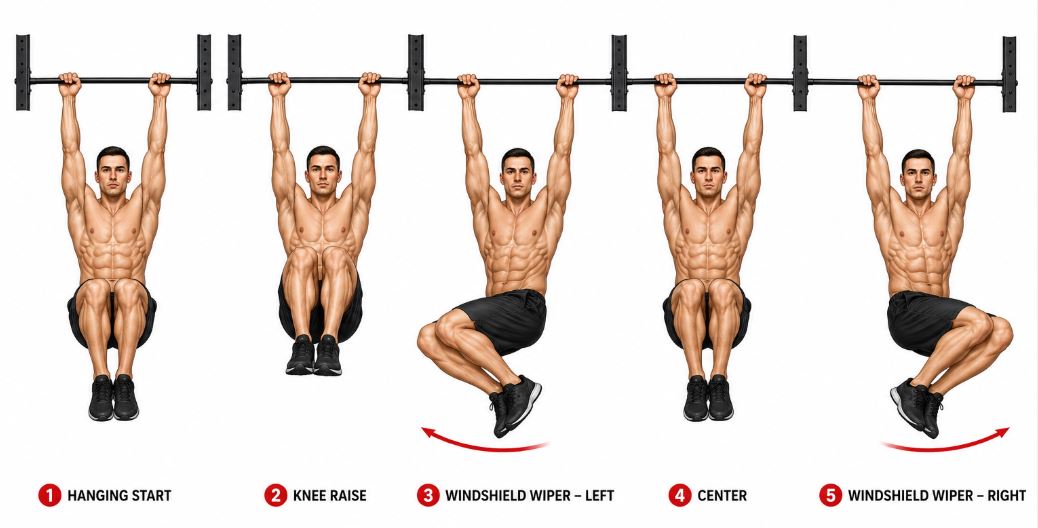
- Perform a full hanging leg raise: raise the legs with a slight bend at the knees until the feet or toes touch the bar — the body forms a V-shape with the hips fully flexed
- This V-position is the starting position for every rep; it is not a brief transition — it is the established position from which the exercise begins and to which the legs return after each rotation

Execution
- From the V-position, slowly rotate the legs to one side — lowering them approximately 90 degrees while keeping the torso facing upward and the upper body in the same relative position
- The hips remain flexed in the V-position throughout — the legs rotate laterally; they do not drop downward
- Control the descent to the side over two to three seconds — the obliques are working eccentrically throughout the lowering phase
- Raise the legs back to the V-position at the top
- Without pausing more than briefly, rotate to the other side in the same controlled manner
- Return to the V-position to complete one full rep
- Keep the arms nearly straight throughout — do not allow the elbows to bend significantly during the movement

The key coaching cue: The upper body stays facing upward throughout the entire movement — it does not rotate with the legs. The legs rotate laterally while the torso remains fixed and facing the ceiling. If the torso is rotating, the movement pattern has broken down. Think of the hips as the pivot point between a fixed upper body and rotating legs.
5 Common Hanging Windshield Wiper Mistakes (And How to Fix Them)
1. Attempting the exercise without mastering the hanging leg raise first
This is not a technical mistake within the exercise — it is a prerequisite mistake before the exercise begins. The V-position starting point requires the ability to perform a full hanging toes-to-bar raise reliably and repeatedly. If a trainee cannot achieve and hold the V-position, everything that follows is a compensated version of the exercise with severely reduced stimulus. Master the hanging leg raise, then the hanging toes-to-bar, before attempting the windshield wiper.
2. Using momentum to swing the legs
Allowing the legs to swing or drop quickly, rather than rotating under controlled oblique contraction, removes the oblique stimulus and increases the risk of losing rotational control. Every degree of lateral rotation should be driven and controlled by the obliques. If the legs are swinging faster than the obliques can manage, the range of motion needs to be reduced until the oblique strength catches up.
3. Letting the torso rotate with the legs
When the torso rotates toward the side, the legs are moving, the exercise loses its defining challenge — the isometric upper-body position that makes the oblique and core demands so exceptional. The upper body must stay completely fixed and facing upward while only the legs rotate. A spotter watching from the side is invaluable for identifying this compensation pattern, which is often invisible to the trainee performing the movement.
4. Working through too large a range of motion too soon
The full 90-degree rotation to each side is the target range for experienced practitioners of this exercise — it is not the starting range. Begin with a small arc of 20 to 30 degrees and gradually increase the range as oblique strength, hip flexibility, and grip endurance develop. A small, controlled range with correct technique is significantly more productive than a large, uncontrolled range with momentum and torso rotation.
5. Grip failure ending the set prematurely
Grip fatigue is frequently the limiting factor in the hanging windshield wiper before the core muscles are adequately stimulated. Use chalk for later sets to extend grip endurance, or use wrist straps if grip failure is consistently preventing adequate core stimulus. The core muscles should be the limiting factor in this exercise, not the hands.
Benefits of the Hanging Windshield Wiper
Complete anterior and lateral core activation
No other common exercise simultaneously trains the upper abs isometrically, the lower abs through sustained hip flexion, and the obliques through dynamic rotational control in a single hanging movement. The hanging windshield wiper produces comprehensive core activation across all three regions of the abdominal wall in a single exercise, which is genuinely exceptional for an oblique-focused movement.
Exceptional serratus anterior development
The serratus anterior — the finger-like muscles along the outer rib cage — is notoriously difficult to train directly. The hanging windshield wiper activates the serratus more intensely than almost any other exercise, making it one of the most direct paths to visible serratus development for trainees who have the core strength to perform it correctly.
Rotational power development
The controlled rotation of substantial leg weight against gravity develops oblique rotational power that carries over directly to athletic movements requiring explosive trunk rotation — throwing, striking, swinging, and changes of direction. For advanced athletes in those sports, this exercise provides a rotational stimulus that few gym exercises can match.
Grip and shoulder endurance alongside core training
Like all hanging exercises, the windshield wiper trains grip strength and shoulder girdle stability as concurrent demands. The combination of core, grip, and shoulder stimulus in one exercise makes it exceptionally time-efficient for advanced athletes with limited training time.
Who Should Use This Exercise
- Advanced trainees who can reliably perform multiple sets of hanging toes-to-bar raises and are specifically seeking oblique rotational development beyond what conventional exercises provide
- Athletes in rotational sports — gymnasts, martial artists, climbers, baseball players, and combat sport athletes — who need exceptional rotational core strength and serratus development
- Trainees seeking maximum oblique and serratus development who have exhausted the stimulus available from conventional oblique exercises and need a genuinely advanced challenge
Who Should Be Cautious
- Anyone who cannot perform a full hanging leg raise to bar height — this is a non-negotiable prerequisite; attempting the windshield wiper without it produces a compensated exercise that provides neither the intended stimulus nor adequate safety
- People with shoulder impingement or rotator cuff issues — the sustained hanging position, combined with the rotational forces, places exceptional demand on the shoulder joint; existing pathology will be aggravated
- People with grip injuries or forearm tendinopathy — grip failure during this exercise is a fall risk; ensure grip health before attempting
- Anyone with lumbar disc issues — the combination of sustained hip flexion at the bar and lateral rotation creates significant lumbar demand; physiotherapy clearance is essential
How to Make It Easier or Harder
Easier
- Reduced range of motion — rotating the legs only 20 to 30 degrees to each side, rather than the full 90 degrees, significantly reduces the oblique demand; the appropriate starting range for trainees new to this exercise
- Bent knees throughout — maintaining a more significant knee bend shortens the lever arm of the legs and reduces the oblique and hip flexor demand; useful while building toward the straighter-leg version
- Lying windshield wiper — performing the same lateral leg rotation lying on the floor removes the hanging demands entirely while preserving the oblique rotation pattern; the primary regression for trainees not yet ready for the hanging version
Harder
- Increased range of motion — progressing toward the full 90-degree rotation to each side
- Straighter legs — reducing the knee bend lengthens the leg lever and increases the oblique, hip flexor, and grip demand substantially
- Slower tempo — a four to five second lowering phase with a deliberate pause at the bottom of each rotation, dramatically increases the eccentric oblique demand
Hanging Windshield Wiper vs. Hanging Leg Raise
Both exercises are performed while hanging from a pull-up bar, with significant demands on the core and hip flexors, but the stimulus and difficulty differ substantially.
| Hanging Windshield Wiper | Hanging Leg Raise | |
|---|---|---|
| Starting position | Legs at bar height — V-position | Legs hanging vertically |
| Movement pattern | Lateral rotation of legs | Straight upward leg raise |
| Primary target | Obliques + full core isometric | Lower abs + hip flexors |
| Serratus activation | Exceptional | Moderate |
| Difficulty | Advanced | Intermediate – Advanced |
| Grip demand | Very high — sustained V-position | High |
| Prerequisite | Full hanging leg raise to bar | Basic hanging strength |
| Best for | Oblique rotational strength, serratus | Lower ab development |
The practical takeaway: The hanging leg raise ends where the hanging windshield wiper begins. The leg raise targets the lower abs and hip flexors through the upward lifting movement; the windshield wiper uses the fully raised position as its starting point and adds lateral rotation to engage the obliques. They are not interchangeable — they are sequential. Master the hanging leg raise before attempting the windshield wiper, and program both in an advanced core program for complete hanging core development.
Exercise Variations
Lying Windshield Wiper
Lie on your back on a mat with arms extended in a T-position, palms pressing into the floor. Raise both legs to vertical — perpendicular to the floor — with a slight bend at the knees. From that position, slowly lower both legs together to one side, rotating at the hips until the legs are as close to the floor as possible without lifting the opposite shoulder. Return to vertical and rotate to the other side. The lying version removes the grip and hanging demands entirely while preserving the oblique rotation pattern — making it the primary regression for trainees building toward the hanging version and a useful standalone exercise for those who cannot yet do the hanging variation.

Hip Crossover (Bent Knee Floor Version)
Lie on your back with hips and knees bent to 90 degrees, arms in a T-position. Lower both legs together to one side until the outside of the knee approaches the floor, keeping both shoulders in contact with the mat. Return through center and repeat to the other side. The bent-knee position shortens the lever arm compared to the straight-leg lying windshield wiper position, making this a more manageable regression while still training the obliques through the same lateral rotation pattern. A good starting point before progressing to straight legs.

Medicine Ball Hip Crossover
The bent-knee floor variation is performed with a small medicine ball or light dumbbell held between the knees. The added weight increases the rotational demand on the obliques without changing the movement pattern. Even a small medicine ball — 2 to 3 kilograms — noticeably changes the exercise, given the legs’ lever arm. A useful intermediate step between the bodyweight floor version and the hanging variation.

Hanging Knee Raise to Windshield Wiper
From a hanging position, raise both knees to chest height — a standard hanging knee raise — and then rotate the knees from side to side rather than lowering them back down. The bent-knee position significantly shortens the lever arm compared to the full V-position windshield wiper, making this a more accessible hanging variation that still trains the obliques through lateral rotation. A useful transition exercise between the hanging knee raise and the full hanging windshield wiper.
Hanging Toes to Bar
The direct prerequisite for the hanging windshield wiper — not a variation of it, but the exercise that must be mastered before the windshield wiper is attempted. From a dead hang, raise straight legs until the toes touch the bar, forming a full V-position. Lower under control and repeat. This movement is itself advanced and requires exceptional hip flexor strength, hamstring flexibility, and core control. If the toes-to-bar cannot be performed reliably for multiple reps, the windshield wiper is not yet an appropriate exercise.

Replacement Exercises (Alternatives)
If the hanging windshield wiper is too advanced or a pull-up bar is unavailable, these exercises develop the same primary muscle groups:
- Hip Crossover
- Russian Twist – Oblique Trunk Rotation
- Twisting Cable Crunch
- Standing Cable Oblique Crunch
- Decline Twisting Sit-Up
- Bicycle Crunch
- Dumbbell Side Bend
- Lateral Crunch
- Broomstick Twist
- Landmine 180s
- Rotary Torso Machine
- Seated Rotary Torso Machine
- Roman Chair Side Bend
- Cross-Over Crunch
- Heel Touches
- Hanging Oblique Knee Raise (Hanging Oblique Crunch)
- Side Jackknife: Double Leg Double Side Jackknife
How To Incorporate the Hanging Windshield Wiper Into Your Workouts
- As the primary core exercise — given its exceptional difficulty, the hanging windshield wiper should be performed first in a core session when the core, grip, and shoulders are completely fresh; fatigued grip or shoulders make this exercise both less effective and less safe
- Low volume, high quality — 3 sets of 5 to 8 reps per side with full range of motion and controlled tempo is more productive than high-volume sets with shortened range and momentum; quality is everything in this exercise
- Not paired with heavy pulling movements — the grip and shoulder demands of the hanging windshield wiper conflict directly with the demands of heavy deadlifts, pull-ups, and rows; program on separate days or ensure the hanging work comes first
- Rep range: 5–8 reps per side — the difficulty of each rep with correct form makes higher rep ranges impractical without technique breakdown; prioritize range of motion quality over rep accumulation
- Sets: 2–3 working sets — more than that at the intensity this exercise requires will compromise grip and shoulder recovery
- Frequency: Once or twice per week maximum — the grip, shoulder, and core demand of this exercise requires significant recovery time between sessions
- Progression trigger: When 3 sets of 8 full-range reps per side with controlled descent, fixed upper body, and no momentum become consistently achievable — increase the range of motion or reduce the knee bend to increase the lever arm
Conclusion
The hanging windshield wiper is the kind of exercise that defines what advanced core training actually means. It is not advanced because it looks impressive — though it does — it is advanced because it genuinely requires the full integration of grip strength, shoulder stability, hip flexibility, hip flexor endurance, lower ab strength, and oblique rotational control before a single proper rep is possible.
That list of prerequisites is also the greatest value of this exercise. Building toward the hanging windshield wiper develops every component of core and upper-body fitness the exercise demands. The journey to the full version — through hip crossovers, lying windshield wipers, hanging knee raises, hanging leg raises, and finally toes-to-bar — is itself a comprehensive core development program.
If you can perform this exercise correctly through a full 90-degree rotation to each side with a fixed upper body, controlled descent, and no momentum, you have a level of core development that most gym-goers never approach. Earning that takes time. It is worth taking.
Want to round out your oblique program with exercises at every level? See our guides to upper ab, lower ab, and oblique exercises for a complete program.
For the complete picture of core training at every level, see our guide to the best core exercises.
Reviewed by a Women’s Strength Specialist: The training recommendations and educational content presented in this article were reviewed by Kelley V., MPH, MS, CSCS, ACE Health Coach , whose expertise includes women’s strength training, hormonal health, and long-term athletic development.
