



Introduction
The hex bar shrug (also known as the trap bar shrug) is one of the most joint-friendly and mechanically efficient ways to train the upper trapezius. Thanks to its neutral grip and centered load position, it combines the advantages of dumbbell shrugs and barbell shrugs into a single powerful movement.
Because the trap bar positions the load around your body rather than in front of it, it reduces lower-back strain and allows heavy loading without excessive forward pull. This makes the hex bar shrug especially effective for lifters who want maximal trap development with improved spinal comfort.
When executed with strict vertical elevation, it becomes one of the best heavy overload exercises for building thick, dense upper traps.
Other Names for Hex Bar Shrugs
Although “hex bar shrug” is common, you may also see:
- Trap bar shrug
- Hex shrug
- Trap bar shoulder shrug
- Neutral-grip shrug
The term “trap bar shrug” is equally correct and widely used.
Required Equipment
To perform the hex bar shrug correctly, you need:
- A hex (trap) bar
- Weight plates
- Flat, stable floor
- Optional: lifting straps
The neutral handles allow a natural arm position and reduce wrist stress compared to a straight bar.
How to Perform Hex Bar Shrugs
To maximize trap development and minimize joint stress, correct execution mechanics are critical. The hex bar setup slightly differs from barbell shrugs due to the centered load position.
Starting Position
Proper setup ensures maximal trap activation and spinal safety.
- Load the trap bar evenly
- Step inside the bar
- Grip handles with a neutral grip
- Stand upright with knees slightly bent
- Brace core and maintain neutral spine
- Arms fully extended
The bar should rest around mid-thigh level.

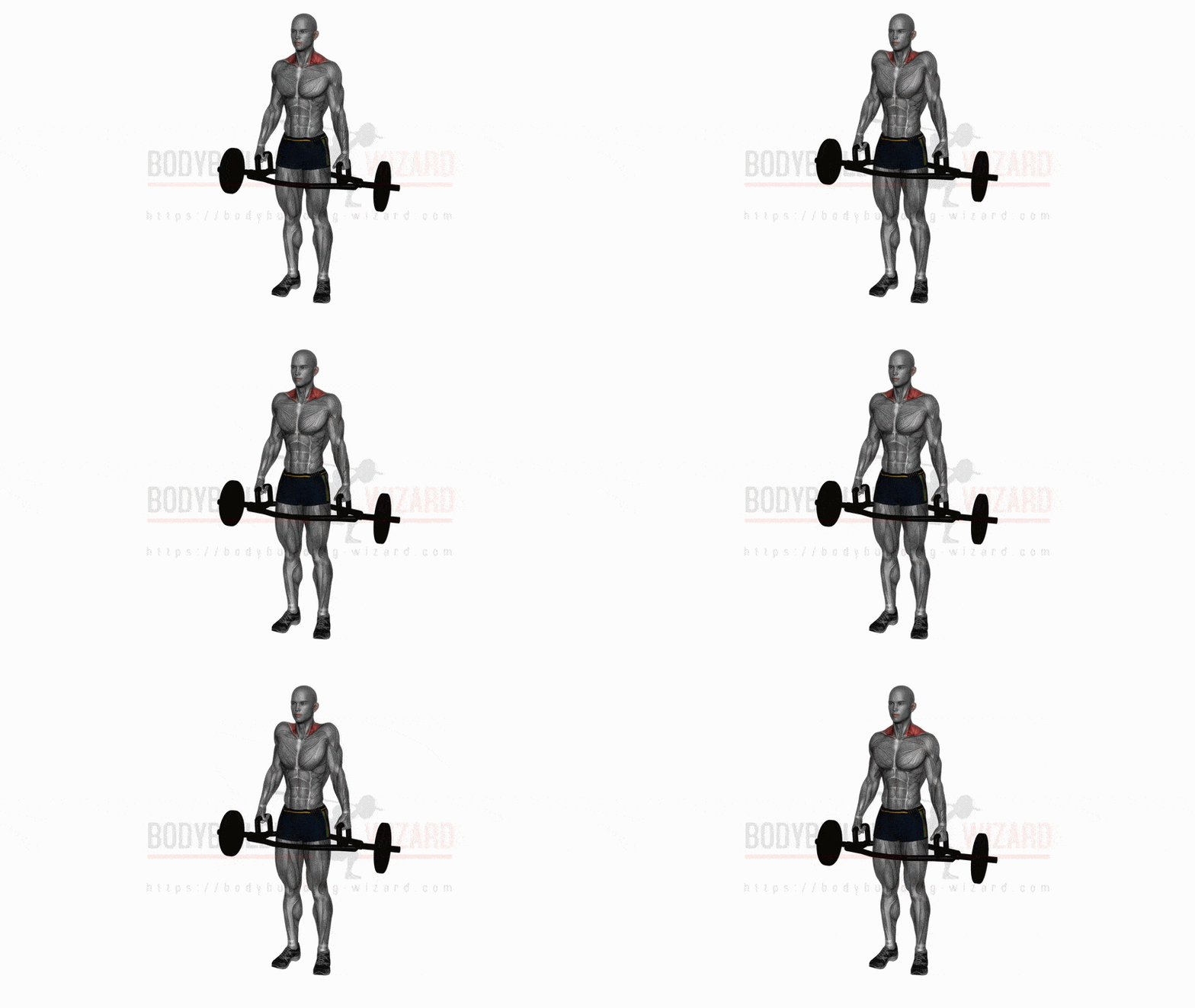
Execution (Action Phase)
The movement is strictly vertical.
- Elevate shoulders toward ears
- Lift as high as possible
- Pause 1–2 seconds at the top
- Lower slowly under control
- Allow full stretch at the bottom
Important: Do not roll your shoulders. The movement is pure elevation.
Technique Optimization Tips
Small technical refinements can significantly improve trap activation and reduce compensatory movement. Because the load is centered, attention to posture becomes even more important.
- Keep neck neutral
- Avoid tilting your head in any direction, bending your elbows, or jutting your chin forward
- Do not lean excessively backward
- Use full ROM – raise your shoulders as high as possible, as if you were trying to touch your trapezius muscles to your ears
- As you lower the trap bar, allow your shoulders to drop down (to sink) as far as possible – this stretches the trapezius and increases the ROM (range of motion)
- Control eccentric (2–4 seconds)
- Use straps if grip limits performance
Because the load is centered, focus on the quality of the contraction.
Quick Form Checklist
Before each working set, reviewing key technical cues ensures consistency and safety. A simple checklist prevents common mechanical breakdowns under heavier loads.
- Neutral spine
- Arms straight
- Vertical shoulder path
- Pause at top
- Controlled descent
- No torso swing
- No shoulder rolling
Technical Emphasis & Targeting Adjustments
Subtle changes in tempo and body positioning can slightly alter the emphasis on the trapezius. However, these adjustments should remain controlled and deliberate.
- Slight backward lean → stronger upper trap emphasis
- Slower eccentric → increased hypertrophy stimulus
- Paused reps → stronger peak contraction
- Heavier low-rep sets → maximal overload stimulus
- Deficit stance → increased stretch
Mechanical Considerations
The hex bar positions the load around your body, reducing anterior pull and lower-back stress compared to barbell shrugs.
The neutral grip decreases wrist strain and often feels more natural than a pronated grip. Because the arms are slightly wider apart than with dumbbells, this variation can enhance upper trap contraction.
It combines the potential to handle heavy loads with improved joint comfort.
Muscles Involved
Knowing which muscles are actively working improves mind-muscle connection and programming precision. While the upper trapezius is dominant, several stabilizers contribute.
MAIN MUSCLES:
Upper trapezius, levator scapulae
SECONDARY MUSCLES:
Middle trapezius, rhomboids, supraspinatus, forearm flexors
ANTAGONISTS:
Lower trapezius, latissimus dorsi, pectoralis major
Common Mistakes
Even though the movement looks simple, technical errors can reduce effectiveness and increase joint stress. Most mistakes occur when lifters prioritize weight over controlled elevation.
- Shoulder rolling
- Using body momentum
- Partial ROM
- Bending elbows
- Overloading too quickly
Exercise Pros and Cons
Advantages
- Neutral grip comfort. The hand position reduces wrist and shoulder stress compared to straight-bar shrugs.
- Centered load distribution. The bar surrounds the body, decreasing forward pull and lower-back strain.
- High loading potential. Allows a heavier weight than most dumbbell variations.
- Improved joint mechanics. Often feels more natural than barbell shrugs.
Potential Drawbacks
- Equipment availability. Not all gyms have a trap bar.
- Less unilateral correction. Both sides work together.
- Limited grip variation. Grip width is fixed by the handle design.
- Encourages heavy ego lifting. Stability may tempt excessive loading.
Hex Bar Shrug Variations
Although the trap bar design limits some adjustments, several effective variations still exist. These modifications mainly affect the range of motion and the emphasis on peak contraction.
- High-Handle Trap Bar Shrug – Using the elevated (high) handles shortens the effective range of motion slightly and allows you to handle heavier loads more safely. This variation is ideal for strength-focused phases where maximal overload is the primary goal. Because the starting position is higher, lifters can focus more on peak contraction and heavy tension at the top.
- Low-Handle Trap Bar Shrug – Using the lower handles increases the total vertical travel of the shoulders relative to the load. While the bar itself does not change trap stretch dramatically, the lower starting handle height increases overall movement amplitude and demands stricter posture control. This version feels more challenging for maintaining neutral spine alignment.
- Paused Trap Bar Shrug – Holding the top position for 2–3 seconds increases time under tension and improves peak contraction control. This reduces momentum and significantly enhances mind-muscle connection. It is particularly effective during hypertrophy-focused phases.
Replacement Exercises (Substitutes)
If a trap bar is unavailable, several exercises can effectively replicate the shrugging motion. Choosing the right substitute depends on whether you prioritize load, comfort, or isolation.
- Barbell shrug
- Dumbbell shrug
- Smith machine shrug
- Cable shrug
- Behind-the-back barbell shrug (rear shrug)
- Machine shrug
- Prone incline dumbbell shrug
- Farmer’s carry
Where This Exercise Fits in a Workout
Perform 3–4 sets of 6–12 reps.
Best used:
- After deadlifts
- During strength phases
- For heavy overload trap work
- When seeking neutral grip comfort
Hex Bar Shrug vs. Barbell Shrug (Comparison Table)
| Criteria | Hex Bar Shrug | Barbell Shrug |
|---|---|---|
| Grip Type | Neutral | Pronated |
| Lower-Back Stress | Lower | Moderate |
| Max Load | Very high | Very high |
| Shoulder Comfort | High | Moderate |
| Natural Alignment | Excellent | Moderate |
| Best For | Heavy yet joint-friendly training | Maximal overload |
Conclusion: The hex bar shrug combines heavy loading with improved joint comfort and reduced lower-back strain. It is often the most balanced option between barbell and dumbbell variations.
Closing Thoughts About Hex Bar Shrugs
From a coaching perspective, hex bar shrugs are one of the most efficient ways to overload the upper trapezius while maintaining joint-friendly mechanics. If your goal is serious trap development, you must train them heavily — and the trap bar allows you to do exactly that. The upper trapezius responds exceptionally well to progressive overload, and this variation makes heavy loading feel more stable and controlled than most alternatives.
Mechanically, the hex bar shrug resembles the dumbbell version, but it offers a clear advantage: you can typically handle more total load than you could manage holding separate dumbbells. In addition, the trap bar design minimizes thigh interference and keeps the load centered around your body, often resulting in a smoother contraction and a stronger peak. For lifters chasing upper-back thickness, this is a major benefit.
One final note for female trainees. Overly developed upper trapezius muscles are not always aligned with women’s aesthetic goals. In most cases, indirect trap stimulation through movements like lateral raises, upright rows, and compound pulling exercises provides more than enough toning. Direct heavy shrug work should be programmed intentionally, based on individual physique goals rather than habit.
Heavyweight — neutral grip — massive traps.
What muscles does the hex bar shrug work?
The hex bar shrug primarily targets the upper trapezius through vertical scapular elevation. Secondary muscles include the levator scapulae, middle trapezius, rhomboids, and forearm flexors for grip stabilization. The movement is designed to build upper trap thickness and neck-to-shoulder density.
Is the hex bar shrug better than the barbell shrug?
The hex bar shrug is often more joint-friendly than the barbell shrug because it uses a neutral grip and centered load distribution. This reduces lower-back stress and wrist strain while still allowing heavy loading. Barbell shrugs may allow similar overload, but the trap bar typically feels more natural biomechanically.
Why is the neutral grip important in hex bar shrugs?
A neutral grip reduces internal shoulder rotation and wrist strain compared to a pronated grip. This allows more comfortable heavy loading while maintaining proper scapular elevation mechanics. For many lifters, this translates into better peak contraction and improved trap activation.
Should you roll your shoulders during hex bar shrugs?
No, shoulder rolling does not increase trapezius activation and may increase joint stress. The trapezius is responsible for scapular elevation, not loaded circular motion. The most effective shrug technique is strict vertical movement — shoulders straight up and straight down.
How heavy should hex bar shrugs be?
Hex bar shrugs should be loaded heavy enough to challenge the upper trapezius while maintaining strict form. Most lifters benefit from 6–12 rep ranges using controlled tempo and a 1–2 second pause at the top. Excessive weight that eliminates peak contraction reduces effectiveness.
Are hex bar shrugs safe for the lower back?
Hex bar shrugs are generally safer for the lower back than barbell shrugs because the load is centered around the body. This reduces anterior pull and spinal shear forces. Maintaining a neutral spine and controlled movement further minimizes risk.
Can beginners perform hex bar shrugs?
Yes, hex bar shrugs are beginner-friendly due to their stable setup and natural grip alignment. The trap bar design simplifies balance demands compared to barbell variations. Beginners should start with moderate loads and focus on controlled scapular elevation.
What rep range is best for hex bar shrugs?
The optimal rep range for hex bar shrugs is typically 6–12 repetitions per set. Lower reps emphasize strength and overload, while moderate reps increase time under tension for hypertrophy. Both approaches effectively stimulate upper trapezius growth.
Do hex bar shrugs build bigger traps?
Yes, hex bar shrugs are highly effective for building larger upper trapezius muscles when performed with progressive overload. The combination of heavy loading, neutral grip mechanics, and stable positioning allows maximal trap stimulation. Consistent programming produces visible upper-back thickness.
When should you program hex bar shrugs in a workout?
Hex bar shrugs are best programmed after compound pulling or shoulder exercises. Because the traps recover relatively quickly, they can also be trained multiple times per week. Many coaches place shrugs at the end of upper-body sessions for focused hypertrophy work.
