



The kneeling cable crunch is one of the few upper ab exercises that lets you progressively overload the rectus abdominis with precision — something floor crunches simply can’t offer. Because resistance comes from a cable, the tension stays constant throughout the entire range of motion, including the top position where bodyweight exercises go slack. That mechanical advantage makes it a staple in the programs I build for intermediate and advanced clients who’ve already outgrown bodyweight ab work.
Muscles Worked
Primary muscle:
- Rectus abdominis — specifically the upper portion. Spinal flexion under load drives the sternum toward the pelvis, which is exactly what the rectus abdominis is built to do.
Secondary muscles:
- External and internal obliques — stabilize the torso during the movement and become primary movers if you add rotation
- Transverse abdominis — braces the spine and maintains intra-abdominal pressure throughout the rep
Antagonists (lengthening under load):
- Spinal erectors and the surrounding lumbar musculature control the return phase and resist spinal flexion
One thing worth noting: the cable pull angle keeps the rectus abdominis under tension even at the start of the rep (the extended position), which is where most crunching movements — including the basic floor crunch — lose their resistance.
How To Perform the Kneeling Cable Crunch
Setup:
- Attach a rope handle to a high pulley cable machine
- Set the weight to a level that lets you complete 10–15 controlled reps without compensating with your arms or hip flexors
- Kneel on the floor facing the machine, approximately 60–90 cm from the weight stack — enough distance to get a full stretch at the top without the weight bottoming out
Starting position:
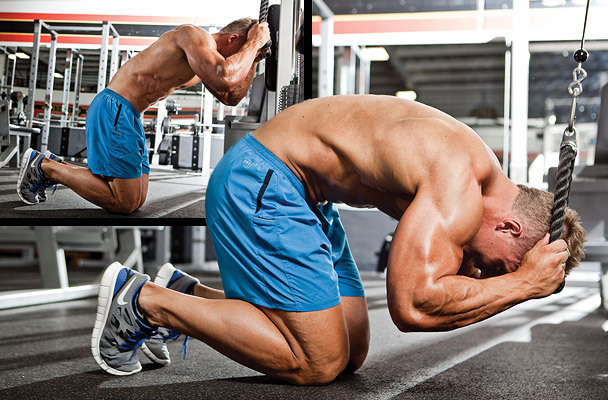
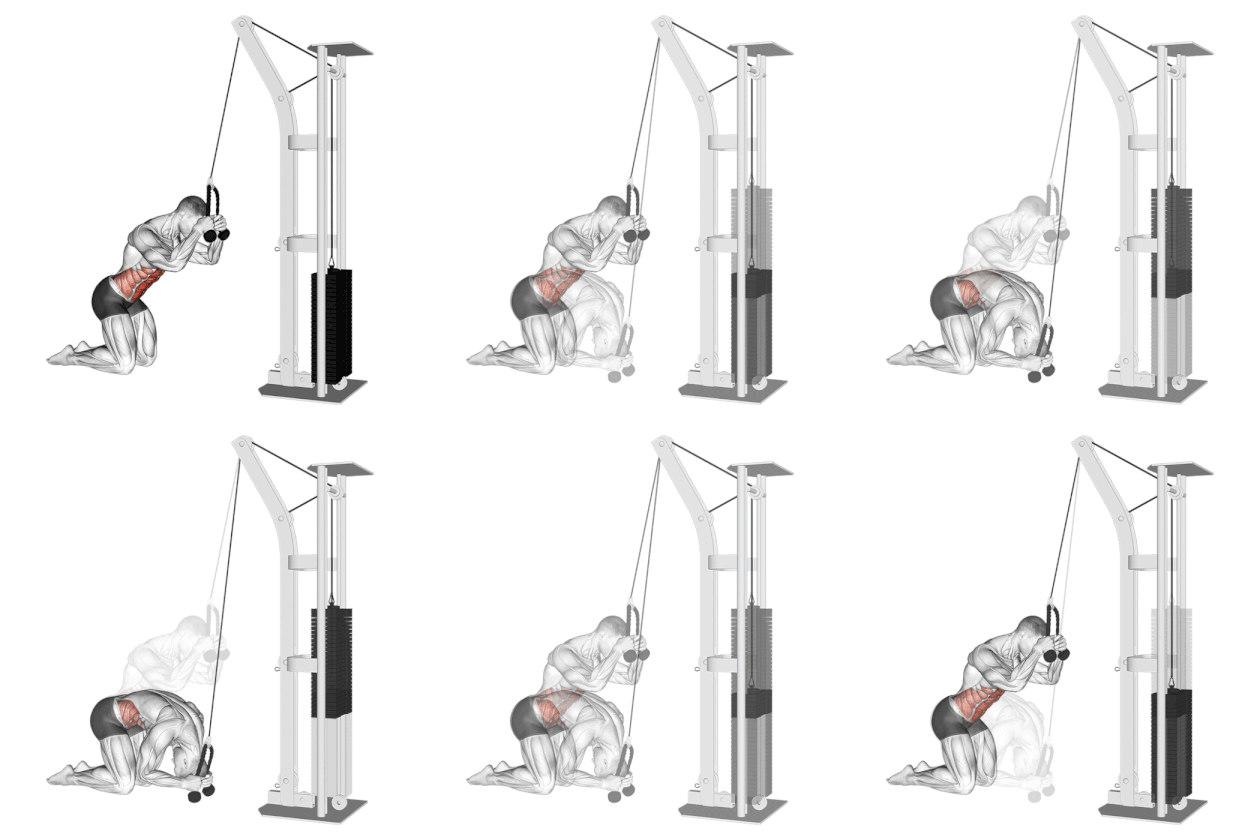
- Hold one end of the rope in each hand and bring the rope to the sides of your head or just in front of your forehead — your hands stay fixed here for the entire set
- Your hips are up, not sitting on your heels — this keeps your abs under constant tension
- Arch your lower back slightly to get a full stretch on the rectus abdominis before each rep
Execution:
- Take a breath in, brace your core
- Exhale and curl your torso downward by driving your elbows toward your knees — think of it as trying to bring your sternum to the floor, not your head to your knees
- Round your lower back completely at the bottom — this is full spinal flexion and the point of the exercise
- Hold the contracted position for 1–2 seconds
- Slowly return to the arched starting position under control — don’t let the weight yank you back up
- Re-arch at the top and repeat
The single most important coaching cue: Your hands and the rope don’t move relative to your head. If the rope is drifting or your elbows are pulling down, your arms are doing the work — not your abs.
Common Mistakes
1. Pulling with the arms. The rope handle encourages a lat pulldown pattern. Your elbows should travel toward your knees because your torso is folding — not because you’re actively pulling with your arms. I cue clients to imagine their hands are glued to their head and that their elbows are just passengers.
2. Sitting back onto the heels: The moment your glutes touch your heels, your hip flexors take over, and your abs switch off. Keep your hips elevated throughout the entire set — even if that means dropping the weight.
3. Not arching at the top: Starting each rep from a neutral or already-flexed spine cuts your range of motion in half. The stretch at the top — a deliberate lower-back arch — is where the rectus abdominis gets its full elongation. Skip it, and you’re leaving half the stimulus on the table.
4. Going too heavy too fast. This is the most common mistake I see with cable ab work. Heavy weight almost always means compensating — with the arms, with momentum, or by shortening the range of motion. The abs respond to time under tension and full range of motion, not maximum load.
5. Looking up at the machine: Where the head goes, the spine follows. If you’re looking up, you’re extending rather than fully flexing. Keep your chin tucked and your gaze toward the floor at the bottom of the rep.
Benefits of Doing Kneeling Cable Crunches
Constant tension throughout the range of motion. Unlike floor crunches or sit-ups, the cable applies resistance at both the lengthened and shortened positions. That means the rectus abdominis never gets a rest mid-set — which is exactly the stimulus needed for hypertrophy.
Progressive overload is straightforward. You can add 2.5–5 kg at a time with precise control. This is the biggest practical advantage over bodyweight ab work — you can actually track and program the progression.
Lower lumbar stress than sit-ups. The kneeling position keeps the pelvis fixed. You’re only moving through spinal flexion, which reduces hip flexor involvement and lumbar loading, making full sit-ups problematic for clients with lower back issues.
Scalable for all training goals: High reps with moderate weight for muscular endurance, lower reps with heavier load for hypertrophy — the same exercise covers both ends of the spectrum without changing the setup.
Who Should Use This Exercise
Intermediate and advanced trainees who have mastered bodyweight crunch mechanics and need a way to progressively overload the upper abs. If a client can’t demonstrate clean floor crunch form, I don’t put them on the cable yet.
Clients training for aesthetics — specifically upper ab definition — will get more direct stimulus from this than almost any other isolation movement.
Athletes who need trunk flexion strength — wrestlers, gymnasts, MMA fighters — benefit from the loaded full range of motion this exercise provides.
Anyone who has plateaued on bodyweight ab work. If someone can do 3 sets of 20 clean floor crunches and isn’t seeing further development, the kneeling cable crunch is the logical next step.
Who Should Be Cautious
People with acute lower back pain or disc issues. Spinal flexion under load is exactly what aggravates disc herniations and certain lumbar pathologies. These clients need to work with a physiotherapist before adding loaded spinal flexion to their program.
Beginners who haven’t yet learned to distinguish ab contraction from hip flexor engagement. If someone doesn’t feel this in their abs within the first few reps, they’re almost certainly compensating — and loading a compensation pattern is counterproductive.
People with neck problems. Holding the rope near the head places some load on the cervical spine, particularly if the client tenses the neck instead of keeping it neutral. A neck issue doesn’t automatically disqualify this exercise, but the setup needs to be adjusted and monitored carefully.
Progressions and Regressions
Regressions (easier)
Basic floor crunch — the starting point for anyone new to ab isolation work. Master the flexion pattern without added load before moving on to cable variations.
Exercise ball crunch — the unstable surface increases range of motion compared to the floor and introduces a mild stability demand. A good bridge between bodyweight and cable work.
Progressions (harder)
Heavier load, same reps — the simplest progression. Add weight in small increments once you can complete 3 sets of 12–15 with full range of motion and no compensation.
Pause reps — hold the fully contracted position for 3–5 seconds. This eliminates momentum and dramatically increases time under tension without adding load.
Kneeling cable crunch with rotation — at the bottom of each rep, rotate one shoulder toward the opposite knee. This brings the obliques in as primary movers and adds a rotational component to the basic pattern. Alternate sides each rep.
Single-arm cable crunch — attach one end of the rope and work each side unilaterally, which exposes and corrects left-right asymmetries.
Kneeling Cable Crunch vs. Machine Crunch
Both exercises isolate the rectus abdominis through spinal flexion under resistance, but they differ in ways that matter for programming.
| Kneeling Cable Crunch | Machine Crunch | |
|---|---|---|
| Resistance curve | Constant tension throughout ROM | Varies by machine design |
| Setup complexity | Moderate — requires rope attachment and positioning | Minimal — sit and adjust pin |
| Range of motion | Full spinal flexion possible | Often limited by machine pad position |
| Stability demand | Higher — no back support | Lower — back pad provides support |
| Best for | Intermediate/advanced, hypertrophy focus | Beginners, high-rep endurance work |
| Progression | Easy — adjust cable weight | Easy — adjust weight stack |
The practical takeaway: The machine crunch is easier to set up and learn, which makes it better for beginners. The kneeling cable crunch offers greater freedom of movement and a better stretch at the top, making it more effective for experienced trainees focused on upper ab development. I often use both in the same program — machine crunch for higher-rep warm-up sets, cable crunch as the primary working-set exercise.
Replacement Exercises (Alternatives)
If the cable machine is occupied, unavailable, or simply not the right fit for a client at a given time, these upper ab exercises work the same movement pattern:
- Machine Crunch
- Basic Abdominal Crunch
- Exercise Ball Crunch
- Decline Bench Sit-Ups
- Decline Crunch
- Classic Floor Sit-Up
- Vertical Leg Crunch
- Modified V-Sit
- V-Ups
Programming Tips
Rep range: 10–15 reps for hypertrophy, 15–20 for muscular endurance. Going below 8 reps with very heavy weight tends to compromise form more than it adds stimulus — the abs respond better to moderate load and high-quality reps than to max-effort singles.
Sets: 3–4 working sets is sufficient. The abs recover quickly, but they’re also trained indirectly throughout a full session — don’t pile on volume for its own sake.
Frequency: 2–3 times per week with at least one rest day between sessions. Like any muscle, the rectus abdominis needs time to recover and adapt.
Where in the session: At the end of a workout, after compound lifts. Core stability matters for squats, deadlifts, and overhead work — pre-fatiguing the abs before those lifts is a tradeoff that rarely makes sense.
Rest between sets: 60–90 seconds. Long enough to restore output quality, short enough to maintain metabolic stress.
Conclusion
The kneeling cable crunch earns its place in a program because it does what bodyweight ab exercises can’t — it applies consistent resistance through the full range of spinal flexion and lets you add load incrementally over time. In my experience working with clients across all levels, the ones who develop the most visible upper abs are the ones who treat their ab training like any other muscle group: progressive overload, controlled reps, and real attention to technique.
The most common mistake I see isn’t a form breakdown — it’s using too much weight too soon and turning a focused ab exercise into a lat pulldown. Keep the load honest, keep your hips up, and let your abs — not your arms — move the weight. Get that right consistently, and this exercise will deliver.
The kneeling cable crunch is one of our top picks in the complete guide to the best upper ab exercises — find out how it compares to nine other proven movements. To round out your training, check out our guides to lower ab exercises, oblique exercises, and core exercises.
Frequently Asked Questions
What is the difference between the kneeling cable crunch and the standing cable crunch?
The kneeling position fixes the pelvis and eliminates hip flexor contribution entirely, forcing the rectus abdominis to do all the work. In the standing cable crunch, the hip flexors can compensate by tilting the pelvis forward, which reduces ab isolation. For pure upper ab development, the kneeling version is the more effective setup.
How close should I kneel to the cable machine?
Approximately 60 to 90 centimetres from the weight stack. Close enough that the cable pulls at a downward angle — this maintains tension at the top of the rep where the abs are in the stretched position. Too close and the cable angle becomes nearly vertical, reducing the stretch. Too far and the weight stack may bottom out before you reach full contraction.
Should I exhale or inhale during the crunch phase?
Exhale during the crunch — as you flex the spine and drive the elbows toward the knees. Exhaling during contraction naturally facilitates deeper abdominal engagement by reducing intra-abdominal pressure at the right moment. Inhale on the return as you extend back to the starting position.
Can the kneeling cable crunch replace planks and other core stability exercises?
No. The kneeling cable crunch is a dynamic flexion exercise that develops strength and hypertrophy in the rectus abdominis. Planks and anti-rotation exercises train the core’s ability to resist movement — a completely different quality. Both types of training serve distinct functions and a complete core program includes both, not one at the expense of the other.
Why do I feel the kneeling cable crunch in my triceps and shoulders?
Because your arms are actively pulling the rope rather than staying passive. The rope should be anchored firmly to the sides of your head — your hands hold it in place, they do not pull it. If the shoulders and triceps are engaging, reduce the weight and focus on initiating every rep with an abdominal contraction before any downward movement begins.
Is the kneeling cable crunch safe for people with knee pain?
It can be, with the right setup. The primary issue is pressure on the patella and tibial tuberosity from kneeling on a hard surface. Using a thick folded mat or dedicated knee pad under both knees resolves most discomfort. If kneeling causes sharp or persistent knee pain regardless of padding, substitute with the seated cable crunch or machine crunch, which achieve a similar training stimulus without any kneeling.
What weight should a beginner start with on the kneeling cable crunch?
Start light enough that you can complete 12 to 15 reps with full range of motion, hips elevated off the heels, and zero arm involvement. For most beginners that is somewhere between 10 and 20 kilograms on the cable stack, but the specific number is less important than the quality of the movement. If you cannot feel the abs working within the first few reps, the weight is either too heavy or the technique needs correction.
Does the kneeling cable crunch work the obliques?
The obliques work as stabilizers in the standard version, but become primary movers if you add rotation at the bottom of each rep — bringing one shoulder toward the opposite knee. This twisting variation is sometimes called the kneeling cable crunch with rotation or the oblique cable crunch, and it is a straightforward way to add oblique training to the same exercise without changing the setup.
How do I know when to increase the weight on the kneeling cable crunch?
When you can complete all prescribed sets and reps — typically 3 to 4 sets of 12 to 15 reps — with full range of motion, consistent technique, and no compensation from the arms or hip flexors across multiple consecutive sessions. Increase by the smallest available increment, usually 2.5 to 5 kilograms, and rebuild from the lower end of the rep range before adding weight again.
Can I do the kneeling cable crunch if I train at home without a cable machine?
Not directly, but resistance bands looped through a high anchor point — a door frame attachment, a pull-up bar, or a sturdy overhead hook — replicate the cable crunch mechanics reasonably well. The resistance curve differs slightly from a cable because bands increase tension as they stretch, but the movement pattern, kneeling position, and coaching cues are identical. It is a practical substitute when cable equipment is unavailable.
