


Introduction
I’ve worked with more than one client over the years who came back into the gym after a two-year layoff — an injury, a surgery, a stretch of life that pushed training off the priority list entirely — expecting to essentially start over from zero. Almost without exception, they didn’t. Within a few months, they were back near their old numbers, while a true beginner training just as hard next to them was still grinding through the basics.
That’s not motivation talking. It’s biology. And it raises a question I get asked constantly, in one form or another: why do previously trained muscles grow back so much faster than they built the first time?
The gym answer to that question is “muscle memory,” a phrase thrown around so casually that it’s almost lost its meaning. Most people using it have no idea what’s actually happening at the cellular level — and, having spent a career in both the coaching side and the kinesiology side of this field, I’d argue the real mechanism is more interesting, and more scientifically solid, than the vague folklore version most lifters have heard. This guide walks through what muscle memory actually is, what the evidence does and doesn’t support, and what it means for how you train after time off.
What Is Muscle Memory?
“Muscle memory” is actually a poor name for two genuinely different phenomena that get lumped together constantly, and untangling them is the first step to understanding either one.
Muscular memory refers to a cellular-level adaptation inside the muscle fiber itself that allows previously trained muscle to regain size faster than it was built originally. This is a structural, physiological memory that lives in the muscle tissue.
Motor memory (sometimes called neural or motor-skill memory) refers to something entirely different: the nervous system’s retained ability to coordinate a movement pattern efficiently — the reason you don’t have to relearn how to squat or ride a bike from scratch, even after years away from it.
| Feature | Muscular Memory | Motor Memory |
|---|---|---|
| Occurs in | Skeletal muscle fibers | Brain and nervous system |
| Main mechanism | Retained myonuclei | Motor learning and neural adaptations |
| Primary benefit | Faster muscle regrowth | Faster return of technique and coordination |
| Developed by | Resistance training | Repeated movement practice |
| Typical example | Regaining lost muscle after a layoff | Quickly relearning the squat or riding a bicycle |
Both contribute to how quickly you “come back” after time off, but they’re driven by completely different biology — one lives in the muscle, the other lives in the brain and spinal cord. I’ll cover both in detail below, because conflating them is where most of the confusion (and most of the bad gym advice) comes from.
Key Point: “Muscle memory” actually describes two distinct phenomena — a structural memory inside muscle tissue and a neural memory for movement skill — that happen to overlap in everyday gym language but work through entirely different biological mechanisms.
Is Muscle Memory Real?
Yes — but not for the reason most lifters think, and this is worth addressing directly because the popular explanation is simply wrong.
The old, and still widely repeated, explanation is that muscle “casing” or fascia gets permanently stretched by prior training and stays that way, like an old rubber band that never fully snaps back. It’s a tidy visual, and it’s not how muscle physiology actually works — fascia doesn’t function as some permanently deformed elastic sleeve, and this explanation has no real support in the muscle physiology literature.
The genuine, evidence-based explanation centers on myonuclei — the cell nuclei inside your muscle fibers — and a small but growing body of cellular research showing that a meaningful portion of the myonuclei gained during a prior period of muscle growth appear to stick around long after the muscle has shrunk back down. That retained cellular machinery, not stretched-out fascia, is what current research suggests gives previously trained muscle its head start.
Key Point: Muscle memory is a real, biologically supported phenomenon, but the popular “stretched fascia” explanation is inaccurate. The evidence-based explanation centers on myonuclei retained inside muscle fibers, not on any permanent change to connective tissue.
The Science Behind Muscle Memory
This is the part of the article I most want lifters to actually understand, rather than just accept on faith, so let’s walk through it carefully.
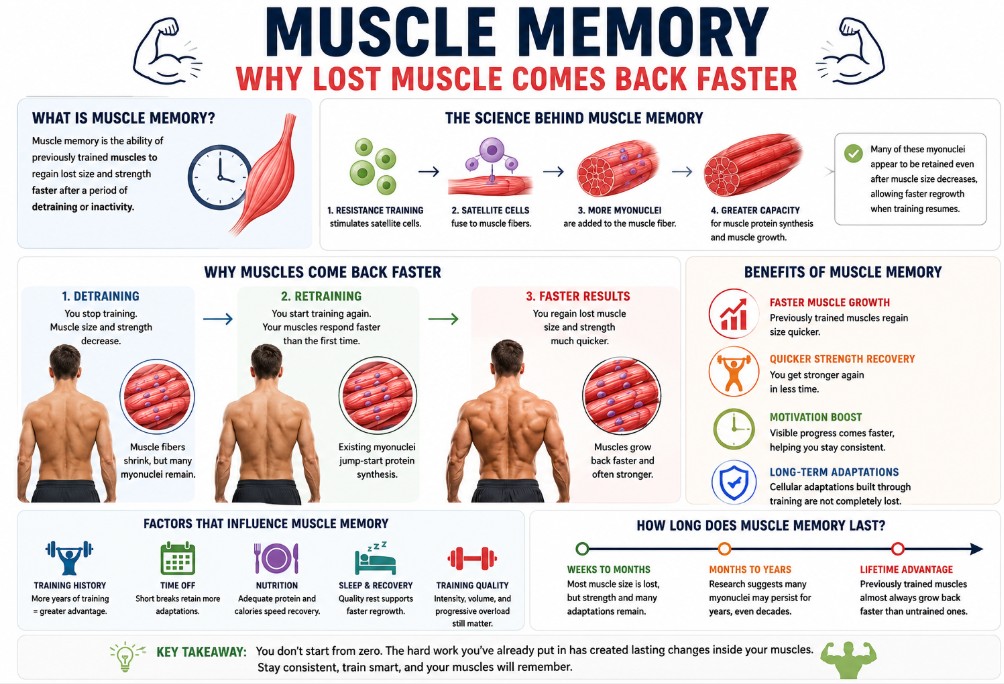
Every time a muscle fiber grows significantly, it doesn’t just get bigger — it also recruits additional cell nuclei from satellite cells, muscle-specific stem cells that fuse with the existing fiber and donate their nuclei to it. Each of those donated nuclei is called a myonucleus, and each one is responsible for supporting protein production across a limited surrounding area of cytoplasm — a concept researchers call the myonuclear domain.
Here’s the part that changed how I explain this to clients: for decades, the assumption was that when a muscle shrinks — from detraining, injury, or illness — it loses those extra myonuclei along with the size, the same way it gained them. Direct, time-lapse imaging studies in animal models overturned that assumption, showing that myonuclei acquired during a hypertrophic growth phase largely persist even after the muscle fiber atrophies back down, in some cases for a substantial portion of the animal’s remaining lifespan.
The practical consequence is straightforward: even after a previously trained muscle fiber shrinks, it still retains more of the cellular machinery needed for protein synthesis than a fiber that has never reached the same size. When you retrain, that fiber isn’t starting from zero — it already has a larger workforce of myonuclei on hand, and each one has a smaller domain to serve, which appears to let the fiber ramp protein synthesis capacity back up more efficiently than it did the first time around.
One frequently cited human training study observed a roughly 23% increase in myonuclear number after just the first training block, a number that then stayed essentially constant through a subsequent period of detraining and retraining — even as fiber size dropped back down during the detraining phase. That’s about as clean a demonstration of the mechanism as exists in the current literature.
Key Point: Muscle memory is driven primarily by myonuclei gained during previous muscle growth that appear to persist even after the muscle shrinks. This gives previously trained fibers a head start in protein-producing capacity when retraining begins, rather than needing to rebuild that capacity from scratch.
Coach’s Note
I’ve seen muscle memory prove itself countless times in people I’ve coached, especially after injuries, surgery, or serious illness forced them to stop training for months or even years. Their size and strength did not return overnight, but they almost always came back far faster than they built them the first time. The science explains why, but real-world coaching experience makes the effect impossible to ignore.
Why Previously Trained Muscles Grow Faster
This is the section that actually answers the question most people come to this article looking for, so let me be direct about it.
A muscle fiber that has never reached a larger size must first recruit satellite cells, acquire additional myonuclei, and expand its capacity for muscle protein synthesis before it can grow substantially. That process — the one every true beginner has to go through — takes time, and it’s a large part of why the first months of serious training tend to produce the most dramatic, and slowest-feeling, changes relative to effort.
A previously trained fiber, by contrast, already has an elevated number of myonuclei sitting in place, even after the fiber itself has shrunk down. Retraining that fiber mostly means ramping up protein synthesis using machinery that’s already there, rather than building new machinery first. In practice, this tends to show up as previously trained muscle regaining size measurably faster than it took to build the first time — which lines up with what I’ve watched happen, over and over, with clients returning from long layoffs.
I’d add one honest caveat here, because it matters clinically: this doesn’t mean regained muscle appears overnight, or that training intensity and consistency stop mattering. It means the rate of regrowth tends to be faster, not that the requirement for hard, progressive training disappears.

Neural Muscle Memory vs Muscle Memory
The myonuclei mechanism explains why muscle tissue comes back faster. It has nothing to do with why your skill at an exercise comes back quickly too — that’s an entirely separate system, and it’s worth understanding on its own terms.
When you learn a new movement pattern — your first few sessions of squatting, for example — a meaningful part of the early improvement isn’t muscle growth at all. It’s your nervous system learning to coordinate the movement: recruiting the right muscles in the right sequence, stabilizing the bar path, reducing wasted energy on balance and coordination. This kind of procedural motor learning involves lasting changes in motor cortex circuitry and coordination with the cerebellum and spinal cord, and once consolidated, it tends to be remarkably durable — similar, functionally, to how riding a bicycle or typing on a keyboard stays with you long after regular practice stops.
This is why a returning lifter often feels coordinated and confident under the bar again within a single session or two, well before their muscle size has caught up. The nervous system’s “memory” for the movement pattern was never really lost; it was just sitting unused. Muscle tissue memory and neural memory for skill both contribute to a fast comeback, but they’re running on separate biological clocks — one in the muscle fiber, one in the brain and spinal cord.
Key Point: Neural motor memory (skill and coordination) and muscular memory (myonuclei retained in muscle tissue) are two distinct systems that both speed up a training comeback, but they operate through completely different biology and recover on different timelines.
How Long Does Muscle Memory Last?
This is genuinely one of the most searched questions on this topic, and I want to be straightforward about where the science currently stands rather than overstate what we know.
Animal studies show that myonuclei can persist for a large portion of an animal’s remaining lifespan after muscle hypertrophy. If a similar effect occurs in humans, muscle memory could last for years—or even decades. However, the human evidence is less conclusive. A comprehensive systematic review and meta-analysis found that rodent myonuclei appear highly permanent, whereas people with more severe muscle atrophy (30% or greater) may lose at least some of their previously acquired myonuclei.
In plain terms: the honest answer is that human researchers are still actively working this out. The animal evidence for long-lasting myonuclear retention is strong. The direct human evidence is real but more limited, and several reviewers have specifically noted that the human data remains genuinely ambiguous on exactly how long the effect lasts and under what conditions it might fade. I’d rather tell a client “months to possibly years, and we don’t have a precise human number yet” than confidently state a figure the literature doesn’t actually support — and I’d encourage you to be skeptical of any source that gives you an exact number here.
Key Point: Muscle memory likely lasts anywhere from many months to potentially years based on animal research, but the precise duration in humans is not yet firmly established in the scientific literature. Be cautious of sources claiming an exact figure.
What Happens During Detraining?
When training stops, several things decline — but not all at the same rate, and understanding the difference matters for how you think about a break from the gym.
- Muscle size decreases as protein synthesis slows relative to breakdown, though meaningful, measurable loss of muscle size generally takes longer than most people assume — one meta-analysis found no significant decrease after 12 to 24 weeks of training cessation, with significant loss becoming apparent mainly after 31 to 52 weeks.
- Strength typically declines faster than muscle size because it depends partly on neural adaptations. Even so, most people retain a substantial amount of strength during the first several weeks of detraining.
- Muscle glycogen stores decline relatively quickly during inactivity, making muscles look and feel noticeably smaller and flatter long before significant muscle loss occurs.
- Neural efficiency — the coordination and motor-unit recruitment patterns built through training — declines gradually, but as covered above, tends to be one of the more durable adaptations.
- Myonuclei, based on current evidence, appear to be the most resilient piece of the puzzle, largely persisting through the kind of detraining periods most recreational lifters experience.
Key Point: During detraining, muscle glycogen and some neural sharpness fade relatively quickly, meaningful muscle size loss generally takes longer than people expect, and myonuclei appear to be the most durable adaptation of all — which is precisely why the comeback tends to outpace the original build.
Can Beginners Benefit From Muscle Memory?
No — and I say this to new clients directly, because it’s a common point of confusion. Muscle memory, by definition, requires a prior period of meaningful hypertrophy to have occurred. There’s nothing to “remember” if a muscle has never been built up to a larger size in the first place.
If you’re new to training, the myonuclei mechanism described throughout this guide simply doesn’t apply to you yet — you’re in the position of building that cellular infrastructure for the first time, which is exactly the slower, harder process every previously trained lifter went through before they had any memory effect to rely on. The encouraging part: every rep you put in now is building the very asset — additional myonuclei — that will make your next comeback, whenever and if it happens, faster than this first build.
Does Muscle Memory Make Bulking Easier After Cutting?
For anyone specifically training for physique, this is arguably the most practically useful application of everything covered above — and it’s a question I get from nearly every client heading into a cut.
Muscle lost during a fat-loss phase often returns much faster during the next bulk because previously trained muscle fibers already retain additional myonuclei from earlier training. This advantage depends on maintaining resistance training and adequate nutrition throughout the cut. This is a big part of why experienced lifters who cut down and then bulk back up often look “back to normal” within a matter of months, in a way that would be unrealistic for someone building that same amount of muscle from an untrained starting point.
It’s also a reasonable factor in the classic “bulk first or cut first” debate for lifters who aren’t carrying excess body fat: since regaining muscle after a reasonable cut is comparatively fast thanks to this mechanism, there’s less physiological cost to prioritizing a lean, controlled bulk phase first.
Does Age Affect Muscle Memory?
Yes, and this is an area I think deserves more attention than it typically gets in gym-level discussions of the topic.
Age affects several of the systems this guide has covered. Satellite cell numbers, which supply the myonuclei responsible for muscle memory in the first place, tend to decline with age, and lower myonuclear and satellite cell content has specifically been observed alongside age-related muscle loss (sarcopenia) in human research. Detraining also appears to take a somewhat larger toll on older adults, with research on resistance training cessation in older populations showing clear, measurable reductions in muscle size following extended breaks from training.
This doesn’t mean muscle memory disappears with age — the underlying mechanism still operates — but the margin is narrower, which is part of why I generally encourage older clients to prioritize training consistency and to treat extended breaks from resistance training more cautiously than I would with a client in their twenties.
How to Maximize Muscle Memory
You can’t manufacture muscle memory that doesn’t yet exist, but you can make the most of what you’ve already built, and set yourself up for a faster comeback down the line:
- Don’t quit entirely. Even minimal maintenance training during a busy period preserves far more than a complete stop.
- Prioritize protein. Adequate protein intake supports muscle protein synthesis whenever you do return to training.
- Apply progressive overload on your return. Your muscle memory advantage still requires a genuine training stimulus to express itself — it doesn’t rebuild muscle passively.
- Sleep and manage recovery. The hormonal environment that supports muscle protein synthesis matters just as much on a comeback as it did the first time around.
- Be patient with the neural side. Coordination often returns faster than size does; don’t mistake feeling strong under the bar in week one for being fully rebuilt.
Common Mistakes
A few patterns I see constantly with returning lifters, almost all of which come from misunderstanding how muscle memory actually works:
- Expecting instant gains. Muscle memory speeds up the comeback; it doesn’t make it instantaneous. Weeks, not days, is still the realistic timeframe.
- Not eating enough protein. The myonuclei advantage means nothing without adequate raw material and a real training stimulus to act on.
- Training too hard, too soon, on return. A layoff reduces work capacity and connective tissue tolerance even if the myonuclei are intact — jumping straight back to old training loads is a common way to get injured.
- Comparing your comeback to a true beginner’s progress. You’re not on the same timeline, and expecting a beginner’s typical trajectory (or a beginner expecting yours) leads to unrealistic expectations in both directions.
Common Myths About Muscle Memory
Myth: Muscle memory works because your fascia stays permanently stretched, like a rubber band.
Reality: This is the most widely repeated explanation for muscle memory, and it isn’t supported by the muscle physiology literature. The real mechanism centers on myonuclei retained within muscle fibers, not any permanent structural change to connective tissue.
Myth: If you take time off, you lose all your gains and start from zero.
Reality: Meaningful loss of muscle size generally takes longer than most people expect, and the myonuclei responsible for muscle memory appear to be one of the most durable adaptations of all—which is precisely why previously trained muscles typically regain size faster than they gained it the first time.
Myth: Muscle memory means you can skip training and still keep your gains.
Reality: Muscle memory describes a faster rate of regaining muscle once you resume training — it does not maintain muscle passively in the absence of any training stimulus.
Myth: Beginners have muscle memory too; they just haven’t “unlocked” it yet.
Reality: Muscle memory requires a prior period of real hypertrophy to generate the elevated myonuclei count the mechanism depends on. There’s no dormant memory effect waiting to be unlocked in untrained muscle.
Myth: Muscle memory is purely a mental or motivational phenomenon.
Reality: While motivation and familiarity with training certainly help, muscle memory has a specific, testable cellular basis in retained myonuclei, alongside a separate, well-documented neural component for movement skill.
Key Point: The most persistent myth about muscle memory — permanently stretched fascia — has no real support in the physiology literature. The evidence-based explanation is cellular, centered on myonuclei, and it requires ongoing training to actually express itself.
