



The moment you grip a heavy barbell and begin a hard set of squats, your nervous system increases motor drive, ATP turnover skyrockets, heart rate rises, cardiac output increases, blood flow redistributes, ventilation increases, sympathetic activity rises, muscle metabolites accumulate, and heat production climbs — all at the same time, all within seconds.
Exercise is not a stress placed on one organ. It’s a coordinated, whole-body physiological response involving nearly every system. This guide maps that entire response, from the instant you start moving to the point recovery begins—with pointers to our dedicated deep-dive guides wherever a topic deserves more detail than a map can give.
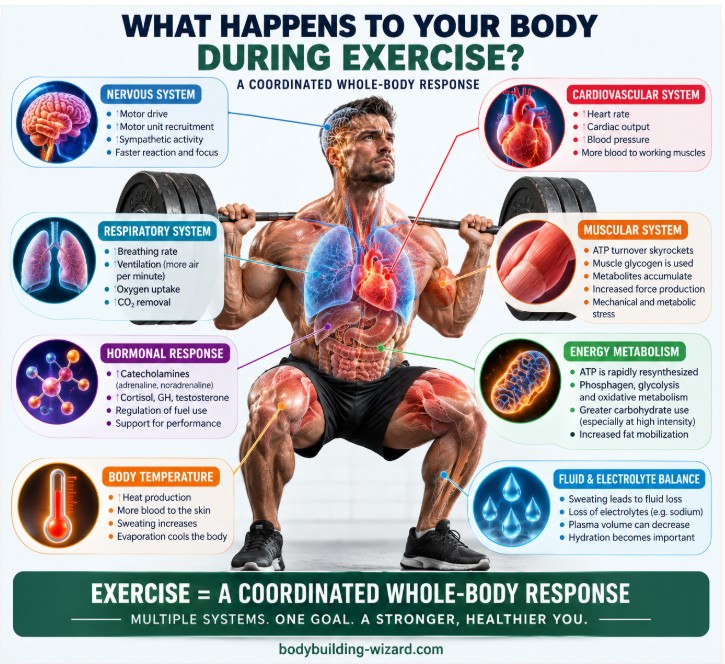
QUICK ANSWER: During exercise, your nervous system increases motor drive and sympathetic activity, your heart and blood vessels increase blood flow to working muscle, your lungs increase ventilation, your muscles rapidly resynthesize ATP through a combination of energy systems, your hormones coordinate fuel mobilization, and your body temperature rises as a byproduct of muscle contraction. These changes happen together, in real time, as a single coordinated response — not as isolated reactions in separate organs.
Acute Response vs. Chronic Adaptation
Fitness content often confuses these two concepts, so it’s worth separating them clearly at the start. Acute response is what happens during and immediately after a single workout — everything covered in this guide. Chronic adaptation is what changes after weeks or months of repeated training — a separate topic covered throughout our exercise physiology cluster, referenced along the way below. This article focuses on the acute response.
The Exercise Response Begins in Your Nervous System
Before a muscle fiber contracts, your nervous system has already acted. Central command generates motor signals in anticipation of movement, often before you’re even consciously aware you’re bracing for effort. Motor unit recruitment and rate coding increase to meet rising force demand — more motor units activate, and those already active fire more frequently, together determining how much force the muscle actually produces. Sympathetic activation triggers a cascade of “fight or flight” physiology — rising heart rate and contractility, redistributed blood flow, and increased circulating catecholamines — that supports every other system covered in this guide. For the full anatomy behind this, see our guides on the Human Nervous System and Neural Adaptations to Strength Training.
ATP Demand Rises Almost Instantly
ATP is the immediate energy currency every muscle contraction requires, and stored ATP is extremely limited — enough for only a very brief effort before it must be continuously resynthesized. That resynthesis draws on three systems: the phosphagen system, glycolysis, and oxidative metabolism.
Here’s the correction worth making to a classic fitness misconception: these three systems don’t switch on sequentially, one after another, as intensity or duration increases. A detailed review of energy system interaction found that energy comes from all three energy-producing pathways during almost all exercise activities, with equal contributions from aerobic and anaerobic systems occurring far earlier than traditionally assumed—around 75 seconds into a maximal effort, not after some fixed “anaerobic phase” ends. All three energy systems contribute simultaneously; their relative contribution shifts with exercise intensity and duration, but none of them is simply “off” until its turn arrives. For the complete breakdown of each system, see our guide on Energy Systems: Aerobic vs. Anaerobic Training.
Fuel Use Changes With Exercise Intensity
Muscle glycogen, blood glucose, and fatty acids all contribute fuel during exercise, and the mix shifts predictably with intensity: higher-intensity efforts lean more heavily on carbohydrate, while lower-to-moderate, prolonged exercise draws relatively more on fat — without this being the simplistic “fat-burning zone” story that oversimplifies the real, continuous relationship between intensity and fuel mix. Resistance exercise specifically draws significantly on muscle glycogen, with the exact contribution varying by volume, load, and muscle group involved.
Your Cardiovascular System Delivers More Blood
Heart rate rises rapidly at exercise onset, stroke volume and cardiac output change to meet rising demand, blood flow redirects toward working muscle through a combination of local vasodilation and sympathetic vasoconstriction elsewhere, and blood pressure responds to the effort — often substantially during heavy resistance exercise, where mechanical muscle compression and bracing add on top of the usual cardiovascular demand. This system turns the oxygen your lungs bring in into something your muscles can use, and it does so on a completely different timescale for a heavy squat than for a steady jog. Each of these responses deserves — and has — its own dedicated treatment: see Cardiovascular Response to Exercise, Heart and Circulatory System Anatomy, and How Weight Training Affects Blood Pressure.
Your Breathing Increases to Support Metabolism
Minute ventilation increases as breathing becomes deeper, more frequent, or both, supporting the rising oxygen uptake and CO2 removal that exercise demands. This isn’t driven by a single trigger — a combination of feedforward neural signals sent alongside movement commands, sensory feedback from working muscles, and chemoreceptor input responding to rising CO2 all contribute together. One correction worth making here: it’s inaccurate to say “your lung capacity expands” during a workout — lung capacity itself doesn’t acutely change; what changes is how much air you’re actually moving in and out with each breath and each minute, and how efficiently your breathing coordinates with bracing under a heavy load. For the full physiology, see Human Respiratory System: Anatomy, Function & Role in Exercise and Effects of Exercise on the Respiratory System.
Hormones Help Coordinate the Exercise Response
Catecholamines (epinephrine and norepinephrine) drive cardiovascular changes and fuel mobilization, rising almost immediately at exercise onset. Insulin and glucagon help regulate blood glucose throughout the effort, adjusting as fuel is drawn from circulation and from stored glycogen. Cortisol rises with longer or more intense exercise, contributing to substrate availability and the broader stress response — a normal, expected part of a hard session rather than something to fear or try to suppress. Testosterone, growth hormone, and IGF-1 can all show acute changes around a training session — but transient post-exercise hormone spikes should not be confused with the mechanisms actually responsible for long-term muscle hypertrophy, a distinction covered in more depth in our Muscle Hypertrophy guide. This isn’t one hormone doing one job — it’s an overlapping, coordinated signaling network responding to the same underlying physiological demand from several directions at once. For the full picture of each hormone individually, see our Hormones & Endocrine System cluster.
Muscle Metabolism Produces Lactate and Other Metabolites
As glycolysis accelerates to meet rising ATP demand, lactate production increases — worth stating plainly that lactate is not simply a useless waste product, a myth that’s persisted in fitness culture far longer than the science has supported it. Lactate is actually a usable fuel that muscle, heart, and other tissues can oxidize for energy, and it also serves as a signaling molecule involved in several adaptive processes. Hydrogen ions and inorganic phosphate also accumulate alongside lactate and contribute to the sense of fatigue during a hard set — but even here, the old “lactic acid burn causes fatigue” story oversimplifies a genuinely multifactorial process. The full mechanisms of both lactate metabolism and exercise fatigue are complex enough to deserve their own dedicated treatment elsewhere on this site, once those articles are published.
Body Temperature Rises
Muscle contraction is mechanically inefficient, so a substantial share of the metabolic energy used during exercise is released as heat rather than external work. Blood carries that heat toward the skin, sweating increases, and evaporation removes heat from the body — a coordinated response that ramps up quickly once a hard set or a sustained effort begins. The complete physiology, including why humidity and hydration status matter so much for how effectively this system works, is covered in Thermoregulation During Exercise and Sweating During Exercise.
Fluid and Electrolyte Balance Begins to Shift
Sweating causes fluid loss, and depending on duration and environmental conditions, sodium and other electrolyte losses can accumulate alongside it, plasma volume can decrease, and cardiovascular strain can rise as a result — the same fluid-shift mechanisms that show up on a basic blood panel as changes in hemoglobin, hematocrit, and other concentration-based markers if blood is drawn while these shifts are still underway. None of this supports the old, dramatic framing of dehydration as some kind of singular physiological enemy — it’s one variable among many that a well-prepared lifter manages, not a catastrophe waiting to happen every session.
What Happens Inside Working Muscle?
At the cellular level, a nerve signal triggers the release of calcium, which enables the interaction between actin and myosin filaments that produces contraction — the basic mechanism underlying every rep you perform. Alongside this, ATP turnover accelerates, glycogen gets used, metabolites accumulate, and both mechanical and metabolic stress develop within the working tissue as a set progresses. For the full anatomical picture of how muscle is organized, from whole muscle down to the sarcomere, see our guide on the Muscular System: Anatomy, Functions & Role in Strength Training.
Does Exercise Damage Muscle?
Sometimes, yes — particularly following novel exercise, substantial eccentric loading, high training volume, or unfamiliar ranges of motion. This kind of exercise-induced muscle damage is part of why creatine kinase and related enzymes can show up elevated on a blood test the day after an unusually hard session, a topic covered in detail in our guide to Blood Tests for Lifters. But the old, simplistic “muscle damage causes inflammation causes hypertrophy” chain deserves a real correction: muscle damage isn’t required for muscle growth, and more damage doesn’t mean more hypertrophy. Plenty of effective, well-designed training produces meaningful growth without leaving lifters devastatingly sore, and chasing soreness as a proxy for a “good workout” is a common, avoidable mistake. For the complete, modern picture of how muscle actually grows, see Muscle Hypertrophy: How Do Muscles Grow?
Exercise Triggers an Acute Inflammatory Response
Inflammation after hard exercise isn’t the enemy it’s often made out to be—it’s a normal part of the repair and adaptation process, with immune cells responding to the physiological stress of training rather than to damage that needs to be minimized at all costs.
What Happens to Your Immune System After Exercise?
This is an area where more recent research has genuinely updated the old, popular version of the story, and it’s worth correcting directly. The traditional idea — that hard training opens a 24-72 hour “window” of dramatically increased infection susceptibility — has been a staple of fitness content for decades. A review debunking this traditional “open window” theory found that the drop in circulating immune cells observed after intense exercise largely reflects those cells temporarily redistributing to peripheral tissues on immune surveillance duty, rather than the immune system entering a genuine, prolonged state of suppression. That’s a meaningfully different, more nuanced picture than a simple shutdown. What matters for infection risk in the real world is chronic under-recovery and accumulated training stress over weeks and months, not any single hard session—one more reason total training load and recovery quality matter more than any individual workout in isolation.
Resistance Training vs. Endurance Exercise: The Responses Are Not Identical
| Response | Heavy Resistance Training | Steady-State Endurance |
|---|---|---|
| ATP demand | Very high, intermittent | Sustained |
| Main fuel | Greater carbohydrate contribution | Mixed carbohydrate/fat |
| Heart rate | Intermittent peaks | Sustained elevation |
| Blood pressure | Large transient peaks possible | Moderate sustained increase |
| Ventilation | Intermittent | Sustained |
| Muscle damage | Often greater, depending on exercise | Usually lower |
| Heat production | High | High |
| Glycogen use | Localized, considerable | Broad, progressive |
What Happens Immediately After Exercise Stops?
The response doesn’t end with your last rep. Heart rate gradually falls, though how quickly depends heavily on your conditioning level and the demand of the session just completed. Ventilation remains elevated for a period as the body continues clearing accumulated CO2 and metabolic byproducts. Blood pressure can fall below its pre-exercise level — a phenomenon called post-exercise hypotension. Oxygen consumption remains elevated as the body manages recovery processes, sometimes discussed as EPOC, without the exaggerated fat-burning claims that term often attracts in fitness marketing. Glycogen replenishment begins, fluid balance starts to restore as you rehydrate, and muscle repair and remodeling get underway — the earliest stages of the adaptation process that repeated training sessions eventually add up to.
From Acute Stress to Long-Term Adaptation
A single workout disrupts homeostasis, recovery follows, and repeated exposure to that same disruption over weeks and months drives adaptation—cardiovascular, muscular, metabolic, neural, and thermoregulatory. Each of those chronic adaptations has its own dedicated guide elsewhere in this cluster; this map shows how they all start from the same acute response.

Practical Takeaways for Lifters
- Heavy sets depend heavily on rapid ATP resynthesis, which helps explain why very short rest periods degrade performance on subsequent heavy sets.
- Rest periods allow partial recovery — how much depends on the demand of the preceding set.
- Carbohydrate availability matters more as training volume increases.
- Hydration matters more as heat and session duration increase.
- Fatigue is multifactorial — not one single mechanism, but several overlapping ones.
- More muscle damage is not better — it’s not the signal that drives growth.
- Recovery begins before you even leave the gym, not just once you get home.
Coach’s Note: A hard workout isn’t one stress — it’s dozens of coordinated physiological stresses happening at the same time. That’s exactly why load, volume, rest periods, nutrition, hydration, and recovery all need to be programmed together rather than in isolation. I’ve seen lifters obsess over optimizing one variable — perfecting their protein timing, say — while ignoring that their rest periods are too short to allow real ATP resynthesis between heavy sets, or that they’re training in a way that makes hydration an afterthought. The body doesn’t experience your program one variable at a time, so managing it one variable at a time only gets you so far.
Bodybuilder’s Take
You don’t grow during the set. The set creates the physiological disturbance your body adapts to later. Everything covered in this guide — the nervous system firing, the heart pumping harder, the metabolites accumulating, the heat building — is the disturbance. Growth happens afterward, during recovery, when that disturbance is appropriate and followed by adequate recovery.
Key Takeaways
- ✓Exercise is a coordinated, whole-body response — nervous, cardiovascular, respiratory, hormonal, and metabolic systems all activate together.
- ✓All three energy systems contribute to ATP resynthesis simultaneously — they don’t switch on sequentially as intensity or duration rises.
- ✓Fuel mix shifts continuously with intensity rather than following a simplistic “fat-burning zone.”
- ✓Transient post-exercise hormone spikes are not the mechanism responsible for long-term muscle growth.
- ✓Lactate is not a waste product, and muscle damage is not required for hypertrophy — two classic fitness myths worth retiring.
- ✓The post-exercise immune cell drop reflects redistribution, not a genuine “shutdown” of immune function.
- ✓Resistance training and endurance exercise produce meaningfully different acute response patterns, not interchangeable versions of the same stress.
- ✓The physiological response continues well after your last rep — heart rate, ventilation, and metabolism all take time to return to baseline.
- ✓Acute response and chronic adaptation are different phenomena — this guide maps the former, while dedicated guides throughout this site cover the latter.
Frequently Asked Questions
What happens to your body when you start exercising?
Within seconds, your nervous system increases motor drive and sympathetic activity, your heart rate and cardiac output rise, blood flow redistributes toward working muscle, ventilation increases, and ATP resynthesis accelerates to meet the sudden rise in energy demand.
Why does heart rate increase during exercise?
Heart rate rises to increase cardiac output and deliver more oxygen and nutrients to working muscle, driven by parasympathetic withdrawal followed by rising sympathetic activation as exercise intensity increases.
Why does breathing increase during exercise?
Breathing increases to supply more oxygen and remove more carbon dioxide as metabolic demand rises, through a combination of chemical, neural, and muscle-sensory signals rather than a single trigger.
What happens to ATP during exercise?
Stored ATP is extremely limited, so it must be continuously resynthesized through the phosphagen system, glycolysis, and oxidative metabolism. All three systems contribute simultaneously, with their relative contribution shifting based on exercise intensity and duration.
What fuel does the body use during weight training?
Resistance training draws significantly on muscle glycogen, with blood glucose and fatty acids also contributing depending on intensity, volume, and duration. Higher-intensity efforts rely more heavily on carbohydrate as a fuel source.
Why does body temperature rise during exercise?
Muscle contraction is mechanically inefficient, so a substantial share of the energy used during exercise is released as heat. Blood carries that heat toward the skin, and sweating and evaporation help dissipate it.
Does exercise damage your muscles?
Sometimes, particularly with novel exercise, heavy eccentric loading, or high training volume. However, muscle damage is not required for muscle growth, and more damage does not translate into more hypertrophy.
Why does blood pressure rise during exercise?
Blood pressure rises due to increased cardiac output, sympathetic activation, and — during resistance exercise specifically — mechanical factors like muscle compression and bracing mechanics such as the Valsalva maneuver.
What happens to hormones during exercise?
Catecholamines rise to support cardiovascular and metabolic demands, cortisol increases with longer or more intense efforts, and insulin/glucagon help regulate blood glucose. Transient changes in testosterone and growth hormone also occur but shouldn’t be confused with the mechanisms driving long-term muscle growth.
How long does your body take to return to normal after exercise?
This varies considerably by marker and by exercise intensity and duration — heart rate and breathing often normalize within minutes to an hour, while glycogen replenishment, fluid balance restoration, and muscle repair can take considerably longer, sometimes days depending on the demand of the session.
References
- Betts, J. G., et al. (2023). Anatomy and Physiology 2e. OpenStax. openstax.org/details/books/anatomy-and-physiology-2e
- Gastin, P. B. (2001). Energy system interaction and relative contribution during maximal exercise. Sports Medicine. link.springer.com/article/10.2165/00007256-200131100-00003
- Egan, B., & Zierath, J. R. (2020). Skeletal muscle energy metabolism during exercise. Nature Metabolism. nature.com/articles/s42255-020-0251-4
- Simpson, R. J., Campbell, J. P., Gleeson, M., et al. (2020). Debunking the myth of exercise-induced immune suppression. Exercise Immunology Review. ncbi.nlm.nih.gov/pmc/articles/PMC5911985
- Kenney, W. L., Wilmore, J. H., & Costill, D. L. (2021). Physiology of Sport and Exercise (8th ed.). Human Kinetics.
- Powers, S. K., & Howley, E. T. (2021). Exercise Physiology: Theory and Application to Fitness and Performance (11th ed.). McGraw Hill.
