

In the ever-evolving fitness world, the term pre-exhaustion training strategy has piqued the interest of bodybuilders and many gym goers. This approach focuses on a specific workout methodology to optimize muscle fatigue for potential growth and strength gains.
The pre-exhaustion training strategy is a technique that involves isolating a particular muscle or muscle group through a single-joint exercise before proceeding with multi-joint exercises.
This comprehensive guide will explore pre-exhaustion training by examining its examples, benefits, and disadvantages. We will also evaluate its effectiveness for hypertrophy and discuss how you can integrate it into your workout routine, concluding with an analysis of the science versus the practical realities of this training method.
What is Pre-Exhaustion Training Strategy?
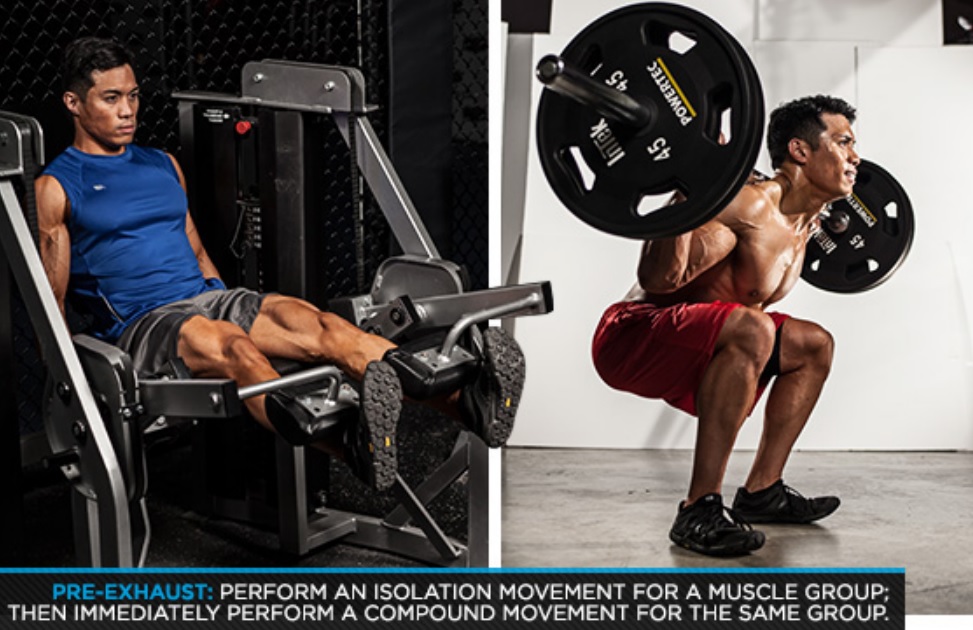
A pre-exhaustion training strategy is a unique workout approach that flips the typical exercise order. It involves performing an isolation (single-joint) exercise for a specific muscle group before moving on to a compound (multi-joint) exercise that engages the same muscle. This method is designed to tire the targeted muscle with the isolation exercise, ensuring it reaches muscular fatigue during the subsequent compound lift for maximum effort and growth.
- Step 1: Perform an isolation movement for the desired muscle group.
- Step 2: Immediately move on to a compound movement incorporating the same muscle.
This is considered one pre-exhaust set. Once you’ve completed one set, take a minute to rest before performing the second set.
Generally speaking, you want to minimize rest between your isolation and compound movement as much as possible (the best option is if there is no rest interval between the isolation movement and the compound movement), but keeping the transition to 10-15 seconds or less is a pretty safe bet. Stick to higher reps on the isolation movement (e.g. 10-12) and keep the reps slightly lower on the compound (e.g. 8-10).
Pre-Exhaustion Training Examples
Here are some examples of pre-exhaustion for several major muscle groups:
- Quads – Leg extensions (isolation exercise) followed by squats (compound exercise).
- Hamstrings – Leg curls (isolation exercise) followed by Romanian deadlifts (compound exercise).
- Chest – Dumbbell flyes (isolation exercise) followed by bench press (compound exercise).
- Shoulders – Dumbbell front raise (isolation exercise) followed by military press (compound exercise).
- Back – Straight arm lat pull down (isolation exercise) followed by pull ups (compound exercise).
- Triceps – Skullcrushers (isolation exercise) followed by close-grip bench press (compound exercise).
Two Ways of Incorporating Pre-Exhaustion
- One practical approach is to integrate pre-exhaustion with a superset methodology. This involves performing one set of isolation exercises targeting a specific muscle group immediately followed by a set of compound exercises engaging the same muscle. Using pre-exhaustion in combination with a superset is common, but not necessary.
- An alternative method is to complete all sets and repetitions of isolation exercises before moving on to the compound exercises in a traditional fashion (no supersets).
The Rationale Behind Pre-Exhaustion
The goal of pre-exhaustion is to allow an isolation lift to pre-fatigue a muscle, so that when you perform a compound lift, that muscle will have to work harder.
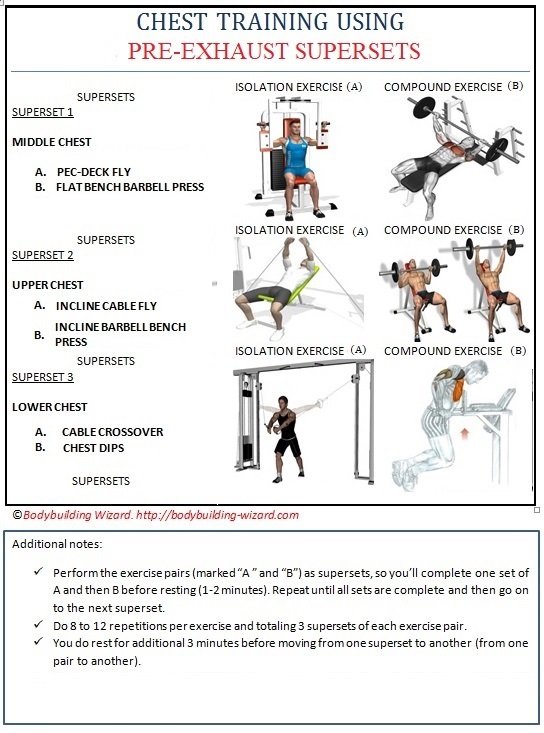
For example, before hitting your bench presses (compound exercise), a pre-exhaust exercise would be the flat bench dumbbell flies (or even the cable crossover or pec-deck machine).
During the flys only the pectorals are involved in performing the movement. When the chest is fatigued, you move to the bench press, where the pecs gain assistance from the shoulders and triceps. So although your pecs are fatigued, your deltoids and triceps are fresh so you can further blast your pecs by doing a set of bench presses immediately after the pec-deck or flyes.
Example Pre-Exhaustion Workout Routine
Here are two examples of a pre-exhaust routine for the chest:
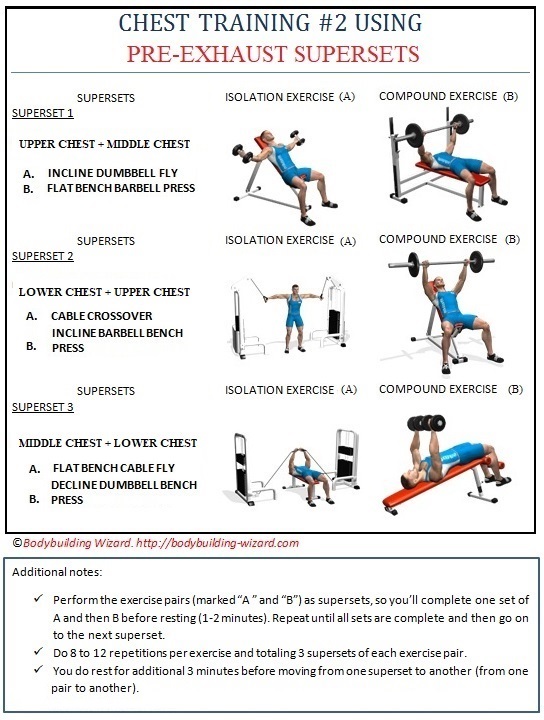
Benefits of Pre-Exhaustion Training System
- Enhances Muscle Activation: By targeting specific muscles first, pre-exhaustion ensures that the desired muscle groups are adequately fatigued, potentially leading to better activation during compound exercises.
- Improves Mind-Muscle Connection: Performing isolation exercises before compound movements can heighten awareness of muscle engagement, improving your focus and connection to the muscles being worked.
- Increases Workout Intensity: Pre-exhaustion can boost your workouts by exhausting muscles earlier in the session, challenging them to grow under enhanced tension.
- Supports Overcoming Plateaus: Varying your training approach with pre-exhaustion can help break through strength and hypertrophy plateaus by stimulating muscles differently.
- Optimizes Time Efficiency: Pre-exhaustion allows for a productive and time-effective training session for those on a tight schedule by ensuring maximum fatigue of target muscle groups in less time.
Drawbacks of Pre-Exhaustion Training Strategy
- Reduced Load Capacity: Pre-exhausting a muscle often means using lighter weights during the following compound exercises, which might curb your strength progression in those movements.
- Risk of Overtraining: Constantly pushing a muscle to fatigue pre-workout can increase the risk of overtraining, making recovery more challenging and potentially leading to injuries.
- Imbalance Development: By consistently pre-exhausting specific muscles, you could unintentionally create imbalances in muscle development, as other muscles might be less effectively targeted.
- Not Beginner-Friendly: This advanced technique might be overwhelming for fitness newbies, who are better off focusing on establishing foundational strength and form.
- Potential for Poor Form: Pre-exhaustion fatigue can result in compromised form during compound exercises, increasing the risk of incorrect technique and injury.
Pros
Cons
How Effective Pre-Exhaustion Training is for Hypertrophy?
Pre-exhaustion training is quite popular in the bodybuilding community for its perceived benefits in promoting hypertrophy. The effectiveness of this strategy for hypertrophy hinges on its ability to fully fatigue the target muscle groups, potentially leading to enhanced muscle growth. However, regarding scientific backing, the evidence presents a nuanced picture.
While anecdotal accounts from bodybuilders suggest that pre-exhaustion can indeed increase workout intensity and is beneficial for muscle growth, the scientific literature often explores this technique compared to traditional training methods. A notable study from the UK evaluated the training effects of pre-exhaustion over 12 weeks and found that although it can enhance muscle activity leading to growth, it may simultaneously reduce overall strength during compound exercises.
Regarding volume, another crucial factor for hypertrophy, the data on pre-exhaustion training presents mixed findings. In one study, participants performed more repetitions of exercises slated earlier in a workout, implying that you might achieve more volume in your isolation exercises when using this strategy. However, this may also reduce total volume for your compound lifts. Intriguingly, a 2019 study revealed that although pre-exhaustion training might decrease overall workout volume, it yields similar strength and hypertrophy outcomes compared to traditional resistance training.
It’s crucial to consider that pre-exhaustion should generally be used to switch up regular training regimens, particularly after long periods of following the same routine, to awaken muscle adaptation. Thus, its efficacy for hypertrophy may be more pronounced when combined with diverse training practices rather than as a standalone approach.
In conclusion, while the research doesn’t highlight pre-exhaustion as a superior strategy, it also doesn’t indicate any harmful effects.
How to Weave Pre-Exhaustion Training into Your Workouts?
For example, when incorporating pre-exhaustion techniques into your chest workout, which consists of five exercises, it’s crucial not to apply the strategy to every set. Instead, at the very beginning of your workout, perform the first two chest exercises (machine pec flys and flat bench press) using the pre-exhaustion system (in combination with a superset).
All other exercises should be performed classically.
This approach ensures that the target muscle is effectively engaged, but the workout isn’t solely reliant on pre-exhaustion, maintaining balance and preventing burnout.
Is Pre-Exhaustion Training System Suitable for Beginners?
No! Building a solid foundation in fundamental exercise techniques and establishing baseline strength levels are essential for beginners. This advanced training strategy can be challenging due to the requirement of proper execution and awareness of muscle fatigue, which could lead to improper form if not carefully monitored. It’s generally recommended for more advanced trainees looking to push past plateaus or increase their focus on specific muscle groups. Instead, beginners should concentrate on mastering multi-joint exercises and developing overall endurance before diving into more complex training methods like pre-exhaustion.
How Pre-Exhaustion Sets Compare to Other Advanced Training Techniques?
Pre-exhaustion sets stand out by enhancing target muscles’ peak performance before they engage in compound movements. This contrasts with other advanced techniques like drop sets and pyramiding, which either aim to extend work duration or systematically increase resistance. While methods like rest-pause training target maximal fatigue through brief rests, pre-exhaust suits lifters aiming for isolation enhancement before engaging larger muscle groups.
Additionally, supersets often combine two different exercises for different muscle groups, whereas pre-exhaustion focuses solely on the same muscle group to amplify its fatigue. This specificity makes pre-exhaustion particularly effective for athletes experiencing plateaus in their routine. Moreover, experienced lifters who incorporate occlusion training might find pre-exhaustion equally beneficial, as both techniques emphasize increasing metabolic stress within muscle fibers to drive growth.
While each advanced training strategy has merits, pre-exhaustion potentially provides a unique advantage in deliberately fatiguing a specific muscle to enhance overall workout efficacy. This deliberate fatigue ensures you are intensely hitting the desired muscle groups, which can be a game-changer when your standard workouts need a fresh challenge.
Conclusion
Pre-exhaust training techniques can create a desirable shocking effect to the target muscle group and help you break through plateaus in your training schedule like never before.
Pre-exhaust training will push you to the limits and should, therefore, be used by advanced weightlifters only. Novice weightlifters should steer well clear of such a technique, as it has the potential to overload your target muscles, resulting rapidly in overtraining and enhancing the likelihood of injury.
Consider exploring resources from reputable fitness organizations and studies for further reading on strength training techniques and strategies.
