


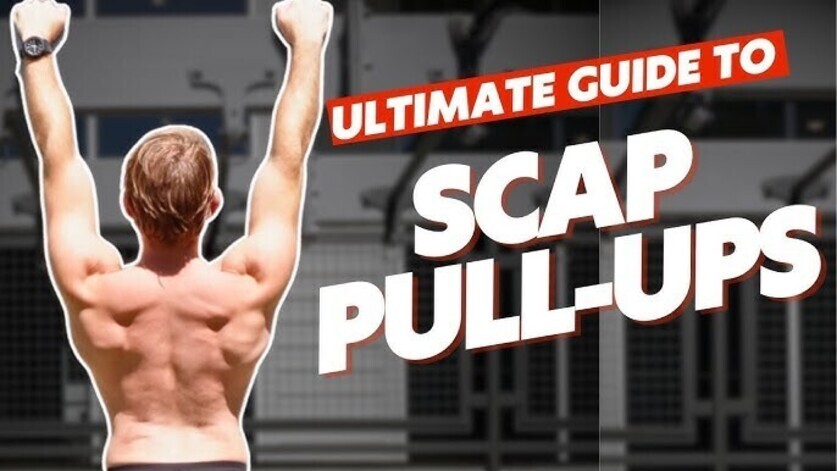
Shoulder Health, Scapular Strength & Pull-Up Foundation
Scapular pull-ups are one of the most underrated yet foundational exercises for building healthy shoulders, strong scapular control, and efficient pulling mechanics. Unlike traditional pull-ups, this movement does not focus on elbow flexion or lat-driven vertical pulling. Instead, it isolates and trains scapular depression and retraction, teaching the body how to control the shoulder blades before adding arm movement.
This exercise acts as a bridge between passive hanging and full pull-ups, making it essential for beginners learning proper pulling mechanics, athletes aiming to improve shoulder stability, and advanced lifters refining scapular strength and control.
Scapular pull-ups are not about getting your chin over the bar — they are about learning how to move the shoulder girdle correctly.
Equipment Needed
Before starting, ensure you have the following:
- Pull-up bar or power rack
- Stable grip surface
- Enough vertical clearance for a full hang
- Optional: lifting straps (for grip-limited beginners)
Step-by-Step Instructions for Scapular Pull-Ups
Proper execution is critical, as this is a scapular-movement exercise, not a traditional pull-up. The goal is controlled shoulder-blade motion, not arm-pulling.
Starting Position (Setup)
This phase establishes the correct joint alignment and scapular positioning before movement begins.
- Hang from the bar using a shoulder-width overhand (pronated) grip
- Arms fully extended, elbows locked
- Body relaxed in a passive dead hang
- Legs slightly bent or crossed behind for stability
- Core is lightly engaged to prevent excessive swinging
- Shoulders in a naturally elevated position (scapulae upwardly rotated)
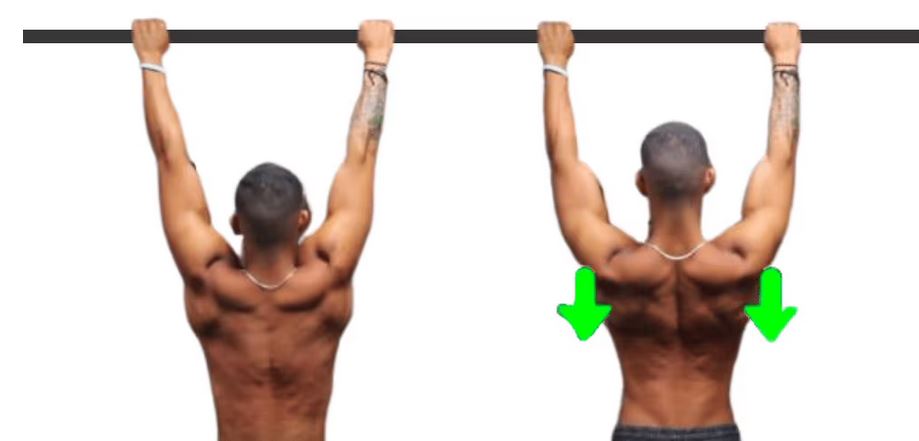
At this point, you are in a passive hang position — the shoulders are elevated, and the scapulae are not actively engaged.
Movement (Execution)
This phase isolates pure scapular motion without elbow flexion.
- Initiate the movement by pulling the shoulder blades down and slightly back
- Think: “pull your shoulders away from your ears.”
- Keep arms completely straight (no elbow bending)
- Chest rises slightly as scapulae depress and retract
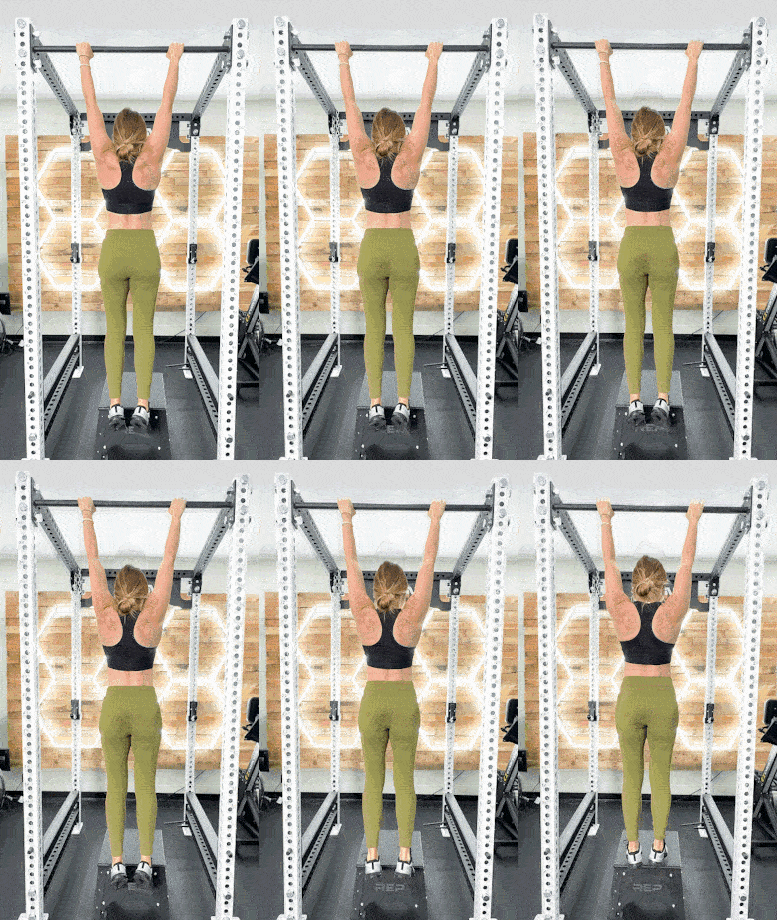
- Body moves upward a few centimeters — not a full pull-up
- Hold the top position for 1–2 seconds with full scapular control
- Slowly relax back into the passive hang position
- Repeat for controlled repetitions
This is scapular depression + retraction, not arm pulling.
Performance Pointers
- Move slowly and under full control
- Avoid momentum or kipping
- Keep elbows fully locked
- Focus on the scapula, not the arms
- Think “shoulders down and back,” not “pull up.”
- Maintain neutral neck alignment
- Control the descent as much as the ascent
- Quality > reps
Common Mistakes
- Bending the elbows (turning it into a mini pull-up)
- Using momentum
- Shrugging instead of depressing scapulae
- Overextending the lower back
- Swinging the body
- Rushing repetitions
- Poor grip positioning
Muscles Involved in Scapular Pull-Ups
Understanding the muscular roles helps clarify why this exercise is so valuable for shoulder health and performance.
Primary Muscles
- Lower trapezius — scapular depression and stability
- Middle trapezius — scapular retraction
- Rhomboids — scapular positioning and control
- Latissimus dorsi — assists scapular depression
- Serratus anterior — scapular stability and upward rotation control
Secondary Muscles
- Rotator cuff (stabilization role)
- Core musculature (anti-swing control)
- Forearm flexors (grip stabilization)
Benefits of Scapular Pull-Ups
- Improved shoulder stability
Builds active control of the scapula, reducing the risk of shoulder injury. - Better pull-up mechanics
Teaches correct initiation of vertical pulling movements. - Scapular motor control
Enhances neuromuscular coordination of the shoulder girdle. - Joint health & longevity
Improves the load tolerance of the shoulder’s passive structures. - Postural support
Strengthens muscles responsible for proper scapular alignment. - Injury prevention
Reduces impingement risk and shoulder dysfunction.
Exercise Variations
To progress or modify the difficulty, use the following variations:
Active Hang
A static hold in the top scapular-depressed position. Builds endurance and scapular stability.
Tempo Scapular Pull-Ups
Slow eccentrics and pauses to increase time under tension and control.
Band-Assisted Scapular Pull-Ups
Resistance band support for beginners to learn movement patterns safely.
Weighted Scapular Pull-Ups
Advanced variation using a light external load for increased scapular strength demand.
Single-Arm Scapular Pull-Ups
An advanced variation that dramatically increases unilateral shoulder demand.
Mixed-Grip Scapular Pull-Ups
One hand pronated, one supinated — challenges grip and asymmetrical control.
Replacement Exercises
If scapular pull-ups are not currently accessible, use:
- Scapular wall slides
- Band straight-arm pulldowns
- Cable scapular depressions
- Serratus punches
- Prone Y-raises
- Active hangs
- Dead hangs with scapular activation
The Scapular Pull-Up Strength Scale
This scale helps assess scapular strength and endurance capacity:
- Beginner: 5–10 controlled reps
- Intermediate: 10–20 controlled reps
- Advanced: 20+ reps with tempo control
- Elite: Weighted scapular pull-ups or extended tempo protocols
Scapular Pull-Ups vs Traditional Pull-Ups
| Feature | Scapular Pull-Ups | Traditional Pull-Ups |
|---|---|---|
| Primary focus | Scapular control | Arm + lat strength |
| Elbow movement | None | Yes |
| Skill development | Foundational | Performance-based |
| Injury risk | Very low | Moderate if poorly performed |
| Shoulder health | Very high | Depends on technique |
| Hypertrophy | Low | High |
| Purpose | Control & stability | Strength & mass |
Scapular Pull-Ups vs. Active & Passive Dead Hang
Although scapular pull-ups and dead hangs may look similar at first glance, they serve different purposes and stress the shoulder complex in distinct ways. A passive dead hang is primarily a relaxation and decompression position, where the body is fully suspended, and the shoulder blades are allowed to elevate freely. Its main role is joint decompression, grip endurance, and passive stretching of the shoulder structures. An active dead hang, on the other hand, introduces light muscular engagement by gently depressing the scapulae, but without producing visible upward movement of the body.
Scapular pull-ups go one step further. Instead of simply holding a position, they involve dynamic scapular movement through controlled depression and retraction, causing a small but deliberate rise of the body while the arms remain straight. This makes scapular pull-ups a true strength exercise, not just a positional hold. In short, dead hangs focus on tolerance and mobility, while scapular pull-ups train active control, strength, and coordination of the scapular muscles — a critical distinction for long-term shoulder health and pull-up progression.
If you still can’t perform a strict pull-up, don’t worry—you’re far from alone. I’ve put together a complete beginner-friendly guide that shows you exactly how to build toward your first proper rep step by step.
Read the Full Pull-Up GuideConclusion
Scapular pull-ups are not a “beginner exercise” — they are a foundational shoulder control drill that remains valuable at every training level. From rehabilitation to elite performance, this movement teaches the body how to properly control the shoulder blades, which is essential for safe and efficient pulling mechanics.
Whether your goal is stronger pull-ups, healthier shoulders, better posture, or long-term joint longevity, scapular pull-ups deserve a permanent place in your training structure.
They don’t build big arms — they build strong shoulders that allow big performance.
Are scapular pull-ups a strength or mobility exercise?
Scapular pull-ups are primarily a strength and motor control exercise for the scapular muscles. While they improve shoulder mobility indirectly, their main purpose is to build active control of scapular depression and retraction rather than passive flexibility.
Can scapular pull-ups help improve regular pull-up performance?
Yes. Scapular pull-ups strengthen the initial pulling phase of a pull-up by improving scapular engagement and timing. This often leads to better pull-up efficiency, cleaner reps, and reduced shoulder strain during full pull-ups.
Should scapular pull-ups be performed before or after pull-ups?
Scapular pull-ups are best performed before pull-ups as an activation drill or on separate days focused on shoulder stability. Doing them first helps reinforce proper scapular mechanics before loading the arms and lats heavily.
How high should the body move during a scapular pull-up?
The body should move only a few centimeters upward. Excessive movement usually indicates elbow bending or overuse of the arms. The goal is controlled scapular motion, not vertical displacement.
Are scapular pull-ups safe for people with shoulder pain?
In many cases, yes — when performed pain-free and with control. Scapular pull-ups can help restore proper shoulder mechanics, but individuals with acute pain or instability should start with dead hangs or consult a professional before progressing.
What is the most common mistake when performing scapular pull-ups?
The most common mistake is bending the elbows, which turns the movement into a partial pull-up. This shifts the load away from the scapular stabilizers and reduces the effectiveness of the exercise.
How often should scapular pull-ups be included in training?
Scapular pull-ups can be performed 2–4 times per week, depending on training volume and shoulder tolerance. They work well as part of warm-ups, accessory work, or dedicated shoulder stability sessions.
Do scapular pull-ups build muscle mass?
Scapular pull-ups contribute to strength and endurance of the scapular muscles but are not ideal for rapid hypertrophy. Their primary role is improving shoulder stability, coordination, and long-term joint health rather than muscle size.
