


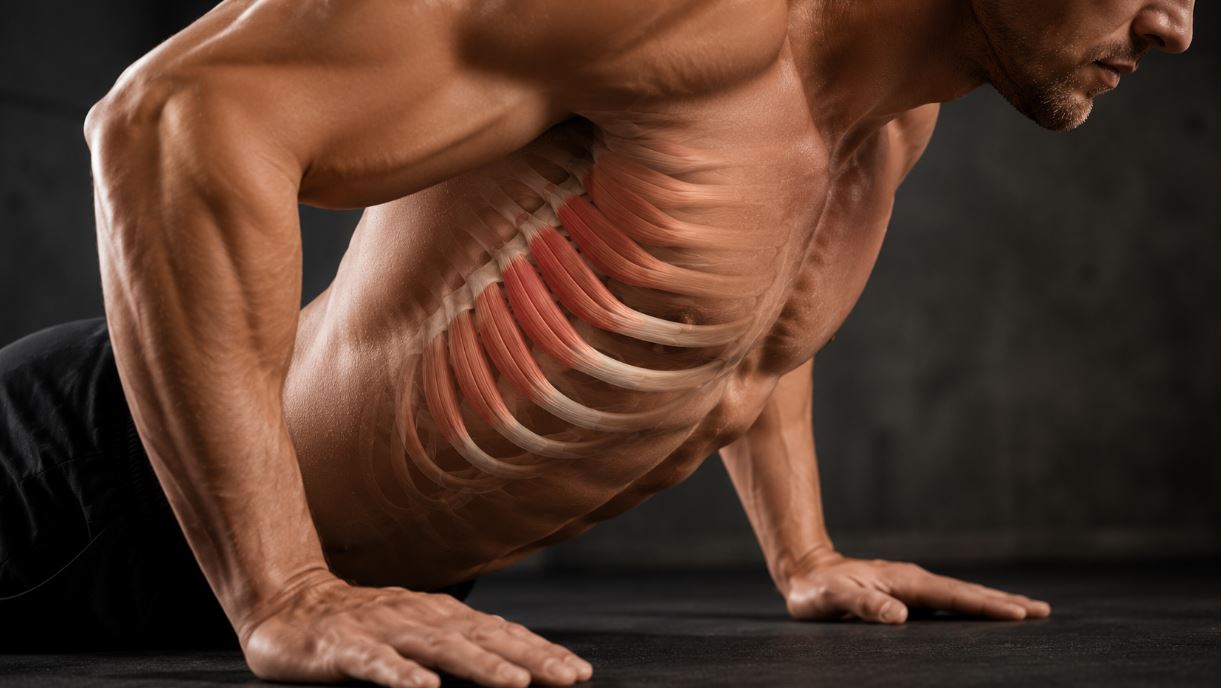
Nicknamed the “boxer’s muscle” for its central role in throwing a punch, the serratus anterior is one of the more visually striking muscles a lean physique can display — yet it’s also one of the most frequently misunderstood, thanks to a persistent myth that heavy bench pressing alone is enough to develop it. Understanding the functional anatomy of the serratus anterior explains why that assumption falls short and reveals a genuinely surprising anatomical detail: part of this “single” muscle may not behave quite as textbooks traditionally describe.
Quick Answer
The serratus anterior is a fan-shaped muscle on the side of the ribcage, named for its saw-toothed appearance. Its primary functions are scapular protraction — pulling the shoulder blade forward and around the ribcage — and upward rotation of the scapula, working as part of a coordinated “force couple” with the trapezius to allow full overhead arm elevation. It’s directly opposed to the rhomboids and middle trapezius, and weakness here is a well-documented cause of a visible condition called scapular winging.
| Muscle type | Fan-shaped muscle of the lateral ribcage |
|---|---|
| Primary functions | Scapular protraction, upward rotation of the scapula |
| Secondary functions | Scapular stabilization, assists forced inhalation |
| Innervation | Long thoracic nerve (C5–C7) |
| Blood supply | Lateral thoracic artery, superior thoracic artery, thoracodorsal artery |
| Common exercises | Push-up plus, incline push-up, landmine press |
| Main bodybuilding role | Shoulder health and the “boxer’s muscle” rib detail |
Overview
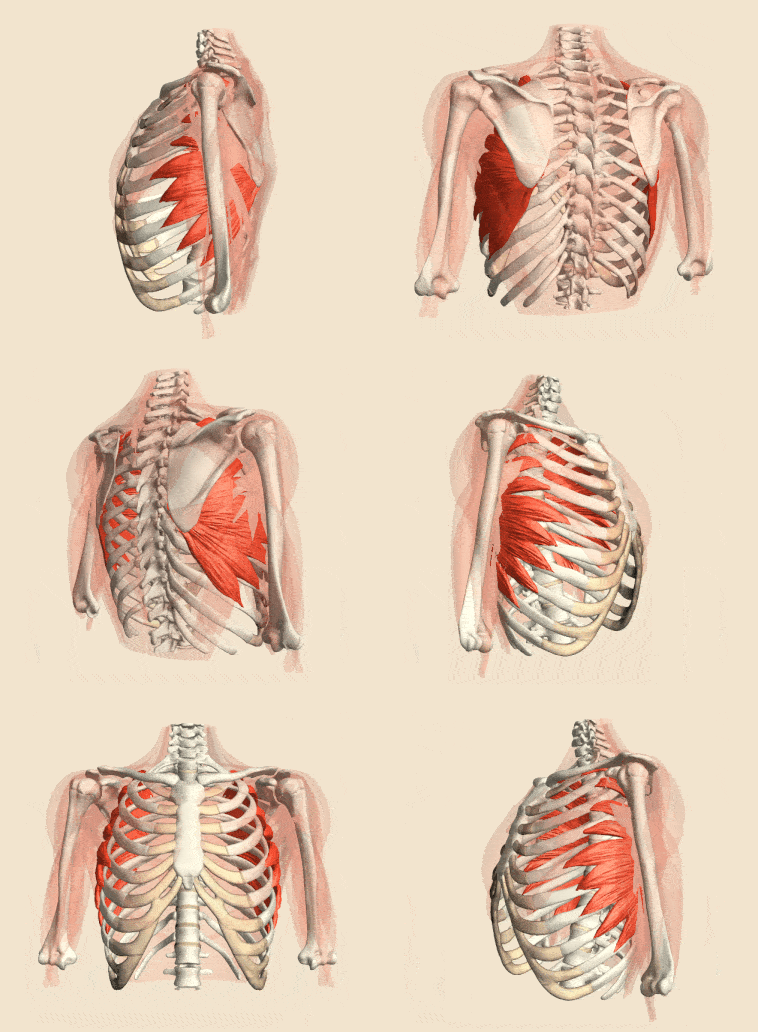
The serratus anterior lies on the lateral wall of the rib cage, mostly hidden beneath the scapula, subscapularis, and parts of the pectoralis major and latissimus dorsi. Only the lower digitations are visible on a lean physique, appearing as the distinctive “gill-like” ridges beneath the armpit that many lifters associate with a shredded, athletic look.
Beyond its aesthetic role, the serratus anterior is one of the more clinically significant muscles in the entire shoulder girdle. Its role in stabilizing the scapula against the ribcage means that weakness here doesn’t just limit strength — it can visibly alter how the shoulder blade sits and moves, with consequences for the rest of the shoulder’s mechanics. To see how it fits into the rest of your muscular system, check out our interactive muscle anatomy tool.
Anatomy & Location
The serratus anterior originates from the outer surfaces of the upper eight or nine ribs and wraps posteromedially around the ribcage to insert along the entire costal (front-facing) surface of the medial border of the scapula. Fibrous divisions called tendinous septa split the muscle into nine finger-like sections known as digitations, giving the muscle its saw-toothed, serrated appearance and namesake.

Characteristics at a Glance
| Characteristic | Value |
|---|---|
| Shape | Fan-shaped, divided into nine finger-like digitations |
| Location | Lateral ribcage, beneath the scapula and pec major |
| Fiber architecture | Multipennate, running obliquely between tendinous septa |
| Crosses | Scapulothoracic joint |
The nine digitations are generally grouped into three functional parts: a superior portion (ribs 1–2, inserting near the superior angle of the scapula), an intermediate portion (ribs 2–3, inserting along the medial border), and an inferior portion (ribs 4–8/9, inserting along the medial border and inferior angle). The inferior portion is the largest and most powerful of the three, and its lowest fibers interdigitate directly with the external oblique — the source of the visible “tie-in” that appears between the ribs and abdomen on very lean physiques.

Origin, Insertion, Innervation & Blood Supply
For a broader explanation of these anatomical terms, see our guide to muscle anatomy basics: origin, insertion, and innervation.
| Attribute | Detail |
|---|---|
| Origin | Outer surfaces of the 1st through 8th/9th ribs |
| Insertion | Costal surface of the medial border of the scapula |
| Innervation | Long thoracic nerve (C5–C7) |
| Blood supply | Lateral thoracic artery (primary), with contributions from the superior thoracic and thoracodorsal arteries |
According to StatPearls’ anatomical reference on the serratus anterior, the muscle’s innervation is genuinely more complex than a single-nerve textbook summary suggests. While the long thoracic nerve is the primary nerve supply overall, the superior portion of the muscle receives an additional, independent nerve branch innervating C4-C6 — one that follows a path similar to that of the nerve supplying the levator scapulae. This has led some anatomists to suggest the superior portion may be developmentally and functionally more closely related to the levator scapulae than to the “true” serratus anterior below it, a nuance rarely discussed outside of specialist anatomical literature.
Function
The serratus anterior’s two primary roles are scapular protraction — pulling the shoulder blade forward and around the ribcage, the motion involved in a punch or a push — and upward rotation of the scapula, which allows the arm to be raised fully overhead. This second function doesn’t occur in isolation: the serratus anterior works as part of a coordinated “force couple” alongside the upper and lower trapezius, with each muscle contributing a distinct rotational pull on the scapula to achieve smooth, controlled upward rotation throughout the full overhead range of motion.
Beyond producing movement, the serratus anterior is a critical scapular stabilizer, keeping the shoulder blade flat against the rib cage during both rest and activity. It also contributes modestly to forced inhalation, helping expand the chest cavity when breathing demand increases.
Synergists & Antagonists
Synergists (muscles that work alongside the serratus anterior to help produce the same movement):
- Pectoralis minor — assists scapular protraction and stabilization, particularly during reaching movements
- Trapezius (upper and lower fibers) — forms the force couple with the serratus anterior for full scapular upward rotation
Antagonist (the muscle group that opposes the serratus anterior’s action, working in the opposite direction):
- Rhomboid muscles and middle trapezius — perform scapular retraction and downward rotation, directly opposing the serratus anterior’s protraction and upward rotation
Common Exercises

Because the serratus anterior activates during most pressing and punching-type movements, it’s rarely completely untrained — but exercises that specifically emphasize scapular protraction at the top of the movement target it far more directly than pressing alone.
| Exercise | Role of the Serratus Anterior |
|---|---|
| Push-up plus | Prime mover (isolation) |
| Incline push-up | Major contributor |
| Landmine press | Major contributor |
| Wall slide | Prime mover (isolation) |
| Flat barbell bench press | Minor contributor |
| Flat dumbbell bench press | Minor contributor |
Bodybuilder’s Take
“Isn’t the serratus anterior already trained enough by bench pressing?” This is a common but incomplete assumption. Standard pressing movements do involve the serratus anterior to some degree, but they don’t emphasize the full-protraction end range where this muscle does its most distinct work — the “reaching” or “punching out” portion at the top of a push-up or press. Adding a deliberate protraction squeeze at the top of a push-up (the “push-up plus” variation) targets this muscle far more specifically than pressing alone.
“Why does my shoulder blade stick out when I do push-ups?” This is a classic sign worth paying attention to, since it often points directly at serratus anterior weakness or inhibition. Because this muscle holds the scapula flat against the ribcage, insufficient strength here can cause the shoulder blade to lift away from the ribcage during pushing movements — a pattern called scapular winging. Building serratus anterior strength with low-load, controlled exercises usually resolves mild cases over time.
“If my rows and pull-ups are strong, could that actually be working against my serratus anterior?” In some cases, yes. Because the rhomboids and serratus anterior pull the scapula in opposite directions, lifters who heavily prioritize rowing and pulling volume relative to protraction-focused work can develop a relative imbalance, sometimes described as “rhomboid dominance,” in which an overly dominant retraction pattern makes it harder to properly activate the serratus anterior. If this applies to you, incorporating light, controlled protraction work and stretching the upper back after heavy pulling sessions can help restore better balance between the two.
Common beginner mistakes:
- Assuming heavy pressing alone fully develops the serratus anterior, missing the specific end-range protraction that isolates it
- Using too much weight on serratus-specific exercises, which are meant to be trained with light loads and precise control
- Ignoring visible scapular winging during pushing exercises instead of addressing it with targeted, low-load activation work
Common Conditions
This section is educational and should not replace professional medical advice.
The serratus anterior’s nerve supply, the long thoracic nerve, follows an unusually long and superficial course along the chest wall. According to StatPearls’ anatomical reference on the long thoracic nerve, this nerve courses approximately 22 to 24 centimeters along the outer surface of the muscle, making it particularly vulnerable to injury from stretch, compression, or direct trauma. Common causes of long thoracic nerve injury include surgical procedures in the axilla (such as lymph node removal), prolonged pressure from carrying heavy loads like a backpack, and blunt trauma. The hallmark sign of long thoracic nerve palsy is scapular winging, in which the shoulder blade visibly lifts away from the rib cage, most noticeable when pushing against resistance or a wall. Persistent scapular winging, shoulder instability, or difficulty raising the arm overhead should be evaluated by a healthcare professional rather than trained through.
Common Myths
Myth: Bench pressing is enough to fully develop the serratus anterior. Pressing movements involve the muscle to some degree, but they don’t emphasize the full-protraction end range that isolates it most directly — dedicated protraction-focused exercises train it more specifically.
Myth: Scapular winging always means a serious injury. While persistent, unexplained winging should be evaluated professionally, mild winging during pushing exercises is often simply a sign of serratus anterior weakness that responds well to targeted, low-load training.
Myth: The serratus anterior is a single, uniform muscle with one job. Research indicates its superior portion has a distinct, partially independent nerve supply and may function somewhat differently from the middle and inferior portions, which are more classically “serratus anterior” in behavior.
Key Takeaways
- The serratus anterior’s main jobs are scapular protraction and upward rotation, working alongside the trapezius for full overhead reach.
- Bench pressing alone doesn’t fully train it — dedicated protraction exercises like the push-up plus are more direct.
- Its nerve supply, the long thoracic nerve, has an unusually long, exposed course, making it vulnerable to injury.
- Scapular winging during push-ups is a common, usually correctable sign of serratus anterior weakness.
- Excessive rowing and pulling volume relative to protraction work can create an imbalance that inhibits serratus activation.
Frequently Asked Questions
What is the main function of the serratus anterior?
Its main jobs are scapular protraction, pulling the shoulder blade forward around the ribcage, and upward rotation of the scapula, which allows full overhead arm elevation.
Why is the serratus anterior called the “boxer’s muscle”?
It’s the muscle primarily responsible for the forward “reaching” motion of the shoulder blade during a punch, which is why it’s closely associated with boxing and punching movements.
Does bench pressing train the serratus anterior?
Only partially. Pressing movements involve the muscle to some degree, but they don’t emphasize the full-protraction end range that isolates it most effectively, so dedicated exercises like the push-up plus train it more directly.
What causes scapular winging?
The most common cause is weakness or inhibition of the serratus anterior, though it can also result from long thoracic nerve injury, which supplies this muscle exclusively.
Can too much back training hurt serratus anterior activation?
In some cases, yes. Heavily prioritizing rowing and pulling volume relative to protraction work can create an imbalance sometimes called “rhomboid dominance,” which can make it harder to properly activate the serratus anterior.
Sources & References
Every claim in this guide is grounded in anatomical references and published research. Explore the primary sources below.
