



Introduction
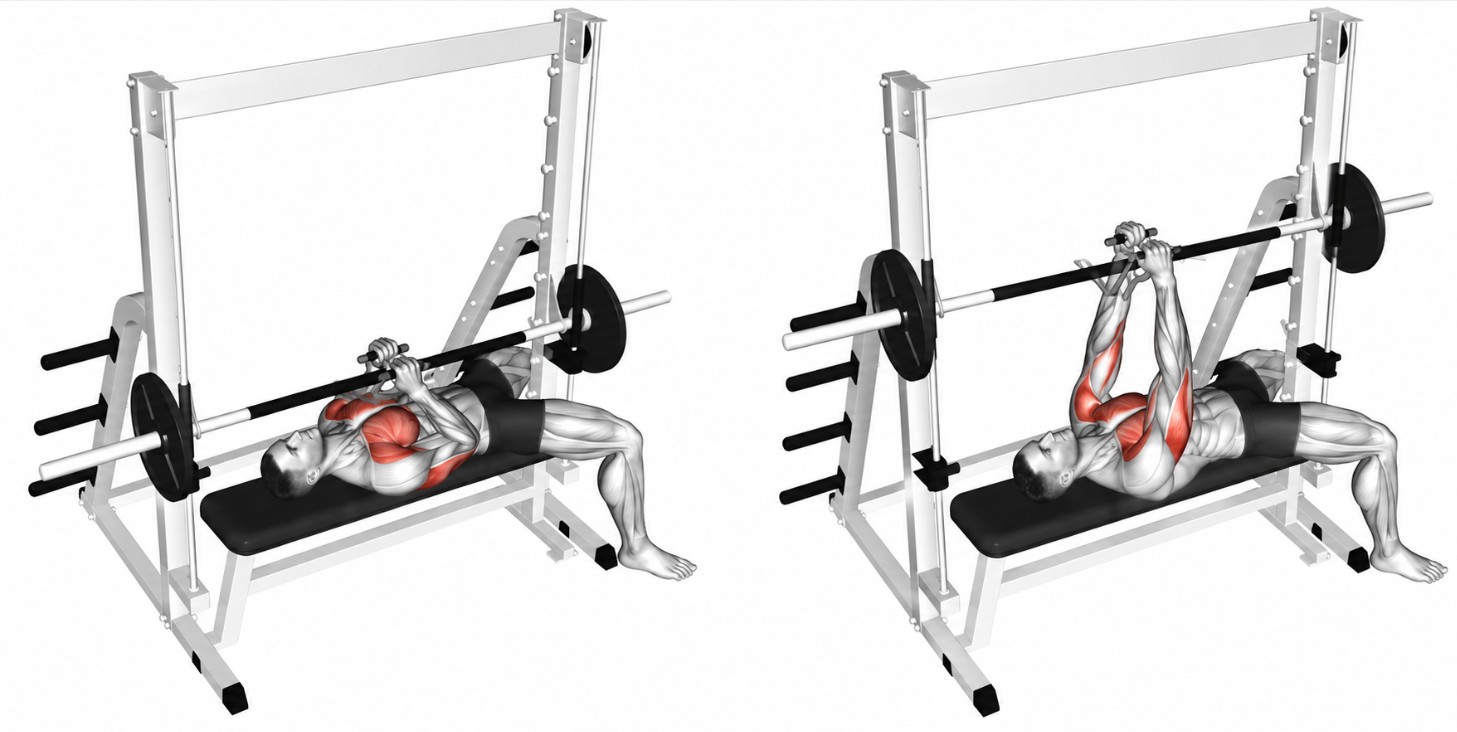
The Smith machine hex press is a close-grip chest press performed on a flat bench inside a Smith machine, using a V-bar attachment placed on the bar. Instead of gripping the bar, you hold the V-bar with a neutral grip, palms facing each other, and press it along the machine’s guided path.
It is a somewhat forgotten exercise that you rarely see in commercial gyms, and when you do, it tends to draw curious looks. Yet it combines several useful features: the stability and safety of the Smith machine bench press, a narrow neutral grip that brings the triceps strongly into play, and the option to press your hands toward each other on the handle for an extra squeezing effort.
The name comes from its free-weight cousin, the dumbbell squeeze press, which is also known as the hex press. The Smith machine version trades the balance challenge of dumbbells for a guided bar path and built-in hooks, making it easier to learn and safer to train hard, even without a spotter.
The Smith machine hex press is a close-grip chest press performed on a flat bench inside a Smith machine, using a V-bar attachment placed on the bar and held with a neutral grip. The narrow hand position and guided bar path train the pectoralis major together with the triceps brachii and anterior deltoids, while the lifter can actively press the hands toward each other on the handle to add an inward, squeezing effort.
Other Names for Smith Machine Hex Press
Because it is a less common exercise, you may come across it under a few different names.
- Smith machine V-bar press
- Smith machine close neutral-grip press
- Smith machine squeeze press
- V-handle Smith press
- Smith hex press
Required Equipment
The Smith machine hex press requires one piece of equipment that is not usually found at the Smith machine, so bring it over before you start.
- Smith machine with rotating hooks and adjustable safety stops
- Flat bench placed in the center of the Smith machine
- V-bar attachment (close-grip neutral handle), usually borrowed from the cable station
How to Perform Smith Machine Hex Press
The key to this exercise is a secure, centered attachment and a bench position that brings the bar down to your lower chest.
Starting Position
Set up the bench, the attachment, and the safety stops before loading any weight.
- Place a flat bench lengthwise in the center of the Smith machine
- Position the V-bar on top of the Smith bar and center it carefully
- Lie back so the V-bar lines up with your lower chest when the bar is lowered
- Set the safety stops just below the point where the V-bar touches your chest
- Grip the V-bar with a neutral grip, palms facing each other, and plant your feet
- Squeeze your shoulder blades together, then rotate the bar to unhook it
Execution (Action Phase)
Keep the movement smooth and controlled, with the V-bar traveling straight over your lower chest.
- Take a breath and brace your core (see our guide on breathing technique)
- Lower the bar slowly until the V-bar lightly touches your lower chest
- Keep your elbows close to your body as you lower the bar
- Exhale and press the bar back up along the rails
- Squeeze your chest for one second near the top without locking your elbows out forcefully
- After the final rep, rotate the bar back onto the hooks
Check that the V-bar is still centered between sets, as it can shift slightly as you rack and unrack the bar.
Video Demonstration
Watching the Smith machine hex press helps you see how the V-bar is positioned on the bar and how the elbows stay close to the body.
In the video below, notice how the lifter lowers the bar with control until the V-bar reaches the lower chest, keeps the elbows tucked, and presses back up with a brief squeeze at the top. The bar never bounces off the chest, and the movement follows the machine’s guided path.

The Smith machine hex press is one of those exercises that gets strange looks in a commercial gym. A V-bar that normally lives on the cable station, sitting on top of a Smith machine bar, looks a bit like someone lost a bet. More than once, a client of mine has been politely asked whether they “know that attachment belongs somewhere else.”
Before you worry about the looks, worry about the attachment. Make sure the V-bar is centered on the Smith bar and sits securely before you unrack, and check that it hasn’t shifted between sets. Then lower the bar to your lower chest with control. A well-centered handle and a smooth descent are what make this exercise feel great instead of awkward.
Quick Form Checklist
Use these cues before every set to keep the exercise safe and effective.
- V-bar centered and secure on the bar
- Bar lowers to the lower chest
- Safety stops set just below the touch point
- Elbows close to the body
- Controlled descent, no bouncing
Technical Emphasis & Targeting Adjustments
A few small adjustments can shift how the Smith machine hex press challenges your chest and triceps.
- Pressing the hands inward → added squeezing effort. Actively pushing your hands toward each other on the V-bar adds an isometric inward effort to the press. Many lifters find this makes the chest contraction easier to feel, particularly near the top.
- Narrow neutral grip → more triceps involvement. The close hand position increases triceps involvement. Research on the bench press has shown that narrow grips produce higher triceps activity, so expect your triceps to work hard as well.
- Lower chest touch point → a more natural pressing path. Bringing the V-bar down to the bottom of your sternum usually keeps the elbows tucked and the forearms vertical. Touching higher on the chest tends to push the elbows outward.
- Slower eccentric → more time under load. Lowering the bar over 2–3 seconds improves control and keeps the chest and triceps working throughout the rep. Learn more about eccentric training and why the lowering phase matters.
- Incline bench → more upper chest involvement. Setting the bench to about 30 degrees shifts more of the work toward the clavicular head of the chest and the front delts.
Common Mistakes
Most mistakes with the Smith machine hex press come from a poor setup. Several of them are also typical bench press mistakes.
- An off-center or loose attachment. A V-bar that sits unevenly on the bar makes the press lopsided and can shift during the set. Center it carefully and check it again between sets.
- Wrong bench position. If the V-bar comes down to your upper chest or neck, the pressing angle becomes awkward, and the elbows drift outward. Move the bench until the V-bar reaches your lower chest.
- Letting the elbows drift far out to the sides. The narrow grip keeps the elbows close to the body. Letting them flare wide makes the movement feel awkward and harder to control, so keep them tucked throughout the set.
- Bouncing the bar off the chest. Using the chest as a springboard removes tension from the muscles and can bruise the sternum. Lower the bar with control and reverse the movement smoothly.
- Bending the wrists back. Letting the wrists extend under the load shifts stress away from the muscles. Keep your wrists straight, with the handles resting in the base of your palms.
The V-bar keeps your hands in a fixed position, but you can still press your hands toward each other on the handle throughout the set. Your hands won’t move, but the inward effort adds an isometric squeezing component, similar to what you do in the dumbbell squeeze press.
Many lifters feel their chest working much more clearly with this cue, especially near the top of the press. Start each set with a firm inward squeeze, keep it through every rep, and notice when it fades, as that is usually a sign that fatigue is setting in.
Mechanical Considerations
The Smith machine hex press combines shoulder flexion and elbow extension, with the narrow neutral grip keeping the upper arms closer to the torso than in a regular bench press. You can read more about these joint actions in our guide to anatomical movements. Because the bar moves along fixed rails, the machine removes most of the balancing demand. A study comparing the Smith machine and free-weight bench press found similar pectoralis major and anterior deltoid activation in both versions, suggesting the guided path does not reduce the work done by the prime movers.
The narrow grip also changes load distribution. Research on bench press grip width shows greater triceps involvement with narrower grips, and a biomechanical modeling study found that grips narrower than 1.5 times shoulder width reduced some measures of shoulder joint loading, although effects varied across load parameters. No study has examined the Smith machine hex press directly, so its benefits are based on research on related pressing exercises and biomechanical reasoning. As a compound exercise, it trains the chest, triceps, and front delts together.
Muscles Worked in Smith Machine Hex Press
MAIN MUSCLES
SECONDARY MUSCLES
STABILIZERS
ANTAGONISTS
The “Inner Chest” Question
The Smith machine hex press is often promoted as an “inner chest” exercise that builds the separation between the pecs at the sternum. It is an appealing idea, but there is no strong evidence that any exercise selectively builds the inner portion of the chest. The pectoralis major attaches along the sternum and works as one muscle during pressing.
The visible line between your pecs depends mainly on overall chest size, your body fat level, and your individual anatomy, including where your muscles attach, as explained in our article on good genetics for bodybuilding. The hex press can certainly help you build a bigger chest, and the inward squeeze makes the contraction easy to feel near the midline, but the best way to show a more defined chest is to build the whole muscle and reduce body fat.
Smith Machine Hex Press Pros and Cons
The Smith machine hex press is a useful but often overlooked exercise with clear strengths and a few limitations. For a broader look at the equipment, see our article on the Smith machine in strength training.
Advantages
- Safe to train alone. The hooks and safety stops allow you to end a set at any point. This lets you take hard sets close to failure without a spotter.
- Combined chest and triceps work. The narrow neutral grip strongly targets the triceps along with the chest. It fits well into push-day routines.
- Easy to learn. The guided bar path removes the balance challenge of the dumbbell squeeze press. Beginners can focus entirely on the pressing movement.
- Small load increments. Standard weight plates allow precise, gradual progression. This makes long-term progress easy to track.
Potential Drawbacks
- Requires an attachment. You need to bring a V-bar from the cable station, which isn’t always available. The setup also takes a little more time than a regular Smith press.
- Fixed bar path. The straight-line movement may not suit every body type. Bench placement becomes important for finding a comfortable groove.
- Triceps may limit the set. With the narrow grip, the triceps can fatigue before the chest, especially for lifters with relatively weak triceps.
- Limited research. The exercise has not been studied directly. Its benefits are based on research on related exercises and practical experience.
Safety Considerations
The Smith machine hex press is one of the safer pressing exercises, but a few precautions still apply.
- Attachment security. A V-bar that shifts or slips during a set is the biggest exercise-specific risk. Always center it carefully and check it between sets.
- Shoulder discomfort. The narrow grip keeps the elbows closer to the body, which many lifters find comfortable, but never ignore pain. Stop if you feel pinching or sharp pain, and learn more about shoulder joint anatomy.
- Wrist strain. Letting the wrists bend back under a heavy load can aggravate wrist injuries. Keep the handles in the base of your palms, with your wrists stacked over your elbows.
- Elbow and triceps tendon irritation. The high triceps involvement and heavy lockouts can irritate the elbows. Use controlled reps and watch for signs of triceps tendonitis.
Smith Machine Hex Press Variations
Incline Smith machine hex press
Difficulty: Similar to the standard version
Setting the bench to about 30 degrees shifts more emphasis onto the upper chest and front delts. It combines the close neutral grip of the hex press with the angle of the Smith machine incline press. Lower the V-bar to your upper chest in this position.
Decline Smith machine hex press
Difficulty: Similar to the standard version
Performed on a decline bench, this variation shortens the range of motion and emphasizes the lower chest fibers. It is the close-grip version of the Smith machine decline press.
Paused Smith machine hex press
Difficulty: Harder than the standard version
Holding the V-bar lightly on your chest for 1–2 seconds before each press removes the stretch reflex. This makes every rep harder and builds strength from the bottom position. Use a lighter load than usual.
Close-grip Smith machine bench press
Difficulty: Similar to the standard version
Without the V-bar, you can grip the Smith bar with a close pronated grip, about shoulder-width apart. This version shifts even more emphasis onto the triceps and is the guided alternative to the close-grip barbell bench press.
Dumbbell squeeze press
Difficulty: Harder than the standard version
The free-weight version of the hex press uses two dumbbells pressed firmly together throughout the set. It requires more stability and control, and you maintain the squeeze entirely through your own effort.
Replacement Exercises (Substitutes) for the Smith Machine Hex Press
If you don’t have a V-bar or want to vary your training, these exercises also combine pressing with an inward squeezing effort or target the pectoralis major in a similar way. You can find more options in our list of the most effective middle chest exercises.
- Lying plate press. The lying plate press uses a weight plate squeezed between the palms. It creates a similar inward effort with very little equipment.
- Svend press. The Svend press is performed standing, pressing a plate forward while squeezing it. It is an excellent finisher for any chest workout.
- Machine fly. The machine fly isolates the chest through horizontal adduction without involving the triceps. It is a good choice when the triceps fatigue too early.
- Pec-deck fly. The pec-deck fly uses forearm pads and a short lever to isolate the chest. It is simple to set up and easy on the elbows.
- Cable crossover. The cable crossover trains the chest through a wide range of angles with constant cable tension.
- Hammer Strength bench press. The Hammer Strength bench press uses plate-loaded lever arms that follow a converging arc. It combines heavy pressing with some inward movement.
How to Program the Smith Machine Hex Press
How you program the Smith machine hex press depends on your training goal, experience level, and where it fits in your chest workout.
Show full programming guideHide programming guide ▾
| Goal | Sets | Reps | Rest | Tempo |
|---|---|---|---|---|
| Hypertrophy | 3–4 | 8–12 | 60–90 s | 2–3 s lowering, 1 s squeeze at top |
| Strength-focused | 3–4 | 6–8 | 90–120 s | Controlled lowering, forceful press |
| Muscular endurance | 2–3 | 15–20 | 30–60 s | Steady, continuous |
Muscle growth can occur across a wide range of repetitions when sets are taken close to failure, so treat these numbers as guidelines rather than strict rules. Adjust your rest periods between sets based on how recovered you feel.
- As a second chest exercise after barbell or dumbbell presses
- On push days as a combined chest and triceps movement
- As a close-grip pressing option when training alone, thanks to the Smith machine hooks
- As part of a Smith machine-based routine (see our overview of Smith machine exercises)
Apply progressive overload with a double-progression approach: once you complete all sets at the top of your rep range with a controlled descent, add the smallest available plates (1.25–2.5 kg per side). Track your hex press numbers separately from your regular Smith machine bench press, since the narrow grip changes how much you can lift.
Smith Machine Hex Press vs Dumbbell Squeeze Press (Comparison Table)
| Criteria | Smith Machine Hex Press | Dumbbell Squeeze Press |
|---|---|---|
| Equipment | Smith machine, bench, V-bar | Two dumbbells, bench |
| Grip | Neutral, fixed on the V-bar | Neutral, dumbbells pressed together |
| Squeeze Mechanism | Optional inward effort on a fixed handle | Required to keep the dumbbells together |
| Stability Demand | Low | Moderate |
| Training Alone | Hooks and safety stops | No built-in safety |
| Load Progression | Small plate increments | Limited by dumbbell jumps |
| Best Use | Heavier close-grip pressing, training alone | Home training, squeeze-focused chest work |
Both exercises share the same basic idea: a narrow, neutral grip combined with an inward squeezing effort. The dumbbell squeeze press requires more control, and because the dumbbells must stay together, the squeeze is built into every rep. It is also easy to perform at home with just a pair of dumbbells.
The Smith machine hex press is the better option when you want to load the movement more heavily or train close to failure alone, thanks to the guided bar path and safety stops. Many lifters use both, rotating them every few weeks to vary the stimulus.
Final Thoughts
The Smith machine hex press is an underrated chest exercise that combines the safety of a guided bar path with a narrow neutral grip that strongly involves the triceps. With a simple V-bar attachment, it becomes a versatile option for push days and chest workouts alike.
It won’t build an “inner chest” on its own, but it can help you build a bigger, stronger chest overall. Center the attachment carefully, lower the bar to your lower chest, press your hands toward each other on every rep, and you’ll quickly see why this exercise deserves more attention.
Frequently Asked Questions
What is the Smith machine hex press?
The Smith machine hex press is a close-grip chest press performed on a flat bench inside a Smith machine, using a V-bar attachment placed on the bar. The neutral, narrow grip trains the chest together with the triceps and front delts.
What is the difference between the Smith machine hex press and the dumbbell squeeze press?
Both are often called the hex press. The Smith machine version uses a V-bar on a guided bar path, while the dumbbell squeeze press is performed with two dumbbells pressed firmly together. The dumbbell version requires more stability, while the Smith version lets you rack the weight at any point.
What attachment do I need for the Smith machine hex press?
You need a V-bar (close-grip neutral handle), the same attachment typically used for cable rows or triceps pushdowns. It is placed on top of the Smith machine bar and centered before you start.
What muscles does the Smith machine hex press work?
It primarily works the pectoralis major, with significant help from the triceps brachii and anterior deltoids. The narrow grip increases the involvement of the triceps compared with a regular bench press.
Does the Smith machine hex press build the inner chest?
There is no strong evidence that any exercise selectively builds the “inner” chest. The pectoralis major works as a whole, and the visible separation at the sternum depends mainly on overall chest size, body fat, and individual anatomy.
Where should the bar touch my chest?
Lower the bar until the V-bar lightly touches your lower or mid-chest, around the bottom of your sternum. Adjust the bench position before you add weight so the bar reaches this point.
Can I do the hex press on a Smith machine without an attachment?
Without an attachment, you would use a close pronated grip on the bar, which is a different exercise: the close-grip Smith machine bench press. The V-bar is what allows the neutral grip that defines the hex press.
How heavy should I go on the Smith machine hex press?
Choose a weight that allows 8–12 controlled reps without bouncing the bar off your chest. Most lifters use noticeably less weight than on a regular Smith machine bench press because of the narrow grip.
Is the Smith machine hex press good for beginners?
Yes. The guided bar path, hooks, and safety stops make it beginner-friendly, as long as the V-bar is properly centered and secured before each set.
Should I do the hex press before or after regular bench press?
Most lifters perform it after their main pressing exercise, when the goal is extra chest and triceps volume. It can also be the main press on days when you want a close-grip, neutral-grip option.
