



Introduction
The stability ball leg curl is one of the best bodyweight hamstring exercises for simultaneously developing posterior-chain strength, core stability, and lower-body coordination. Unlike traditional machine-based leg curls that stabilize the body for you, this exercise forces the hamstrings, glutes, abs, and spinal stabilizers to work together to maintain proper body position throughout the movement.
Although the exercise primarily targets the hamstrings through knee flexion, maintaining elevated hips on an unstable surface dramatically increases the involvement of core and posterior chain stabilizers. This combination makes the stability ball leg curl far more demanding than it initially appears.
One of the biggest advantages of the stability ball leg curl is its ability to train the hamstrings with minimal equipment and virtually no spinal loading. Because the movement uses bodyweight resistance instead of external loads, it works extremely well for home workouts, athletic training, rehabilitation settings, and injury-prevention programs.
The exercise is also surprisingly challenging from a coordination standpoint. Maintaining hip elevation while pulling the ball toward the body requires constant tension throughout the posterior chain. Many lifters quickly discover that hamstring weakness, poor core stability, or lack of coordination becomes immediately obvious during the movement.
Required Equipment
To perform the stability ball leg curl correctly, you need:
- Stability ball (Swiss ball)
- Flat exercise surface
- Enough open space for full leg extension
Choosing the correct ball size is important for maintaining proper positioning and movement mechanics. When lying on the floor with your heels on the ball, your knees and hips should move comfortably through the full range of motion without excessive instability.
Unlike machine-based hamstring curls, the stability ball variation relies entirely on bodyweight resistance and self-stabilization. This makes the exercise highly accessible while simultaneously increasing demands on balance, coordination, and core control.
Other Names for the Stability Ball Leg Curl
This exercise may also be referred to as:
- Swiss Ball Hamstring Curl
- Exercise Ball Leg Curl
- Stability Ball Hamstring Curl
- Ball Leg Curl
- Exercise-Ball Supine Leg Curl
Although the terminology varies slightly, all versions involve curling the ball toward the body while maintaining elevated hips and tension in the posterior chain.
How to Perform the Stability Ball Leg Curl
Starting Position (Setup)
Proper setup is essential because the exercise depends heavily on body positioning, hip stability, and core control.
- Lie on your back with your arms resting beside your body.
- Place your heels or lower calves on top of the stability ball.
- Keep your legs fully extended and toes pointing upward.
- Press the heels into the ball and lift the hips off the floor.
- Create a straight line from your shoulders to your ankles.
- Brace the core and keep the glutes engaged throughout the movement.
At the start of the exercise, your body, legs, and the ball should form a stable bridge position.

Execution (Movement Phase)
- Initiate the movement by flexing the knees.
- Pull the ball toward your glutes by driving the heels downward and backward.
- Keep the hips elevated throughout the curl.
- Continue until the knees are fully flexed and the ball is close to the body.
- Pause briefly and squeeze the hamstrings at peak contraction.
- Slowly extend the legs and return the ball to the starting position under control.
The movement should remain smooth and controlled without allowing the hips to collapse toward the floor.

Technique Optimization Tips for the Stability Ball Leg Curl
Because the exercise combines hamstring training with unstable-body positioning, small technical details significantly affect exercise quality.
- Keep the hips elevated throughout the set.
- Avoid arching the lower back excessively.
- Maintain constant core tension.
- Move slowly during both phases of the exercise.
- Keep the knees aligned with the hips and feet.
- Avoid pressing excessively through the neck and shoulders.
- Focus on hamstring contraction rather than simply rolling the ball.
A highly effective cue is: “Drive the heels down while pulling the ball toward the glutes.”
Mechanical Resistance Analysis
The stability ball leg curl differs from traditional machine-based hamstring curls because the body must remain suspended in a bridge position throughout the movement. This dramatically increases the demands for stabilization across the core, glutes, and spinal stabilizers.
The exercise primarily trains the hamstrings through knee flexion, but maintaining elevated hips also forces the posterior chain to work isometrically during the entire set. As fatigue accumulates, many lifters notice the core and glutes working nearly as hard as the hamstrings themselves.
Because resistance comes primarily from bodyweight and leverage rather than from external loading, the exercise emphasizes muscular control, coordination, and endurance over maximal strength production. However, advanced variations — especially single-leg versions — can become extremely challenging even for experienced lifters.
Common Mistakes
Although the stability ball leg curl appears simple, maintaining proper body position throughout the movement is surprisingly challenging. Small technical mistakes can quickly reduce hamstring activation and compromise stability.
- Allowing the hips to drop during the curl
- Using momentum instead of controlled movement
- Hyperextending the lower back
- Pulling the ball too quickly
- Losing core tension during the set
- Pressing excessively through the neck and shoulders
- Letting the knees flare outward excessively
One of the most common mistakes is lowering the hips as the knees bend. This reduces hamstring tension and shifts work away from the posterior chain.
Muscles Involved in the Stability Ball Leg Curl
Although the exercise primarily targets the hamstrings, multiple muscle groups must work together to stabilize the body and maintain proper alignment.
MAIN MUSCLES:
SECONDARY MUSCLES:
Gastrocnemius, sartorius, gracilis
STABILIZERS:
Core musculature, erector spinae, obliques
ANTAGONIST STABILIZERS:
Stability Ball Leg Curl Pros and Cons
The stability ball leg curl is one of the best bodyweight hamstring exercises because it combines posterior-chain training with core stabilization and coordination demands.
Advantages
- Excellent hamstring and core integration
The exercise trains the hamstrings while simultaneously challenging the core and glute stabilizers. - Minimal spinal loading
Unlike deadlift variations, the movement places very little compressive stress on the spine. - Highly accessible exercise
Only a stability ball and floor space are required. - Improves coordination and body control
The unstable surface increases neuromuscular demands and movement awareness. - Effective for rehabilitation and athletic training
Many athletes and rehabilitation programs use stability ball curls to improve posterior-chain function and knee stability.
Potential Drawbacks
Despite its benefits, the stability ball leg curl also has limitations.
- Limited maximal loading potential
Bodyweight resistance eventually becomes insufficient for advanced strength development. - Balance may limit performance
Poor coordination or stability can reduce exercise quality. - Difficult for beginners initially
Many new lifters struggle to maintain elevated hips and body control simultaneously. - Progressive overload is less straightforward
Increasing difficulty often requires advanced unilateral variations instead of simply adding weight.
Many people underestimate how difficult bodyweight hamstring training can be until they try stability ball leg curls with strict form. The instability forces the entire posterior chain to work together, exposing weak links in both hamstring strength and core control.
As a coach working with athletes and recreational lifters, I’ve found that stability ball leg curls are excellent for improving posterior-chain coordination, reducing excessive lower-back loading, and teaching lifters how to maintain hip stability under fatigue.
Stability Ball Leg Curl Variations
Small changes in body position or exercise setup can dramatically alter the movement’s difficulty and the demands on stabilization. Progressing gradually through different variations is often the best approach.
Single-Leg Stability Ball Leg Curl
The single-leg version dramatically increases hamstring loading, core stabilization demands, and unilateral control. It is significantly more difficult than the standard bilateral variation.
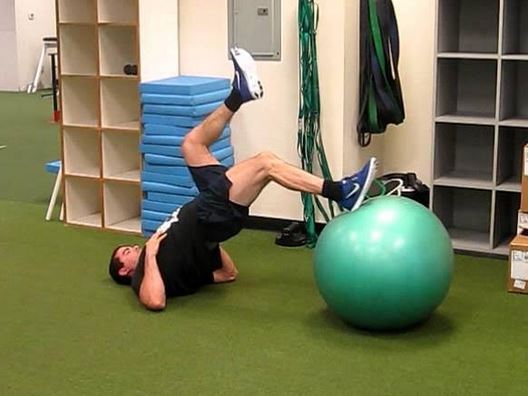
Lying Stability Ball Hip Lift
This beginner-friendly variation focuses primarily on maintaining the bridge position without adding knee flexion. It is often used as a progression toward full stability ball curls.

Slider Leg Curl
Using sliders or towels instead of a stability ball creates a similar movement pattern while slightly reducing instability and coordination demands.

Suspension Trainer Hamstring Curl
Suspension trainers further increase instability and place enormous demands on core stabilization and posterior chain control.

Nordic Hamstring Curl
The Nordic hamstring curl is an advanced eccentric-focused hamstring exercise known for exceptional strength and injury-prevention benefits.

Alternative Exercises for Hamstring Development
Although the stability ball leg curl is excellent for bodyweight posterior-chain training, combining it with machine and free-weight exercises usually produces more complete hamstring development.
Seated Leg Curl
The seated leg curl isolates the hamstrings during knee flexion while placing the muscles under greater stretch from hip flexion.

Lying Leg Curl
The lying leg curl provides stable bilateral hamstring isolation and generally allows heavier loading than bodyweight variations.

Romanian Deadlift
The Romanian deadlift trains the hamstrings through loaded hip hinging and is one of the best overall posterior-chain strength and hypertrophy exercises.

Glute-Ham Raise
The glute-ham raise combines knee flexion and hip extension into one challenging posterior-chain movement with tremendous athletic carryover.

Cable Leg Curl
Cable leg curls provide continuous tension throughout the movement while also improving unilateral hamstring control and stabilization.

Stability Ball Leg Curl vs Lying Leg Curl
Both exercises train the hamstrings through knee flexion, but the way tension is created and stabilized differs dramatically. Understanding these differences helps determine which variation best fits your training goals, experience level, and available equipment.
Conclusion: Both exercises are highly effective for hamstring development. The stability ball leg curl emphasizes body control, core stability, and posterior-chain coordination, while the lying leg curl allows greater external loading and stricter hamstring isolation.
Why Stability-Based Hamstring Training Matters
Many traditional hamstring exercises focus almost entirely on force production, but athletic movement and injury resilience also depend heavily on stabilization and coordination. Exercises like the stability ball leg curl challenge the posterior chain in a more integrated way by forcing the body to maintain alignment under instability.
This becomes especially valuable for athletes because sprinting, deceleration, and directional changes all require the hamstrings to work alongside the glutes and core stabilizers. The ability to maintain pelvic control and hip stability under fatigue is often just as important as raw hamstring strength.
For general fitness lifters, stability-based hamstring training can also improve movement awareness, posture, and lower-body coordination while reducing excessive spinal loading associated with heavier free-weight posterior-chain exercises.
Final Thoughts
The stability ball leg curl is one of the best bodyweight exercises for developing the hamstrings, glutes, and core simultaneously, while improving balance, coordination, and posterior chain control.
When performed with elevated hips, controlled tempo, and strict positioning, the exercise becomes far more challenging than most people expect. Used strategically within a complete lower-body program, stability ball leg curls can significantly improve hamstring function, athletic stability, and overall posterior-chain endurance.
Why do stability ball leg curls feel harder on the core than expected?
The exercise requires the pelvis and spine to remain stable while the legs move dynamically on an unstable surface. This forces the abdominal muscles, obliques, and spinal stabilizers to work continuously to prevent the hips from collapsing.
Are stability ball leg curls effective for building muscle without weights?
Yes — especially for beginners and intermediate lifters. Although the exercise uses bodyweight resistance, the combination of instability, hip elevation, and hamstring contraction can create a surprisingly strong hypertrophy stimulus.
Why do hamstrings cramp so often during stability ball leg curls?
Hamstring cramps are extremely common because the muscles must simultaneously flex the knees and stabilize the hips. Weak hamstrings, dehydration, fatigue, or poor neuromuscular coordination often contribute to cramping during this exercise.
Should the hips stay elevated during the entire movement?
Absolutely. Keeping the hips elevated maintains continuous posterior-chain tension and increases hamstring recruitment. Allowing the hips to drop turns the exercise into a much easier movement with significantly less training value.
Are stability ball leg curls useful for runners and athletes?
Very much so. The exercise improves posterior-chain coordination, knee-flexion strength, pelvic stability, and core control — all important qualities for sprinting, jumping, and reducing hamstring injury risk.
Why does the single-leg version feel dramatically harder?
Single-leg stability ball curls greatly increase stabilization demands because one hamstring and glute must control both movement and pelvic alignment independently. Even strong lifters are often surprised by the difficulty increase.
Can stability ball leg curls help reduce lower-back stress during hamstring training?
Yes. Because the exercise relies primarily on bodyweight resistance and floor-supported positioning, it trains the posterior chain with far less spinal compression than heavy deadlift variations.
Are stability ball leg curls better as a warm-up or main exercise?
They can work well for both depending on the athlete and program design. Many lifters use them as activation work before heavier posterior-chain training, while others use advanced variations as a primary hamstring exercise in bodyweight-focused workouts.
