



Overview (Introduction)
The step-up exercise is one of the most effective yet underrated movements for building lower-body strength, balance, and athletic coordination. Unlike traditional squats, the step-up is a unilateral exercise, meaning each leg works independently—making it highly valuable for correcting muscle imbalances and improving overall movement quality.
As a coach working with lifters and athletes, I often use step-ups to develop real-world strength and stability. This exercise closely mimics everyday and athletic movements, such as climbing stairs, running, and jumping, making it highly functional and transferable to sports performance.
Another major advantage of the step-up is its accessibility. It can be performed with just bodyweight or progressed to dumbbells or a barbell, making it suitable for beginners, home workouts, and advanced training programs alike. It’s also a great alternative for those who struggle with squats due to balance issues or joint discomfort.
When performed with proper control and technique, the step-up becomes a powerful tool for building strong, stable, and well-balanced legs.
Equipment Needed
The step-up exercise requires minimal equipment, which makes it one of the most practical movements for both gym and home training. Its simplicity is one of its biggest advantages, allowing you to focus on movement quality, balance, and control.
As a coach working with lifters and athletes, I often use step-ups because they are easy to set up and can be quickly adjusted for different fitness levels.
- Stable platform (box, bench, or step): The most important piece—height should allow roughly a 90° knee angle when your foot is placed on it.
- Optional: dumbbells: Held at your sides to increase resistance.
- Optional: barbell: Placed across the upper back for advanced loading.
- Flat, stable footwear: Helps maintain balance and proper force transfer.
In practice, the most critical factors are the platform’s height and stability. Too high can compromise form, while too low reduces the effectiveness of the exercise.
Step-by-Step Instructions for the Step-Up Exercise
Executing the step-up exercise correctly is all about control, balance, and proper alignment. As a coach, I always emphasize that this movement should be driven by the working leg, not momentum from the trailing leg.
A. Starting Position (Setup)
- Stand facing a stable platform (box, bench, or step).
- Place one foot fully on the platform, ensuring your entire foot is in contact.
- Your working knee should be bent at approximately 90 degrees.
- Keep your torso upright with your chest up and shoulders back.
- Engage your core to stabilize your body.
- Let your arms hang naturally at your sides (or hold dumbbells if using weights).
- Keep your head neutral, looking straight ahead.
Key coaching cue: “Full foot on the box, body tall, core tight”—this ensures a stable and effective setup.
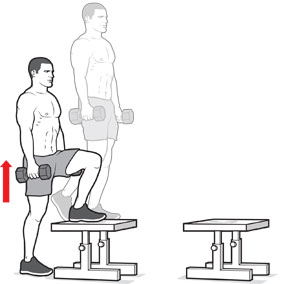
B. Movement (Execution)
Once your setup is stable, the goal of the step-up exercise is to lift your body using the working leg only, while maintaining balance and control throughout the movement. As a coach, I always stress that this is a controlled strength exercise, not a jump or a push-off from the back leg.
- Inhale and brace your core before initiating the movement.
- Drive through the heel and mid-foot of the working leg to lift your body upward.
- Extend your knee and hip simultaneously as you step up.
- Bring your trailing leg onto the platform without pushing off aggressively from the ground.
- Stand tall at the top, keeping your torso upright and stable.
- Pause briefly at the top position to maintain control.
- Step down slowly by bending your working leg and lowering yourself under control.
- Return to the starting position without losing balance.
- Complete all reps on one leg before switching sides.
Tempo recommendation: Controlled step-up, brief pause at the top, slow and stable descent.
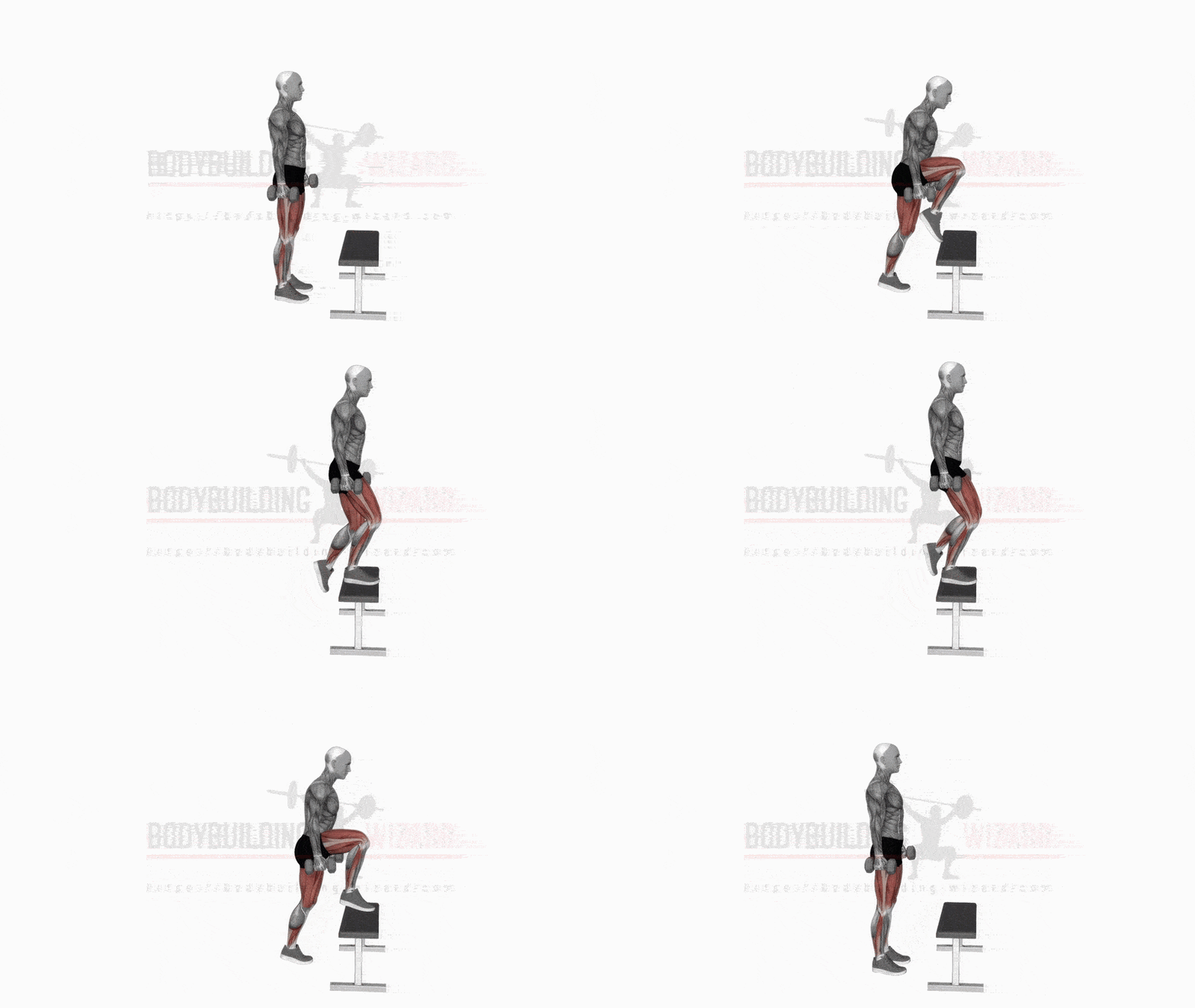
Resistance Curve Insight
The step-up is most challenging during the upward phase, where your working leg must generate enough force to lift your entire body. Because it’s a unilateral movement, it also places high demand on balance and coordination, making control essential for effectiveness.
Muscles Worked in the Step-Up Exercise
The step-up exercise is a unilateral compound movement that primarily targets the quadriceps and glutes, while also engaging several stabilizing muscles to maintain balance and control. Because each leg works independently, it is highly effective for improving muscle symmetry and coordination.
As a coach working with lifters and athletes, I often use step-ups to develop functional strength and eliminate side-to-side imbalances, which are common even in experienced lifters.
Primary Muscles
- Quadriceps (vastus lateralis, vastus medialis, vastus intermedius, rectus femoris): Responsible for extending the knee and driving the body upward.
- Gluteus maximus: Plays a major role in hip extension during the step-up phase.
Secondary Muscles
- Hamstrings: Assist in hip extension and help stabilize the knee joint.
- Adductors: Support hip stability and contribute to force production.
Stabilizers
- Core musculature: Prevents your torso from leaning forward or rotating during the movement.
- Calves (gastrocnemius and soleus): Help stabilize the ankle and assist with balance.
From my experience, the step-up is one of the best exercises for building real-world strength and athletic coordination. Because you must control your entire body on one leg, it forces proper muscle engagement and exposes any weakness or imbalance immediately.
Technical Emphasis & Targeting Adjustments
The step-up exercise can be significantly altered by adjusting box height, loading style, and execution technique. As a coach, I use these variables to shift emphasis between quads, glutes, and overall athletic performance, while also adapting the movement to different fitness levels.
Box Height
| Height | Muscle Emphasis / Training Effect |
|---|---|
| Low box (below knee level) | More controlled movement, greater emphasis on quadriceps |
| Medium height (knee level ~90°) | Balanced activation of quads and glutes (ideal for most lifters) |
| High box (above knee level) | Increased glute activation and hip involvement, but requires more mobility and control |
Loading Style
| Load Type | Effect |
|---|---|
| Bodyweight | Best for beginners and learning proper balance and coordination |
| Dumbbells (at sides) | Improves stability and allows progressive overload |
| Barbell (on back) | Increases total load but requires more balance and control |
Execution Focus
| Technique | Effect |
|---|---|
| Controlled step-up (no push-off) | Maximizes muscle activation in the working leg |
| Explosive step-up | Improves power and athletic performance |
| Slow eccentric (step-down) | Increases time under tension and muscle control |
In my experience, the most effective way to perform step-ups is with a controlled tempo and minimal assistance from the trailing leg. If you push off too much from the ground, you reduce the effectiveness of the exercise and turn it into a momentum-based movement.
Performance Optimization Tips (Coach’s Cues)
Once you’ve mastered the basics, the step-up exercise becomes a powerful tool for building strength, balance, and athletic performance—but only if you execute it with precision. As a coach, I’ve found that small adjustments in control and intent make the biggest difference.
- Drive through the working leg only: Minimize push-off from the trailing leg to maximize muscle activation.
- Keep your full foot on the platform: This ensures stability and proper force transfer.
- Stay upright: Keep your chest up and avoid leaning forward.
- Control the descent: Step down slowly to improve balance and increase time under tension.
- Engage your core: This prevents twisting and helps maintain proper alignment.
- Use appropriate box height: Choose a height that allows control without compromising form.
- Pause at the top: This reinforces balance and improves coordination.
- Train both sides equally: Helps eliminate strength imbalances.
Step-Up Variations (Bodyweight, Dumbbell, Barbell, Lateral)
The step-up exercise can be adapted in multiple ways to match your strength level and training goals. As a coach, I often rotate these variations to improve balance, increase load, and target different muscle groups.
1) Bodyweight Step-Up
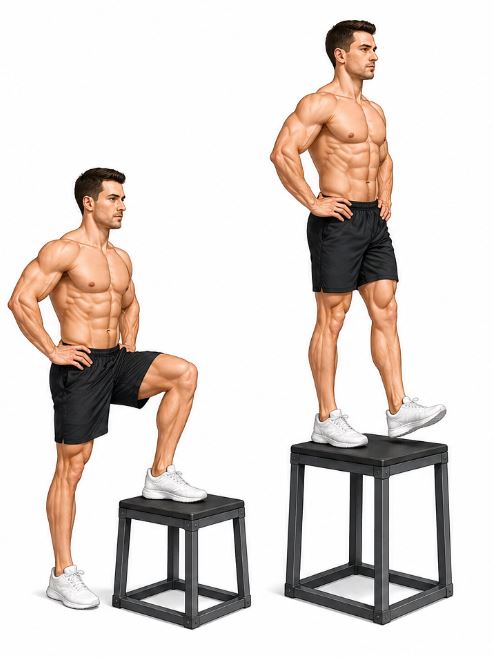
How to perform:
- Perform the movement using only your body weight.
- Focus on balance, control, and a full range of motion.
Why it works:
Perfect for beginners to develop coordination, stability, and proper movement mechanics before adding resistance.
2) Dumbbell Step-Up
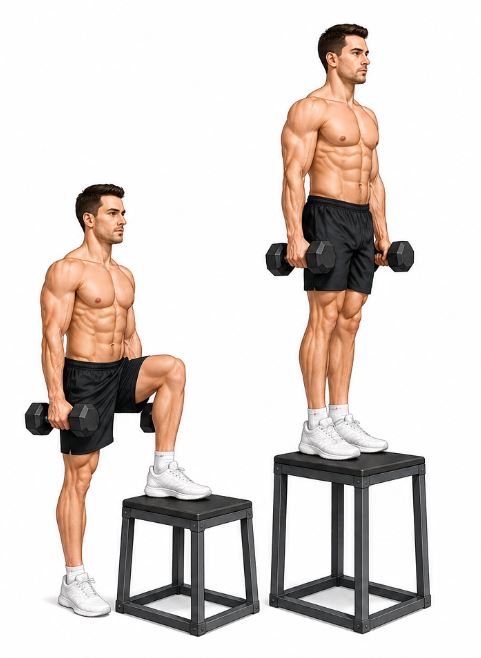
How to perform:
- Hold a pair of dumbbells at your sides.
- Perform controlled step-ups while maintaining balance.
Why it works:
Allows for progressive overload while maintaining stability and control.
3) Barbell Step-Up
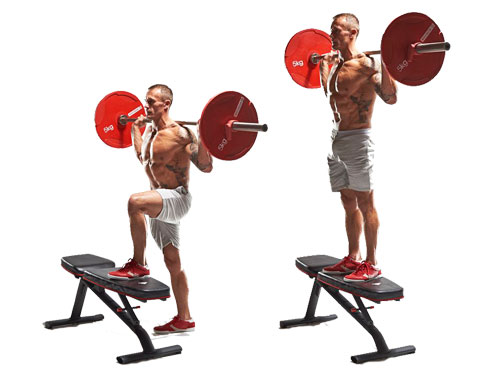
How to perform:
- Place a barbell across your upper back.
- Perform the movement with controlled tempo and proper alignment.
Why it works:
Increases total load and challenges strength and coordination, making it ideal for advanced lifters.
4) Lateral Step-Up
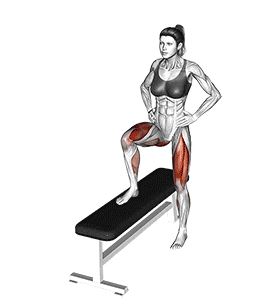
How to perform:
- Stand beside the platform and step up sideways.
- Drive through the leg closest to the platform.
Why it works:
Targets the glutes, adductors, and lateral stabilizers, improving side-to-side strength and athletic performance.
Alternative / Replacement Exercises for the Step-Up Exercise
While the step-up exercise is excellent for building unilateral strength, balance, and coordination, there are several effective alternatives you can use depending on your goal, equipment, or limitations. As a coach, I often rotate these exercises to target similar muscles while adding variety or reducing joint stress. If you’re building a leg day routine, make sure to include this in a plan based on the best quadriceps exercises.
- Bulgarian Split Squat: A powerful unilateral exercise that builds strength, balance, and muscle symmetry.
- Lunges (forward or reverse): Improve coordination and lower-body strength with dynamic movement.
- Dumbbell Squat: A more stable, bilateral movement that helps develop overall leg strength.
- Barbell Back Squat: Ideal for building maximum strength and full lower-body development.
- Leg Press: A machine-based option that allows heavy loading with reduced balance demands.
- Hack Squat: Provides controlled, quad-focused training with lower stability requirements.
- Step-Downs: A regression variation that emphasizes control and knee stability.
In my experience, the step-up is one of the best exercises for improving real-world strength and movement quality, especially because it forces each leg to work independently. However, combining it with exercises like split squats and lunges often leads to the best overall results.
The key is to choose movements that match your goal—whether it’s strength, hypertrophy, or balance.
Key Benefits of the Step-Up Exercise
The step-up exercise is one of the most effective movements for building functional strength, balance, and athletic performance. Its unilateral nature makes it especially valuable for developing muscle symmetry and coordination, which are often overlooked in traditional lower-body training.
As a coach, I frequently use step-ups to improve both strength and movement quality, particularly for athletes and individuals looking to move better in real-world situations.
- Builds unilateral leg strength: Each leg works independently, helping correct muscle imbalances.
- Improves balance and coordination: Requires stability and control throughout the movement.
- Highly functional movement: Mimics everyday and athletic actions, such as climbing stairs and running.
- Targets quads and glutes effectively: Provides strong lower-body activation with proper technique.
- Low equipment requirement: Can be performed almost anywhere with minimal setup.
- Joint-friendly when performed correctly: Controlled movement can reduce excessive stress compared to heavy squats.
- Scalable for all fitness levels: Easily adjusted with different heights, loads, and variations.
Who Should Use This Exercise?
The step-up exercise is suitable for a wide range of individuals, from beginners to advanced athletes. Because it combines strength, balance, and coordination, it’s especially valuable for those who want more than just muscle size—this is a true functional strength movement.
As a coach working with lifters and athletes, I regularly use step-ups to improve movement quality, stability, and performance, not just raw strength.
- Beginners: Ideal for learning basic lower-body movement patterns in a controlled and accessible way.
- Athletes: Excellent for developing balance, coordination, and unilateral strength that transfers directly to sports.
- Individuals with muscle imbalances: Helps correct left-right strength differences by training each leg independently.
- Home trainees: Requires minimal equipment, making it perfect for home workouts.
- Those with limited squat tolerance: Can be a useful alternative for people who struggle with traditional squats.
- Intermediate and advanced lifters: Great for accessory work, stability training, and increased training volume.
Step-Up vs Lunges: Which Is Better?
The step-up exercise and lunges are both excellent unilateral movements that build lower-body strength, balance, and coordination. While they target similar muscles, they differ in movement pattern, stability demands, and training focus.
As a coach working with lifters and athletes, I use both exercises depending on the goal—each has unique advantages.
| Criteria | Step-Up | Lunges |
|---|---|---|
| Movement Pattern | Vertical step onto the platform | Forward/backward stepping |
| Balance Requirement | High | Moderate to high |
| Stability Demand | High (single-leg control) | Moderate |
| Quad Activation | High | High |
| Glute Activation | Moderate to high | High |
| Coordination | Very high | High |
| Joint Stress | Lower (controlled movement) | Can be higher depending on the stride |
If your goal is to improve balance, coordination, and controlled unilateral strength, the step-up is often the better option. It forces you to stabilize your body and generate force from a single leg without momentum.
If your goal is to develop dynamic strength and movement control, lunges may be more effective. They involve more motion and can better simulate athletic movement patterns.
In practice, the best results come from using both:
- Step-ups for controlled strength, balance, and stability
- Lunges for dynamic movement and athletic coordination
Where This Exercise Fits in a Workout
The step-up exercise is extremely versatile and can be used as a primary movement, accessory lift, or conditioning tool, depending on your goal. Because it’s a unilateral exercise that requires balance and coordination, it’s best performed when you can focus on control and technique.
As a coach working with lifters and athletes, I most often program step-ups to improve movement quality, stability, and muscle symmetry, either early in the workout or after heavier compound lifts.
Recommended Placement
- As a primary movement (beginners): Perform early in the workout to build coordination, balance, and foundational strength.
- As an accessory exercise: Use after squats or leg presses to target each leg individually and correct imbalances.
- In athletic training: Place early in the session to emphasize balance, control, and coordination.
- In conditioning workouts: Can be used in circuits to improve both strength and cardiovascular fitness.
Sets & Reps Guidelines
- Strength/hypertrophy: 3–4 sets of 8–15 reps per leg
- Balance/control focus: 2–4 sets of 8–12 controlled reps per leg
- Endurance/conditioning: 2–3 sets of 12–20 reps per leg
In my experience, the step-up delivers the best results when you focus on controlled execution and minimal momentum. Treat each repetition as a single-leg strength movement rather than a quick stepping motion, and you’ll get far more benefit from the exercise.
Conclusion
The step-up exercise is one of the most effective movements for building functional lower-body strength, balance, and coordination. Its unilateral nature makes it especially valuable for correcting imbalances and improving overall movement quality.
As a coach, I’ve seen that step-ups can significantly enhance both strength and athletic performance, especially when performed with control and proper technique. While they may look simple, they challenge stability, coordination, and muscle control in a way that many traditional exercises do not.
When incorporated into a well-structured program, the step-up becomes a powerful tool for developing stronger, more balanced, and more athletic legs.
What is the step-up exercise?
The step-up exercise is a unilateral lower-body movement where you step onto an elevated platform, primarily targeting the quads and glutes while improving balance and coordination.
What muscles does the step-up exercise work?
The step-up exercise mainly works the quadriceps and glutes, while also engaging the hamstrings, calves, adductors, and core stabilizers.
Is the step-up exercise good for beginners?
Yes, the step-up is very beginner-friendly because it uses a natural movement pattern and can be performed with body weight.
How high should the box be for step-ups?
The box height should allow your knee to bend at roughly 90 degrees when your foot is placed on the platform.
Should I push off with my back leg?
No, you should minimize push-off from the trailing leg to ensure the working leg does most of the work.
Are step-ups better than squats?
Step-ups are better for unilateral strength and balance, while squats are better for overall strength and heavier loading.
Can step-ups build muscle?
Yes, the step-up exercise can build muscle effectively when performed with proper form, sufficient resistance, and progressive overload.
What is the difference between step-ups and lunges?
Step-ups involve stepping onto a platform, while lunges involve stepping forward or backward, creating different stability and movement demands.
Are step-ups safe for the knees?
Yes, when performed with proper control and alignment, step-ups can be joint-friendly and suitable for many individuals.
How often should I do step-ups?
Most people can include step-ups 2–3 times per week, depending on their training program and recovery.
