



Introduction
The Swiss ball reverse crunch takes the fundamental movement pattern of the flat floor reverse crunch and adds an unstable surface beneath the lower back. That single change does two things simultaneously: it increases the range of motion by allowing the spine to arch over the ball at the bottom of each rep, and it demands continuous stabilization from the obliques, transverse abdominis, and hip stabilizers just to maintain position throughout the set. The result is a lower ab exercise that is both more demanding and more complete than its floor equivalent.
Also known as the stability ball reverse crunch or exercise ball reverse crunch, this exercise requires a stability ball positioned next to something stable to grip— such as a squat rack, cable machine, or wall bars. That anchor point is not optional: without something to hold behind the head, the upper body will rock, and the lower abs will lose their isolation.
This is a more challenging exercise than the flat reverse crunch but more accessible than hanging variations. For trainees who have outgrown the floor version and do not yet have the grip strength or shoulder stability for hanging work, the Swiss ball version is one of the most effective intermediate progressions available.
What is the swiss ball reverse crunch?
The Swiss ball reverse crunch is a lower ab exercise performed lying on a stability ball with the middle of the back centered on the ball and hands gripping a stable anchor point behind the head. From that position, the hips lift off the ball and the knees draw toward the chest through a lower ab contraction. The unstable surface increases both the range of motion and the stability demand compared to the flat floor version.
Muscles Worked in the Swiss Ball Reverse Crunch
Primary muscle
- Rectus abdominis (lower portion) — the movement is driven by posterior pelvic tilt, with the lower portion of the rectus abdominis contracting to lift the hips off the ball and draw the knees toward the chest. The curved surface of the ball allows the spine to arch further back at the bottom than the flat floor permits, giving the lower abs a greater stretch before each contraction and loading them through a longer range of motion per rep.
Secondary muscles
- External and internal obliques — work significantly harder than in the flat floor version due to the continuous instability of the ball surface; actively stabilize the torso against lateral movement throughout the set
- Transverse abdominis — braces the spine and maintains intra-abdominal pressure; increased activation compared to floor work due to the balance demand
- Hip stabilizers — engage continuously to keep the body centered on the ball
- Hip flexors (iliopsoas, rectus femoris) — assist with drawing the knees toward the chest
Antagonists
- Spinal erectors and surrounding lumbar musculature lengthen over the ball during the extension phase and drive the controlled return to the starting position.
How To Perform the Swiss Ball Reverse Crunch
Starting position
- Position a stability ball next to a squat rack, cable machine, or wall bars — something stable you can reach behind your head to grip
- Sit on the ball and walk your feet forward, rolling the ball under your body until the middle of your back is centered on top of the ball
- Extend both arms overhead and grip the stable anchor point firmly behind your head — forearms can rest alongside the head for additional stability
- Bend your hips and knees to 90 degrees — thighs perpendicular to the floor, lower legs parallel to the ground
- Your feet should be off the floor or just lightly touching — do not use the feet for balance or support

Execution
- Exhale and initiate the movement with a posterior pelvic tilt — the pelvis tilts before the knees begin to move
- Contract the lower abs and lift the hips and glutes off the ball, drawing the knees toward the chest
- Only the hips, glutes, and lower back should leave the ball — the upper back stays in contact with the ball throughout
- Continue until the knees are as close to the chest as possible and the lower abs are fully contracted
- Hold the top position for one to two seconds
- Slowly lower the hips back to the ball — allow the spine to arch over the ball at the bottom, giving the lower abs their full stretch before the next rep
- Maintain the 90-degree knee angle throughout the entire movement — do not let the knees open up
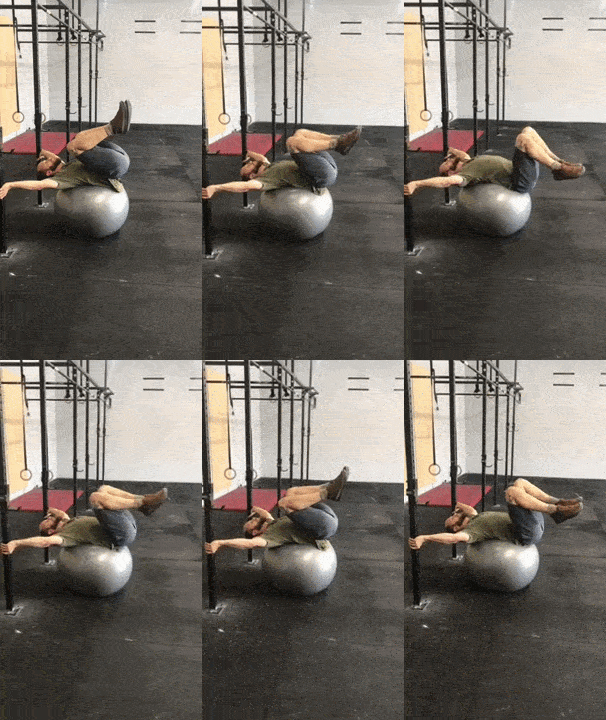
The key coaching cue: The anchor grip behind the head is for stability, not propulsion. The hands hold on — they do not pull. If the arms are generating force to help complete the rep, the lower abs are not doing the work. Grip firmly, stay stable, let the abs do the lifting.
Common Mistakes in the Swiss Ball Reverse Crunch
1. Not using an anchor point
Attempting this exercise without something to grip behind the head almost always causes the upper body to rock as the hips lift, destabilizing the ball and turning the exercise into a balance challenge rather than a lower-ab exercise. Always position the ball next to something stable before starting. If no suitable anchor is available, use the flat floor reverse crunch instead.
2. Losing the knee angle
The 90-degree bend in the knees must be maintained throughout the entire movement. When the knees open up, or the feet swing outward, the hip flexors take over, and the lower ab isolation disappears. This is the same critical technical point as the flat floor reverse crunch — the ball does not change that requirement.
3. Letting the feet touch the floor
Resting the feet on the floor between reps removes all tension from the lower abs and hip flexors. Keep the feet elevated throughout the set — heels close to the floor but not resting on it. That sustained tension is what makes the exercise genuinely demanding.
4. Skipping the extension at the bottom
The curved surface of the ball is the primary mechanical advantage of this variation over the floor version — it allows the spine to arch back further at the bottom of each rep, loading the lower abs through a greater range. Stopping the lowering phase before the spine fully drapes over the ball cuts short the very thing that makes the Swiss ball version more effective. Let the spine extend over the ball fully at the bottom before initiating the next rep.
5. Using an improperly inflated or damaged ball
An underinflated ball is softer and less stable than a properly inflated one, altering movement mechanics and reducing effectiveness. A damaged ball is a safety risk — a ball that fails during a loaded movement can cause an unexpected fall. Always check the ball for damage and ensure it is properly inflated before starting.
Benefits of the Swiss Ball Reverse Crunch
Greater range of motion than the floor version
The curved surface of the ball allows the spine to extend further back at the bottom of each rep than the flat floor permits. That extended position gives the lower abs a fuller stretch before each contraction — more range means more stimulus per rep when the technique is correct.
Increased core stabilizer activation
The instability of the ball forces the obliques, transverse abdominis, and hip stabilizers to work continuously throughout the set just to keep the body centered. That stabilization demand is a meaningful secondary benefit that the floor version cannot provide, and that directly transfers to functional core strength.
More demanding than the floor reverse crunch without requiring specialized equipment
A stability ball is inexpensive and widely available. The Swiss ball version provides a significantly harder lower-ab stimulus than the floor version, without requiring a decline bench, captain’s chair, or pull-up bar. That makes it a practical intermediate progression for home training environments.
Useful teaching tool for posterior pelvic tilt under instability
The ball’s instability makes any compensation pattern — hip flexor dominance, momentum, or loss of knee angle — immediately obvious, as it destabilizes the entire setup. In a sense, the ball enforces honest technique by making errors more apparent and more immediately consequential than the forgiving flat floor.
Who Should Use This Exercise
- Intermediate trainees who have mastered the flat floor reverse crunch and want a harder bodyweight option before moving to incline bench or hanging variations
- Trainees who train at home with a stability ball and want to progress beyond floor-based lower ab exercises without specialized gym equipment
- Anyone looking to increase core stabilizer activation alongside lower ab training — the ball adds an oblique and transverse abdominis demand that the floor version does not provide
- Trainees who want variety in lower ab programming without changing the fundamental movement pattern
Who Should Be Cautious
- People with lower back pain or lumbar disc issues — the spinal extension over the ball at the bottom of each rep places the lumbar spine in a loaded extension position; anyone with active disc pathology should use the flat floor version instead
- Complete beginners who have not yet mastered the flat reverse crunch — adding instability before the basic movement pattern is learned reliably compounds the difficulty in an unproductive way
- People with balance or vestibular issues — the unstable ball surface can be genuinely disorienting; these trainees should use the flat bench or floor version instead
- People with wrist or shoulder issues — sustained gripping of the anchor point requires shoulder and wrist stability; adjust the grip position if discomfort occurs
Progressions and Regressions
Regressions (easier)
- Flat floor reverse crunch — the foundational version with no instability demand; master this before moving to the ball
- Flat bench reverse crunch — lying on a flat bench with something to grip behind the head; provides the anchor point stability of the Swiss ball version without the balance challenge
Progressions (harder)
- Swiss ball reverse crunch with ankle weights — adding external resistance increases the demand on the lower abs and hip flexors on top of the stability challenge; even a small weight changes the exercise considerably
- Incline reverse crunch — the same hip lift movement on a decline bench; adds gravitational resistance without the balance demand, making it a different kind of harder
- Hanging knee raise — the next major progression; removes all surface support and adds grip, shoulder stability, and anti-swing demands
Swiss Ball Reverse Crunch vs. Reverse Crunch
Both exercises use the same posterior pelvic tilt and hip lift movement pattern, but the ball changes the mechanics in two meaningful ways.
| Swiss Ball Reverse Crunch | Reverse Crunch | |
|---|---|---|
| Surface | Unstable — stability ball | Stable — floor or bench |
| Range of motion | Greater — spine extends over ball | Standard |
| Core stabilizer demand | High — obliques and TVA activated continuously | Low |
| Balance demand | Moderate | None |
| Difficulty | Intermediate | Beginner |
| Equipment needed | Stability ball + anchor point | None |
| Best for | Progression from floor, home training | Learning the movement pattern |
The practical takeaway: The Swiss ball reverse crunch is a direct and effective progression from the flat floor version. It provides a greater range of motion, greater core stabilizer activation, and a more honest feedback mechanism for technique errors — all without requiring any gym equipment beyond a stability ball. When floor reverse crunches have become too easy, and a decline bench is not available, the Swiss ball version is the most accessible and practical next step.
Exercise Variations
Swiss Ball Reverse Crunch with Ankle Weights
Fasten ankle weights around each ankle before positioning on the ball. Follow the standard Swiss ball reverse crunch instructions. The added weight increases the demand on the lower abs and hip flexors on top of the instability challenge. Start with 1 to 2 kilograms per ankle — the combination of added weight and ball instability makes even a light load noticeably harder than the same weight on a stable surface.

Swiss Ball Reverse Crunch with Extended Hold
At the top of each rep, hold the fully contracted position for three to five seconds before lowering. This isometric hold forces the lower abs and core stabilizers to sustain the contraction simultaneously — a more demanding stimulus than dynamic reps alone. Effective for increasing intensity without adding load or changing the setup.
Replacement Exercises (Alternatives)
If a stability ball is unavailable or not the right fit, these exercises target the same primary muscle group:
- Reverse Crunch
- Captain’s Chair Leg Raise
- Captain’s Chair Knee Raise
- Hanging Leg Raise
- Hanging Knee Raise
- Lying Hip Raise
- Lying Leg Raise
- Incline Reverse Crunch
- Full V-Sit (Jackknife Sit-Up)
Programming Tips
- Rep range: 12–15 reps per set for bodyweight, 10–12 reps with ankle weights — the stability demand makes this less suited to very high rep ranges where technique degrades under fatigue
- Sets: 3–4 working sets
- Tempo: Two seconds up, one second hold at the top, three seconds down — the slow descent over the ball is where the range of motion advantage of this variation lives; do not rush it
- Frequency: 2–3 times per week with at least one rest day between sessions
- Where in the session: At the end of the workout after compound movements; pairs well with an upper ab exercise as a superset
- Ball check: Always inspect the ball for damage and verify inflation before starting — a damaged or underinflated ball changes the exercise mechanics, and a ball failure mid-set is a fall risk
- Progression trigger: When you can complete 4 clean sets of 15 reps with full spinal extension at the bottom, consistent knee angle, and a controlled three-second descent on every rep — add light ankle weights or progress to the incline reverse crunch
Conclusion
The Swiss ball reverse crunch earns its place in a lower ab program by doing something neither the flat floor version nor the incline bench version can do — it combines an extended range of motion with a continuous core stability demand in a single accessible exercise. The curved surface provides the stretch; the instability demands stabilization; and the result is a lower ab stimulus that is more complete per rep than the floor version it replaces.
The anchor point behind the head is non-negotiable. Without it, the exercise devolves into a balance challenge that has little to do with the lower abs. With it, the ball becomes a genuine training tool rather than a gimmick.
Get the setup right, maintain the knee angle, and let the spine extend fully over the ball at the bottom of every rep. That full extension is the advantage the ball provides — waste it by rushing the descent, and you might as well be on the floor.
The Swiss ball reverse crunch is featured in our complete guide to the best lower ab exercises as a practical intermediate progression for trainees who train at home or want more range of motion than the floor version provides. Pair this with our guides to upper ab, oblique, and core training for a complete program.
Frequently Asked Questions
What size stability ball should I use for the Swiss ball reverse crunch?
A 65 cm ball suits most people between 175 and 190 cm tall. When lying on the ball with the middle of your back centered on top, your hips and knees should both be close to 90 degrees. A ball that is too small forces excessive hip flexion; one that is too large reduces the spinal extension at the bottom of the rep that makes this variation more effective than the floor version.
Can I do this exercise without an anchor point to grip?
Not effectively. Without something to grip behind the head, the upper body rocks forward as the hips lift and the ball destabilizes. The anchor point is what isolates the lower ab contraction. If no suitable anchor is available at your gym or home setup, do the flat floor reverse crunch instead.
Is the Swiss ball reverse crunch harder than the incline reverse crunch?
They are hard in different ways. The incline reverse crunch adds gravitational resistance through the bench angle. The Swiss ball version adds instability and a greater range of motion but less gravitational load. Most trainees find the incline version harder overall, but the Swiss ball version is more demanding for the obliques and deep stabilizers due to the balance requirement.
Why does the ball keep rolling during the exercise?
Usually because the ball is not properly inflated or the anchor grip is too loose. A correctly inflated ball is firm enough to hold its position under load. Grip the anchor point firmly with both hands throughout the set — a loose grip allows the upper body to shift, which sends the ball rolling. Placing the ball against a wall initially can help while you develop the stability needed to control it independently.
How is this different from the exercise ball crunch?
They are opposite movements on the same equipment. The exercise ball crunch is an upper ab exercise — the torso curls toward fixed legs. The Swiss ball reverse crunch is a lower ab exercise — the hips lift toward a fixed torso. One targets the upper rectus abdominis, the other targets the lower portion. Pairing them as a superset covers the full length of the rectus abdominis efficiently.
