



Few muscles change a physique’s silhouette as dramatically as a well-developed trapezius. It’s the muscle that gives elite lifters that “no-neck” look, the one Olympic weightlifters carry like armor, and yet most bodybuilders train it as an afterthought — a few sets of shrugs tacked onto the end of a back day. Understanding trapezius muscle functional anatomy changes that: once you know that the trap isn’t one uniform muscle but three functionally distinct regions with different jobs, “just do more shrugs” stops being a complete training strategy.
Quick Answer
The trapezius is a large, kite-shaped superficial muscle spanning the back of the neck and upper-to-mid back. It’s functionally divided into three regions — upper, middle, and lower fibers — each responsible for different scapular movements: elevation, retraction, and depression, respectively. Together, these regions stabilize and move the shoulder blade during nearly every upper-body movement, and the trapezius is one of the broadest muscles in the entire human body by surface area.
| Muscle type | Large, flat, superficial back and neck muscle |
|---|---|
| Primary functions | Scapular elevation, retraction, depression, and upward rotation |
| Secondary functions | Neck extension and lateral flexion, postural support of the shoulder girdle |
| Innervation | Spinal accessory nerve (cranial nerve XI); sensory input from C3–C4 |
| Blood supply | Transverse cervical artery |
| Common exercises | Shrugs, face pulls, rows, Y-raises |
| Main bodybuilding role | Upper back thickness and the “no-neck” look |
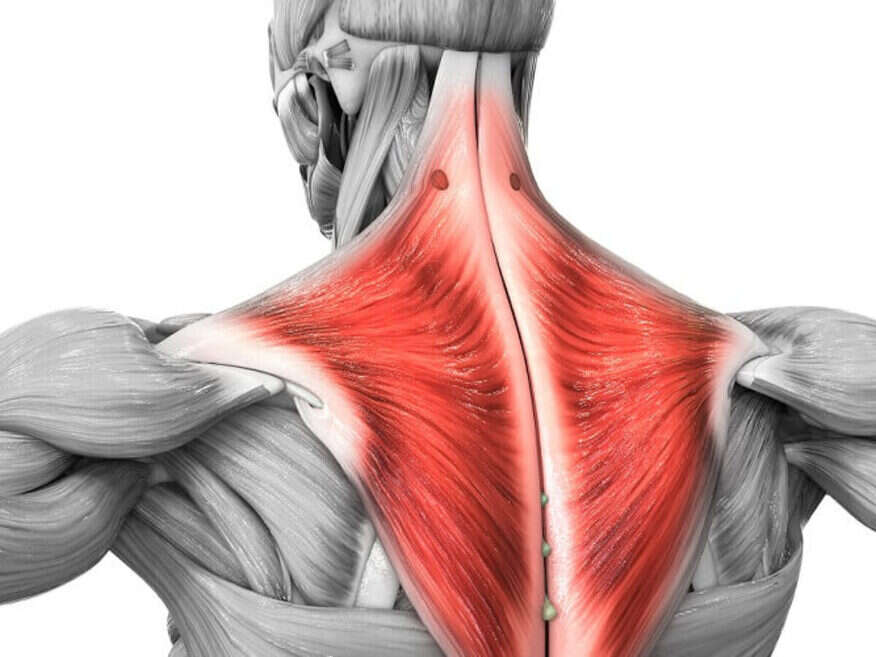
Overview
Why Is the Trapezius Important?
The trapezius does far more than build an intimidating neckline. It’s central to virtually every shoulder blade movement — stabilizing the scapula during pressing, enabling the upward rotation needed for overhead lifting, and supporting posture against the constant pull of gravity on your head and arms. Poor trapezius function, especially in the middle and lower regions, is strongly associated with rounded shoulder posture and shoulder impingement. For lifters, well-developed traps are also one of the clearest visual markers of serious training experience — it’s very hard to fake trap development, since the muscle responds directly to heavy loading over years, not weeks. To see how it fits into the rest of your muscular system, check out our interactive muscle anatomy tool.
Trapezius Muscle Functional Anatomy & Location
The trapezius sits just beneath the skin across the back of the neck, shoulders, and upper-to-mid back, making it one of the most visible and largest muscles in the human body by surface area. A solid grasp of trapezius muscle functional anatomy starts with its shape: its name comes from its kite-like, trapezoid shape — wide across the shoulders, narrowing as it runs up the neck and down the spine. Unlike deeper stabilizer muscles, the trapezius is easy to see and feel even at moderate development, which is part of why it has such an outsized effect on overall upper-body appearance.
Finding Your Trapezius: Surface Anatomy
Shrug your shoulders straight up toward your ears, and you’ll feel the upper trapezius contract along the top of your shoulders and sides of your neck. Now pull your shoulder blades together, as if trying to pinch a pencil between them — that’s the middle trapezius. Finally, reach one arm overhead and try to pull your shoulder blade down and in toward your spine; the muscle working along your mid-back doing that is the lower trapezius.
Characteristics at a Glance
| Characteristic | Value |
|---|---|
| Shape | Large, flat, kite/trapezoid-shaped |
| Muscle group | Superficial back and neck |
| Number | Pair (left and right), often described as one continuous sheet |
| Fiber direction | Varies by region — diagonal (upper), horizontal (middle), diagonal (lower) |
| Crosses | Scapulothoracic articulation; upper fibers also influence the cervical spine |
Origin, Insertion, Innervation & Blood Supply
| Attribute | Detail |
|---|---|
| Origin | Medial third of the superior nuchal line, external occipital protuberance, nuchal ligament, and spinous processes of C7 through T12 |
| Insertion | Lateral third of the clavicle (upper fibers); acromion process and spine of the scapula (middle and lower fibers) |
| Innervation | Spinal accessory nerve (cranial nerve XI) for motor function; ventral rami of C3–C4 for sensory/proprioceptive input |
| Blood supply | Transverse cervical artery, with contributions from the dorsal scapular artery |
The trapezius has an unusually long origin, running from the base of the skull all the way down to roughly the twelfth thoracic vertebra — a span of the entire upper and mid-spine. All of these fibers converge laterally to insert along the clavicle, acromion, and scapular spine. According to StatPearls’ anatomical reference on the trapezius, the muscle’s motor innervation comes entirely from the spinal accessory nerve, a cranial nerve rather than a spinal nerve — which is clinically significant, since it means trapezius weakness after neck surgery or trauma often points to accessory nerve involvement specifically, not a more general nerve root problem.
Anatomical Variations
Compared to muscles like the biceps or palmaris longus, the trapezius is relatively consistent in its anatomy across individuals — significant anomalies are rare and mostly limited to isolated case reports of accessory muscle slips or unusual fusion with nearby structures. Because the trapezius is such a broad, thin sheet of muscle rather than a discrete, compact belly, most “variation” between individuals shows up as differences in fiber thickness and development rather than structural anomalies.
Clinical Relevance
The trapezius is one of the most clinically important muscles for surgeons operating in the neck and shoulder region, since the spinal accessory nerve runs relatively superficially through an area sometimes involved in lymph node biopsies or neck dissections. Damage to this nerve can cause a recognizable pattern of shoulder drop, winged scapula, and weakness raising the arm overhead — distinct from other causes of shoulder dysfunction because it specifically follows the trapezius’s innervation pattern. The muscle is also one of the most common sites of muscular tension and trigger points in people who sit at desks for long hours, largely due to sustained low-level upper trapezius activation from poor posture.
An Evolutionary Note
The trapezius’s broad attachment along the entire spine, paired with its role in stabilizing and moving the shoulder blade, is thought by some comparative anatomists to reflect the demands of an upright posture combined with highly mobile shoulders — a combination that supports both carrying loads and the wide range of overhead and rotational arm movements associated with throwing and climbing in human evolutionary history. This is more of an anatomical observation than settled science, but it may help explain why the trapezius responds to such a broad range of movement directions in training, from vertical shrugging to horizontal rowing to overhead reaching.
Actions
Primary Actions
- Scapular elevation — shrugging the shoulder blades upward (primarily upper fibers)
- Scapular retraction — pulling the shoulder blades together toward the spine (primarily middle fibers)
- Scapular depression — pulling the shoulder blades downward (primarily lower fibers)
- Upward rotation of the scapula — rotating the shoulder blade so the arm can lift fully overhead (upper and lower fibers working together)
Secondary Functions
- Neck extension and lateral flexion — tilting and extending the head and neck (upper fibers)
- Postural support — resisting the constant downward pull of gravity on the arms and head throughout the day
Functional Regions of the Trapezius
Although the trapezius is anatomically a single continuous muscle, it’s most useful to think of it as three functional regions, since each has a distinct fiber direction, primary role, and often responds best to different exercises.

Upper fibers run diagonally from the skull and neck down to the outer clavicle. Their primary job is elevating the scapula (shrugging) and assisting with upward rotation during overhead movements. These fibers tend to be the most active during everyday stress and poor posture, which is part of why upper trap tightness is such a common complaint among desk workers.
Middle fibers run nearly horizontally from the spine out to the acromion and scapular spine. Their main job is scapular retraction — pulling the shoulder blades together — which is critical for maintaining upright posture and for stabilizing the shoulder blade during rowing and pulling movements.
Lower fibers run diagonally upward from the lower thoracic spine to the base of the scapular spine. Their primary role is to depress the scapula and assist the upper fibers in upward rotation during overhead reaching. The lower trapezius is frequently the weakest and most underdeveloped of the three regions, since few common exercises or everyday movements directly challenge it.
Because these three regions can be trained somewhat independently through exercise selection, a complete trapezius program typically includes movements that bias each region rather than relying on shrugs alone.

Synergists, Antagonists & Stabilizers
Synergists (muscles that assist different trapezius functions):
- Rhomboid major and minor — assist scapular retraction alongside the middle trapezius
- Levator scapulae — assists scapular elevation alongside the upper trapezius
- Serratus anterior — works with the trapezius during upward rotation of the scapula
Antagonists (muscles that oppose trapezius actions):
- Pectoralis minor and serratus anterior (oppose scapular retraction during protraction)
- Levator scapulae and rhomboids can act as antagonists to the lower trapezius during scapular depression
Stabilizers (muscles that support the shoulder complex while the trapezius works):
Muscles Closely Related
A few neighboring muscles are worth understanding alongside the trapezius, since they share functions or locations, or are frequently confused with it.
- Rhomboid major and minor — sit directly beneath the middle and lower trapezius, and work alongside it to retract the scapula. Because the rhomboids are deep to the trapezius, they’re never visible on their own, even in very lean, developed physiques.
- Levator scapulae — a small, deep neck muscle that assists the upper trapezius in elevating the scapula. It’s a frequent source of neck tightness and is often confused with upper trapezius tension, even though it’s a distinct muscle.
- Serratus anterior — works as a functional partner to the trapezius during upward rotation of the scapula, particularly during overhead pressing and pulling.
- Latissimus dorsi — sits below and lateral to the trapezius on the back; the two muscles overlap slightly and are both heavily involved in rowing and pulling movements, though their individual roles are quite different.
Role During Common Exercises
| Exercise | Role of the Trapezius |
|---|---|
| Barbell/dumbbell shrug | Prime mover, upper fiber bias |
| Face pull | Major contributor, middle fiber bias |
| Cable Y-raise | Major contributor, lower fiber bias |
| Bent-over row | Major contributor (middle/lower stabilization) |
| Pull-up (pronated grip) | Major contributor, middle fiber bias |
| Overhead press | Stabilizer (upward rotation) |
| Deadlift | Stabilizer (isometric, resists scapular depression under load) |
Bodybuilder’s Take
This is where trap training actually gets interesting.
“Why do my traps only ever get bigger on top, never in the middle or lower back?” This is extremely common, and it comes down to one thing: shrugs almost exclusively hit the upper fibers. If shrugging is your only trap exercise, the middle and lower regions simply never get a direct, heavy training stimulus. Adding face pulls, Y-raises, and rowing variations with a strong scapular retraction cue is what actually develops the middle and lower trapezius.
“Does grip matter on pull-ups for trap development?” Yes — research comparing pull-up grip variations found meaningfully higher middle trapezius activation with a pronated (overhand) grip compared to a neutral grip, which is a useful detail if you’re specifically trying to bias the middle traps during back training.
“Why do my traps feel tight all the time even though I don’t train them much?” Upper trapezius fibers are heavily recruited during everyday stress, poor posture, and any activity that involves holding the arms up or carrying weight (grocery bags, backpacks, or phones held at ear level). This means the upper traps are often overworked and tight relative to the middle and lower fibers, which tend to be undertrained — a common imbalance worth correcting with more direct middle/lower trap work rather than more shrugging.
For a full breakdown of trapezius-specific exercises and how to program them, see our complete guide: Creating Beastly Traps: An Ultimate Guide to Trapezius Muscle Exercises.
Common beginner mistakes:
- Training only shrugs and neglecting middle/lower trap-specific work
- Using excessive momentum on shrugs, which reduces time under tension and increases neck strain
- Shrugging in a circular “rolling” motion instead of a straight vertical path, which doesn’t add training benefit and may increase shoulder joint stress
Best Exercises

| Exercise | Main Function Trained | Main Benefit | Best For |
|---|---|---|---|
| Barbell shrug | Scapular elevation | Allows heaviest loading | Upper trap mass |
| Dumbbell shrug | Scapular elevation | Greater range of motion | Upper trap mass and detail |
| Incline prone dumbbell shrug | Scapular elevation/retraction | Removes momentum, strict form | Upper/middle trap density |
| Cable face pull | Scapular retraction | High middle trap and rear delt activation | Middle trap and posture |
| Cable Y-raise | Scapular depression, upward rotation | Directly targets lower fibers | Lower trap development |
| Bent-over barbell row | Scapular retraction (stabilization) | Heavy compound loading | Overall upper back thickness |
Stretching & Mobility
- Ear-to-shoulder stretch — while seated or standing, gently lower your head toward one shoulder to stretch the upper trapezius on the opposite side.
- Cross-body shoulder stretch — pulling one arm across the chest lightly stretches the middle trapezius and posterior shoulder.
- Cat-cow or thoracic extension stretch — helps mobilize the mid-back region where the middle and lower trapezius attach.
- Doorway or foam roller release — light pressure along the upper traps and along the spine near the shoulder blades can help ease tension in overworked upper fibers.
What Does Research Say?
EMG Findings
A widely cited EMG study comparing exercises for the trapezius and serratus anterior muscles found that the unilateral shoulder shrug produced the greatest activation of the upper trapezius, while the greatest activation of the middle trapezius came from shoulder horizontal extension with external rotation and a prone overhead arm raise performed in line with the lower trapezius fibers. The same overhead prone arm raise also produced the greatest lower trapezius activation of all exercises tested — meaning a single exercise variation (the prone overhead reach) can meaningfully hit both middle and lower fibers depending on exact arm angle.
Separate research comparing pull-up grip variations found that a pronated grip produced significantly greater middle trapezius activation than a neutral grip, reinforcing that grip and hand position — not just the exercise itself — can meaningfully change which fibers of the trapezius do the most work.
Biomechanical Findings
Where dedicated EMG comparisons are more limited — for example, comparing specific shrug variations like barbell vs. dumbbell vs. Smith machine — the reasoning generally comes down to range of motion and loading angle. Dumbbell and free-weight shrugs typically allow a more natural scapular elevation path and greater range of motion than fixed-bar or machine variations, which several strength coaches consider biomechanically favorable for upper trap development, even where head-to-head hypertrophy research on shrug variations specifically remains limited.
Common Conditions Affecting the Trapezius
This section is educational and should not replace professional medical advice.
- Trapezius myalgia/trigger points — one of the most common sources of chronic neck and shoulder tension, frequently linked to prolonged poor posture, stress, or sustained low-level muscle activation (such as long hours at a desk).
- Trapezius strain — an acute overstretch or tear, often from sudden heavy loading, awkward lifting mechanics, or whiplash-type injuries.
- Spinal accessory nerve injury — can occur after neck surgery or trauma, producing a distinctive pattern of shoulder drop, winged scapula, and weakness lifting the arm overhead.
- Postural dysfunction — chronic upper trapezius overactivity combined with weak middle/lower fibers is a common pattern associated with rounded shoulders and forward head posture.
Risk Factors
- Prolonged poor posture — extended periods of desk work, phone use, or driving without postural breaks place sustained tension on the upper trapezius.
- Neglecting middle and lower trap training — an imbalance between an overworked upper trapezius and undertrained middle/lower fibers is a common contributor to shoulder and neck discomfort.
- Sudden heavy loading without warm-up — jerking a heavy shrug or lifting with poor mechanics increases strain risk.
- High stress levels — the upper trapezius is particularly reactive to psychological stress, often tensing involuntarily during such periods.
Persistent pain, sudden weakness, or a visibly asymmetrical or winged shoulder blade should be evaluated by a healthcare professional rather than trained through.
Common Myths
A clear picture of the trapezius muscle’s functional anatomy dispels most persistent training myths surrounding this muscle.
Myth: Shrugs are all you need for complete trapezius development. Shrugs primarily target the upper fibers. Without dedicated middle and lower trap work — face pulls, Y-raises, rowing with strong scapular retraction — a large portion of the muscle is left undertrained.
Myth: Big traps always mean strong traps. Trapezius size (particularly upper fiber hypertrophy) doesn’t necessarily indicate balanced strength across all three regions. It’s common to see lifters with substantial upper trap mass but a comparatively weak, underdeveloped lower trapezius.
Myth: Rolling your shoulders during shrugs builds more muscle. A circular “rolling” shrug doesn’t add meaningful training benefit over a straight vertical shrug and may increase unnecessary stress on the shoulder joint. A controlled, vertical shrug path is generally considered safer and just as effective.
Myth: Trapezius tightness always means the muscle is overdeveloped. Tightness is much more often linked to sustained low-level activation from stress or poor posture than to the muscle simply being “too big.” Even lifters with modest trap development frequently experience upper trap tightness from desk work alone.
Myth: Heavy deadlifts and shrugs are interchangeable for trap development. While deadlifts do heavily involve the trapezius as an isometric stabilizer, the muscle doesn’t move through a meaningful range of motion during the lift, so deadlifts contribute far less to direct trapezius hypertrophy than dedicated shrugging or scapular movements.
Key Takeaways
- The trapezius is a large, kite-shaped muscle divided into three functional regions: upper, middle, and lower fibers.
- Shrugs primarily train the upper fibers; middle and lower fibers need dedicated exercises like face pulls and Y-raises.
- The upper trapezius is highly reactive to stress and posture, often leaving it chronically overworked relative to the other regions.
- EMG research shows a prone overhead arm raise produces the greatest activation of both the middle and lower trapezius fibers.
- The trapezius shares close functional relationships with the rhomboids, levator scapulae, and serratus anterior.
- Like any muscle, the trapezius grows best through progressive overload, adequate range of motion, and consistent recovery.
What is the main function of the trapezius?
The trapezius moves and stabilizes the shoulder blade in multiple directions — elevating it (shrugging), retracting it (pulling the shoulder blades together), and depressing it (pulling it down) — depending on which region of the muscle is active.
Do shrugs work the whole trapezius?
No. Shrugs primarily target the upper fibers. Developing the middle and lower trapezius requires different movements, such as face pulls, Y-raises, and rows performed with a strong scapular retraction cue.
Why are my upper traps always tight?
The upper trapezius is highly reactive to stress and poor posture, and is heavily recruited during everyday activities like carrying bags or looking down at a phone, which often leaves it chronically overworked relative to the middle and lower fibers.
Which exercise best targets the lower trapezius?
A prone overhead arm raise (performed in line with the lower trapezius fibers) and cable Y-raises are among the most effective exercises for directly targeting the lower trapezius.
Is trapezius pain always a sign of injury?
Not necessarily. Mild tension or soreness is common and often related to posture or stress, but sharp pain, sudden weakness, or a visibly uneven shoulder blade should be evaluated by a professional.
How often should I train traps for growth?
Most lifters see good results training traps directly two to three times per week, combined with the indirect volume from rowing and pulling movements, along with adequate recovery between sessions.
Why are Olympic weightlifters’ traps so big?
The snatch and clean & jerk both require an explosive upward pull of a heavy barbell, which heavily recruits the upper trapezius during the shrug-like final pull phase. Because Olympic lifters perform this movement pattern at near-maximal loads, at high frequency, and over years of training, their traps end up exceptionally developed — often more so than bodybuilders, who tend to train shrugs as an accessory movement rather than a core lift performed multiple times per week.
Sources & References
Every claim in this guide is grounded in anatomical references and published research. Explore the primary sources below.
