

Whey protein is one of the most researched and widely used muscle-building supplements in the fitness industry. Known for its high biological value, rich amino acid profile, and fast digestion, whey protein is a staple for athletes, bodybuilders, and anyone serious about improving their physique and recovery. In this article, we’ll break down all the main types of whey protein — how they’re made, what sets them apart, and which one is best for your goals.
From my experience as a fitness coach, choosing the right whey protein isn’t just about the label — it’s about matching the product’s characteristics with your training demands, digestion, and budget.
What Is Whey Protein and Why Are There Different Types?
Whey protein is derived from milk, specifically from the liquid portion that separates during the cheese-making process. This liquid, called whey, is filtered and dried into a powder rich in complete protein, containing all nine essential amino acids.
The different types of whey protein are defined by:
- Degree of filtration and purification [4] – more processing means higher protein content but fewer other nutrients like fats, carbs, and bioactive compounds.
- Processing method – microfiltration, ultrafiltration, ion-exchange, or enzymatic hydrolysis.
- Lactose and fat content – affects digestibility and suitability for lactose-intolerant users.
- Absorption speed – varies from fast to ultra-fast depending on particle size.
💡 Coach’s Note: “When I explain this to clients, I compare whey protein to coffee — it’s the same base ingredient, but how it’s processed changes the strength, flavor, and effect.”
Main Types of Whey Protein
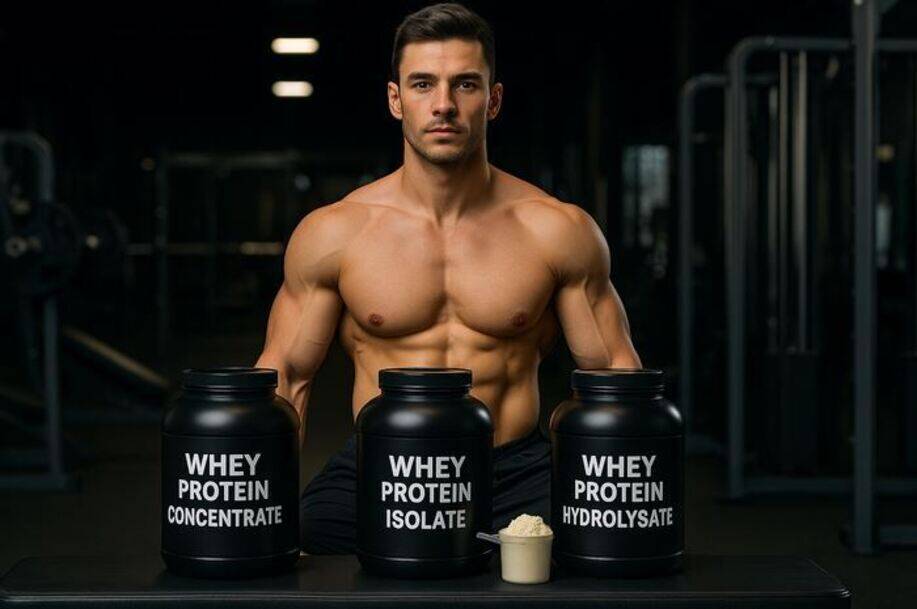
1. Whey Protein Concentrate (WPC)
Definition: Whey protein concentrate is the least processed form of whey, containing both protein and small amounts of fats, carbohydrates (mainly lactose), and beneficial bioactive compounds from milk.
- Protein content: ~70–80%
- Advantages: Affordable, retains immune-boosting peptides, good taste, and texture.
- Drawbacks: Higher lactose content may cause bloating or discomfort in lactose-intolerant individuals [4].
- Best for: Everyday use by those without lactose issues.
💡 Coach’s Insight: “I often start beginners on WPC because it’s cost-effective and delivers results when paired with a balanced diet. The slight extra fat and carbs are negligible for most people.”
2. Whey Protein Isolate (WPI)
Definition: Whey protein isolate is a highly filtered whey with most lactose and fat removed, resulting in a purer protein powder and faster absorption.
- Protein content: 90%+
- Advantages: Very low lactose, minimal fat, fast digestion, suitable for low-carb diets.
- Drawbacks: More expensive; can taste less creamy [3].
- Best for: Post-workout shakes, lactose-sensitive athletes, cutting phases.
3. Whey Protein Hydrolysate (WPH)
Definition: Whey protein hydrolysate is pre-digested whey in which protein chains are broken into smaller peptides [4] for ultra-fast absorption and reduced allergenic potential. With such a fast absorption rate, it is used during and after workouts.
- Protein content: 80–90% (depending on base type).
- Advantages: Quickest absorption, ideal for peri-workout use, gentle on digestion.
- Drawbacks: High price, slightly bitter taste.
- Best for: Elite athletes, competition prep, those with digestive issues from other whey forms.
💡 Coach’s Insight: “Hydrolyzed whey shines in scenarios where every minute counts for recovery — like back-to-back training sessions.”
4. Native Whey Protein
Definition: Native whey protein is extracted directly from fresh milk rather than as a byproduct of cheese-making, preserving higher leucine content [3] and more natural protein structures.
- Protein content: 80–90%
- Advantages: High leucine, minimal processing, clean taste.
- Drawbacks: Costly, limited availability.
- Best for: Purists and those seeking maximum leucine for muscle protein synthesis.
5. Whey Protein Blends
Definition: Whey protein blends combine two or more whey types (e.g., concentrate + isolate + hydrolysate) to balance cost, taste, and absorption rates. This is a middle-of-the-road option for those who are maintaining weight rather than bulking or cutting, and who want a quality supplement that’s also cost-effective.
- Protein content: Varies (often 75–85%)
- Advantages: Good flavor, versatile, affordable compared to pure isolate or hydrolysate.
- Drawbacks: Exact ratios are often undisclosed; quality can vary.
- Best for: General supplementation without specific digestion or budget constraints.
6. Other Specialized Forms
Definition: Specialty whey proteins undergo unique processing to alter digestion speed or preserve specific bioactive fractions.
- Examples:
- Micellar Whey – slower digestion, closer to casein in effect.
- Cross-Flow Microfiltered Whey (CFM) – maintains more bioactive peptides.
Comparison Table: Whey Protein Types
The table below summarizes the main types of whey protein, highlighting their source, processing method, protein percentage, lactose content, absorption speed, cost, and the situations they are best suited for. This quick comparison makes it easy to see the key differences at a glance, helping you choose the whey protein type that aligns best with your goals, dietary needs, and budget [3].
| Type | Source & Processing | Protein % | Lactose Content | Absorption Speed | Cost | Best For |
|---|---|---|---|---|---|---|
| WPC | Byproduct of cheese, minimal filtration | 70–80% | Moderate | Fast | Low | Everyday use |
| WPI | Filtered via micro/ultrafiltration | 90%+ | Low | Very fast | Medium–High | Lactose-sensitive, cutting |
| WPH | Enzymatically pre-digested | 80–90% | Low | Ultra-fast | High | Elite recovery |
| Native Whey | Directly from milk, no cheese process | 80–90% | Low | Fast | Very high | Purists |
| Blends | Mix of types | Varies | Varies | Mixed | Medium | General use |
Personal Coach’s Insights: Matching Whey to Goals
💡 From my years of coaching, I’ve learned that whey protein choice isn’t just about picking the “best” product on paper — it’s about matching the right form to your body’s needs, your training style, and even your budget. Here’s how I guide my clients when selecting whey protein:

Muscle gain with no lactose issues – WPC is fine
WPC is affordable, tasty, and still delivers a high-quality amino acid profile. The slightly higher lactose and fat content aren’t a problem for those who digest dairy well, and the extra nutrients can even help maintain a calorie surplus for muscle growth.
Cutting phase with strict macros – WPI
Whey protein isolate offers over 90% protein with minimal fats and carbs, making it easier to stay in a calorie deficit while still hitting your protein targets. Its fast absorption also works well post-workout to support recovery without excess calories [5].
Fastest recovery possible – WPH
Hydrolyzed whey is partially broken down into peptides, meaning your body absorbs it more quickly than any other form. This makes it perfect for athletes training multiple times a day or in situations where every minute of recovery counts [5].
Premium nutrition focus – Native Whey
Native whey comes directly from fresh milk and retains slightly higher leucine content, which can further stimulate muscle protein synthesis. For those who want the “cleanest” option and don’t mind paying more, this is the top-shelf choice.
Balanced everyday choice – Blends
Whey blends mix concentrate, isolate, and sometimes hydrolysate, providing a balance of cost, taste, and varied digestion rates. They work well for people who want one all-around powder for any time of day without overthinking timing or purity.
Potential Drawbacks and Considerations
- Lactose sensitivity can limit WPC use.
- Hydrolyzed and native whey cost significantly more [5].
- Overuse of shakes can crowd out whole-food nutrition.
💡 Coach’s Note: “I’ve seen better results when clients treat whey protein as a supplement to a diet rich in whole foods, not a replacement.”
Best Combinations (Stacks)
Whey protein is powerful on its own, but when strategically combined with other supplements, its benefits can be amplified. These combinations — often called “stacks” — are designed to target specific performance goals, from faster recovery to greater strength gains. [5] Over the years, I’ve tested many of these with clients, and the right pairing can make a noticeable difference in results.
- Whey + Creatine – strength and mass gains.
- Whey + Beta-Alanine – better high-intensity endurance.
- Whey + Carbs Post-Workout – faster glycogen replenishment.
Who Should Use Whey Protein?
- Athletes needing quick recovery.
- Lifters seeking extra protein without heavy meals.
- People struggling to hit protein targets with food alone.
Who Should Avoid Whey Protein?
- People with dairy allergies.
- Severe lactose intolerance (unless using WPI/WPH).
- Certain kidney conditions (consult a doctor).
Health Benefits of Each Whey Protein Type
1. Whey Protein Concentrate (WPC)
- Supports Muscle Growth and Repair — Rich in essential amino acids and BCAAs, particularly leucine, which triggers muscle protein synthesis.
- Boosts Immune Function — Contains bioactive compounds [1] like lactoferrin and immunoglobulins that support the immune system. [2]
- Promotes Gut Health — Slightly higher lactose content can support beneficial gut bacteria in individuals without lactose intolerance.
- Sustained Energy Release — The slower digestion rate compared to isolate can help maintain satiety and steady energy. [1]
2. Whey Protein Isolate (WPI)
- Ideal for Lactose-Intolerant Individuals — Ultra-filtered to remove most lactose, making it easier to digest [2] .
- Rapid Muscle Recovery — Quick absorption delivers amino acids to muscles faster after training.
- Supports Lean Muscle Development — Minimal fats and carbs help preserve muscle mass while promoting fat loss.
- Improves Metabolic Rate — High protein content can boost thermogenesis and daily calorie burn. [1]
3. Whey Protein Hydrolysate (WPH)
- Fastest Absorption Rate — Pre-digested peptides allow for almost immediate delivery of amino acids to muscles.
- Reduced Allergenic Potential — Hydrolysis breaks down proteins into smaller peptides, lowering the risk of allergic reactions.
- Excellent for Post-Workout Recovery — Minimizes muscle soreness and speeds up glycogen replenishment.
- Enhanced Insulin Response — May help shuttle nutrients more efficiently into muscle cells. [1]
Conclusion
Whey protein comes in many forms, and understanding the differences is key to choosing the one that supports your goals, budget, and digestion. By matching the processing method and nutrient profile to your needs, you’ll get better results and better value.
💡 As a coach, I tell my clients: Don’t overcomplicate it — pick the type that fits your routine and use it consistently alongside a solid training and diet plan. While any whey protein won’t instantly deliver the freaky size of Big Ramy, Lou Ferrigno, or Jay Cutler, it’s still a cornerstone of nutrition for anyone chasing growth.
The information provided in this article is intended for general informational and educational purposes only. It should not be considered medical advice or a substitute for professional consultation. Dietary supplements are not meant to diagnose, treat, cure, or prevent any disease, and their effectiveness may vary between individuals.
Always consult a qualified healthcare professional before starting any new supplement regimen—especially if you are under 18, pregnant, breastfeeding, have a medical condition, or take prescription medications.
The author and the Bodybuilding Wizard website are not responsible for any health issues, side effects, or adverse outcomes resulting from the use or misuse of supplements discussed herein. Use supplements only as directed by the manufacturer and prioritize a balanced diet, proper training, and recovery as the foundation of your fitness journey.
