



Working from home during the COVID-19 pandemic has its perks—no commute, flexible hours, and pajama dress code. But it also means logging long hours at your desk, turning your home office into a sedentary trap. As a certified strength and conditioning coach, I’ve seen countless clients lose muscle tone and energy simply because they couldn’t get to the gym.
In this article, you’ll discover a series of no-equipment and minimal-equipment exercises you can perform beside your desk. Whether on a video call or wrapping up a report, these moves will help you maintain—and even build—lean muscle without leaving your home workspace.
The Rise of At-Home Fitness: A Pandemic-Fueled Shift
When COVID-19 first hit, public gyms and studios shuttered overnight. Faced with isolation and social-distancing rules, millions turned their living rooms into makeshift workout spaces. In fact, the European e-commerce market for fitness gear jumped from $256.1 M in 2019 to a projected $447.9 M by 2027—a signal that people aren’t just buying dumbbells for now, they’re investing in long-term home setups.
Trainer’s Insight:
“I saw clients swap their gym memberships for resistance bands and adjustable benches almost immediately. What began as a necessity is rapidly becoming the new normal.”
Simultaneously, remote work soared: surveys in spring 2021 showed 12.3 % of Europeans working from home (up from about 5 % pre-pandemic). Many will stick with hybrid or fully remote models even when offices reopen. That means desks will stay busy—and so should your muscles. Combining brief strength breaks with your WFH routine, you tap into a growing movement: blending productivity and fitness without leaving your home office.
Benefits of Desk-Friendly Strength Training
- Combat Sedentary Behavior
Prolonged sitting slows your metabolism, reduces insulin sensitivity, and contributes to muscle atrophy. Short, frequent strength breaks rev up your system and blast calories even after you sit back down. - Improve Posture & Circulation
Desk work often leads to rounded shoulders and tight hip flexors. Targeted exercises open the chest, strengthen the back, and promote blood flow to your legs and core. - Boost Energy & Focus
A 2-minute workout spike releases endorphins and oxygenates the brain, perfect for reigniting focus in the mid-afternoon slump.
Trainer’s Insight:
“I recommend clients break up every 45–60 minutes of seated work with at least one exercise. Even a quick circuit can make a dramatic difference in posture and mood.”
Safety & Preparation
Before you begin:
- Clear Your Space: Push your chair back, move any cables, and ensure at least 2–3 ft of free space around your desk.
- Choose Sturdy Furniture: A solid desk edge or a stable chair without wheels is crucial for dips and push-ups.
- Warm Up: Even at your desk, you can activate your muscles:
- Arm Circles: 10 forward, 10 backward
- Leg Swings: 10 per leg (front-to-back)
- Torso Twists: 10 each side
Trainer’s Insight:
“Skipping a warm-up is the fastest way to experience muscle strain. Five dynamic movements are all you need to prime your body.”
Upper-Body Exercises
Desk Push-Ups
- Setup: Place your hands shoulder-width apart on the edge of your desk.
- Execution: Walk your feet back until your body forms a straight line from head to heels. Bend your elbows to lower your chest toward the desk, then press up.
- Variations:
- Narrow grip (triceps emphasis)
- Incline to decline (feet on chair) for more chest activation

Chair or Desk Dips
- Setup: Sit on the edge of a sturdy chair or bench. Place hands beside hips, fingers facing forward.
- Execution: Slide your hips off the seat, lower your torso by bending your elbows to ~90°, and press back up.
- Tip: Keep elbows tight to minimize shoulder strain.

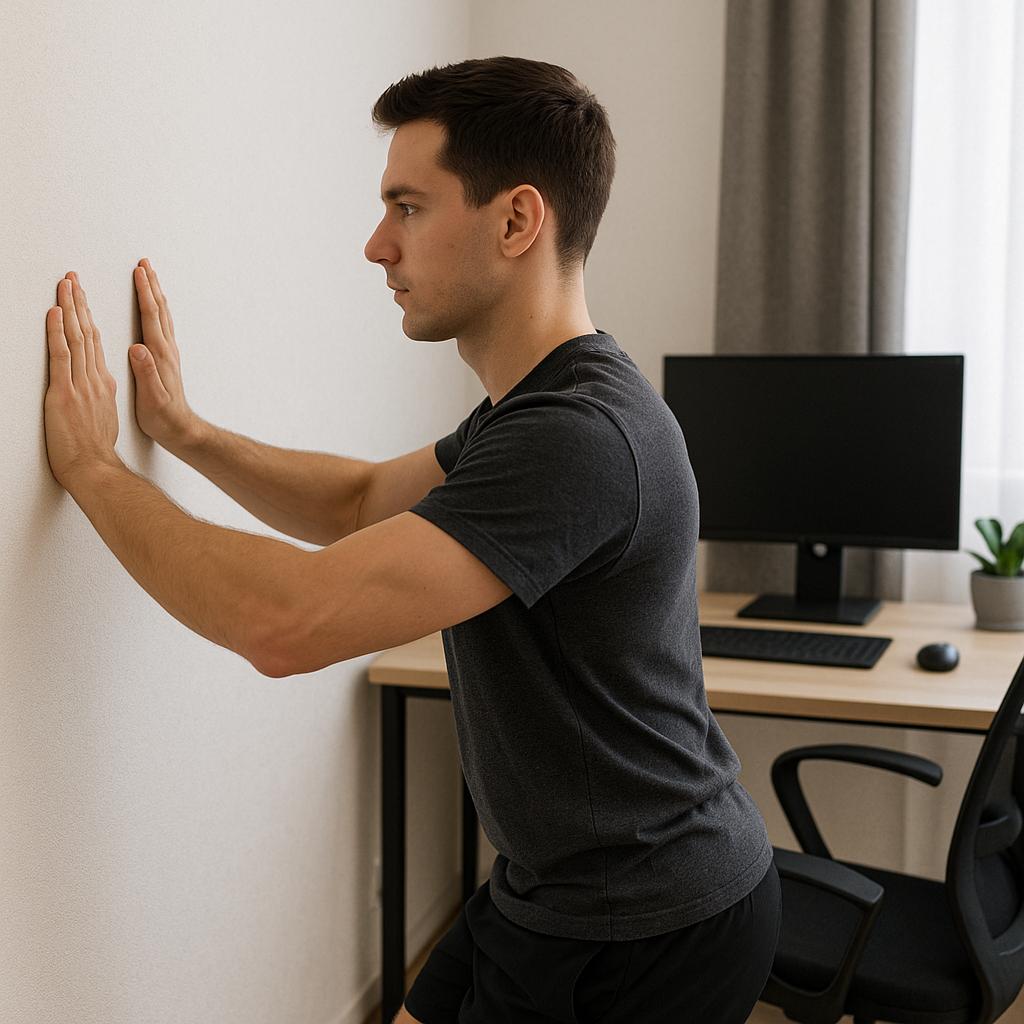
Isometric Wall Presses
- Setup: Stand a foot away from a wall, press palms into the wall at chest height.
- Execution: Push as hard as possible into the wall and hold for 20–30 seconds.
- Benefit: Builds static strength in the chest and shoulders when dynamic movement isn’t possible.
Core Strength Moves
Seated Leg Raises
- Setup: Sit tall on your chair edge, grip the sides for stability.
- Execution: Keeping knees bent at 90°, lift both feet a few inches off the floor. Pause, then lower slowly.
- Progression: Straighten legs to increase difficulty.


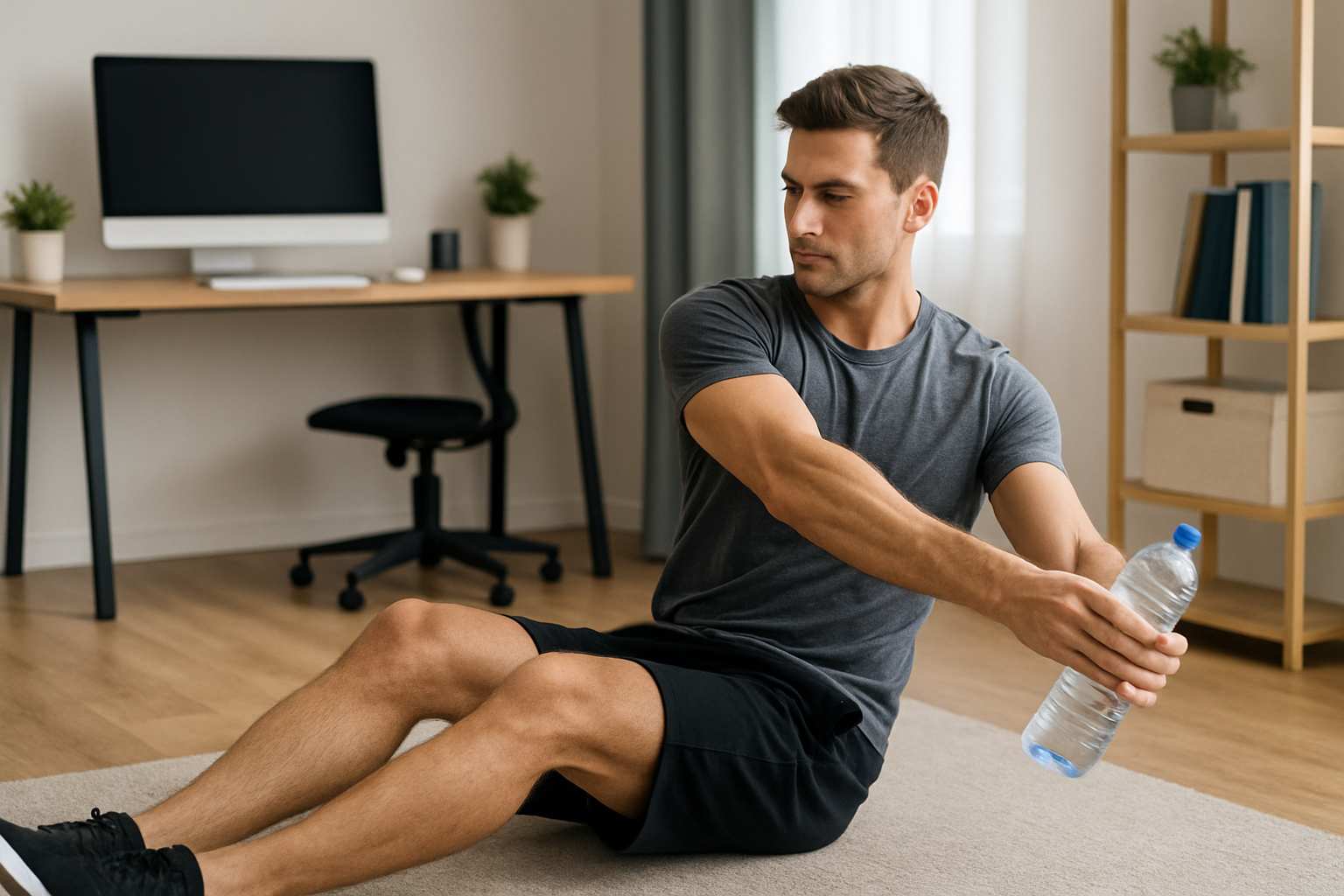
Seated Russian Twists
- Setup: Hold a water bottle or small weight in both hands.
- Execution: Lean back slightly, lift feet if you can, and twist your torso to each side, tapping the bottle on the floor.
Ab Bracing (“Vacuum”)
- Setup: Sit upright, exhale fully.
- Execution: Draw your belly button toward your spine and hold for 10–20 seconds. Repeat 3–5 times.

Trainer’s Insight:
“These core drills not only sculpt your midsection but also support your lower back, which is critical when we sit for extended periods.”
Lower-Body & Glute Activation
Chair Squats (Sit-to-Stand)
- Setup: Stand in front of your chair, feet hip-width apart.
- Execution: Hinge at the hips and bend knees to tap the seat, then stand back up without using your hands.

Desk Hip Thrusts
- Setup: Rest your upper back on the edge of your desk or a low bench, feet flat on the floor.
- Execution: Drive hips upward, squeezing glutes at the top, then lower down.

Calf Raises
- Setup: Stand on a stair or sturdy platform—heels hanging off the edge.
- Execution: Rise onto toes, pause, then lower heels below platform level.

Resistance-Band Add-Ons
If you have a loop or tube band, you can drastically increase intensity:
- Band Rows: Anchor under desk leg, pull elbows back to squeeze shoulder blades.


- Seated Biceps Curls: Step on the band, curl handles up.

- Lateral Raises: Stand on the band, lift arms to shoulder height.

- Band Pull-Apart: Hold the band in front of you with extended arms. This is the starting position. Move your arms to the back, extended to your side.

Trainer’s Insight:
“Bands are compact and budget-friendly; I recommend keeping one at your desk to unlock a full upper-body routine.”
Stretching & Mobility Breaks
Mix in these stretches to counteract desk posture:
- Neck & Shoulder Rolls: 10 each direction
- Hip Flexor Stretch: Lunge half-kneeling at chair edge, press hips forward
- Hamstring Stretch: Sit on chair edge, extend one leg, hinge at hips
- Spinal Twist: Seated, place hand on opposite knee and rotate
Sample “Desk Workout” Routine
Perform this circuit every 60 minutes for 2–3 rounds:
| Exercise | Reps/Duration |
|---|---|
| Desk Push-Ups | 10–12 |
| Chair Squats | 15 |
| Seated Leg Raises | 12–15 |
| Desk Dips | 8–10 |
| Seated Russian Twists | 20 total (10/side) |
| Ab Bracing | 20 sec hold |
Trainer’s Insight:
“Circuit training keeps your heart rate up and maximizes calorie burn. Adjust reps based on your current fitness level.”
Tips for Consistency & Progress
- Set Reminders: Use calendar alerts or your phone to nudge you every hour.
- Track Your Workouts: Note reps and sets in a simple log or smartphone app.
- Progress Gradually: Once exercises become easy, increase reps, add a band, or elevate your feet.
- Stay Hydrated & Fuel Up: Muscle growth requires protein—aim for at least 20 g of lean protein within an hour after your workday.
Conclusion
Building muscle at your desk isn’t just about aesthetics—it’s about health, energy, and resilience in unpredictable times. By weaving these quick strength breaks into your workday, you’ll stave off the adverse effects of sitting, improve your posture, and feel more focused.
Ready to take your home-office fitness to the next level? Check out Bodybuilding Wizard’s complete At-Home Training Programs and let’s build strength—one rep at a time.
