


Introduction
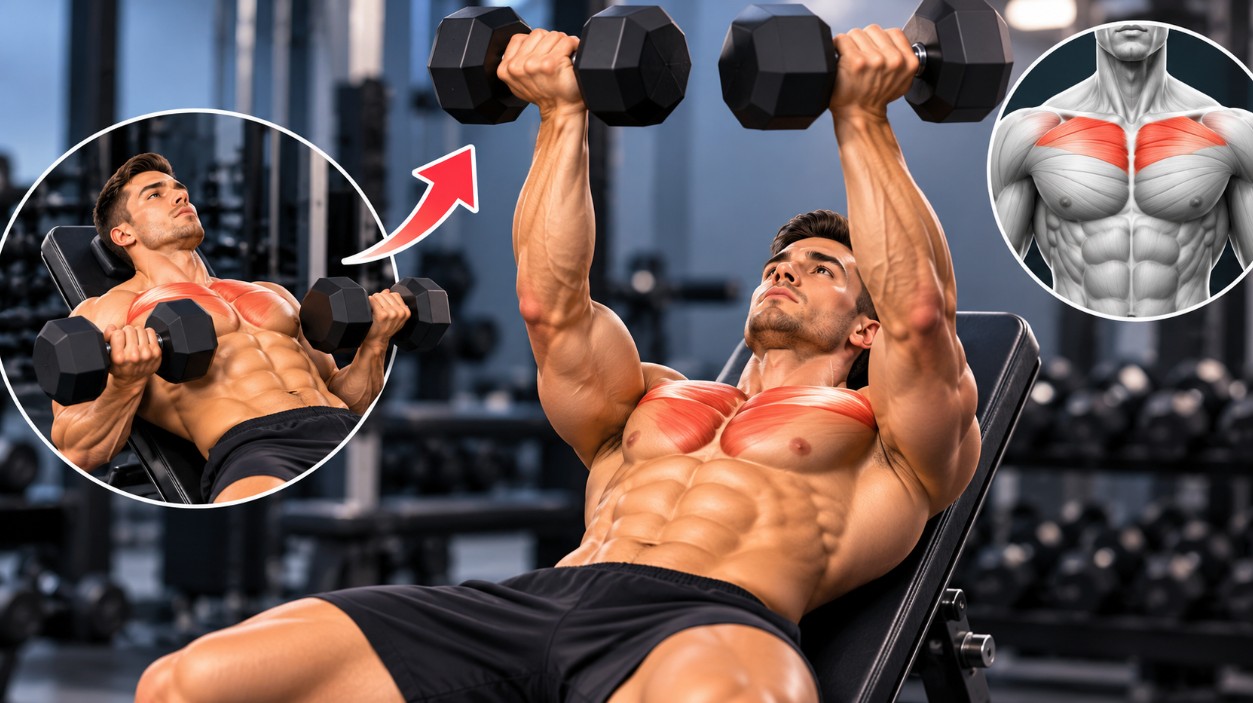
The reverse-grip incline dumbbell press is a variation of the classic incline dumbbell bench press in which you hold the dumbbells with an underhand (supinated) grip, palms facing toward your head. The setup and bench angle stay the same, but turning the hands around changes how the elbows move and how the press feels.
It combines two strategies that lifters use to emphasize the upper chest. The incline shifts the pressing direction upward relative to the torso, while the underhand grip, as research on the reverse-grip bench press suggests, keeps the elbows tucked and has been linked to greater activity of the clavicular portion of the chest. The dumbbells add another benefit: each arm moves independently, without a bar that can roll out of an underhand grip.
The result is an interesting, slightly unusual upper chest press that works well as a training variation. It is not a replacement for the standard incline press, but it is a valuable addition to your upper-chest exercise list, especially when you want to vary the stimulus.
The reverse-grip incline dumbbell press is an upper chest exercise performed on an incline bench, in which the dumbbells are held with a supinated (underhand) grip, palms facing toward the head, and pressed from the upper chest to arm’s length. The incline and the underhand grip both shift emphasis toward the clavicular (upper) head of the pectoralis major, while the elbows stay close to the body and the anterior deltoids and triceps brachii assist.
Other Names for Reverse-Grip Incline Dumbbell Press
The exercise has several names, all describing the underhand grip.
- Underhand incline dumbbell press
- Supinated incline dumbbell press
- Reverse-grip incline DB press
- Incline dumbbell reverse press
- Underhand-grip incline press
Required Equipment
You only need dumbbells and an adjustable bench.
- A pair of dumbbells, lighter than you use for the regular incline press
- An adjustable bench set to an incline of about 30 degrees
How to Perform Reverse-Grip Incline Dumbbell Press
The underhand grip makes the setup and the first few reps feel different, so start light and focus on control.
Starting Position
Get the dumbbells into position with a neutral grip before switching to the underhand grip.
- Set an adjustable bench to about 30 degrees and sit with a dumbbell on each thigh
- Kick the dumbbells up with your knees and lie back, holding them over your chest with a neutral grip
- Rotate your hands into a supinated (underhand) grip, palms facing toward your head
- Keep the handles resting in the heels of your palms with your wrists straight
- Plant your feet and press your upper back into the bench
- Pull your shoulder blades slightly back and down
Execution (Action Phase)
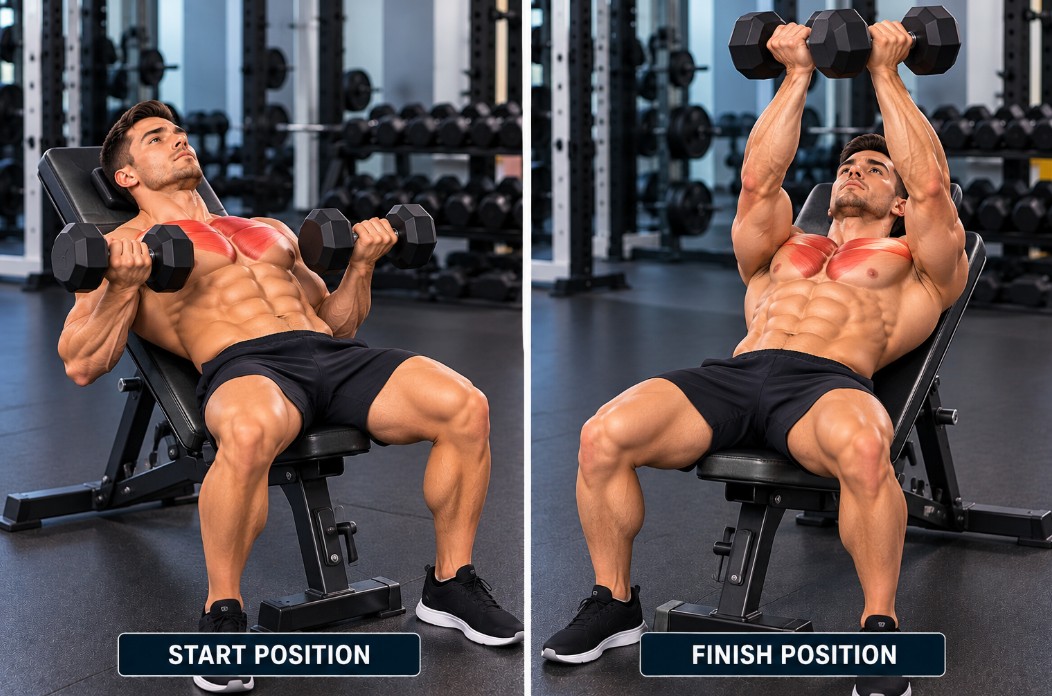
Lower and press the dumbbells with your elbows tucked close to your body.
- Take a breath and brace your core (see our guide on breathing technique)
- Lower the dumbbells slowly to the sides of your upper chest
- Keep your elbows close to your body as the dumbbells descend
- Exhale and press the dumbbells back up over your upper chest
- Bring the dumbbells close together at the top without clashing them
- Keep your wrists straight throughout the set
At the end of the set, rotate back to a neutral grip before lowering the dumbbells to your thighs and sitting up.
Video Demonstration
Watching the reverse-grip incline dumbbell press helps you see how the elbows stay tucked and the wrists stay straight.
In the video below, notice how the lifter holds the dumbbells with an underhand grip, lowers them slowly to the sides of the upper chest with the elbows close to the body, and presses them back up without the dumbbells drifting apart. Keep the wrists straight throughout the movement.

The first time clients try the reverse-grip incline dumbbell press, they usually look like someone carrying two suitcases with the handles turned the wrong way. The wrists bend back, the dumbbells tilt, and a weight that felt easy on a regular incline press suddenly seems twice as heavy. It is a humbling moment, and a very common one.
With my clients, I simply start lighter than they expect, focus on keeping the wrists straight with the handle resting in the heel of the palm, and let the elbows stay close to the body. Within a couple of sessions, the grip stops feeling strange, and many of them tell me they feel their upper chest working in a completely new way.
Quick Form Checklist
Run through these cues before every set to keep the exercise safe and controlled.
- Bench set to about 30 degrees
- Underhand grip, palms toward the head
- Wrists straight, handles in the heels of the palms
- Elbows close to the body
- Controlled lowering to the upper chest
Technical Emphasis & Targeting Adjustments
A few adjustments can change how the reverse-grip incline dumbbell press feels.
- Moderate incline (about 30 degrees) → upper chest focus. Research on bench pressing found that the clavicular head reached its highest activation at around 30 degrees, while the front delts became increasingly active at steeper angles.
- Elbows tucked → natural pressing path. The underhand grip naturally keeps the elbows close to the body. Letting them flare out makes the dumbbells harder to control.
- Slight inward angle of the dumbbells → more comfortable wrists. Many lifters find it more comfortable to angle the dumbbells slightly, with the inner ends closer together than the outer ends.
- Slower eccentric → more control. Lowering the dumbbells over 2–3 seconds helps you stay in control of the less familiar grip. Learn more about eccentric training.
- Single-arm sets → better focus. Pressing one dumbbell at a time lets you focus on each side, one benefit of unilateral training.
Common Mistakes
Most mistakes come from treating the exercise exactly like a regular incline press. Several of them overlap with typical bench press mistakes.
- Bending the wrists back. Letting the dumbbells roll toward your fingers strains the wrists and makes them harder to control. Keep the handles in the heels of your palms.
- Using too much weight. The underhand grip makes the dumbbells feel heavier. Start noticeably lighter than on the regular incline press.
- Letting the elbows flare. The underhand grip is designed to keep the elbows tucked. Letting them drift out to the sides makes the movement awkward and less stable.
- Setting the bench too steep. A bench close to upright shifts the work to the front delts. Keep the incline at about 30 degrees.
- Starting in the underhand grip. Kicking the dumbbells up with an underhand grip strains the wrists and shoulders. Start with a neutral grip and rotate once the dumbbells are over your chest.
Getting the dumbbells into position with an underhand grip is awkward, so don’t start in the reverse grip. Kick the dumbbells up with your knees using a regular neutral grip, press them up over your chest, and only then rotate your hands so the palms face toward your head.
At the end of the set, reverse the process: rotate back to a neutral grip at the top, then lower the dumbbells to your thighs as you sit up. This keeps your wrists and shoulders out of awkward positions during the setup, which is where many lifters strain something before the first rep even begins.
Mechanical Considerations
With an underhand grip, the elbows stay close to the body, so the press relies more on shoulder flexion and less on horizontal adduction than a regular incline press. You can read more about these joint actions in our guide to anatomical movements. Because the clavicular head of the chest is an important shoulder flexor, this plausibly explains the upper-chest emphasis. On a flat bench, an EMG study found that a supinated grip increased activity of the clavicular portion of the pectoralis major and the biceps, although the study used short isometric holds in a small group.
Dumbbells also produce substantial chest activation, comparable to barbell pressing, while allowing each arm to move independently. No study has directly examined the reverse-grip incline dumbbell press, so its combined effect is based on research on incline angles, grip orientation, and dumbbell pressing. As a compound exercise, it trains the upper chest, front delts, and triceps together.
Muscles Worked in Reverse-Grip Incline Dumbbell Press
MAIN MUSCLES
- Pectoralis major (with emphasis on the clavicular head)
SECONDARY MUSCLES
STABILIZERS
ANTAGONISTS
Reverse-Grip Incline Dumbbell Press Pros and Cons
The reverse-grip incline dumbbell press is a useful variation, but it also has clear limitations.
Advantages
- Two upper chest strategies in one. The incline and the underhand grip both shift emphasis toward the upper chest.
- No bar to roll. Unlike the barbell version, dumbbells can’t roll out of an underhand grip, which makes the exercise easier to control.
- Elbows naturally tucked. Many lifters find the tucked elbow position comfortable for the shoulders.
- Independent arm movement. Each side works on its own, which helps reveal and address strength differences.
Potential Drawbacks
- Lighter loads. The underhand grip limits how much weight you can handle compared with the regular incline press.
- Wrist discomfort. The supinated position can feel uncomfortable at first and takes time to adapt to.
- Awkward setup. Getting into position requires switching grips, which takes practice.
- Limited research. The exercise hasn’t been studied directly, so its benefits are based on related research.
Safety Considerations
A review of resistance-training injuries reported that the shoulder complex accounted for up to 36% of documented injuries and disorders, although much of the available evidence was retrospective. Keep these precautions in mind.
- Wrist discomfort. The underhand grip can aggravate existing wrist injuries. Keep the wrists straight and strengthen the forearm muscles if needed.
- Biceps tendon irritation. The biceps are more active with an underhand grip. Lifters with biceps tendonitis should use light loads or choose another variation.
- Shoulder discomfort. A steep bench or flared elbows can make the press uncomfortable. Stop if you feel pinching, and learn more about shoulder joint anatomy.
- Previous pectoral strain. Lifters recovering from a pectoral strain should start with light dumbbells and a controlled range of motion.
Reverse-Grip Incline Dumbbell Press Variations
Reverse-grip flat dumbbell press
Difficulty: Similar to the standard version
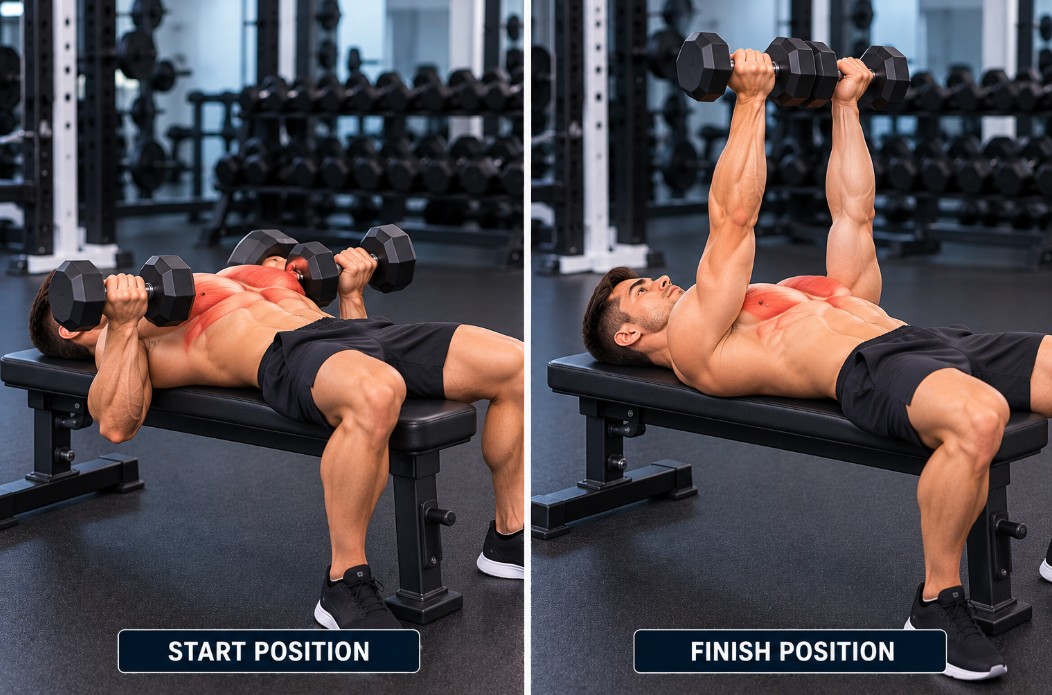
Performing the exercise on a flat bench keeps the underhand grip but removes the incline. It is the dumbbell version of the reverse-grip bench press.
Single-arm reverse-grip incline dumbbell press
Difficulty: Harder than the standard version
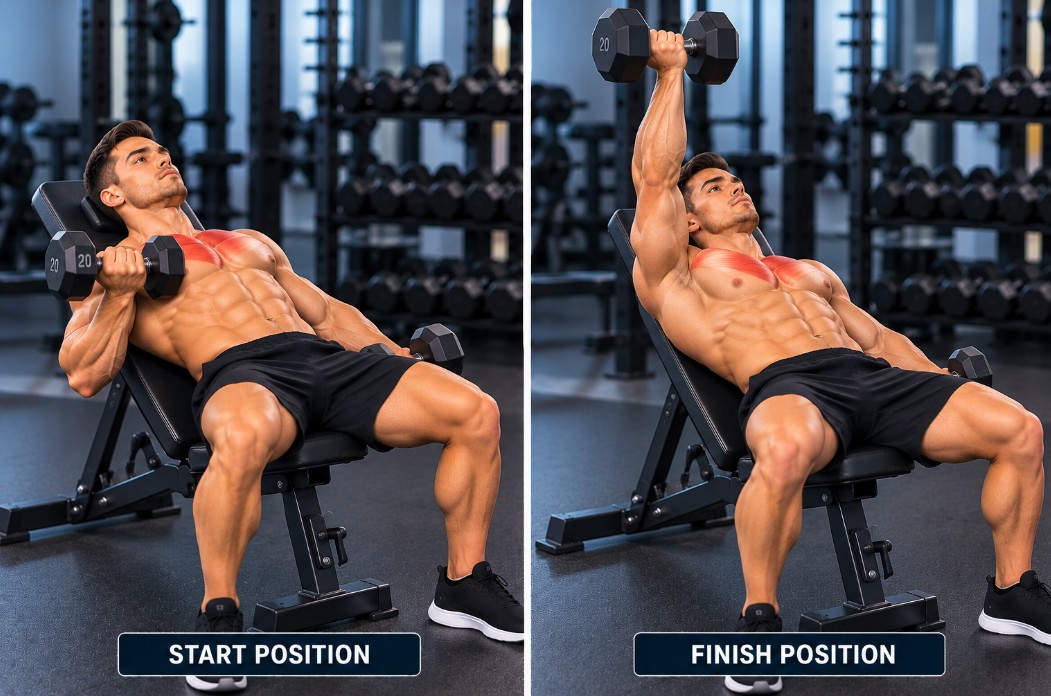
Pressing one dumbbell at a time lets you focus fully on each side and challenges your core to keep the body stable on the bench.
Low-incline reverse-grip dumbbell press
Difficulty: Similar to the standard version
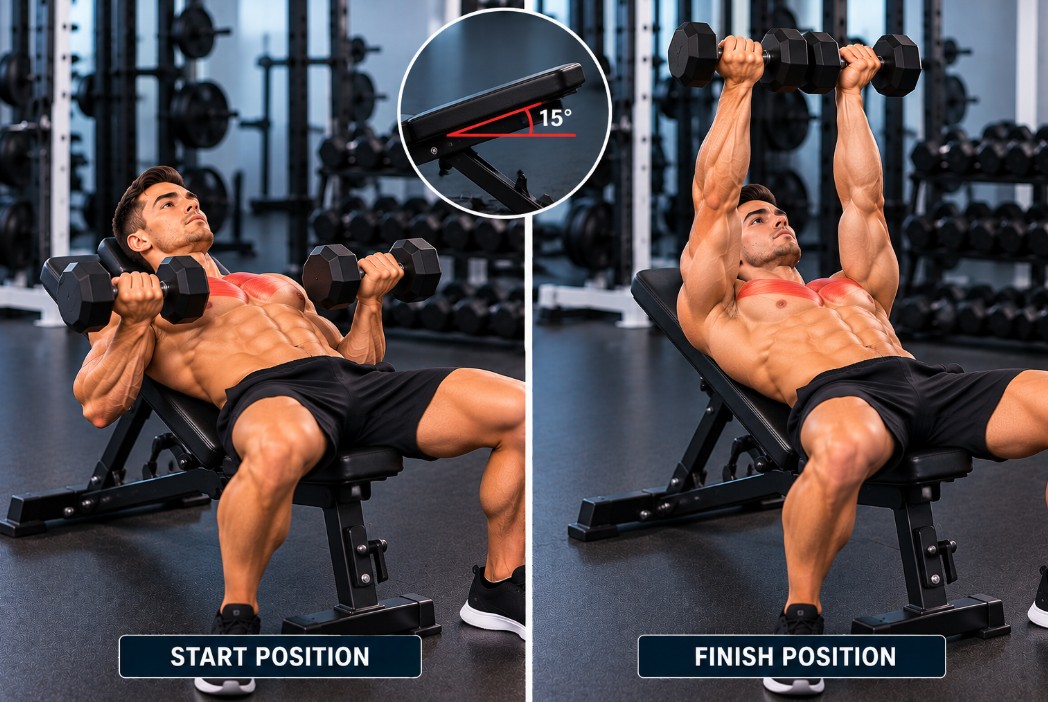
Setting the bench to about 15 degrees blends the flat and incline versions. Some lifters find it more comfortable for the shoulders.
Reverse-grip Smith machine incline press
Difficulty: Easier than the standard version
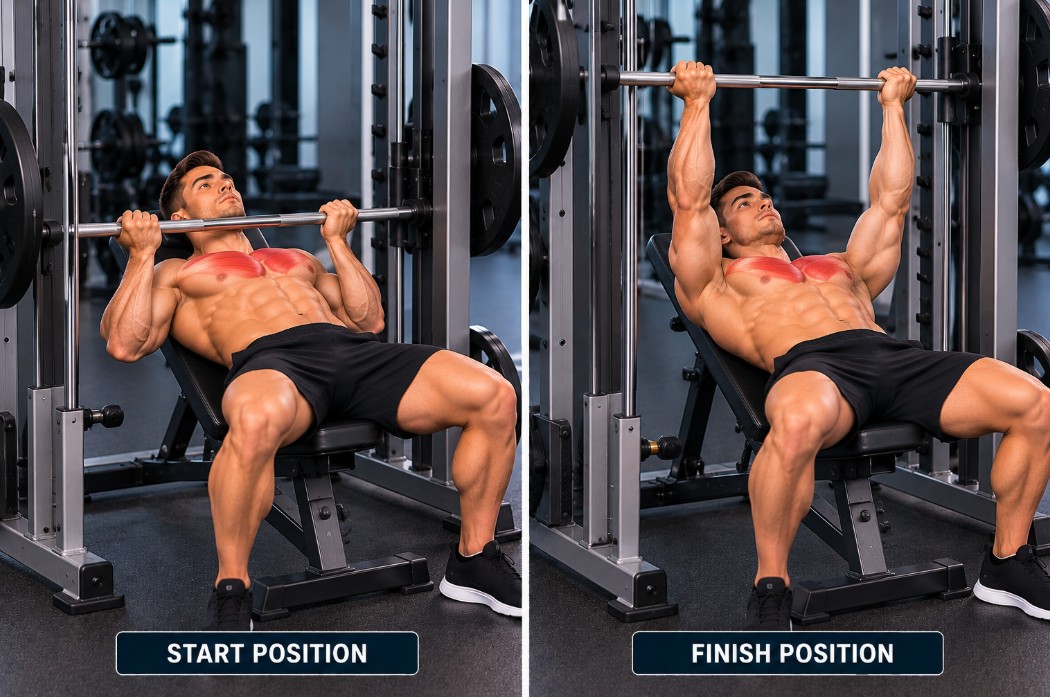
Using a Smith machine removes the need to stabilize the weights. It combines the underhand grip with the guided path of the Smith machine incline press.
Paused reverse-grip incline dumbbell press
Difficulty: Harder than the standard version
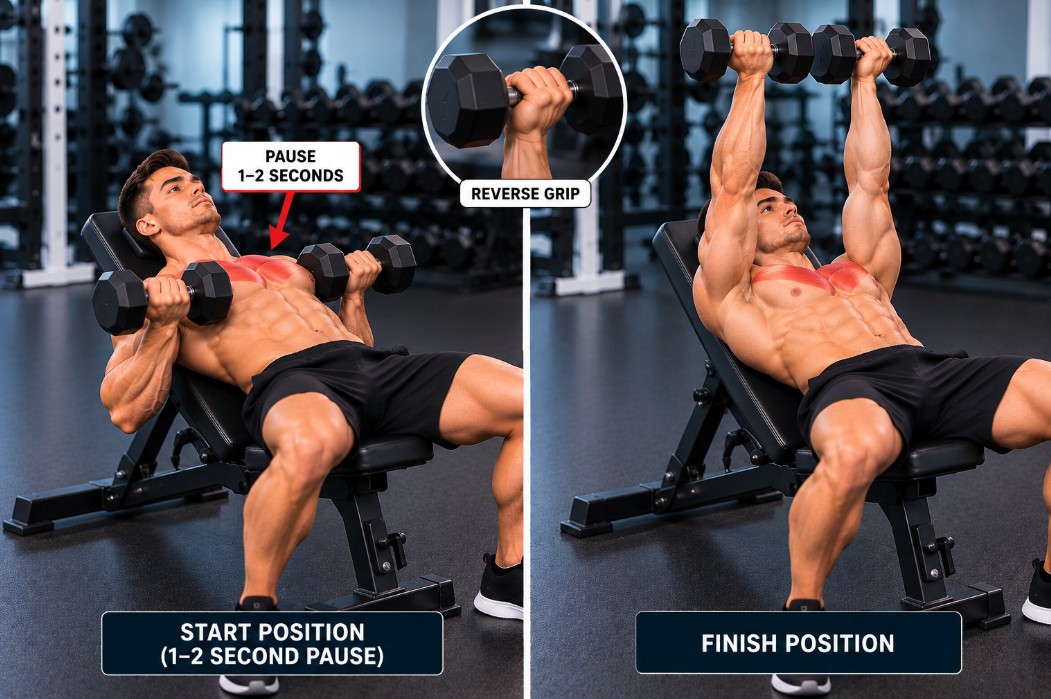
Holding the dumbbells at the bottom for 1–2 seconds before each press removes the rebound and reinforces control. Use lighter weights than usual.
Replacement Exercises (Substitutes) for the Reverse-Grip Incline Dumbbell Press
If the underhand grip doesn’t suit you, these exercises also emphasize the upper chest.
- Incline barbell bench press. The incline barbell bench press lets you load the upper chest heavier with a standard grip.

- Machine incline chest press. The machine incline chest press provides a guided path for safe, high-effort upper chest work.

- Landmine chest press. The landmine chest press is a standing press with an incline-like angle.
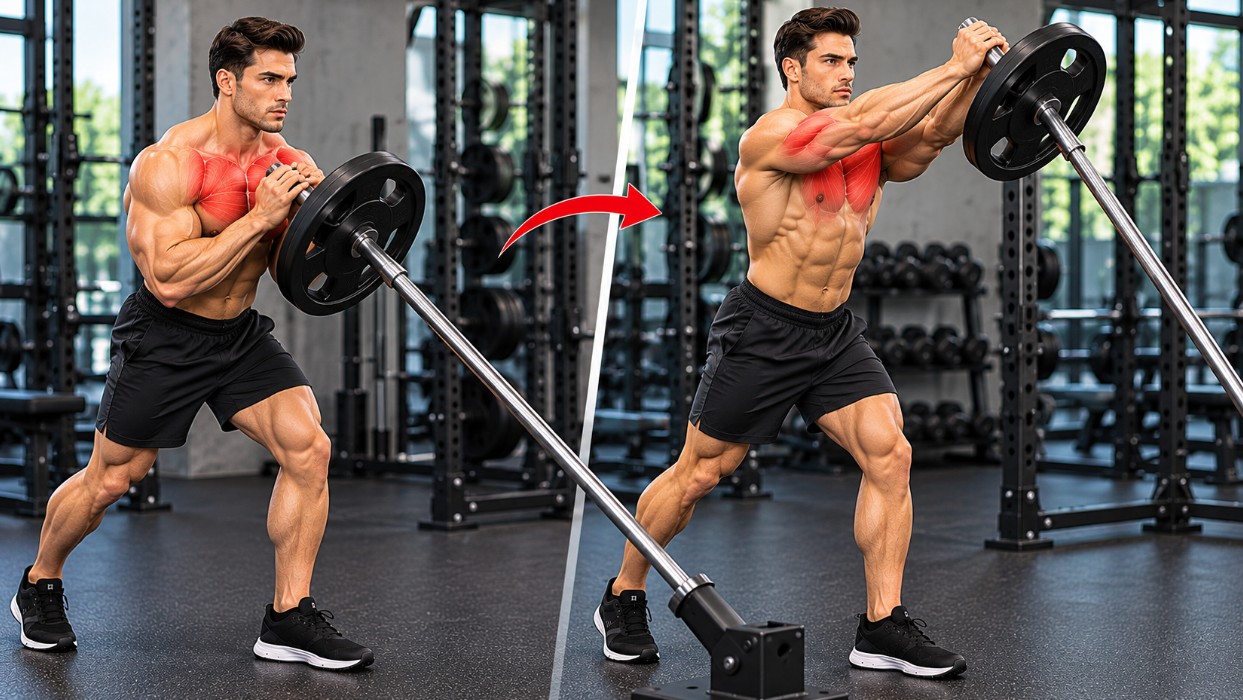
- Incline dumbbell champagne press. The incline dumbbell champagne press keeps the dumbbells together for a constant squeeze.

- Low-pulley cable fly. The low-pulley cable fly isolates the upper chest with an upward arc.
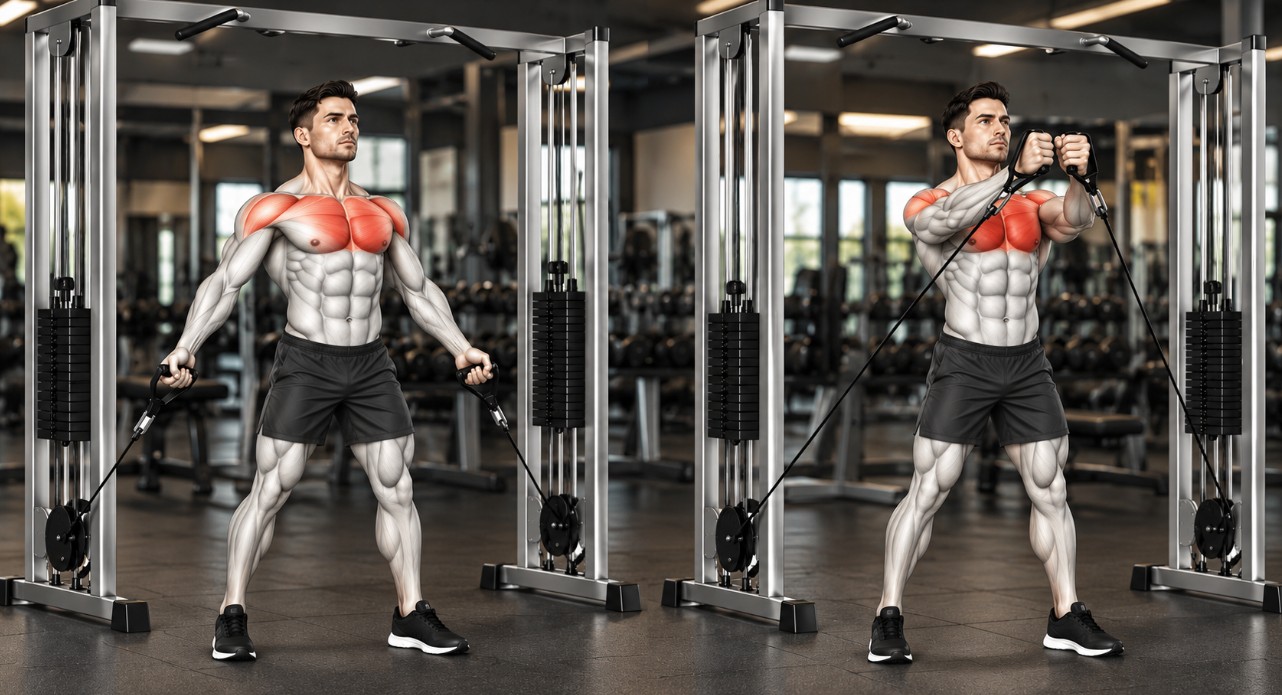
- Incline cable fly. The incline cable fly keeps tension on the upper chest near the top of the movement.

How to Program the Reverse-Grip Incline Dumbbell Press
How you program this exercise depends on your training goal and where it fits in your upper chest workout.
Show full programming guideHide programming guide ▾
| Goal | Sets | Reps | Rest | Tempo |
|---|---|---|---|---|
| Hypertrophy | 3–4 | 8–12 | 90–120 s | 2–3 s lowering |
| Strength-focused | 3–4 | 6–8 | 2 min | Controlled lowering, forceful press |
| Muscular endurance | 2–3 | 12–15 | 60 s | Steady, controlled |
Muscle growth can occur across a wide range of repetitions when sets are taken close to failure, so treat these numbers as guidelines rather than strict rules. Adjust your rest periods between sets based on how recovered you feel.
- As a secondary upper chest press after an incline barbell or regular incline dumbbell press
- As the main upper chest press when you want to vary your training
- On push days as a combined upper chest and triceps exercise
- In rotation with other incline presses every few weeks to vary the stimulus
Apply progressive overload conservatively: add reps first, then move to the next pair of dumbbells once you complete all sets at the top of your rep range with straight wrists and a controlled bar path. Because the grip is less familiar, increase the load more gradually than on a regular incline dumbbell press.
Reverse-Grip vs Regular Incline Dumbbell Press (Comparison Table)
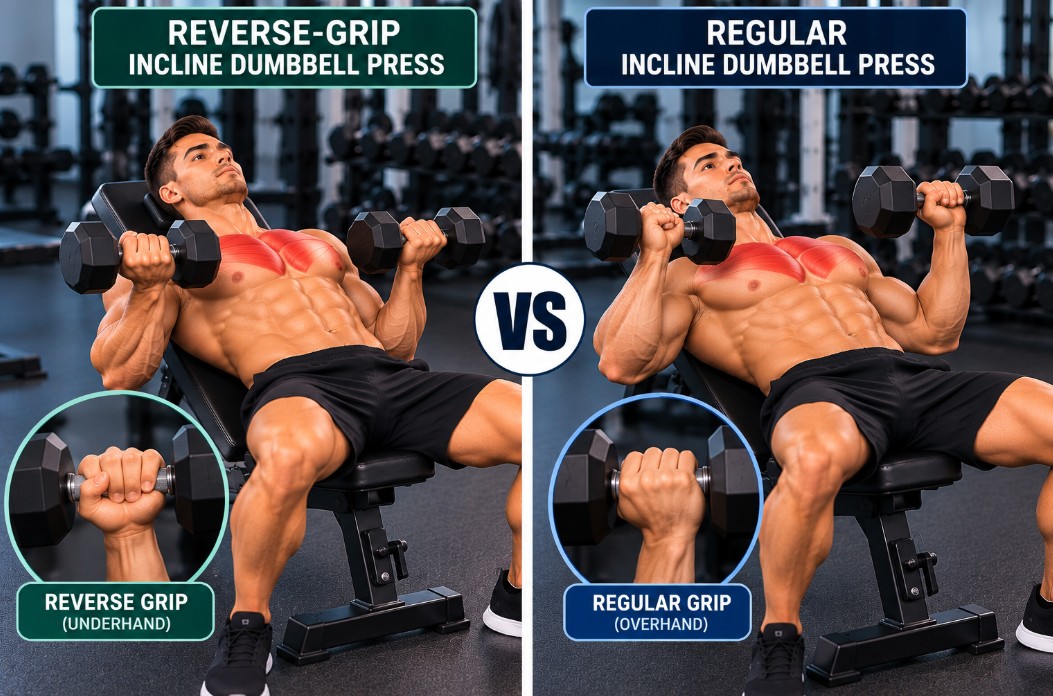
| Criteria | Reverse-Grip Incline Dumbbell Press | Regular Incline Dumbbell Press |
|---|---|---|
| Grip | Supinated (underhand) | Pronated (overhand) or neutral |
| Elbow Position | Tucked close to the body | Moderately tucked |
| Typical Load | Lighter | Heavier |
| Biceps Involvement | Higher | Lower |
| Learning Curve | Moderate | Easy |
| Best For | Upper chest variety, tucked-elbow pressing | Primary upper chest pressing |
The regular incline dumbbell press remains the better choice as a primary upper chest exercise. It allows heavier loads, feels more natural, and is easier to progress over time. For more on bench angles, read our comparison of incline vs. flat bench press.
The reverse-grip version is a useful variation that adds the underhand grip to an incline press. Many lifters rotate it into their program every few weeks to vary the stimulus.
Final Thoughts
The reverse-grip incline dumbbell press combines an incline bench with an underhand grip, two strategies associated with greater upper chest emphasis. With dumbbells instead of a barbell, it is also easier to control and allows each arm to work independently.
Start with lighter dumbbells, keep your wrists straight and your elbows tucked, and switch grips only when the dumbbells are over your chest. Used as a variation alongside your regular incline presses, it can help you build a fuller upper chest. To learn more about the bone where the upper chest attaches, read our guide to the clavicle.
Frequently Asked Questions
What is the reverse-grip incline dumbbell press?
It is an incline dumbbell press performed with a supinated (underhand) grip, palms facing toward your head. The elbows stay close to the body, and the exercise emphasizes the upper chest.
Does the reverse-grip incline dumbbell press work the upper chest more?
An EMG study found that a supinated grip increased activity of the clavicular (upper) head on a flat bench, and incline pressing also shifts activity toward the upper chest. No study has examined this exact exercise, so the combined effect is based on related research.
What is the difference between the reverse-grip incline dumbbell press and the regular incline dumbbell press?
The regular version uses an overhand or neutral grip and allows heavier loads. The reverse-grip version uses an underhand grip, keeps the elbows tucked, and places more demand on the triceps and biceps for stabilization.
What is the difference from the reverse-grip bench press?
The reverse-grip bench press uses a barbell on a flat bench. The reverse-grip incline dumbbell press uses dumbbells on an incline bench, which allows each arm to move independently and adds the upper chest emphasis of the incline.
What bench angle should I use?
An incline of about 30 degrees is a good starting point. Steeper angles increasingly involve the front delts.
How heavy should the dumbbells be?
Use dumbbells noticeably lighter than for a regular incline dumbbell press, at least until you are comfortable with the grip. Increase the load gradually.
Is the reverse-grip incline dumbbell press hard on the wrists?
It can feel uncomfortable at first, because the wrists are in an unfamiliar position. Keep the handle in the heel of your palm, the wrists straight, and the load light until you adapt.
How do I get into position with an underhand grip?
Kick the dumbbells up with a neutral grip, press them over your chest, and then rotate your hands into the underhand grip. Reverse the process at the end of the set.
Should the dumbbells touch at the top?
They can come close together or lightly touch at the top, but avoid clashing them. Keep the movement controlled throughout.
Is the reverse-grip incline dumbbell press good for beginners?
It is better suited to lifters who are already comfortable with the regular incline dumbbell press. Beginners should master the standard version first.
