



You can describe every rep you perform in the gym using anatomical movements. A squat involves hip and knee flexion followed by hip and knee extension. A lateral raise is primarily shoulder abduction. A biceps curl is elbow flexion. Once you know this standardized vocabulary, you’re no longer memorizing hundreds of exercises as isolated movements — you’re recognizing a much smaller set of joint actions that show up again and again across your entire training program. This guide builds directly on our Basic Anatomy and Physiology pillar and our Muscular System guide, giving you the specific language used to describe what a joint is actually doing during any exercise.
QUICK ANSWER: Anatomical movements describe how one body segment moves relative to another at a joint. Terms such as flexion, extension, abduction, adduction, and rotation give trainers, lifters, clinicians, and researchers a standardized language for describing human movement, so that the same exercise or joint action can be discussed precisely regardless of who’s describing it.
| Movement | Basic Meaning | Gym Example |
| Flexion | Decreases joint angle | Curl |
| Extension | Increases joint angle | Rising from a squat |
| Abduction | Away from the midline | Lateral raise |
| Adduction | Toward the midline | Cable adduction |
| Rotation | Turns around a longitudinal axis | Shoulder rotation |
Why Lifters and Trainers Should Understand Joint Actions
Understanding joint actions helps you see what’s happening during an exercise, not just follow instructions. It helps you identify muscle function directly from movement, choose exercises based on the function you actually want to train, understand agonist and antagonist relationships without guesswork, analyze technique more precisely, make sense of exercise research and biomechanical guides that use this terminology, and communicate more precisely with coaches, physical therapists, and other professionals. This vocabulary is exactly what separates “this exercise works your shoulders” from a precise, useful understanding of what the shoulder joint is actually doing — the same standardized terms you’ll find in any anatomy reference on movement terminology.
Anatomical Position: The Starting Point for Describing Movement
Before you can describe any movement, you need a fixed reference point. That reference is the anatomical position: standing upright, facing forward, arms at the sides, palms facing forward, and feet facing forward. This convention, along with the movement terminology built on it, is internationally standardized so anatomists, clinicians, and researchers worldwide describe movement the same way. Every anatomical movement term — flexion, abduction, rotation, and the rest — describes a change relative to this starting position. This matters more than it seems: without a shared reference point, “moving the arm forward” could mean flexion, abduction, or rotation depending on the starting position, so the entire system of movement description depends on this fixed convention. For the complete picture of anatomical position and the full set of directional terms (anterior, posterior, medial, lateral, proximal, distal, superficial, deep, and more), see our dedicated guide to Anatomical Position and Directional Terms.
Anatomical Planes and Axes of Movement
Movement is also described in relation to three anatomical planes, and most single-joint movements happen predominantly in one of them.
| Plane | Divides Body Into | Primary Movements | Exercise Example |
| Sagittal | Left/right | Flexion, extension | Squat |
| Frontal | Front/back | Abduction, adduction | Lateral raise |
| Transverse | Upper / lower | Rotation | Cable rotation |
Real exercises frequently combine movement across more than one plane at once — a single-arm dumbbell row, for instance, involves sagittal-plane shoulder extension along with some frontal- and transverse-plane movement at the scapula. The three-plane model is a teaching tool that makes individual joint actions easier to understand, not a claim that every real-world movement is confined to a single plane.
Flexion
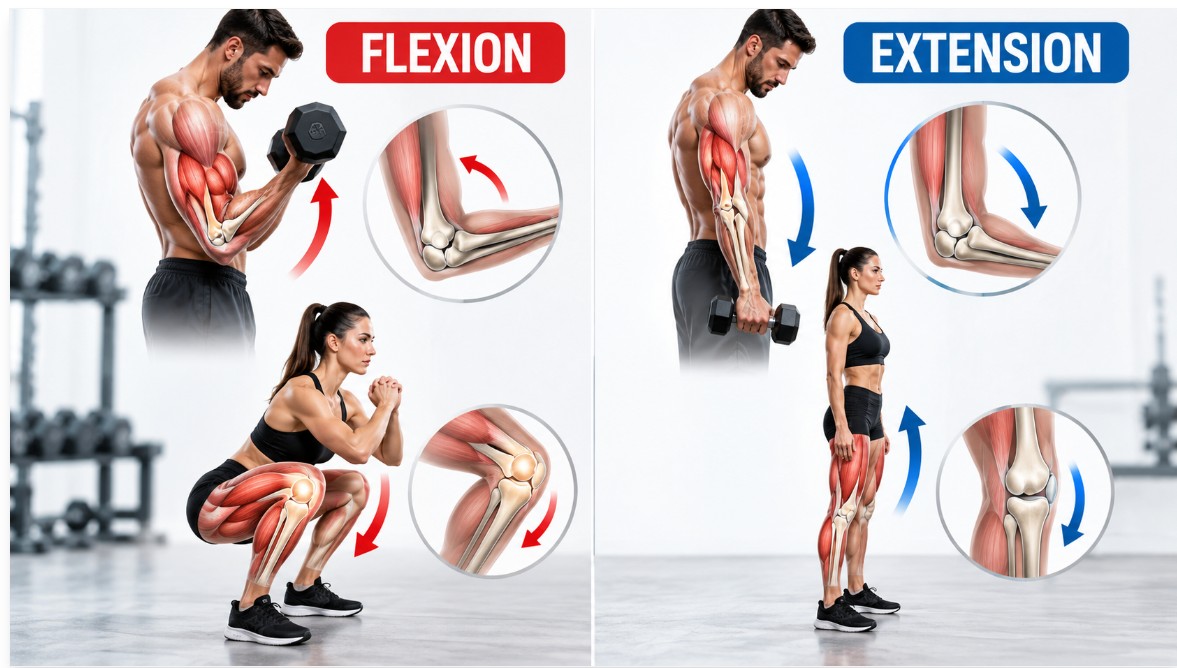
Flexion is a movement that decreases the angle between two body segments at a joint, as classified in standard anatomy references. Elbow flexion happens during a biceps curl, hip flexion happens when you raise your thigh, knee flexion happens during a leg curl, shoulder flexion happens during a front raise, and trunk flexion happens during a crunch. One nuance worth knowing: “decreasing joint angle” is a useful simplification, but at more complex joints — the shoulder and the spine in particular — the standard anatomical convention for what counts as flexion doesn’t always map perfectly onto that simple description, so it’s worth learning the convention for each joint rather than assuming the general rule applies everywhere without exception.
Extension
Extension is essentially the opposite of flexion: a movement that increases the joint angle. Elbow extension happens during a triceps pushdown, hip extension happens when rising from a squat or performing a hip thrust, knee extension happens during a leg extension, and shoulder extension happens when the arm moves posteriorly, behind the body.
Hyperextension
Hyperextension refers to extension that continues beyond the normal anatomical range for that joint. Despite how the term sounds, it doesn’t automatically mean “dangerous movement” — some joints, like the fingers or the neck, have hyperextension built into their normal range of motion. The term simply describes going past a joint’s typical resting extension, and whether that’s a problem depends entirely on the joint, the load involved, and the context.
Abduction
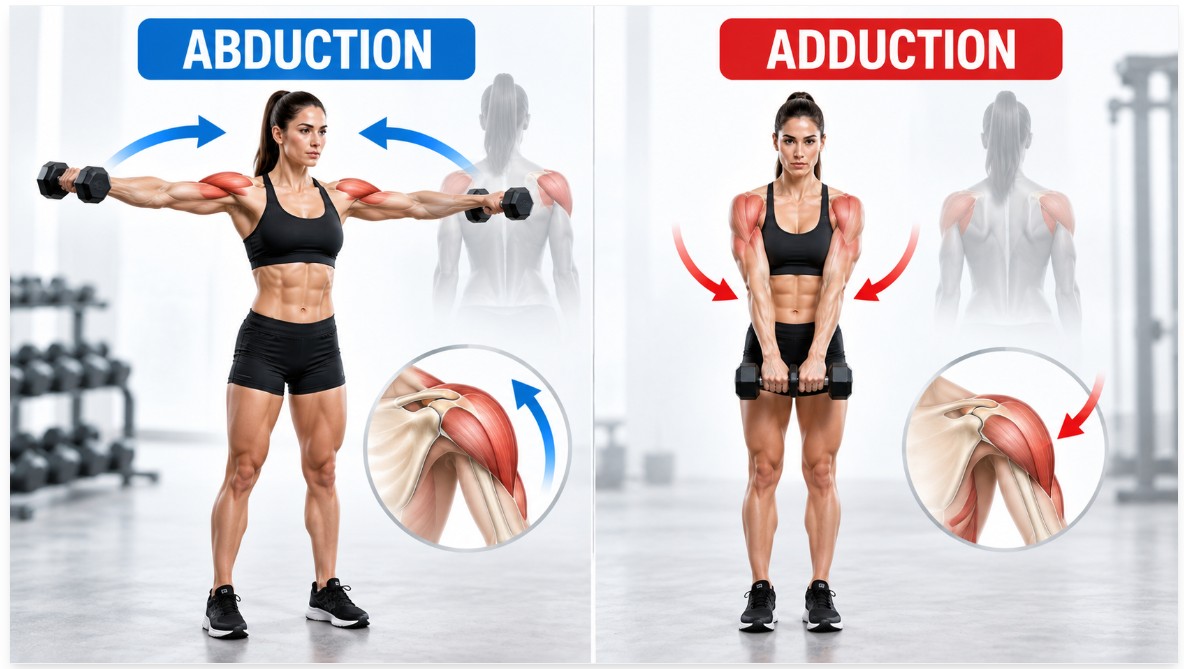
Abduction is movement away from the body’s midline. Shoulder abduction occurs during a lateral raise; hip abduction occurs during a cable hip abduction exercise. Fingers and toes follow a slightly different reference line — their midline is the middle finger or middle toe rather than the body’s central axis — so spreading the fingers apart is finger abduction relative to that digit-specific midline.
Adduction
Adduction is movement toward the body’s midline — the reverse of abduction. Shoulder adduction and hip adduction follow the same logic as their abduction counterparts, just in the opposite direction. A lateral raise offers a clean practical contrast: raising the arm outward and upward is shoulder abduction, while controlling the arm back down toward the body is shoulder adduction.
It’s worth being precise here, because this is a common point of confusion: joint action is not the same thing as muscle contraction type. During that same lateral raise, the shoulder performs abduction on the way up and adduction on the way down, but whether the deltoid is acting concentrically or eccentrically during either phase depends on which muscle you’re tracking and how the exercise is loaded — the joint-action label and the muscle-contraction label answer two completely different questions. We cover this distinction in full in Types of Muscle Contractions: Concentric, Eccentric & Isometric Explained.
Internal and External Rotation
Rotation deserves extra attention because it matters so much for lifting, especially at the shoulder and hip.
Internal (Medial) Rotation
Internal rotation turns a limb toward the body’s midline around its long axis. At the shoulder, this happens whenever the arm rotates inward; at the hip, it’s the equivalent inward turning of the thigh.

External (Lateral) Rotation
External rotation turns a limb away from the midline. At the shoulder, this movement is closely tied to rotator cuff function and shoulder health, and it’s directly trained in exercises like the cable external rotation. See our Shoulder Joint Anatomy and Rotator Cuff Muscles guides, and the practical Cable External Rotation exercise guide, for the full picture.
Horizontal Abduction and Horizontal Adduction
This pair is enormously relevant to bodybuilding, even though general anatomy resources often don’t connect it clearly to training.
Horizontal Adduction
Horizontal adduction happens when the arm moves across the front of the chest, roughly parallel to the floor. This is the primary joint action in a bench press and a chest fly, and it’s a major reason the pectoralis major is so heavily involved in both.
Horizontal Abduction
Horizontal abduction is the reverse: the arm moving away from the chest and backward, roughly in the same horizontal plane. A reverse fly is a clear example, and it’s a large part of why that exercise emphasizes the posterior deltoid. See Flat Barbell Bench Press, Standing Dumbbell Chest Fly, and Bent-Over Dumbbell Lateral Raise for how this plays out in real exercises.
Pronation and Supination
These terms specifically describe forearm rotation. Supination turns the palm anteriorly, or upward when the elbow is bent; pronation turns it posteriorly, or downward. This shows up constantly in curl variations — a supinated curl keeps the palm facing up throughout, while a pronated (reverse) curl keeps the palm facing down, changing which forearm and upper-arm muscles are emphasized. A simple memory aid: supination is the position you’d use to hold a bowl of soup in your palm. See Supinating Dumbbell Curl for a practical example of this grip in action.
Dorsiflexion and Plantar Flexion
These describe ankle movement specifically. Dorsiflexion brings the top of the foot toward the shin — this is exactly what has to happen at the ankle during the descent of a barbell squat, which is part of why limited ankle dorsiflexion mobility can noticeably affect squat depth and technique. Plantar flexion moves the foot away from the shin, pointing the toes downward — the primary joint action in a calf raise. See Standing Barbell Calf Raise for the clearest example of plantar flexion as a trained movement.
Inversion and Eversion
Inversion turns the sole of the foot to face medially, toward the other foot; eversion turns it to face laterally, away from the other foot. These movements matter for ankle stability and mechanics, particularly around balance-demanding exercises and injury prevention, even though they’re rarely trained as primary movements the way dorsiflexion and plantar flexion are.
Elevation and Depression
These terms describe scapular movement specifically. Elevation raises the scapula, as in a shrug; depression lowers it, as in the downward pull of the scapula that happens in many pulling exercises. The trapezius plays a major role in both, and scapular control through this range is a recurring theme in shoulder health and technique discussions across this site.
Protraction and Retraction
This pair is especially important for chest and back training. Scapular protraction moves the shoulder blades around the rib cage, away from the spine; scapular retraction moves them back toward the spine. A push-up plus emphasizes protraction, while a row emphasizes retraction. It’s worth pushing back on a common bodybuilding oversimplification here: not every pulling exercise needs to end in maximal scapular retraction — how much retraction is appropriate depends on the exercise, the joint action being trained, and the specific goal of the movement, not a blanket rule that “more retraction is always better.” See The Role of the Scapula in Bodybuilding for the full picture.
Upward and Downward Rotation of the Scapula
Beyond elevation, depression, protraction, and retraction, the scapula also rotates. Upward rotation tilts the bottom of the shoulder blade outward and is essential for raising the arm fully overhead without impinging structures in the shoulder; downward rotation reverses this. This is directly relevant to overhead pressing and lateral raise mechanics, and it connects closely to the shoulder joint anatomy covered in Shoulder Joint Anatomy: Structure, Movement & Stability for Lifters.
Opposition and Reposition
These describe thumb-specific movement: opposition brings the thumb across the palm to touch the other fingers, and reposition returns it to the anatomical position. These aren’t central to bodybuilding training, but they’re part of a complete anatomical movement vocabulary and show up in grip-related discussions.
Lateral Flexion
Lateral flexion describes sideways bending of the trunk or neck, away from the midline. A side bend is the clearest gym example, and lateral trunk movement shows up as a stabilization demand in many unilateral loaded carries and single-arm exercises, even when it isn’t the primary trained movement.
Circumduction
Circumduction isn’t a single joint action in the same sense as the others — it’s a combination: flexion flowing into abduction, into extension, into adduction, in a continuous sequence. As a result, the distal segment of the limb traces a circular or cone-shaped path. Arm circles at the shoulder and similar movements at the hip are the clearest examples.
Joint Action vs. Muscle Action: Don’t Confuse the Two
This is one of the most important distinctions in this entire guide. Take a dumbbell curl: on the way up, the joint action is elbow flexion, and the biceps is acting concentrically. On the way down, the joint action is elbow extension, and the biceps is acting eccentrically — the muscle is still the elbow flexor throughout; it’s simply controlling the joint as it extends rather than producing the extension itself. This is exactly why it’s inaccurate to treat “flexion” and “concentric” as synonyms, or “extension” and “eccentric” as synonyms — joint action describes what’s happening at the joint, while muscle action describes what the muscle is doing, and the two don’t always align the way you’d assume. For the complete breakdown of muscle actions, see Types of Muscle Contractions: Concentric, Eccentric & Isometric Explained.
How Muscles Produce Joint Actions
Muscles rarely produce a joint action alone. The agonist (or prime mover) is primarily responsible for the movement; the antagonist is the muscle on the opposite side of the joint that lengthens or controls the movement; synergists assist the agonist; and stabilizers hold other joints steady so the movement can happen efficiently. During elbow flexion, the biceps brachii, brachialis, and brachioradialis all contribute as flexors to varying degrees depending on forearm position, while the triceps brachii acts as the antagonist. We cover this framework — and how it applies across major muscle groups — in more depth in our Muscular System pillar.
One Exercise Can Involve Multiple Joint Actions
Most real exercises involve several joint actions happening at once, at different joints.
Barbell Back Squat
During the descent: hip flexion, knee flexion, and ankle dorsiflexion. During the ascent: hip extension, knee extension, and the ankle reversing out of dorsiflexion toward a more neutral or slightly plantarflexed position.
Bench Press
During the lowering phase: shoulder horizontal abduction and elbow flexion. During the pressing phase: shoulder horizontal adduction and elbow extension.
Lat Pulldown
Depending on grip and technique: shoulder adduction and/or extension, elbow flexion, and scapular depression and retraction working together.
Romanian Deadlift
Hip flexion during the lowering phase and hip extension during the ascent, with relatively little change in knee angle compared to a squat — which is exactly why the Romanian deadlift emphasizes the hip extensors so heavily relative to the quadriceps. See Romanian Deadlift and Wide-Grip Lat Pulldown for the full technique breakdowns.
Compound vs. Isolation Exercises Through the Lens of Joint Actions
A single-joint exercise involves coordinated movement primarily around one major joint — a leg extension (knee extension) or a biceps curl (elbow flexion) are clear examples. A multi-joint exercise involves coordinated movement across multiple joints at once — a squat (hip, knee, and ankle) or a bench press (shoulder and elbow) are the clearest examples. It’s worth being precise about what “isolation exercise” actually means here: it’s a practical training term describing an exercise built around a single joint action, not a literal claim that only one muscle is working — as covered above, synergists and stabilizers are still active even during single-joint movements.
Major Joint Actions Cheat Sheet
| Joint Action | What Happens | Main Joint(s) | Gym Example |
| Flexion | Joint bends | Elbow, hip, knee, shoulder | Curl |
| Extension | Joint straightens | Elbow, hip, knee | Leg extension |
| Abduction | Away from midline | Shoulder, hip | Lateral raise |
| Adduction | Toward midline | Shoulder, hip | Cable adduction |
| Internal rotation | Rotates inward | Shoulder, hip | Cable internal rotation |
| External rotation | Rotates outward | Shoulder, hip | Cable external rotation |
| Horizontal adduction | Across the body | Shoulder | Chest fly |
| Horizontal abduction | Away, horizontally | Shoulder | Reverse fly |
| Pronation | Forearm rotates palm down | Radioulnar | Pronated curl |
| Supination | Forearm rotates palm up | Radioulnar | Supinated curl |
| Dorsiflexion | Foot toward shin | Ankle | Squat descent |
| Plantar flexion | Foot away from shin | Ankle | Calf raise |
| Inversion | Sole turns inward | Foot | — |
| Eversion | Sole turns outward | Foot | — |
| Elevation | Structure moves upward | Scapula | Shrug |
| Depression | Structure moves downward | Scapula | — |
| Protraction | Scapula moves forward | Scapulothoracic | Push-up plus |
| Retraction | Scapula moves backward | Scapulothoracic | Row |
| Lateral flexion | Side bending | Spine | Side bend |
| Circumduction | Circular sequence | Shoulder, hip | Arm circle |
How to Analyze Any Exercise Using Joint Actions
This is a simple, repeatable four-step method you can apply to any exercise, including ones you’ve never seen before:
- Identify the joints that move throughout the exercise.
- Determine the direction of movement at each of those joints.
- Name the joint action occurring at each joint, using the terminology in this guide.
- Identify the muscles producing or controlling those actions.
Try it on a squat or a bench press using the breakdowns above, and you’ll notice the method works identically regardless of how unfamiliar the specific exercise is — which is exactly the point.
Bodybuilder’s Take: Once you understand joint actions, you no longer need to memorize every exercise as an isolated movement. If you know what the shoulder, elbow, hip, and knee are actually doing, you can reason through why a specific exercise loads certain muscles, and predict how a technique change will shift that demand, instead of relying purely on memorized exercise-muscle lists.
Common Mistakes When Describing Exercise Movement
A few recurring errors show up constantly in fitness content and gym conversation: confusing joint action with muscle contraction type, assuming “lowering the weight” always means an eccentric action for every muscle involved, describing an exercise by which direction the weight moves rather than which joint action is occurring, forgetting anatomical position as the reference point, treating complex shoulder and scapular movement as a single simple action when it’s really several joint actions happening together, and assuming a real-world movement occurs strictly in one anatomical plane when most compound exercises involve some combination of all three.
Coach’s Note: Learn Movements, Not Exercise Names. Exercises come and go, but human joint actions do not. In my experience, a trainer who genuinely understands flexion, extension, abduction, and rotation can look at an exercise they’ve never seen before — a new machine, a variation someone shows them, a movement from another sport — and analyze it correctly on the spot. A trainer who has only ever memorized names and muscle-worked lists is stuck the moment something unfamiliar shows up. Learn the movements, and every new exercise becomes readable rather than mysterious.
Key Takeaways
- ✓Anatomical movements are described relative to the anatomical position, the fixed starting reference for the whole system.
- ✓Flexion decreases joint angle; extension increases it.
- ✓Abduction moves a limb away from the midline; adduction moves it toward the midline.
- ✓Internal and external rotation, horizontal abduction and adduction, and pronation and supination cover most of the remaining movement vocabulary lifters actually need.
- ✓Joint action and muscle contraction type are two different things and shouldn’t be treated as synonyms.
- ✓Most real exercises involve several joint actions occurring simultaneously at different joints.
- ✓“Isolation exercise” describes a single dominant joint action, not literally one working muscle.
- ✓Learning joint actions lets you analyze any exercise, familiar or brand new, using the same simple method.
Frequently Asked Questions
What are the main anatomical movements?
The core anatomical movements include flexion, extension, abduction, adduction, internal and external rotation, horizontal abduction and adduction, pronation and supination, dorsiflexion and plantar flexion, and circumduction, along with several joint-specific terms like elevation, depression, protraction, and retraction.
What is the difference between flexion and extension?
Flexion decreases the angle between two body segments at a joint, like bending the elbow during a curl. Extension increases that angle, like straightening the elbow during a triceps pushdown.
What is the difference between abduction and adduction?
Abduction moves a body segment away from the body’s midline, like raising the arm out to the side. Adduction moves it back toward the midline, like lowering that arm back down.
What is internal vs. external rotation?
Internal (medial) rotation turns a limb inward, toward the body’s midline, around its long axis. External (lateral) rotation turns it outward, away from the midline. Both are especially relevant at the shoulder and hip.
What is the difference between a joint action and a muscle contraction?
A joint action describes what’s happening at a joint, like flexion or extension. A muscle contraction type describes what a muscle is doing to produce or control that action, like concentric, eccentric, or isometric. They describe different things and don’t always line up the way people assume.
What joint actions occur during a squat?
During the descent: hip flexion, knee flexion, and ankle dorsiflexion. During the ascent: hip extension, knee extension, and the ankle moving out of dorsiflexion.
What joint actions occur during a bench press?
During the lowering phase: shoulder horizontal abduction and elbow flexion. During the pressing phase: shoulder horizontal adduction and elbow extension.
What plane do flexion and extension occur in?
Flexion and extension primarily occur in the sagittal plane, the plane that divides the body into left and right halves.
Why should lifters learn anatomical movements?
Learning this vocabulary lets you analyze any exercise, including ones you’ve never seen before, by identifying the joint actions involved rather than memorizing exercises individually — which improves exercise selection, technique analysis, and communication with coaches and other professionals.
References
- Betts, J. G., et al. (2023). Anatomy and Physiology 2e — Section 9.4, Types of Body Movements. OpenStax. openstax.org/details/books/anatomy-and-physiology-2e
- Neumann, D. A. (2016). Kinesiology of the Musculoskeletal System: Foundations for Rehabilitation (3rd ed.). Elsevier.
- Standring, S. (Ed.). (2020). Gray’s Anatomy: The Anatomical Basis of Clinical Practice (42nd ed.). Elsevier.
- Moore, K. L., Dalley, A. F., & Agur, A. M. R. (2023). Clinically Oriented Anatomy (9th ed.). Wolters Kluwer.
- Federative International Programme for Anatomical Terminology (FIPAT). Terminologia Anatomica, 2nd ed. fipat.library.dal.ca/ta2
- Tortora, G. J., & Derrickson, B. (2017). Principles of Anatomy and Physiology (15th ed.). Wiley.
- Saladin, K. S. (2020). Anatomy & Physiology: The Unity of Form and Function (9th ed.). McGraw Hill.
- Kenhub. Anatomical Terms of Movement. kenhub.com
