



Most shoulder injuries in lifters don’t come from the deltoid — they come from the four small, deep muscles most people have never trained directly. The rotator cuff works behind the scenes on nearly every upper-body exercise you do, and its size has almost nothing to do with its importance: a shoulder with impressive deltoids but a neglected rotator cuff is a shoulder waiting for an injury. Understanding rotator cuff functional anatomy is essential for any lifter serious about long-term shoulder health, not just size.

Quick Answer
The rotator cuff is a group of four muscles — the supraspinatus, infraspinatus, teres minor, and subscapularis — that surround the shoulder joint and hold the head of the humerus centered in the shoulder socket. Often remembered by the acronym “SITS,” these muscles work together to stabilize the shoulder during virtually every arm movement while also contributing to internal and external rotation. Despite being far smaller than the deltoid, the rotator cuff is one of the most clinically important muscle groups in the entire upper body.
| Muscle group | Four deep muscles surrounding the shoulder joint |
|---|---|
| Primary functions | Shoulder joint stabilization, internal/external rotation |
| Members | Supraspinatus, infraspinatus, teres minor, subscapularis |
| Innervation | Suprascapular nerve (supraspinatus, infraspinatus); axillary nerve (teres minor); upper and lower subscapular nerves (subscapularis) |
| Common exercises | Band external rotation, cable internal rotation, face pulls |
| Main bodybuilding role | Shoulder stability and long-term joint health |
Overview
The rotator cuff sits deep beneath the deltoid, working continuously to keep the head of the humerus centered in the shallow glenoid socket of the scapula — a joint built for an enormous range of motion at the cost of inherent stability. Every time you press, pull, or raise your arm, the rotator cuff is working to prevent the shoulder from shifting out of proper alignment, even though you rarely feel it directly the way you feel your deltoid or chest working.
This is exactly why rotator cuff training tends to get neglected: it’s invisible in the mirror, it doesn’t respond to heavy loading the way larger muscles do, and its benefits are mostly preventative rather than immediately visible. But rotator cuff injuries are among the most common and most disruptive injuries in lifters, and unlike a strained muscle, a significant rotator cuff tear can require surgery and months away from training.
The four rotator cuff muscles also don’t work in isolation from the rest of the shoulder. They’re in constant functional communication with the deltoid, trapezius, and scapular stabilizers, all of which need to coordinate properly for the shoulder to move efficiently and safely under load. A weak or poorly coordinated rotator cuff doesn’t just risk injury to itself — it can also alter movement mechanics throughout the entire shoulder complex, which is part of why rotator cuff health is relevant even to lifters who have never directly experienced shoulder pain. To see how these muscles fit into the rest of your muscular system, check out our interactive muscle anatomy tool.
Anatomy & Location
All four rotator cuff muscles originate on the scapula and insert on the humerus, with their tendons blending together into a musculotendinous “collar” that wraps around the front, top, and back of the shoulder joint. According to StatPearls’ anatomical reference on the rotator cuff, this tendon collar reinforces the shoulder joint capsule itself, meaning the rotator cuff isn’t just adjacent to the joint but is structurally woven into it. Of the four, only the infraspinatus is externally visible, sitting in a triangle between the rear deltoid, teres major, and trapezius; the other three are completely hidden beneath surrounding muscle.
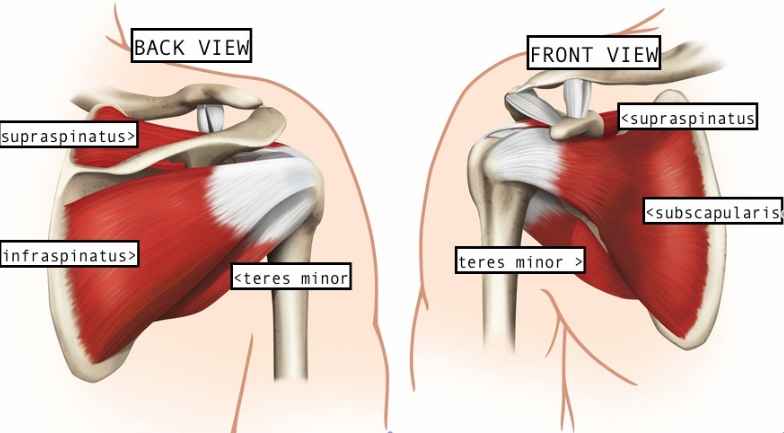
The Four Rotator Cuff Muscles (SITS)
| Muscle | Primary Action | Location |
|---|---|---|
| Supraspinatus | Initiates the first ~15° of shoulder abduction | Top of the shoulder blade |
| Infraspinatus | External rotation | Back of the shoulder blade (externally visible) |
| Teres minor | External rotation | Below the infraspinatus |
| Subscapularis | Internal rotation | Front of the shoulder blade (only anterior rotator cuff muscle) |
The supraspinatus is the smallest of the four and the first to act during any overhead reaching motion, initiating the earliest phase of abduction before the deltoid takes over the rest of the range. The infraspinatus is the largest and thickest of the group, and it’s the primary driver of external rotation — spinning your arm outward so your palm faces forward. The teres minor lies just below the infraspinatus and assists it in the same external-rotation function, though it’s considerably smaller. The subscapularis is the largest, strongest, and most used of the four, uniquely positioned on the front of the scapula, where it drives internal rotation — the motion involved in throwing and one of the primary movements trained in pressing exercises.

Function
Individually, each rotator cuff muscle has a distinct primary action, but collectively their most important shared job is dynamic joint stabilization — actively holding the humeral head in the glenoid socket throughout the shoulder’s full range of motion. Kenhub’s anatomical reference on the rotator cuff notes that some fibers of the teres minor interlock with the infraspinatus, and the supraspinatus and subscapularis tendons interlock as well, wrapping around portions of the biceps tendon — a level of structural interconnection that helps explain why an injury to one rotator cuff muscle so often affects the function of its neighbors.
Internal rotation, powered mainly by the subscapularis, tends to be the stronger of the two rotational directions because it’s assisted by larger muscles such as the chest and lats. External rotation, powered by the infraspinatus and teres minor, is comparatively weaker and far more commonly undertrained, which is part of why so many shoulder rehabilitation and injury-prevention programs emphasize it specifically.

Common Exercises
| Exercise | Rotator Cuff Muscles Trained |
|---|---|
| Band external rotation | Infraspinatus, teres minor |
| Cable internal rotation | Subscapularis |
| Face pull | Infraspinatus, teres minor (with posterior deltoid) |
| Side-lying external rotation | Infraspinatus, teres minor |
| Empty can raise | Supraspinatus |
For a complete, structured rotator cuff training program, see our full guide: 12 Best Rotator Cuff Exercises for Strong, Stable & Pain-Free Shoulders.
Bodybuilder’s Take
“Do I really need to train my rotator cuff directly, or is it covered by regular training?” For most lifters who do standard pressing and pulling, the answer is probably not fully. Internal rotation gets significant indirect work from chest and lat exercises, but external rotation — arguably the more important function for shoulder health — receives very little stimulus from typical training. This imbalance between strong internal rotators and comparatively weak external rotators is one of the most common and most correctable shoulder issues among lifters.
“Why does my shoulder feel unstable even though my deltoids are well developed?” Deltoid size and rotator cuff strength are largely independent of each other. It’s entirely possible to have well-developed, visually impressive shoulders while still having a weak, undertrained rotator cuff — the deltoid provides bulk and power, but the rotator cuff provides the fine control and joint centering that keeps the shoulder stable under load.
“When should I do rotator cuff work in my training session?” Most coaches recommend light rotator cuff activation work as part of a warm-up before heavy pressing or overhead work, since a properly “switched on” rotator cuff helps center the shoulder joint before it’s placed under significant load. Some lifters also benefit from a separate, dedicated rotator cuff session later in the week, using slightly more volume than a brief warm-up allows, particularly if they have a history of shoulder discomfort or notice ongoing instability during heavy lifts.
“Does it matter whether I use a cable, band, or dumbbell for external rotation work?” Yes, and this is worth knowing before you pick an exercise. A cable or pulley system maintains meaningful resistance throughout the entire range of motion, including at the very top and bottom. A resistance band behaves similarly, offering relatively low tension at the start and building toward the end range. A dumbbell, by contrast, relies on gravity for resistance — which means tension is highest when the forearm is horizontal and drops off substantially as the arm rotates past perpendicular, since gravity is no longer pulling directly against the movement. For lifters specifically targeting the infraspinatus and teres minor through a full range of motion, a cable or band setup generally provides more consistent loading than a dumbbell.
Common beginner mistakes:
- Using too much weight on rotator cuff exercises, which are meant to be trained with light loads and precise control rather than progressive heavy overload
- Training internal rotation (indirectly, through pressing) far more than external rotation
- Skipping rotator cuff work entirely until after an injury has already occurred, rather than as ongoing prevention
Common Conditions
This section is educational and should not replace professional medical advice.
Rotator cuff tears are among the most common and disruptive injuries in lifters, ranging from mild tendon irritation to a complete tear requiring surgical repair. Unlike many muscle strains, rotator cuff tears often develop gradually from long-term tendon overuse rather than a single traumatic event, though sudden injuries do occur. The supraspinatus tendon is particularly vulnerable to impingement syndrome, in which the tendon becomes compressed between the head of the humerus and the overlying acromion during overhead movement, leading to pain and progressive weakness if left unaddressed. Persistent shoulder pain, weakness during overhead movements, or a noticeable loss of range of motion should be evaluated by a healthcare professional.
Common Myths
Myth: The rotator cuff is a single muscle. It’s actually four separate muscles with distinct origins, insertions, and primary actions, unified mainly by their shared role in shoulder stabilization.
Myth: Heavy lifting is the best way to strengthen the rotator cuff. Rotator cuff muscles generally respond better to light loads, high control, and precise movement patterns than to heavy progressive overload, unlike larger muscle groups.
Myth: If you don’t feel shoulder pain, your rotator cuff is fine. Rotator cuff dysfunction often develops gradually and silently before becoming symptomatic, which is part of why proactive, preventative training matters even in the absence of current pain.
Key Takeaways
- The rotator cuff is four muscles (SITS: supraspinatus, infraspinatus, teres minor, subscapularis), not one.
- Its main collective job is dynamic shoulder joint stabilization, not producing large movements.
- External rotation is far more commonly undertrained than internal rotation in typical lifting programs.
- Only the infraspinatus is externally visible; the other three rotator cuff muscles are completely hidden.
- Deltoid size and rotator cuff strength are largely independent, so visible shoulders don’t guarantee joint stability.
Frequently Asked Questions
What are the four rotator cuff muscles?
The supraspinatus, infraspinatus, teres minor, and subscapularis, often remembered using the acronym “SITS.”
What is the main function of the rotator cuff?
Its main job is dynamically stabilizing the shoulder joint by holding the head of the humerus centered in the shoulder socket during arm movement.
Do I need to train my rotator cuff if I already lift weights?
Most lifters get enough indirect internal rotation work from pressing and pulling, but external rotation is rarely trained without dedicated exercises, making direct rotator cuff work worthwhile for most people.
Which rotator cuff muscle is visible externally?
Only the infraspinatus is visible from the outside. The supraspinatus, teres minor, and subscapularis are all hidden beneath surrounding muscle.
Should rotator cuff exercises be heavy or light?
Light. Rotator cuff muscles generally respond better to controlled, precise movement with lighter loads than to heavy progressive overload.
Sources & References
Every claim in this guide is grounded in anatomical references and published research. Explore the primary sources below.
