

The subscapularis is the largest and strongest of the four rotator cuff muscles by a wide margin — its cross-sectional area is actually larger than the other three rotator cuff muscles combined — yet it sits completely out of sight on the front of the shoulder blade, facing the ribcage rather than the back like its three counterparts. Understanding subscapularis functional anatomy reveals a genuinely surprising twist: despite being labeled the shoulder’s primary internal rotator, research suggests its real job may be something else entirely.
Quick Answer
The subscapularis is the largest and most powerful of the four rotator cuff muscles, occupying the front surface of the shoulder blade facing the ribcage. It’s the only rotator cuff muscle capable of internal rotation, and it’s also a critical anterior stabilizer, helping prevent the head of the humerus from sliding forward out of the shoulder socket. Some research suggests this stabilizing role may actually be more clinically important than its contribution to rotational strength, since larger muscles like the pectoralis major and latissimus dorsi are considerably stronger internal rotators.
| Muscle type | Largest and strongest of the four rotator cuff muscles |
|---|---|
| Primary functions | Internal rotation of the shoulder, anterior joint stabilization |
| Secondary functions | Weak adduction assistance |
| Innervation | Upper and lower subscapular nerves (C5–C7) |
| Blood supply | Subscapular artery |
| Common exercises | Cable internal rotation, dumbbell internal rotation, band internal rotation |
| Main bodybuilding role | Shoulder stability and internal rotation strength |
Overview
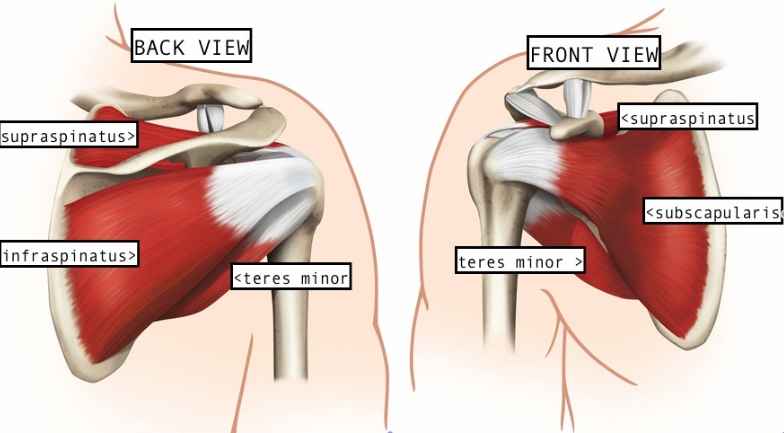
The subscapularis is one of four muscles that make up the rotator cuff, alongside the supraspinatus, infraspinatus, and teres minor. It’s the outlier of the group in more ways than one: it’s by far the largest, it’s the only one positioned on the front of the shoulder blade rather than the back, and it’s the only rotator cuff muscle capable of internal rotation.
Despite its size and strength, the subscapularis is genuinely difficult to train in true isolation, and it’s frequently the last rotator cuff muscle lifters think to address — largely because internal rotation feels like it’s already “covered” by pressing and pulling exercises. This assumption isn’t entirely wrong, but it overlooks an important distinction: the subscapularis’s real value to a lifter isn’t primarily about internal-rotation strength but about a stabilizing function that larger muscles simply aren’t positioned to provide. To see how it fits into the rest of your muscular system, check out our interactive muscle anatomy tool.
Anatomy & Location
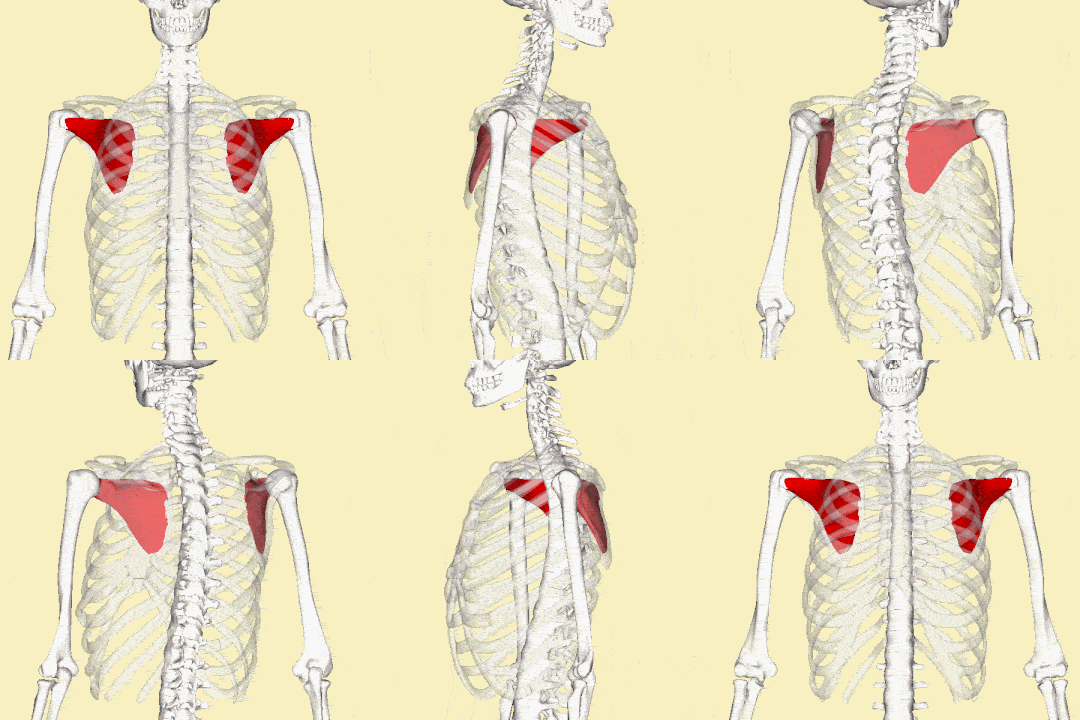
The subscapularis is a large, triangular muscle that fills the subscapular fossa — the broad, shallow depression on the front (costal) surface of the scapula, facing the ribcage rather than the back. This positioning alone sets it apart from the other three rotator cuff muscles, which all sit on the posterior surface of the scapula.

Characteristics at a Glance
| Characteristic | Value |
|---|---|
| Shape | Large, triangular, multipennate |
| Size | Largest of the four rotator cuff muscles — cross-sectional area exceeds the other three combined |
| Location | Front surface of the shoulder blade, facing the ribcage |
| Crosses | Shoulder (glenohumeral) joint |
The subscapularis tendon has a genuinely complex insertion pattern: rather than attaching as a single simple structure, research has described it as having three distinct regions — a superior portion that blends with the biceps tendon pulley system, a thick, fibrous middle portion, and a more muscular lower attachment. This complexity is part of why subscapularis injuries can be more functionally disruptive than their frequency alone would suggest.
Origin, Insertion, Innervation & Blood Supply
For a broader explanation of these anatomical terms, see our guide to muscle anatomy basics: origin, insertion, and innervation.
| Attribute | Detail |
|---|---|
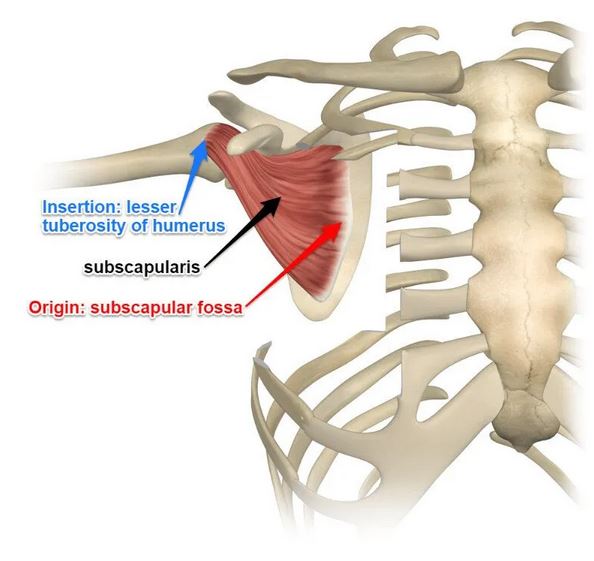
| Origin | Medial two-thirds of the subscapular fossa (anterior surface of the scapula) |
| Insertion | Lesser tubercle of the humerus and the anterior shoulder joint capsule |
| Innervation | Upper and lower subscapular nerves (C5–C7) |
| Blood supply | Subscapular artery |
According to StatPearls’ anatomical reference on the subscapularis, the muscle is innervated by two nerves — the upper subscapular nerve, which innervates the upper portion of the muscle, and the lower subscapular nerve, which innervates the lower portion — both of which branch from the posterior cord of the brachial plexus. Kenhub’s anatomical reference on the subscapularis notes that the remaining three rotator cuff muscles insert onto the greater tubercle of the humerus, whereas the subscapularis inserts onto the lesser tubercle instead —a structural detail that reflects its distinct role as the cuff’s sole internal rotator.
Function
The subscapularis’s textbook primary function is internal rotation of the shoulder — the motion involved in reaching into a back pocket or tucking in a shirt. However, this isn’t the full picture. Research examining the muscle’s biomechanics has found that the pectoralis major and latissimus dorsi are actually considerably stronger internal rotators than the subscapularis, which has led researchers to argue that the subscapularis’s more critical role is as a dynamic anterior stabilizer — actively resisting forward translation of the humeral head within the shoulder socket. In this light, the subscapularis functions less like a prime mover and more like a continuously active safeguard against shoulder instability, particularly during movements that place the arm in vulnerable positions.
Synergists & Antagonists
Synergists (muscles that work alongside the subscapularis to help produce the same movement):
- Pectoralis major and latissimus dorsi — both are considerably stronger internal rotators that assist and often overshadow the subscapularis in this function
- Teres major — also assists internal rotation, working closely with the latissimus dorsi
Antagonists (muscles that oppose the subscapularis’s action, working in the opposite direction):
- Infraspinatus and teres minor — both perform external rotation, directly opposing the subscapularis
Muscles Closely Related
The subscapularis is frequently mistaken for a similarly named rotator cuff neighbor, despite the two having almost nothing in common functionally.
- Supraspinatus — the similar-sounding name (“sub-” versus “supra-“) is the main source of confusion, but the two muscles sit on opposite sides of the scapula, perform entirely different actions (the supraspinatus initiates abduction, the subscapularis performs internal rotation), and are innervated by different nerves (suprascapular nerve versus the subscapular nerves).
- Infraspinatus — another similarly prefixed name that’s sometimes confused with the subscapularis, despite sitting on the back of the scapula and performing external rotation, essentially the opposite of the subscapularis’s primary action.
Common Exercises
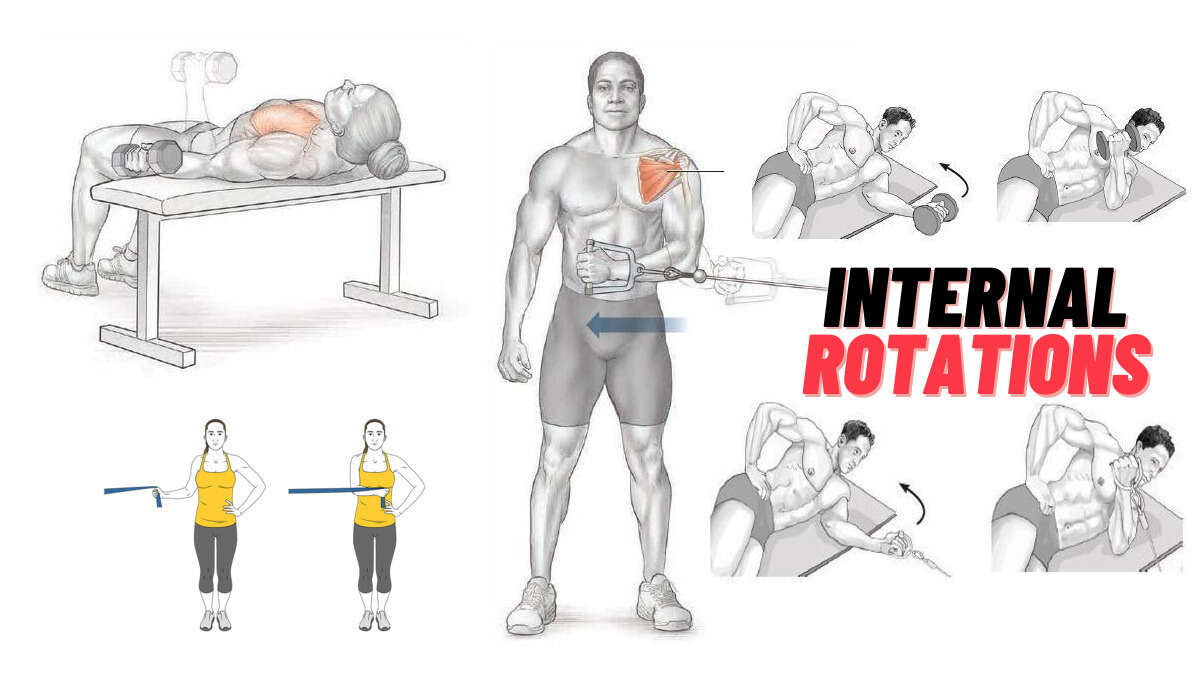
| Exercise | Role of the Subscapularis |
|---|---|
| Cable internal rotation | Prime mover |
| Dumbbell internal rotation | Prime mover |
| Band internal rotation | Prime mover |
For a complete rotator cuff training program, see our full guide: 12 Best Rotator Cuff Exercises for Strong, Stable & Pain-Free Shoulders.
Worth noting: the subscapularis is also significantly activated during many multi-joint pressing exercises, such as the bench press and overhead press, since these movements involve a meaningful degree of internal rotation. However, this indirect activation trains the muscle’s contribution to rotational force, not its distinct role as a dynamic anterior stabilizer — the two functions aren’t interchangeable, which is why dedicated internal rotation work still has value even for lifters who press heavily.
Bodybuilder’s Take
“If my chest and lats already handle internal rotation, why train the subscapularis at all?” Because its more important role isn’t raw rotational strength — it’s stability. Even if the pec major and lats produce more internal-rotation force, the subscapularis performs continuous, largely invisible work, keeping the humeral head centered in the socket, especially during pressing and overhead movements, where the shoulder is vulnerable to anterior translation. Neglecting it doesn’t necessarily show up as weak internal rotation; it more often shows up as general shoulder instability or discomfort during heavy pressing.
“Does equipment choice matter for internal rotation exercises, like it did for the infraspinatus?” Yes, for the same reason. A cable or pulley system maintains tension throughout the entire range of motion, including at the very top and bottom, while a dumbbell relies on gravity and loses meaningful tension once the forearm rotates past horizontal. For subscapularis-specific work, a cable or band setup generally provides more consistent loading through the full range than a dumbbell does.
Common beginner mistakes:
- Assuming pressing and pulling exercises fully cover internal rotation strength, while ignoring the subscapularis’s distinct stabilizing role
- Using a dumbbell for internal rotation work and missing out on the more consistent tension a cable or band provides
- Overlooking subscapularis health entirely when addressing general shoulder instability, since its role as a stabilizer is less intuitive than the more visible rotator cuff muscles
Common Conditions
This section is educational and should not replace professional medical advice.
The subscapularis is less prone to tears than the supraspinatus, but when injuries do occur, they can be more functionally disruptive due to the muscle’s proximity to the long head of the biceps tendon, which the subscapularis helps stabilize. Two clinical tests are commonly used to assess subscapularis function: the lift-off test, in which weakness prevents a person from lifting the back of their hand away from their lower back, and the belly press test, in which weakness causes a person to compensate by extending their elbow or shoulder rather than pressing their palm into their abdomen using internal rotation alone. Trigger points in the subscapularis can also produce referred pain into the posterior shoulder and down the arm, and some clinicians describe overactive subscapularis dysfunction as capable of mimicking a “frozen shoulder” presentation, since both conditions can produce a similar restriction in overhead and rotational range of motion. Persistent shoulder pain, weakness during internal rotation, or difficulty reaching behind the back should be evaluated by a healthcare professional rather than trained through.
Common Myths
Myth: The subscapularis is the shoulder’s strongest internal rotator. Research suggests that the pectoralis major and latissimus dorsi produce greater internal rotation force than the subscapularis, whose primary clinical importance lies in anterior shoulder stabilization.
Myth: If your bench press and pulldowns are strong, your subscapularis is automatically fine. Strong pressing and pulling numbers reflect the larger internal rotators, not necessarily the subscapularis’s distinct stabilizing function, which can be undertrained even in lifters with strong pressing numbers.
Myth: All rotator cuff muscles are equally prone to tearing. The subscapularis is actually less commonly torn than the supraspinatus, though injuries to it can be more functionally significant due to its close relationship with the biceps tendon.
Key Takeaways
- The subscapularis is the largest and strongest rotator cuff muscle, with a cross-sectional area exceeding the other three combined.
- It’s the only rotator cuff muscle capable of internal rotation, though the pec major and lats are actually stronger internal rotators.
- Its more clinically important role may be as a dynamic anterior stabilizer, preventing the humeral head from sliding forward.
- The lift-off test and belly press test are standard clinical assessments for subscapularis function.
- Like other rotator cuff muscles, it responds better to controlled, moderate loading than heavy progressive overload.
Frequently Asked Questions
What is the main function of the subscapularis?
Its textbook function is internal rotation of the shoulder, but research suggests its more critical role is as an anterior stabilizer, helping prevent the humeral head from sliding forward out of the socket.
Is the subscapularis the strongest internal rotator of the shoulder?
No. The pectoralis major and latissimus dorsi are both considerably stronger internal rotators, even though the subscapularis is the only rotator cuff muscle that performs this action.
What are the lift-off test and belly press test?
Both are clinical tests used to assess subscapularis function. The lift-off test checks whether a person can lift the back of their hand away from their lower back, while the belly press test checks whether they can press their palm into their abdomen using internal rotation rather than compensating with the elbow or shoulder.
Is the subscapularis commonly injured?
It’s less commonly torn than the supraspinatus, but injuries can be more functionally disruptive due to its close relationship with the long head of the biceps tendon.
What is the best exercise for the subscapularis?
Cable or band internal rotation exercises generally provide more consistent tension through the full range of motion than dumbbell variations, which lose tension as the arm rotates past horizontal.
Sources & References
Every claim in this guide is grounded in anatomical references and published research. Explore the primary sources below.
