



Your upper body is where most lifters focus the bulk of their training — and for good reason. From the pressing power of your chest and shoulders to the pulling strength of your back and the visible definition of your arms, these muscles drive nearly every pushing, pulling, and pressing movement you perform. Rather than looking at each muscle in isolation, this guide explains how the major upper body muscle groups fit together as one coordinated system — and links to our complete anatomy guides for every muscle within it.
Key Facts
The upper body muscles are organized into six major groups — chest, shoulders, back, arms, core, and neck — spanning everything from the sternum to the base of the skull. Together, these muscles of the upper body handle shoulder flexion/extension/rotation, elbow flexion/extension, scapular movement, spinal extension, and trunk rotation, making them central to nearly every pressing, pulling, and carrying movement.
| Major muscle groups | Chest (1), shoulders (8), back (8), arms (3), core (4+), neck (1) |
|---|---|
| Primary joint actions | Shoulder flexion/extension/abduction/rotation, elbow flexion/extension, scapular retraction/protraction/elevation, spinal extension |
| Largest muscle (by surface area) | Latissimus dorsi — the widest muscle in the human back |
| Key compound lifts | Bench press, overhead press, pull-up/row, deadlift |
| Main bodybuilding role | Upper-body mass, pressing/pulling strength, and postural/shoulder stability |
Why Upper Body Muscle Anatomy Matters for Lifters
If you train upper body muscle groups without understanding how they relate to each other, you end up with the classic imbalance: an overdeveloped chest and front delts, an undertrained back and rear delts, and shoulders that ache under heavy pressing. Every major upper body muscle in this guide contributes differently to pressing movements (bench press, overhead press) versus pulling movements (rows, pull-ups), and knowing which group is actually doing the work in a given exercise is what separates programming by feel from programming with intent.
It also matters for shoulder health specifically. The shoulder is the most mobile — and least inherently stable — joint in the body, and it relies almost entirely on surrounding muscles (the rotator cuff, the scapular stabilizers) rather than bony structure for stability. Understanding upper body anatomy explained at this level isn’t just about aesthetics; it’s directly tied to training pain-free for the long term.
The Major Upper Body Muscle Groups
To see exactly where each of these muscles sits and how they layer over one another, our interactive muscle anatomy tool works as a live, clickable upper body muscles diagram — hover over any region to see the individual muscle and its function. Below is the full breakdown of major muscles of the upper body, organized by group, with links to our complete guide on each.
Chest
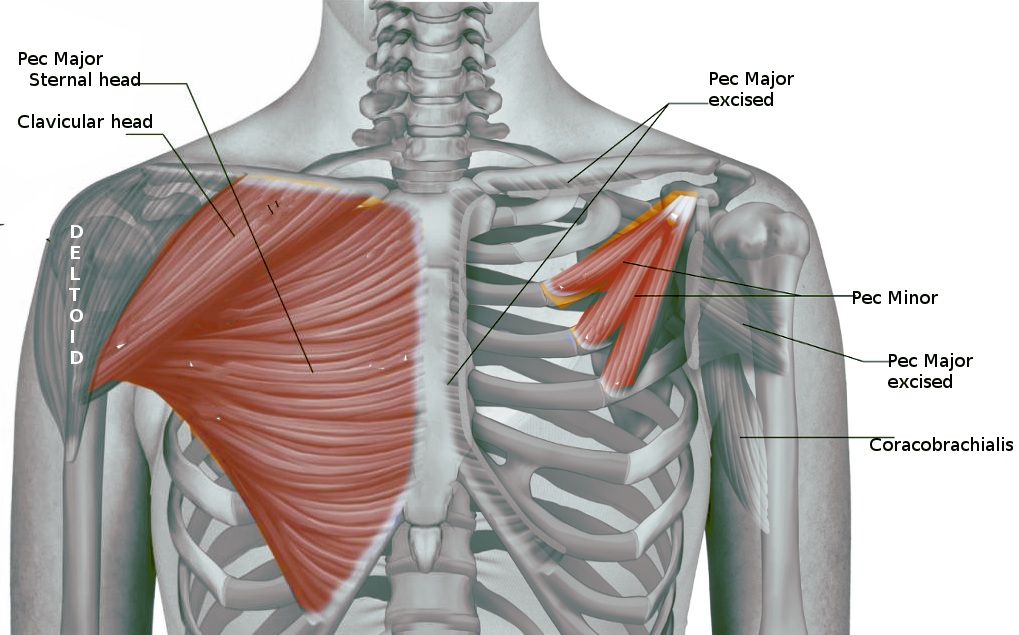
The chest muscles sit on the front of the ribcage and are responsible for horizontal shoulder movement — pressing and hugging motions.
| Muscle | Distinguishing Feature | Full Guide |
|---|---|---|
| Pectoralis major | The primary chest muscle, made of a clavicular (upper) and sternal (lower/mid) head with different activation depending on bench angle | Pectoralis Major Guide |
Main exercises: Bench press, incline/decline press, dips, and cable/dumbbell flys all train the chest — see our full Chest Exercises library for exercise-by-exercise breakdowns.
Fun fact: The pectoralis major’s clavicular (upper) and sternal (lower) heads have different fiber orientations, which is why bench angle genuinely changes which portion of the chest is emphasized — incline presses shift more work onto the upper fibers, decline presses onto the lower fibers.
Shoulders
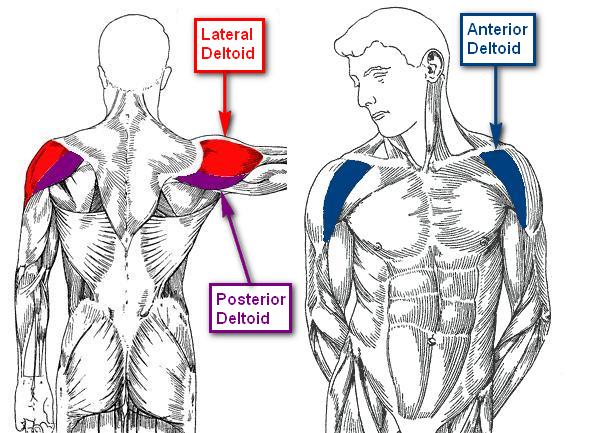
The shoulder muscles sit at the top of the arm, spanning the deltoid on the surface and the four rotator cuff muscles underneath it, together producing the joint’s exceptional range of motion.
| Muscle | Distinguishing Feature | Full Guide |
|---|---|---|
| Anterior deltoid | The most “accidentally trained” head — heavily involved in nearly all pressing | Anterior Deltoid Guide |
| Lateral deltoid | The head primarily responsible for shoulder width | Lateral Deltoid Guide |
| Rear (posterior) deltoid | By far the most commonly underdeveloped of the three heads | Rear Deltoid Guide |
| Rotator cuff (4 muscles) | Deep stabilizers that keep the humeral head centered in the socket during every shoulder movement | Rotator Cuff Guide |
Main exercises: Overhead press, lateral raises, face pulls, and rear-delt flys are the core shoulder builders — see our full Shoulder Exercises library for the complete breakdown.
Fun fact: The deltoid can’t even initiate the first 15 degrees or so of arm abduction on its own — the supraspinatus (one of the four rotator cuff muscles) has to fire first to stabilize and help lift the arm before the much larger deltoid takes over the rest of the movement.
Back
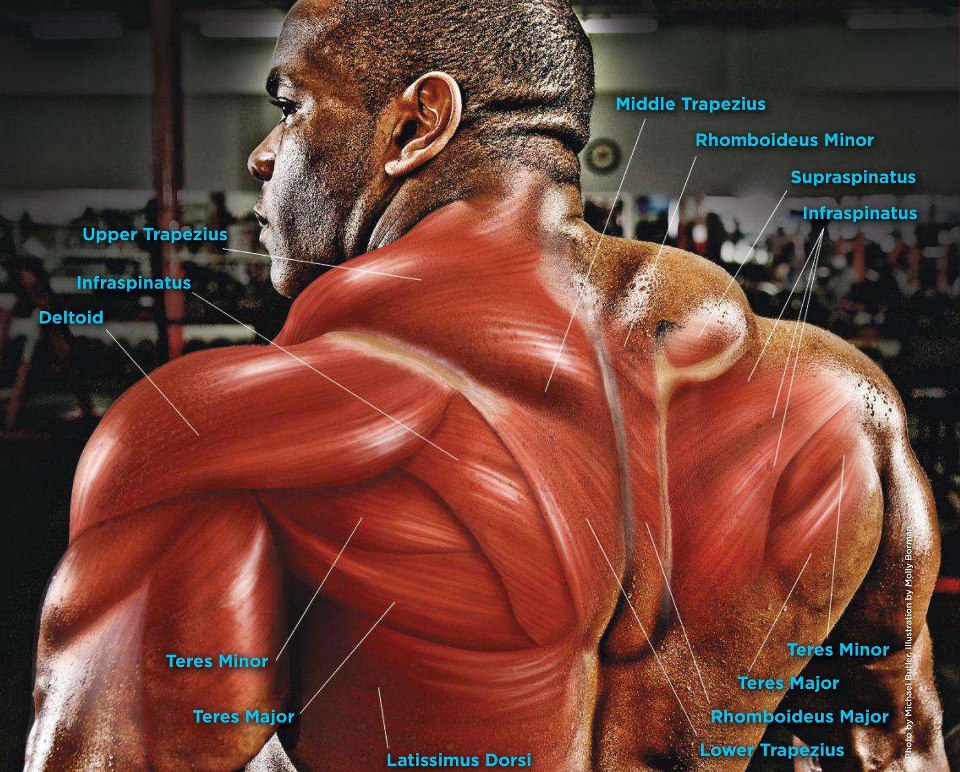
The back muscles span from the base of the skull to the lower spine, controlling scapular movement, shoulder extension/adduction, and spinal stability.
| Muscle | Distinguishing Feature | Full Guide |
|---|---|---|
| Latissimus dorsi | The widest muscle in the back; primarily responsible for the “V-taper” | Latissimus Dorsi Guide |
| Trapezius | Spans the neck to mid-back; changes a physique’s silhouette more dramatically than almost any other muscle | Trapezius Guide |
| Rhomboids | Commonly named but poorly understood scapular retractors, deep to the traps | Rhomboid Guide |
| Teres major | Nicknamed the “lat’s little helper” for how closely it works with the latissimus dorsi | Teres Major Guide |
| Erector spinae | The deep spinal column of muscles responsible for keeping the torso upright under load | Erector Spinae Guide |
| Quadratus lumborum | Nicknamed “the muscle the kidneys rest on”; buried deep in the lower back | Quadratus Lumborum Guide |
| Levator scapulae | Named directly for its job: “raiser of the scapula” | Levator Scapulae Guide |
| Serratus anterior | Nicknamed the “boxer’s muscle” for its central role in throwing a punch | Serratus Anterior Guide |
Main exercises: Pull-ups, rows, lat pulldowns, and deadlifts are the core back builders — see our full Back Exercises library for the complete breakdown.
Fun fact: A widely repeated gym belief is that changing your lat pulldown grip width or angle meaningfully shifts how much the latissimus dorsi gets worked — but a 2025 EMG study comparing seven pulldown grip variations found no significant difference in lat activation across any of them.
Arms
The arm muscles sit between the shoulder and wrist, producing elbow flexion, elbow extension, and forearm rotation/grip.

| Muscle | Distinguishing Feature | Full Guide |
|---|---|---|
| Biceps brachii | Carries more symbolic weight in the gym than almost any other muscle | Biceps Brachii Guide |
| Triceps brachii | Makes up roughly two-thirds of upper-arm mass; its long head also crosses the shoulder joint | Triceps Brachii Guide |
| Forearm muscles | A dense group of wrist flexors, extensors, and the brachioradialis | Forearm Muscles Guide |
Main exercises: Barbell curls, close-grip bench press, and dips/pushdowns are the core arm builders — see our full Arm Exercises library for the complete breakdown.
Fun fact: Unlike the other two triceps heads, the long head of the triceps crosses both the shoulder and elbow joints — the arm equivalent of the rectus femoris in the quadriceps — which is part of why overhead triceps extensions can train it more effectively than pressdowns performed with the arm at the side.
Core
The core muscles wrap around the trunk between the ribcage and pelvis, stabilizing the spine and transferring force between the upper and lower body.

| Muscle | Distinguishing Feature | Full Guide |
|---|---|---|
| Rectus abdominis | The “six-pack” muscle; primarily responsible for trunk flexion | Rectus Abdominis Guide |
| Obliques (external & internal) | Handle trunk rotation and lateral flexion, and resist unwanted twisting under load | Oblique Muscles Guide |
| Transversus abdominis | The deepest abdominal muscle; often called the body’s natural “corset” | Transversus Abdominis Guide |
Main exercises: Planks, Pallof presses, dead bugs, and cable crunches are the core builders — see our full Core Exercises library for the complete breakdown.
Fun fact: The core’s primary job isn’t producing trunk movement — it’s resisting unwanted movement. Anti-extension, anti-rotation, and anti-lateral-flexion exercises, such as the plank and Pallof press, train this stabilizing function more directly than traditional crunches.
The broader definition of “core” also extends into muscles covered under our Lower-Body Muscles guide rather than here — the glutes (gluteus maximus, gluteus medius, gluteus minimus), hip flexors (iliopsoas, rectus femoris, sartorius, tensor fasciae latae, pectineus), hamstrings, and hip adductors all contribute to trunk and pelvic stability alongside the abdominal wall. See our Core Muscles guide for the complete picture of how these groups interact.
Neck
The neck muscles support and move the head and cervical spine, and are frequently neglected in training despite their role in both aesthetics and injury prevention. See our full Neck Muscles guide for the complete anatomy breakdown.

How These Groups Work Together: Muscles Used in Bench Press, Overhead Press & Pull-Ups
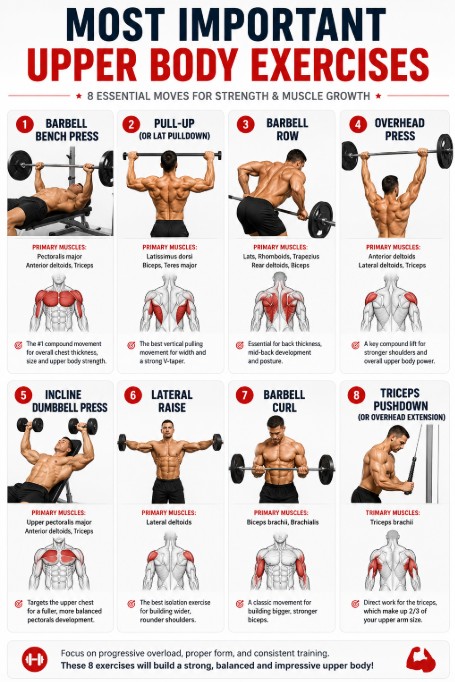
Individual muscle guides explain each muscle in isolation, but no major upper-body exercise works only one muscle. The bench press, overhead press, and pull-up (or row) are compound movements that require coordinated action of the chest, shoulders, back, and arms. Understanding which muscles drive each lift not only improves exercise selection but also helps identify weaknesses that may be limiting strength, technique, or muscle growth.
Muscles Used in the Bench Press
The bench press is a horizontal pressing movement. A systematic review of surface EMG studies on the bench press confirms the pectoralis major as the primary mover, with the anterior deltoid and triceps brachii as major secondary contributors throughout the full range of motion. The scapular stabilizers (serratus anterior, rhomboids) work isometrically to keep the shoulder blades stable against the bench.
Primary movers:
- Pectoralis major
- Anterior deltoid
- Triceps brachii
Secondary contributors:
- Serratus anterior (scapular stabilization)
- Rhomboids and trapezius (scapular retraction)
- Forearm muscles (grip and wrist stability)
Coach’s Note: Most lifters obsess over chest activation on the bench press, but shoulder-blade position matters just as much for both performance and joint health. If your serratus anterior and rhomboids aren’t doing their stabilizing job, you’ll feel it in your shoulders long before you feel it in your chest.
Muscles Used in the Overhead Press
The overhead press is a vertical pressing movement that demands more shoulder stability than the bench press. The anterior and lateral deltoid drive the movement, with the triceps brachii extending the elbow through the top half of the range. The rotator cuff works continuously and isometrically to keep the humeral head centered in the socket as the arm moves overhead — a much larger stability demand than in horizontal pressing.
Primary movers:
- Anterior deltoid
- Lateral deltoid
- Triceps brachii
Secondary contributors:
- Rotator cuff (dynamic joint stabilization)
- Upper trapezius and serratus anterior (scapular upward rotation)
- Core musculature (trunk stabilization against the overhead load)
Coach’s Note: If your overhead press stalls or your shoulder aches under load, the rotator cuff — not the deltoid — is usually the missing piece. It’s a stabilizer, not a prime mover, so it rarely gets trained directly even by lifters who press heavy year-round.
Muscles Used in Pull-Ups and Rows
Pull-ups and rows are the primary pulling patterns for the back. A 2025 EMG study comparing multiple pulling exercise variations found the latissimus dorsi as the dominant mover across grip and variation types, with the biceps brachii, rear deltoid, and trapezius all contributing meaningfully depending on the specific movement pattern used.
Primary movers:
- Latissimus dorsi
- Biceps brachii
- Rhomboids and middle trapezius
Secondary contributors:
- Rear deltoid
- Teres major
- Erector spinae (postural stabilization, especially in bent-over rows)
- Forearm muscles (grip)
Coach’s Note: Lifters chase grip variations hoping to “target” the lats differently, but the research doesn’t support it — grip width changes comfort and secondary muscle involvement more than it changes latissimus dorsi activation itself.
Pressing vs. Pulling: Which Muscles Work Hardest?
| Muscle Group | Bench Press | Overhead Press | Pull-Up / Row |
|---|---|---|---|
| Chest | ⭐⭐⭐⭐⭐ | ⭐ | — |
| Front/side delts | ⭐⭐⭐ | ⭐⭐⭐⭐⭐ | — |
| Rear delts | — | ⭐⭐ | ⭐⭐⭐ |
| Triceps | ⭐⭐⭐⭐ | ⭐⭐⭐⭐ | — |
| Lats | — | — | ⭐⭐⭐⭐⭐ |
| Biceps | — | — | ⭐⭐⭐⭐ |
| Rotator cuff | ⭐⭐ | ⭐⭐⭐⭐ | ⭐⭐ |
Coach’s Note: After years of coaching lifters, I’ve found the most common upper-body imbalance isn’t weak arms — it’s a chest and front-delt-dominant pressing routine paired with a badly undertrained pulling side. Chasing a 1:1 ratio of pressing-to-pulling volume solves more shoulder pain and posture complaints than almost any single exercise swap.
Common Upper Body Muscle Myths
Myth: Bench pressing alone is enough to develop the entire upper body. The bench press is excellent for the chest, front delts, and triceps, but it does almost nothing for the back, rear delts, or biceps. Without dedicated pulling work, most lifters end up with a visibly imbalanced pressing-dominant physique.
Myth: You can meaningfully change which part of the lats a pulldown or pull-up targets by changing your grip. Controlled EMG research directly contradicts this — grip width and orientation change comfort and secondary-muscle involvement, but not latissimus dorsi activation itself.
Myth: A big chest and arms mean a strong, healthy upper body. Size in the “mirror muscles” says little about rotator cuff strength, scapular control, or posterior chain development — all of which matter more for shoulder health and pressing longevity than chest or arm size alone.
Myth: The rotator cuff doesn’t need direct training if you already lift heavy. Because it works as a stabilizer rather than a prime mover in most compound lifts, the rotator cuff rarely gets adequate direct stimulus from pressing and pulling alone — dedicated external rotation and stability work is usually necessary.
Myth: Isolation exercises are a waste of time if you do compound lifts. Compound lifts should form the foundation of most programs, but isolation work — lateral raises, face pulls, bicep curls, tricep extensions — fills in gaps that compound lifts consistently miss, particularly for the rear delts, rotator cuff, and arms.
Conclusion
The best physiques aren’t built by accident—they’re built by understanding anatomy. When you know how the major upper body muscles function and work together, every set, rep, and exercise has a purpose. Master the fundamentals here, then explore our individual muscle guides to take your training and muscle development to the next level.
Continue with the muscles of the legs and hips, including the quadriceps, hamstrings, glutes, calves, adductors, and hip flexors.
Explore Lower Body MusclesKey Takeaways
- The major upper body muscles fall into six groups: chest, shoulders, back, arms, core, and neck.
- The latissimus dorsi is the widest muscle in the back and primarily responsible for the “V-taper.”
- Bench press and overhead press are pressing-dominant and chest/shoulder/triceps-focused; pull-ups and rows are pulling-dominant and back/biceps-focused — a complete program needs both.
- The rotator cuff works as a stabilizer in most compound lifts and rarely gets enough direct stimulus without dedicated training.
- Grip variations on pulling exercises change comfort and secondary muscle involvement, not latissimus dorsi activation itself.
Sources & References
Every claim in this guide is grounded in anatomical references and published research.
What are the major upper body muscles?
The major upper body muscles are the chest (pectoralis major), shoulders (deltoids and rotator cuff), back (latissimus dorsi, trapezius, rhomboids, serratus anterior, and others), arms (biceps, triceps, and forearms), core (rectus abdominis, obliques, transversus abdominis), and neck muscles. Together, they control nearly every pushing, pulling, lifting, carrying, and stabilizing movement performed in daily life and strength training.
Which is the largest upper body muscle?
The latissimus dorsi is the largest upper body muscle by surface area. It spans much of the back and plays a major role in shoulder extension, adduction, and internal rotation. Developing the lats is essential for creating the classic V-taper physique and improving pulling strength in exercises such as pull-ups and rows.
What muscles make up the shoulders?
The shoulders consist of the three heads of the deltoid (anterior, lateral, and posterior) along with the four rotator cuff muscles: supraspinatus, infraspinatus, teres minor, and subscapularis. While the deltoids produce movement, the rotator cuff stabilizes the shoulder joint during nearly every upper-body exercise.
What muscles are used during the bench press?
The bench press primarily targets the pectoralis major, anterior deltoid, and triceps brachii. Secondary muscles, including the serratus anterior, trapezius, rhomboids, and forearm muscles, stabilize the shoulder blades and maintain proper bar control throughout the lift.
What muscles do pull-ups work?
Pull-ups mainly work the latissimus dorsi, but they also heavily recruit the biceps brachii, teres major, rhomboids, middle trapezius, rear deltoids, and forearm muscles. Because multiple muscle groups work together, pull-ups are considered one of the most effective compound exercises for upper-body development.
Do compound exercises train every upper body muscle?
No. Compound lifts train many muscles simultaneously, but they don't fully develop every muscle group. For example, the bench press provides little stimulus for the rear deltoids or rotator cuff, while pull-ups don't adequately train the chest or triceps. Most balanced bodybuilding programs combine compound lifts with targeted isolation exercises.
Why is the rotator cuff so important?
The rotator cuff keeps the head of the humerus centered within the shoulder socket during movement. Without proper rotator cuff function, pressing and pulling exercises become less stable, increasing the risk of shoulder pain and injury. Although these muscles are relatively small, they play a critical role in long-term shoulder health and performance.
What is the best way to build a balanced upper body?
A balanced upper body requires training both pushing and pulling muscles with similar weekly volume. Most lifters should include chest, shoulders, back, arms, and core exercises while avoiding programs that focus almost exclusively on pressing movements. Prioritizing posture, scapular stability, and progressive overload leads to better muscle development and fewer overuse injuries.
Are the core muscles considered part of the upper body?
Yes. The abdominal muscles—including the rectus abdominis, internal and external obliques, and transversus abdominis—are generally considered part of the upper body because they stabilize the trunk and transfer force between the upper and lower body. However, true core function also depends on muscles in the hips and pelvis, including the glutes and hip flexors.
Where can I learn more about individual upper body muscles?
This guide provides an overview of the major upper body muscle groups, but each muscle has unique anatomy, functions, and training considerations. Explore our detailed anatomy guides for the chest, shoulders, back, arms, core, and neck to learn how each muscle works, which exercises target it most effectively, and how it contributes to strength, hypertrophy, and injury prevention.
