



Nicknamed “the muscle the kidneys rest on,” the quadratus lumborum is buried so deep in the trunk that most lifters have never consciously felt it working — yet it’s involved in nearly every lifting movement that requires a stable, braced lower back. It’s also frequently misclassified: despite being commonly called a “back muscle,” it’s technically part of the posterior abdominal wall. Understanding the functional anatomy of the quadratus lumborum clears up this confusion and reveals why a popular “oblique” exercise is actually targeting a completely different muscle.

Quick Answer
The quadratus lumborum (often abbreviated QL) is a deep, quadrilateral-shaped muscle located on either side of the lumbar spine, connecting the pelvis to the lowest rib and the lumbar vertebrae. Its primary function is lateral flexion of the trunk when contracting on one side, along with assisting spinal extension and stabilizing the 12th rib during breathing when contracting on both sides. Despite being commonly grouped with the back muscles, it’s technically the deepest muscle of the posterior abdominal wall.
| Muscle type | Deep quadrilateral muscle of the posterior abdominal wall |
|---|---|
| Primary functions | Lateral flexion of the trunk (unilateral) |
| Secondary functions | Spinal extension assistance, 12th rib stabilization during breathing |
| Innervation | Subcostal nerve (T12) and lumbar plexus branches (L1–L4) |
| Blood supply | Lumbar, subcostal, iliolumbar, and median sacral arteries |
| Common exercises | Side plank, suitcase carry, Roman chair side bend |
| Main bodybuilding role | Lower back and core stability during heavy lifting |
Overview
The quadratus lumborum sits deep within the trunk, tucked between the pelvis and the lowest rib, lateral to the erector spinae group. It’s genuinely close neighbors with the kidneys, which sit directly against it, and it works continuously behind the scenes during standing, walking, and virtually every loaded lift that challenges trunk stability.
Despite its deep, hidden location, the quadratus lumborum has real clinical and training significance — it’s frequently discussed in connection with chronic lower back pain, and it’s commonly (and often incorrectly) targeted by an exercise most lifters believe works their obliques instead. To see how it fits into the rest of your muscular system, check out our interactive muscle anatomy tool.
Anatomy & Location: The Functional Anatomy of the Quadratus Lumborum
The quadratus lumborum is an irregularly quadrilateral-shaped muscle situated deep in the posterior abdominal wall, lying just lateral to the spine and dorsal to the psoas major. Despite its common nickname as a “back muscle,” it’s anatomically classified as part of the abdominal wall rather than the intrinsic back musculature — a distinction most lifters never learn.
Characteristics at a Glance
| Characteristic | Value |
|---|---|
| Shape | Irregular, roughly quadrilateral |
| Location | Deep posterior abdominal wall, lateral to the lumbar spine |
| Fiber architecture | Three distinct fiber layers running in different directions |
| Crosses | Lumbar spine, lowest rib |
According to Kenhub’s anatomical reference on the quadratus lumborum, the muscle is the deepest structure of the posterior abdominal wall and sits in close proximity to the colon, kidneys, and diaphragm on its front surface, with the deep intrinsic back muscles located behind it. The kidneys rest directly against the quadratus lumborum, which is part of why it’s sometimes casually described as “the muscle the kidneys sit on.”
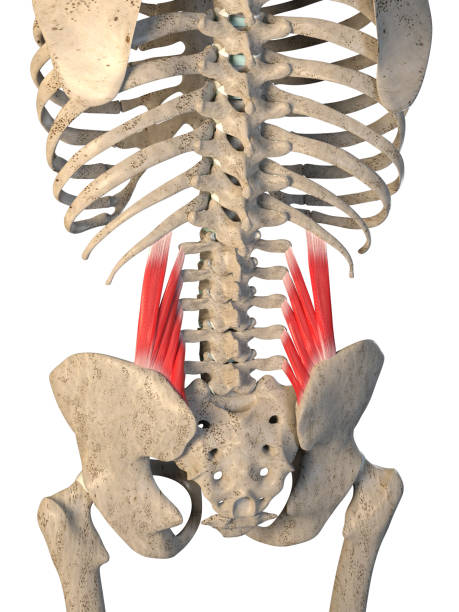
Origin, Insertion, Innervation & Blood Supply
For a broader explanation of these anatomical terms, see our guide to muscle anatomy basics: origin, insertion, and innervation.
| Attribute | Detail |
|---|---|
| Origin | Iliac crest (inner lip) and the iliolumbar ligament |
| Insertion | Internal surface of the 12th rib and the transverse processes of the L1–L4 vertebrae |
| Innervation | Subcostal nerve (T12) and branches of the lumbar plexus (L1–L4) |
| Blood supply | Branches of the lumbar, subcostal, iliolumbar, and median sacral arteries |
According to StatPearls’ anatomical reference on the quadratus lumborum, the muscle has three distinct fiber layers running in different directions, which makes it genuinely difficult for anatomists to precisely determine its actions solely from fiber contraction analysis. The same source notes an honest scientific gap: uncertainty persists in the literature about whether abnormalities in the quadratus lumborum are truly a primary source of lower back pain, or whether the muscle simply reflects tension patterns generated by surrounding structures.
Function
The quadratus lumborum’s primary role is lateral flexion of the trunk — bending sideways — produced when the muscle contracts unilaterally (on one side only). When both sides contract together, the muscle assists in spinal extension and helps stabilize the 12th rib during forceful breathing, bracing it against the pull of the diaphragm during deep inhalation. Despite sometimes being described as a spinal extensor, research indicates that the quadratus lumborum’s contractile contribution to trunk extension is comparatively weak compared with the much larger multifidus and erector spinae muscle groups — its primary, most distinct contribution is lateral flexion and general trunk stabilization rather than a powerful extension force. This distinction is central to understanding the functional anatomy of the quadratus lumborum: it’s primarily a stabilizer and lateral mover, not a primary extensor.
Synergists & Antagonists
Synergists (muscles that work alongside the quadratus lumborum to help produce the same movement):
- External and internal obliques — assist lateral flexion of the trunk
- Erector spinae — assists spinal extension alongside the quadratus lumborum, though it contributes far more force to this action
Antagonist (the muscle group that opposes the quadratus lumborum’s action, working in the opposite direction):
- The contralateral quadratus lumborum and obliques (i.e., the same muscles on the opposite side of the body) — since lateral flexion to one side is directly opposed by the corresponding muscles on the other side of the spine, which must lengthen and control the movement
- Rectus abdominis — indirectly opposes the QL’s contribution to spinal extension through its own flexion action

Common Exercises
Because the quadratus lumborum primarily performs lateral flexion and trunk stabilization rather than producing a large, visible range of motion, it responds well to both isometric stability work and controlled, loaded lateral flexion.
| Exercise | Role of the Quadratus Lumborum |
|---|---|
| Side plank | Prime mover (isometric) |
| Suitcase carry | Prime mover (isometric) |
| Roman chair side bend | Prime mover |
| Dumbbell side bend | Prime mover |
| Conventional deadlift | Major contributor (stabilization) |
| Barbell back squat | Major contributor (stabilization) |
Bodybuilder’s Take
“I thought the dumbbell side bend worked my obliques — was I wrong?” Largely, yes, and this is one of the more common misunderstandings in ab training. The side bend is a lateral flexion movement, and the muscle primarily responsible for lateral flexion of the spine is the quadratus lumborum, not the obliques. While the obliques do assist, the dominant mover in a controlled side bend is the QL. If your goal was oblique development specifically, rotational and anti-rotation exercises are a more direct route; if you’re after lower back and lateral trunk stability, the side bend is doing exactly what it should.
“Is the quadratus lumborum really a major factor in lower back pain?” It’s frequently discussed in that context, but it’s worth knowing that even researchers acknowledge genuine uncertainty here — it’s not firmly established whether quadratus lumborum tightness or dysfunction is a primary cause of lower back pain, or more of a downstream reflection of tension elsewhere in the trunk and hips. This doesn’t mean QL health doesn’t matter, but it does mean it’s rarely the sole answer to chronic lower back discomfort.
“Why is the side plank considered such a good QL exercise?” Research on healthy individuals has found the side plank effectively activates the quadratus lumborum and surrounding abdominal muscles while generating comparatively low overall spinal loading, making it a reasonably low-risk way to build lateral trunk stability compared to heavier-loaded lateral flexion movements.
Common beginner mistakes:
- Assuming the dumbbell side bend trains the obliques, when it’s primarily working the quadratus lumborum instead
- Treating persistent lower back tightness as automatically a “weak QL” problem, when the research on this connection is genuinely mixed
- Neglecting lateral trunk stability work entirely, since most standard programs focus heavily on flexion/extension and largely ignore lateral flexion and anti-lateral-flexion training
Common Conditions
This section is educational and should not replace professional medical advice.
The quadratus lumborum is frequently discussed in connection with chronic lower back pain and tightness, particularly in people with prolonged sitting habits or weakness in the surrounding hip and glute musculature. However, as noted above, the scientific literature has not firmly established the quadratus lumborum as a definitive primary source of lower back pain, and its role may reflect broader tension patterns rather than a standalone cause. Because of its deep location and stabilizing role, tightness or spasm of the quadratus lumborum can sometimes produce pain that’s difficult to distinguish from other sources of lower back discomfort. Persistent lower back pain, especially pain accompanied by radiating symptoms or changes in bowel, bladder, or kidney function, should be evaluated by a healthcare professional rather than self-treated.
Common Myths
A clear grasp of the functional anatomy of the quadratus lumborum clears up most of the persistent confusion surrounding this deep, often misunderstood muscle.
Myth: The dumbbell side bend primarily trains the obliques. The side bend is a lateral flexion movement, and the quadratus lumborum is the primary mover of lateral flexion, not the obliques — a common and persistent point of confusion in ab training.
Myth: The quadratus lumborum is officially classified as a back muscle. It’s technically the deepest muscle of the posterior abdominal wall, not one of the intrinsic back muscles, even though it’s commonly grouped with the back in casual conversation.
Myth: Quadratus lumborum tightness is a proven, primary cause of most lower back pain. Genuine uncertainty remains in the scientific literature about whether QL dysfunction is a primary driver of lower back pain or more of a secondary reflection of broader tension patterns.
Myth: The quadratus lumborum is a powerful spinal extensor. While it assists spinal extension when contracting bilaterally, research indicates its contribution to extension force is comparatively weak next to the much larger erector spinae and multifidus muscles.
Key Takeaways
- The quadratus lumborum is technically an abdominal wall muscle, not a true back muscle, despite common classification.
- Its main function is lateral flexion of the trunk, not powerful spinal extension.
- The dumbbell side bend primarily trains the QL, not the obliques, despite common assumptions.
- Its link to chronic lower back pain is widely discussed but not firmly established in scientific literature.
- The side plank is a research-supported, relatively low-risk exercise for building lateral trunk stability.
Frequently Asked Questions
What is the main function of the quadratus lumborum?
Its main job is lateral flexion of the trunk, bending sideways, along with assisting spinal extension and stabilizing the lowest rib during breathing.
Is the quadratus lumborum a back muscle or an abdominal muscle?
Technically, it’s classified as the deepest muscle of the posterior abdominal wall, even though it’s commonly and casually grouped with the back muscles.
Does the dumbbell side bend work the obliques or the quadratus lumborum?
Primarily the quadratus lumborum. Since the side bend is a lateral flexion movement, the QL is the dominant mover, even though it’s commonly assumed to be an oblique exercise.
Does a tight quadratus lumborum cause lower back pain?
It’s frequently discussed as a factor, but the scientific literature hasn’t firmly established it as a definitive primary cause, and its role may be more reflective of broader tension patterns.
What is the best exercise for the quadratus lumborum?
Research suggests the side plank effectively activates the quadratus lumborum while generating relatively low overall spinal loading, making it a reasonably low-risk option for lateral trunk stability.
Sources & References
Every claim in this guide is grounded in anatomical references and published research. Explore the primary sources below.
