


Introduction
The standard forearm plank is the version almost everyone learns first — and for most people, it’s also the only version they ever do. That’s a missed opportunity. The plank isn’t a single exercise; it’s a family of exercises that share a common principle — using the core to resist movement rather than create it — expressed through dozens of different positions, each with its own demand profile.
Once a standard plank becomes easy, the answer isn’t simply holding it longer. Time under tension matters, but so does progressive overload, and the plank family offers an entire ladder of progressions that load the core in genuinely different ways: removing a point of support, adding instability, changing the direction of resistance, or combining the hold with controlled movement. Without that ladder, most people plateau at a 60-second forearm plank and never develop the more advanced stability the plank family is capable of building.
It’s also worth being clear that “harder” doesn’t always mean “better” for your specific goal. A Chinese reverse plank builds posterior chain strength that a side plank simply doesn’t address, and a side plank trains anti-lateral flexion that no amount of forearm plank holding will ever touch. Difficulty ranking is useful for structuring progression, but the right plank for you depends on what you’re training for, not just how advanced you want to look.
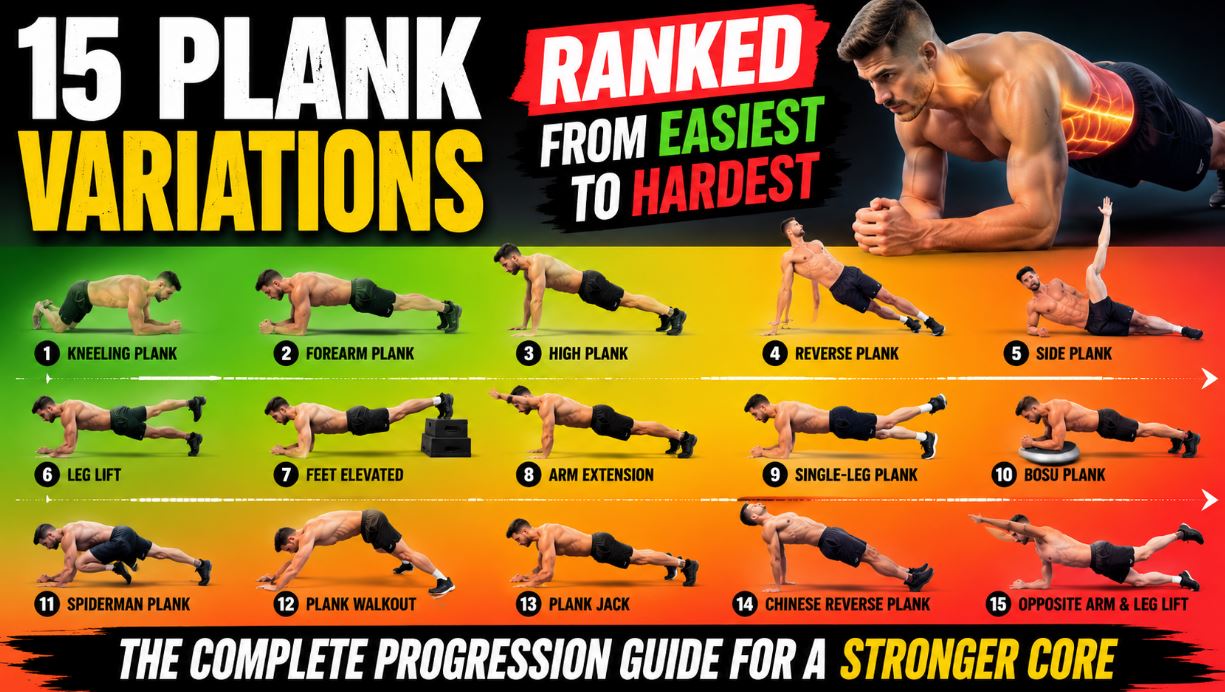
This guide ranks 15 plank variations from easiest to hardest, breaks down what each one trains and who it’s for, and gives you a structured four-week plan to move through the progression with intent rather than guesswork.
Plank Difficulty Ranking
| Rank | Exercise | Difficulty | Best For |
|---|---|---|---|
| 1 | Kneeling Plank | 1/10 | Complete beginners |
| 2 | Forearm Plank | 2/10 | Core endurance |
| 3 | High Plank (Straight-Arm) | 3/10 | Total-body conditioning |
| 4 | Reverse Plank | 4/10 | Posterior chain |
| 5 | Side Plank | 5/10 | Obliques |
| 6 | Plank with Leg Lift | 5/10 | Glutes |
| 7 | Feet Elevated Plank | 6/10 | Shoulder and core demand |
| 8 | Plank with Arm Extension | 6/10 | Anti-rotation |
| 9 | Single-Leg Plank | 7/10 | Balance and hip stability |
| 10 | BOSU Plank | 7/10 | Instability training |
| 11 | Spiderman Plank | 7/10 | Obliques + hip mobility |
| 12 | Plank Walkout | 8/10 | Full-body dynamic control |
| 13 | Plank Jack | 8/10 | Conditioning + core endurance |
| 14 | Chinese Reverse Plank | 9/10 | Elite posterior chain |
| 15 | Plank with Opposite Arm and Leg Lift | 10/10 | Maximum anti-rotation |
A note on this ranking before you use it: difficulty here reflects the technical and stability demand of each position under bodyweight, not necessarily how exhausted you’ll feel. Some lower-ranked planks — the reverse plank in particular — can feel brutal on muscles you don’t usually train directly, even though the position itself is mechanically less demanding than something like the plank with opposite arm and leg lift. Use this table as a progression map, not a strict suffering scale.
The 15 Plank Variations
1. Kneeling Plank
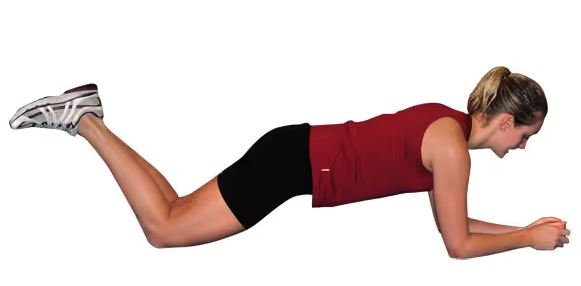
Difficulty: 1/10 | Muscles: Rectus abdominis, transverse abdominis | Best for: Complete beginners
The kneeling plank is the forearm plank performed with the knees on the floor instead of full leg extension. Shortening the lever arm this way dramatically reduces the core demand, making it the most accessible entry point into plank training. It’s the right starting place for anyone who cannot yet hold a standard forearm plank with a level spine.
Who should use it: Absolute beginners, anyone returning to training after a break, or anyone whose forearm plank consistently breaks down with hip sag.
2. Forearm Plank
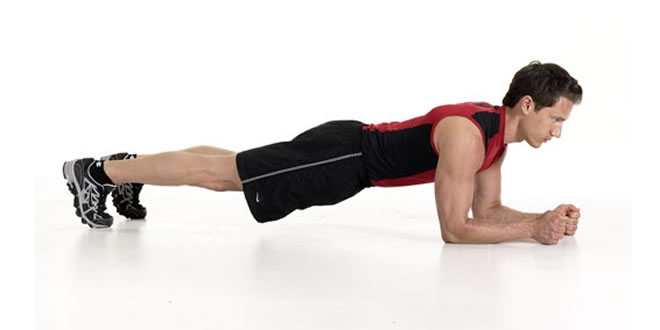
Difficulty: 2/10 | Muscles: Rectus abdominis, transverse abdominis, obliques | Best for: Core endurance
The forearm plank is the foundational anti-extension exercise in core training — full leg extension, forearms on the floor, body in one straight line, resisting lower back sagging into extension. It’s the benchmark most people measure their core endurance against, and for good reason: holding it correctly, with active glute and ab bracing rather than passive sagging, genuinely trains the entire anterior core.
Who should use it: Nearly everyone. This is the exercise the rest of the plank family builds from.
3. High Plank (Straight-Arm Plank)

Difficulty: 3/10 | Muscles: Shoulders, chest, rectus abdominis | Best for: Total-body conditioning
The high plank is the top position of a push-up held statically — straight arms, hands under the shoulders. It distributes more of the load to the shoulders and chest than the forearm version does, making it more of a total-body conditioning exercise than a pure core-isolation movement. It’s also the more familiar version for most people, since it looks identical to the push-up position they already know.
Who should use it: Beginners as an entry point, and anyone who wants total-body conditioning rather than core-isolated training.
4. Reverse Plank

Difficulty: 4/10 | Muscles: Glutes, hamstrings, lower back | Best for: Posterior chain
The reverse plank flips the entire concept — facing the sky rather than the ground, supported by the hands and heels, with the glutes, hamstrings, and lower back doing the primary stabilizing work instead of the abs. It’s one of the most neglected exercises in core training, since most programs are built almost entirely around forward-facing planks, leaving the posterior chain undertrained.
Who should use it: Anyone whose core training is anterior-dominant, runners with tight hip flexors, and anyone wanting balanced front-and-back core development.
5. Side Plank

Difficulty: 5/10 | Muscles: Obliques, quadratus lumborum | Best for: Obliques
The side plank trains an entirely different function than the forward-facing versions — anti-lateral flexion, resisting the hips from dropping toward the floor rather than resisting extension. It’s widely considered one of the single best exercises available for direct oblique and quadratus lumborum development, precisely because that lateral stabilization function gets so little direct attention elsewhere.
Who should use it: Anyone building a complete core program — the side plank fills a gap that forward-facing planks cannot address.
6. Plank with Leg Lift

Difficulty: 5/10 | Muscles: Glutes, hip stabilizers, core | Best for: Glutes
From a standard forearm or high plank, lifting one leg a few inches off the floor removes a point of ground contact and adds a meaningful glute activation demand to the supporting hip. The core has to resist the slight rotational pull created by the lifted leg, making this a useful bridge between the basic plank and the more advanced limb-removal variations later in this list.
Who should use it: Trainees who have mastered the standard plank and want a manageable first step toward removing points of support.
7. Feet Elevated Plank

Difficulty: 6/10 | Muscles: Core, shoulders, shoulder girdle | Best for: Shoulder and core demand
Elevating the feet on a bench, box, or stability ball changes the body’s angle relative to gravity, increasing the percentage of body weight the upper body has to support. This variation works well with either the forearm or high-plank base and is a straightforward way to increase difficulty without changing the fundamental movement pattern.
Who should use it: Anyone who has plateaued on a standard plank and wants a simple loading progression before attempting limb-removal variations.
8. Plank with Arm Extension

Difficulty: 6/10 | Muscles: Rectus abdominis, obliques, transverse abdominis | Best for: Anti-rotation
The plank with arm extension removes one of the four points of ground contact by lifting and extending one arm forward. That single change creates a genuine anti-rotation demand in addition to the standard anti-extension challenge, since the body tends to rotate toward the remaining supporting arm. It’s a meaningfully harder exercise than it looks from the outside.
Who should use it: Trainees who have mastered the standard plank and are ready to add a rotational stability component.
9. Single-Leg Plank

Difficulty: 7/10 | Muscles: Core, hip stabilizers, glutes | Best for: Balance and hip stability
Lifting one leg fully off the floor — rather than just raising it a few inches as in the leg lift variation — removes a point of support entirely and demands considerably more hip and core stability to prevent the pelvis from dropping or rotating toward the unsupported side. This is a more advanced expression of the same principle behind the plank with leg lift.
Who should use it: Trainees who have mastered the plank with leg lift and want a more demanding single-limb stability challenge before progressing to combined arm-and-leg variations.
10. BOSU Plank

Difficulty: 7/10 | Muscles: Core, shoulders, deep stabilizers | Best for: Instability training
Performing a forearm or high plank with the forearms or hands on a BOSU ball introduces continuous instability that the core and shoulders must manage throughout the entire hold. Unlike the stable variations on this list, the BOSU plank never lets the supporting muscles settle into a fixed pattern — they’re constantly micro-adjusting, which is a genuinely different training stimulus than a stable-surface plank of equivalent body position.
Who should use it: Trainees seeking a proprioceptive challenge alongside core strength, and athletes whose sports involve unstable surfaces or unpredictable balance demands.
11. Spiderman Plank
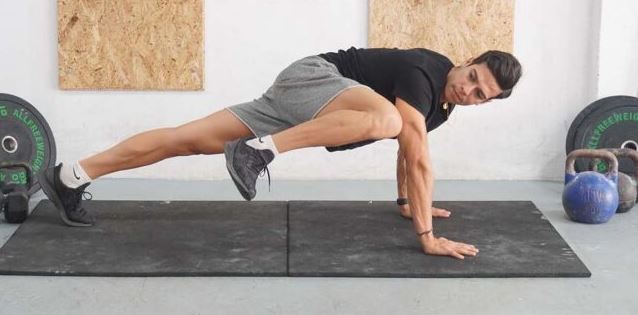
Difficulty: 7/10 | Muscles: Obliques, hip flexors, core stabilizers | Best for: Obliques + hip mobility
From a high plank, driving one knee out and up toward the same-side elbow — like a climbing spider — combines the static anti-extension demand of the plank with a dynamic oblique and hip flexor challenge on each rep. Because the knee travels outside the body rather than straight underneath it, this variation also pulls in a meaningful hip mobility component that most other planks on this list don’t address.
Who should use it: Trainees who have mastered the standard plank and the plank with leg lift, and want a dynamic oblique challenge that also opens up hip mobility.
12. Plank Walkout

Difficulty: 8/10 | Muscles: Core, shoulders, hamstrings | Best for: Full-body dynamic control
Starting standing, bend forward to walk the hands into a high plank, hold briefly, then walk the hands back to standing, combining a dynamic full-body movement with a static hold in the middle. The transitions into and out of the plank position demand as much core control as the hold itself, since the spine must remain stable while the body moves through a large range of motion in both directions.
Who should use it: Trainees who want to combine plank stability training with dynamic movement and hamstring flexibility, often used as a warm-up or conditioning exercise.
13. Plank Jack

Difficulty: 8/10 | Muscles: Core, hip abductors, shoulders | Best for: Conditioning + core endurance
From a high plank, jumping both feet apart and back together — like a horizontal jumping jack — adds a continuous, explosive lower-body movement on top of the standard plank hold. The core has to resist repeated impacts and shifting base of support with every single jump, which makes this one of the most metabolically demanding variations on this list and a genuinely difficult way to finish a core or conditioning session.
Who should use it: Advanced trainees who want to combine plank-based core stability with a genuine cardiovascular and conditioning challenge, often used as a circuit or HIIT finisher.
14. Chinese Reverse Plank

Difficulty: 9/10 | Muscles: Glutes, hamstrings, upper back | Best for: Elite posterior chain
The Chinese reverse plank takes the standard reverse plank and elevates it with three benches — two under the elbows, one under the feet — dramatically increasing the range of motion the hips travel through and the resulting demand on the posterior chain. Holding a strict 30-second Chinese reverse plank is considered a genuinely good benchmark of advanced posterior chain strength.
Who should use it: Trainees who have mastered the standard reverse plank and want the most demanding posterior chain plank variation available.
15. Plank with Opposite Arm and Leg Lift

Difficulty: 10/10 | Muscles: Rectus abdominis, obliques, transverse abdominis | Best for: Maximum anti-rotation
The plank with opposite arm and leg lift removes two points of ground contact simultaneously — one arm and the contralateral leg — leaving the body balanced on just two diagonal points. This is widely considered the most demanding anti-rotation challenge in the standard plank progression, since the diagonal base offers far less stability than any single-limb-removal variation.
Who should use it: Advanced trainees who have mastered the standard plank, the leg lift variation, and the arm extension variation, in that order — this exercise should not be attempted as an introduction to plank training.
Honorable Mentions: Plank-Adjacent Movements
A few exercises sit right on the border of this list — they begin in a plank-like position but evolve into something distinct enough that they don’t quite belong in a strict plank ranking. They’re worth knowing about if you’ve worked through all 15 variations above and want to keep progressing.
The Swiss-ball jackknife starts in a plank position with the shins resting on a stability ball, then rolls the ball toward the chest in a dynamic knee-tuck. It combines plank-style anti-extension with a genuine reverse-crunch movement, making it more of a hybrid exercise than a pure plank hold.
The Swiss-ball pike uses the same starting position but drives the hips up into an inverted V instead of tucking the knees. Controlled EMG research has identified it as one of the most effective exercises tested for activating the rectus abdominis, obliques, and latissimus dorsi together — genuinely exceptional activation data, even though the dynamic hip-drive movement takes it outside a strict plank classification.
If you’ve mastered every variation in the ranking above, both of these are excellent next steps — they apply everything the plank family has taught your core, just through a more dynamic, hybrid movement pattern.
Which Plank Variation Builds the Strongest Core?
There’s no single “strongest” plank, because the plank family trains at least three distinct core functions, and the most effective core training program addresses all three rather than maximizing just one.
Anti-extension is the function trained by the forearm plank, high plank, feet elevated plank, and most of the limb-removal variations. This is the core’s capacity to resist the lower back from sagging into extension under load — the foundational plank skill that nearly every other variation builds from.
Anti-rotation is trained specifically by the plank with arm extension and, at a far more advanced level, the plank with opposite arm and leg lift. This is the capacity to resist the trunk twisting when a point of support is removed asymmetrically — a function that has direct carryover to nearly any sport involving asymmetrical loading or rapid direction changes.
Anti-lateral flexion is trained by the side plank and its variations. This is the capacity to resist the hips dropping sideways — a function the forward-facing plank family doesn’t address at all, which is exactly why the side plank deserves a permanent place in a complete program rather than being treated as optional.
Posterior chain training — the reverse plank and Chinese reverse plank — sits slightly outside the anti-movement framework above, since these exercises actively produce hip extension rather than purely resisting movement. But they belong to the same family because they use the same straight-line body principle, just facing in opposite directions.
The strongest core comes from rotating through all four categories rather than mastering one and ignoring the rest. A trainee who can hold a five-minute forearm plank but has never tried a side plank has a seriously incomplete core, regardless of how impressive that endurance number sounds.
Which Plank Is Best for Beginners?
Start with the kneeling plank if a standard forearm plank cannot be held with a level spine for at least 20 to 30 seconds. Once the kneeling version feels controlled, progress to the standard forearm plank, and alternate it with the high plank to get comfortable with both forearm and straight-arm support.
From there, add the reverse plank and the side plank — both are accessible to beginners and round out the anti-extension foundation with anti-lateral-flexion and posterior-chain work. A beginner who has these four variations under control — kneeling or forearm plank, high plank, reverse plank, side plank — has a genuinely complete foundational core program before ever attempting a limb-removal variation.
Which Plank Is Best for Athletes?
Athletes benefit most from the variations that train anti-rotation and dynamic control, since most sports involve asymmetrical loading, rapid direction changes, or unstable surfaces rather than static, symmetrical positions.
The plank with arm extension and the plank with opposite arm and leg lift directly train the anti-rotation capacity that protects the spine during cutting, throwing, and contact. The BOSU plank adds the proprioceptive instability training that carries over to unpredictable playing surfaces and contact sports. The plank walkout combines core stability with the dynamic full-body movement pattern that most sports actually demand, rather than the purely static hold that dominates the rest of the plank family.
For athletes in rotational sports specifically — tennis, golf, baseball, and combat sports — prioritizing anti-rotation variations over pure endurance holds yields more transferable strength than simply chasing a longer plank time.
Common Plank Progression Mistakes
Chasing duration instead of quality. A two-minute plank held with sagging hips and a relaxed core delivers less benefit than a properly braced 30-second hold. Time under tension only counts if the tension is genuinely there.
Skipping straight to advanced variations. Attempting the plank with opposite-arm and opposite-leg lifts before mastering the standard plank, leg lift, and arm extension variations in sequence almost always results in compensated technique that defeats the purpose of the exercise.
Ignoring the side plank entirely. Most self-directed plank progressions remain exclusively within the forward-facing family and never address anti-lateral flexion, leaving a genuine gap in core development.
Letting the hips sag or pike. This is the single most common technical failure across nearly every variation on this list — the body should form one continuous straight line, not a sagging curve or an inverted V.
Holding the breath throughout the set. Bracing the core is not the same as holding the breath; breathing steadily while maintaining tension through muscular contraction is both more sustainable and more effective.
Adding instability before mastering stability. Progressing to a BOSU or Swiss-ball variation before the equivalent stable-surface version is fully controlled usually just produces a wobbling, compensated rep rather than genuine progress.
Neglecting the posterior chain. Most plank training is anterior-dominant by default. Without deliberately adding the reverse plank and its progressions, an entire half of the body’s stabilizing musculature goes undertrained.
Rushing the progression timeline. Moving to a harder variation every week, regardless of whether the current one is genuinely controlled, builds bad habits faster than it builds strength. Each step in the progression should be earned with consistent, technically sound holds before advancing.
Sample Plank Progression Plan
This four-week plan assumes a starting point of being comfortable with a basic forearm plank for at least 30 seconds. Adjust the starting week based on your current level.
Week 1: Foundation
- Forearm plank: 3 sets of 30–45 seconds
- High plank: 3 sets of 20–30 seconds
- Reverse plank: 3 sets of 20–30 seconds
- Side plank: 3 sets per side of 20–30 seconds
Week 2: Building
- Forearm plank: 3 sets of 45–60 seconds
- Plank with leg lift: 3 sets per side of 20–30 seconds
- Reverse plank: 3 sets of 30–40 seconds
- Side plank: 3 sets per side of 30–40 seconds
Week 3: Progressing
- Feet elevated plank: 3 sets of 30–40 seconds
- Plank with arm extension: 3 sets of 8–10 reps per side
- Chinese reverse plank (or continue standard reverse plank if not yet ready): 3 sets of 20–30 seconds
- Single-leg plank: 3 sets per side of 15–20 seconds
Week 4: Advancing
- BOSU plank or Spiderman plank: 3 sets of 20–30 seconds (or 8–10 reps per side for the Spiderman plank)
- Plank with opposite arm and leg lift: 2–3 sets of 16–20 total alternating reps
- Chinese reverse plank: 3 sets of 25–35 seconds
- Plank walkout: 3 sets of 6–8 reps
Progress to the next week only when every exercise in the current week is performed with a genuinely straight body line and full control. If any exercise consistently breaks down, repeat that week rather than advancing on schedule.
Conclusion
The plank family is far larger than the single hold most people default to, and that’s the entire point of this list. Anti-extension, anti-rotation, anti-lateral flexion, and posterior chain training each demand a different variation, and no single plank — no matter how advanced — covers all four.
Use the difficulty ranking as a map, not a finish line. The goal isn’t to eventually hold a plank jack circuit and call your core training complete; it’s to build a program that rotates through each function the plank family can train, progressing through each one with the same patience and attention to technique that got you through the forearm plank in the first place.
Master the basics, earn each progression, and choose the variation that matches what you’re actually training for — not just the one that looks the most impressive.
Key Takeaways
- The plank family trains four distinct core functions — anti-extension, anti-rotation, anti-lateral flexion, and posterior chain — not just one generic “core strength.”
- Harder doesn’t mean better for your goal — a side plank and a Chinese reverse plank build completely different qualities that difficulty ranking alone won’t tell you.
- Progress in sequence, not by skipping ahead — each variation builds the control needed for the next; jumping straight to advanced planks almost always produces compensated technique.
- Quality beats duration every time — a properly braced 30-second hold delivers more than a two-minute hold with sagging hips.
- The side plank and reverse plank are the most commonly skipped — most self-built routines stay anterior-dominant and never address anti-lateral flexion or the posterior chain.
- Use the 4-week plan as a floor, not a fixed schedule — repeat any week until every exercise is performed with a genuinely straight body line before advancing.
