


Muscle names like sternocleidomastoid, rectus femoris, or flexor carpi radialis can look intimidating at first. But these names are rarely random. Once you learn a handful of basic naming conventions, a muscle’s name can often tell you where it is, what it looks like, where it attaches, or even what movement it produces — before you’ve ever looked at a diagram.
Understanding this terminology makes anatomy far easier to learn, and it helps lifters and coaches understand muscle function and exercise selection more precisely. This guide is a companion to our Muscular System: Anatomy, Functions & Role in Strength Training pillar — think of this as the decoder ring for every muscle name you’ll come across in that guide and beyond.
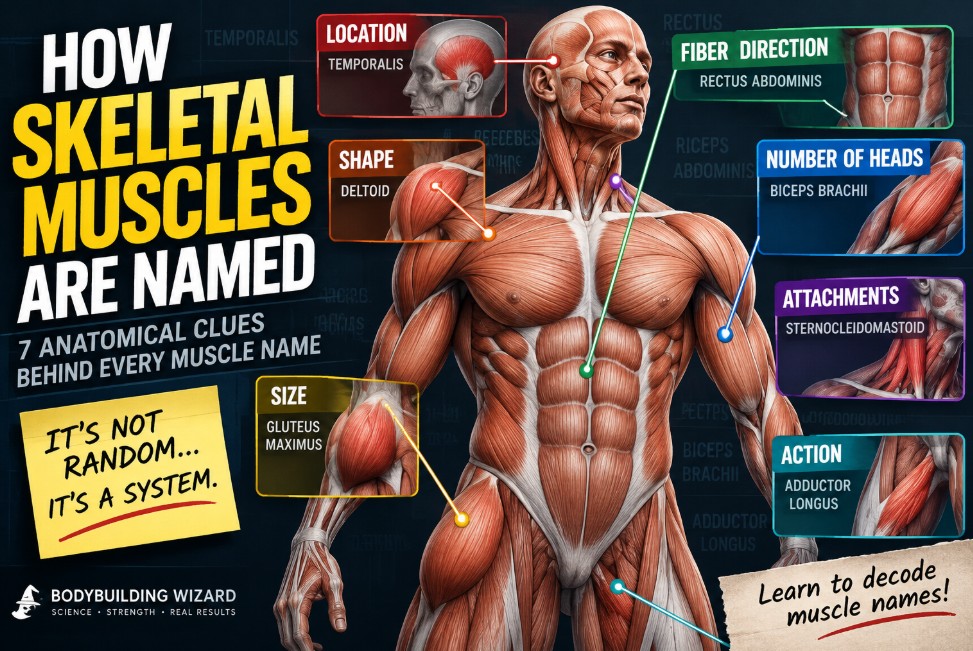
QUICK ANSWER: Skeletal muscles are commonly named according to one or more anatomical characteristics, including their location, shape, relative size, fiber direction, number of heads or origins, attachment points, and action. For example, gluteus maximus describes a large muscle of the gluteal region, while biceps brachii indicates a two-headed muscle of the arm. Learning these naming conventions makes unfamiliar muscle names much easier to understand.
Muscle Naming Criteria at a Glance
Before breaking each naming convention down in detail, it helps to see the full picture in one place. The table below summarizes the seven main criteria used to name skeletal muscles, along with one clear example for each.
| Naming Criterion | What It Describes | Example |
| Location | Where the muscle is located | Temporalis |
| Shape | Overall shape | Deltoid |
| Size | Relative size or length | Gluteus maximus |
| Fiber direction | Orientation of muscle fibers | Rectus abdominis |
| Number of heads | Number of heads or origins | Biceps brachii |
| Attachments | Where the muscle attaches | Sternocleidomastoid |
| Action | Movement produced | Adductor longus |
Why Do Muscle Names Sound So Complicated?
Muscle Names Are Descriptive, Not Random
Anatomical terminology draws heavily on Latin and Greek, which is exactly why muscle names can feel foreign at first glance. This isn’t accidental or inconsistent between sources, either — muscle names, like the rest of human anatomical terminology, follow an internationally standardized nomenclature maintained so anatomists, clinicians, and educators worldwide use the same terms. And the vast majority of these names aren’t arbitrary labels — they function almost like a short anatomical code, packing location, shape, size, or action into a single word.
One Muscle Name Can Contain Several Clues
Take rectus femoris: rectus means “straight,” describing the fiber direction, while femoris tells you it’s associated with the femur (thigh). Or consider a more intimidating example, sternocleidomastoid: sterno- refers to the sternum, cleido- to the clavicle, and mastoid to the mastoid process of the skull — three attachment points packed into one word. Once you see it this way, even the longest muscle names stop looking like nonsense syllables and start looking like a map.
The 7 Main Ways Skeletal Muscles Are Named
Anatomy textbooks generally group these naming conventions into a small set of recurring categories — OpenStax’s widely used Anatomy and Physiology textbook is one clear example — and once you know what to look for, you’ll start spotting them in nearly every muscle name you encounter.
1. Muscles Named by Location
Many muscle names describe the body region, nearby bone, or structure the muscle sits near or on. The temporalis sits over the temporal region of the skull; the tibialis anterior lies in the anterior compartment of the leg, alongside the tibia; the intercostals sit between the ribs; the brachialis sits in the brachial (upper arm) region; the pectoralis major sits over the chest, or pectoral, region. Directional terms like anterior, posterior, medialis, and lateralis add further orientation — once you know that tibialis anterior lies in the front compartment of the shin, you already have a good idea of where to look for it. These same anterior, posterior, medial, and lateral terms are core anatomical directional terms in their own right — see Anatomical Position and Directional Terms for the complete picture of how they’re defined and used.

2. Muscles Named by Shape
Some muscle names describe their outline. The deltoid is triangular, resembling the Greek letter delta. The trapezius has a trapezoid-like shape. The rhomboid major and minor are named for their rhomboid (diamond) shape. The orbicularis muscles are circular, and the serratus anterior has a saw-like, serrated edge.

| Term | Meaning | Example |
| Deltoid | Triangular | Deltoid |
| Rhomboid | Diamond/rhombus-shaped | Rhomboid major |
| Orbicularis | Circular | Orbicularis oculi |
| Serratus | Saw-like | Serratus anterior |

3. Muscles Named by Size or Length
Several Latin terms describe a muscle’s relative size: maximus (largest), minimus (smallest), medius (middle), major (larger), minor (smaller), longus (long), and brevis (short). The gluteal group is the textbook example: gluteus maximus, gluteus medius, and gluteus minimus form a clean size hierarchy in a single muscle group. The chest offers a similar pair — pectoralis major and pectoralis minor.

4. Muscles Named by Fiber Direction
Rectus means “straight,” transversus (or transverse) means “across,” and oblique means “diagonal.” The abdominal wall is the clearest example of this system in action: the rectus abdominis runs its fibers predominantly vertically, the transversus abdominis runs predominantly transversely, and the external and internal obliques run at a diagonal. For the full picture of how these fit together, see our Abdominal Muscles Anatomy guide.

5. Muscles Named by Number of Heads or Origins
Here the naming logic becomes almost mathematical: bi- means two, tri- means three, and quadri- means four. Biceps brachii breaks down to “two heads” plus “arm.” Triceps brachii is “three heads” plus “arm.” Quadriceps femoris is a four-headed muscle group associated with the femur.

Bodybuilder’s Take: “Quadriceps” is often loosely described as a muscle that “extends the femur,” which isn’t quite right. The quadriceps as a group primarily extends the knee, while one of its four heads, the rectus femoris, also crosses the hip and contributes to hip flexion since it’s the only one of the four with an origin above the hip joint. That distinction matters for exercise selection: it’s part of why a leg extension trains all four heads similarly, while a movement like a squat or a leg raise recruits the rectus femoris differently depending on hip position.
6. Muscles Named by Their Attachments
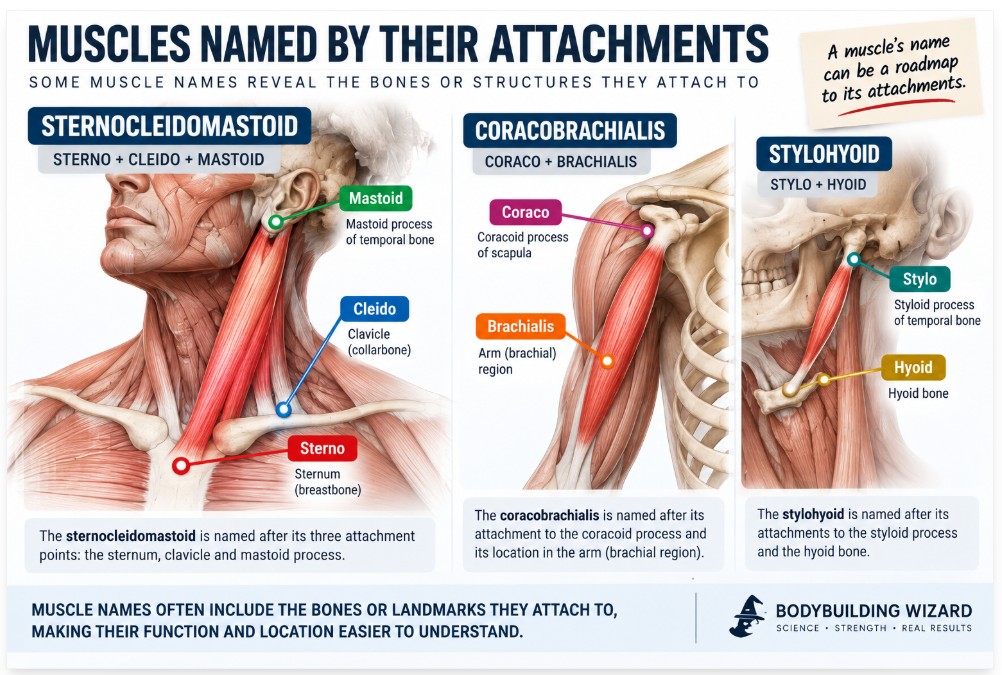
Some of the most intimidating-looking muscle names are simply listing attachment points. Sternocleidomastoid is the textbook example: sterno- (sternum), cleido- (clavicle), and mastoid (mastoid process) identify its sternal, clavicular, and mastoid attachments in a single word. A related example is brachioradialis: brachio- places it in the arm region, while -radialis points to its attachment near the radius in the forearm — another case where the name combines a location clue with an attachment clue rather than a single, pure category. Once you know to look for this pattern, an enormous “scary” word turns into a small anatomical map. We cover the origin/insertion concept itself in more depth in the Muscular System pillar.
7. Muscles Named by Their Action
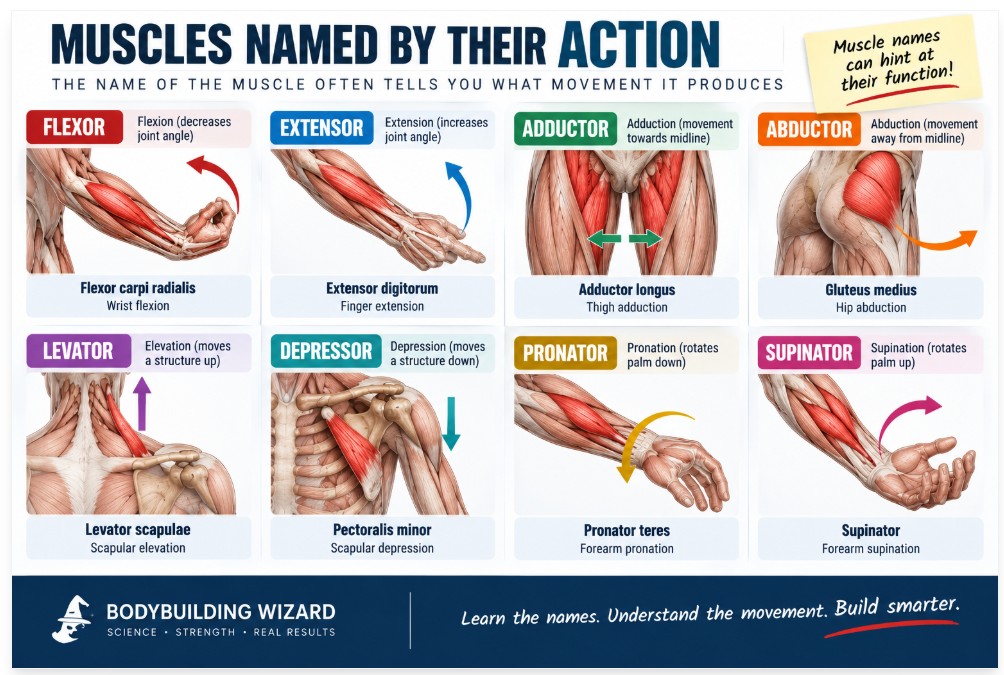
This is probably the most intuitive category for lifters, because the name tells you the joint action directly: flexor (flexion), extensor (extension), adductor (adduction), abductor (abduction), levator (elevation), depressor (depression), pronator (pronation), and supinator (supination). Real examples include adductor longus, flexor carpi radialis, extensor digitorum, pronator teres, supinator, and levator scapulae. When a muscle is named after its action, part of its name may immediately tell you what movement it can produce.
Most Muscles Are Named Using More Than One Characteristic
The seven categories above aren’t isolated boxes — most real muscle names combine two or more of them at once. Breaking a name into its parts is usually the fastest way to understand it.
| Muscle | Break the Name Down | What the Name Tells You |
| Biceps brachii | bi + ceps + brachii | Two-headed muscle of the arm |
| Rectus abdominis | rectus + abdominis | Straight-oriented abdominal muscle |
| Gluteus maximus | gluteus + maximus | Largest gluteal muscle |
| Adductor longus | adductor + longus | Long muscle that performs adduction |
| Tibialis anterior | tibialis + anterior | Muscle associated with the tibia, on the anterior leg |
| Sternocleidomastoid | sterno + cleido + mastoid | Attachments to the sternum, clavicle, and mastoid process |
How to Decode a Muscle Name You’ve Never Seen Before
Knowing the rules is one thing; applying them on the fly is what actually makes anatomy easier. Here’s a simple five-step process for decoding any unfamiliar muscle name:
- Look for a location clue — roots like brachii, femoris, abdominis, or carpi.
- Look for size or shape — major, minor, maximus, minimus, longus, brevis.
- Look for numbers — bi-, tri-, quadri-.
- Look for an action — flexor, extensor, adductor, abductor.
- Look for direction or attachment clues — rectus, oblique, transverse, sterno-, cleido-.
Let’s test it on a muscle you may never have formally studied: flexor carpi radialis. Flexor tells you it produces flexion. Carpi places it at the wrist. Radialis tells you it has a radial association — it runs along the radial (thumb) side of the forearm and, in practice, actually contributes to both wrist flexion and radial deviation. Without ever opening a textbook page on this specific muscle, you already know roughly what it does and where to find it — that’s the entire value of learning the naming system.
Common Muscle Naming Terms Every Lifter Should Know
| Term | Meaning |
| Anterior | Front |
| Posterior | Back |
| Medial | Toward the midline |
| Lateral | Away from the midline |
| Major | Larger |
| Minor | Smaller |
| Maximus | Largest |
| Minimus | Smallest |
| Longus | Long |
| Brevis | Short |
| Rectus | Straight |
| Oblique | Diagonal |
| Transverse | Across |
| Flexor | Produces flexion |
| Extensor | Produces extension |
| Adductor | Produces adduction |
| Abductor | Produces abduction |
| Bi- | Two |
| Tri- | Three |
| Quadri- | Four |
Once these terms start feeling familiar, the fastest way to make them stick is to see them attached to real muscles on a body — our Interactive Muscle Anatomy tool lets you click through individual muscles and see exactly where these naming clues show up in practice.
Why Understanding Muscle Names Matters for Lifters and Coaches
You don’t need a background in Latin to train effectively. But understanding muscle naming terminology helps you locate unfamiliar muscles, understand basic muscle function at a glance, interpret anatomy diagrams, make sense of exercise descriptions that reference specific muscles, distinguish neighboring muscles from one another (like the three gluteal muscles, or the four heads of the quadriceps), communicate more precisely with coaches, physical therapists, and other professionals, and learn new anatomy far faster, since new muscle names stop being isolated vocabulary and start fitting into a system you already know.
Bodybuilder’s Take: You don’t need to memorize hundreds of Latin terms to build muscle. The useful skill isn’t memorization — it’s learning to recognize the handful of recurring clues hidden inside muscle names, so that the next unfamiliar term you run into in a program or an anatomy diagram is something you can partly decode yourself.
Muscle Names Don’t Always Tell the Whole Story
Naming conventions are a fantastic learning tool, but they aren’t a complete biomechanical guide. A muscle’s name typically captures only one or two of its characteristics, while its actual function in training depends on its full set of attachments, its line of pull, the position of the joint it crosses, its internal architecture, its moment arm at different joint angles, and, for multi-joint muscles, which joints it crosses at all. In short: a muscle’s name is not a complete description of what it does in a given exercise. For the fuller picture of how these factors interact, see our Muscular System guide.
Coach’s Note: Learn the Logic, Not Just the Vocabulary. When I was first learning anatomy, it became far easier to remember a muscle’s name once I connected it to its location, function, and movement, rather than trying to memorize the word in isolation. Take adductor longus: a student sees a complicated-looking Latin term and tries to memorize it as a string of syllables. A coach or kinesiologist sees “adductor” (what it does) plus “longus” (a descriptive characteristic) and has effectively already learned it. That shift, from memorizing words to reading the logic behind them, is the single biggest difference in how quickly anatomy terminology sticks.
Key Takeaways
- ✓Skeletal muscle names are usually descriptive rather than random.
- ✓Muscles can be named according to location, shape, size, fiber direction, number of heads, attachments, or action.
- ✓A single muscle name may describe several anatomical characteristics at once.
- ✓Learning common Latin and Greek roots makes unfamiliar muscle names easier to decode.
- ✓Terms such as major, minor, rectus, longus, flexor, and adductor appear repeatedly throughout muscular anatomy.
- ✓Understanding muscle terminology makes anatomy easier to learn and apply to exercise selection.
- ✓A muscle’s name provides useful clues, but it does not describe everything about its biomechanics or function.
Frequently Asked Questions
Why are muscles named in Latin?
Modern anatomical terminology developed largely from Latin (and some Greek) roots because historical anatomists used these languages as the scientific standard, creating a consistent, internationally shared naming system that’s still used today, regardless of the anatomist’s native language.
What are the main criteria used to name skeletal muscles?
The main criteria are location, shape, relative size or length, fiber direction, number of heads or origins, attachment points, and the action or movement the muscle produces. Most muscle names combine two or more of these criteria at once.
What does “biceps” mean?
“Biceps” means “two heads,” referring to a muscle with two separate points of origin that join into one muscle belly. Biceps brachii, for example, has two heads originating on the scapula.
What do maximus, medius, and minimus mean in muscle names?
These are relative size terms: maximus means “largest,” medius means “middle” or “intermediate,” and minimus means “smallest.” The gluteal muscles — gluteus maximus, medius, and minimus — are the clearest example of this size hierarchy.
What does “rectus” mean in anatomy?
“Rectus” means “straight” and refers to muscle fibers that run parallel to the muscle’s long axis, or in some cases parallel to the body’s midline. Rectus abdominis and rectus femoris are two common examples.
Can a muscle be named using more than one characteristic?
Yes — most muscle names actually combine several naming criteria at once. Sternocleidomastoid, for example, combines two attachment points (sternum, clavicle) with a third (mastoid process), while adductor longus combines an action (adduction) with a length descriptor (long).
Does a muscle’s name always describe its function?
Not completely. A muscle’s name usually highlights only one or two characteristics — often location, shape, or a primary action — while its full function depends on additional factors like its attachments, line of pull, and the joints it crosses. The name is a useful starting clue, not a complete functional description.
References
- Betts, J. G., et al. (2023). Anatomy and Physiology 2e — Chapter 11.4, Naming Skeletal Muscles. OpenStax. openstax.org/details/books/anatomy-and-physiology-2e
- Standring, S. (Ed.). (2020). Gray’s Anatomy: The Anatomical Basis of Clinical Practice (42nd ed.). Elsevier.
- Moore, K. L., Dalley, A. F., & Agur, A. M. R. (2023). Clinically Oriented Anatomy (9th ed.). Wolters Kluwer.
- Federative International Programme for Anatomical Terminology (FIPAT). Terminologia Anatomica, 2nd ed. fipat.library.dal.ca/ta2
- Drake, R. L., Vogl, A. W., & Mitchell, A. W. M. (2019). Gray’s Basic Anatomy (2nd ed.). Elsevier.
- Kenhub. Muscle Nomenclature: How Are Muscles Named? kenhub.com
- Tortora, G. J., & Derrickson, B. (2017). Principles of Anatomy and Physiology (15th ed.). Wiley.
- Saladin, K. S. (2020). Anatomy & Physiology: The Unity of Form and Function (9th ed.). McGraw Hill.

2 Comments
OMG thank you! I’m trying to become a personal trainer and this just helped me tremendously. Thinking about it like this just totally makes sense to me. If you have any more examples like this I would love to see it. Thanks again!
Dear Christina! We have many posts regarding human anatomy (primary muscle anatomy) which are very easy to read and learn. ANATOMY SECTION