



Of the four muscles that make up the quadriceps, only one crosses two joints instead of one — and that single anatomical fact explains almost everything unusual about how the rectus femoris behaves, why it’s the most commonly injured of the four quad heads, and why certain “quad exercises” barely touch it at all.

Key Facts
The rectus femoris is one of the four quadriceps muscles and the only one that crosses both the hip and knee joints. It originates from the ilium (via a direct and an indirect head) and inserts, via the quadriceps tendon and patella, onto the tibial tuberosity — allowing it to flex the hip and extend the knee, sometimes simultaneously, as in kicking.
| Muscle type | One of four quadriceps femoris muscles |
|---|---|
| Primary functions | Knee extension, hip flexion |
| Unique feature | Only quadriceps head that crosses the hip joint (biarticular) |
| Innervation | Femoral nerve (L2–L4) |
| Blood supply | Descending branch of the lateral circumflex femoral artery |
| Common exercises | Leg extension (best for hypertrophy specifically), sissy squat, reverse Nordic curl |
| Main bodybuilding role | Quad sweep/definition, hip-knee force transfer in sprinting and kicking sports |
Rectus Femoris Anatomy & Location
The rectus femoris is one of four muscles that make up the quadriceps femoris group, alongside:
- Vastus lateralis — the largest and strongest of the four heads
- Vastus medialis — the innermost head, known for its teardrop shape and role in patellar tracking
- Vastus intermedius — the deepest head, hidden entirely beneath the rectus femoris
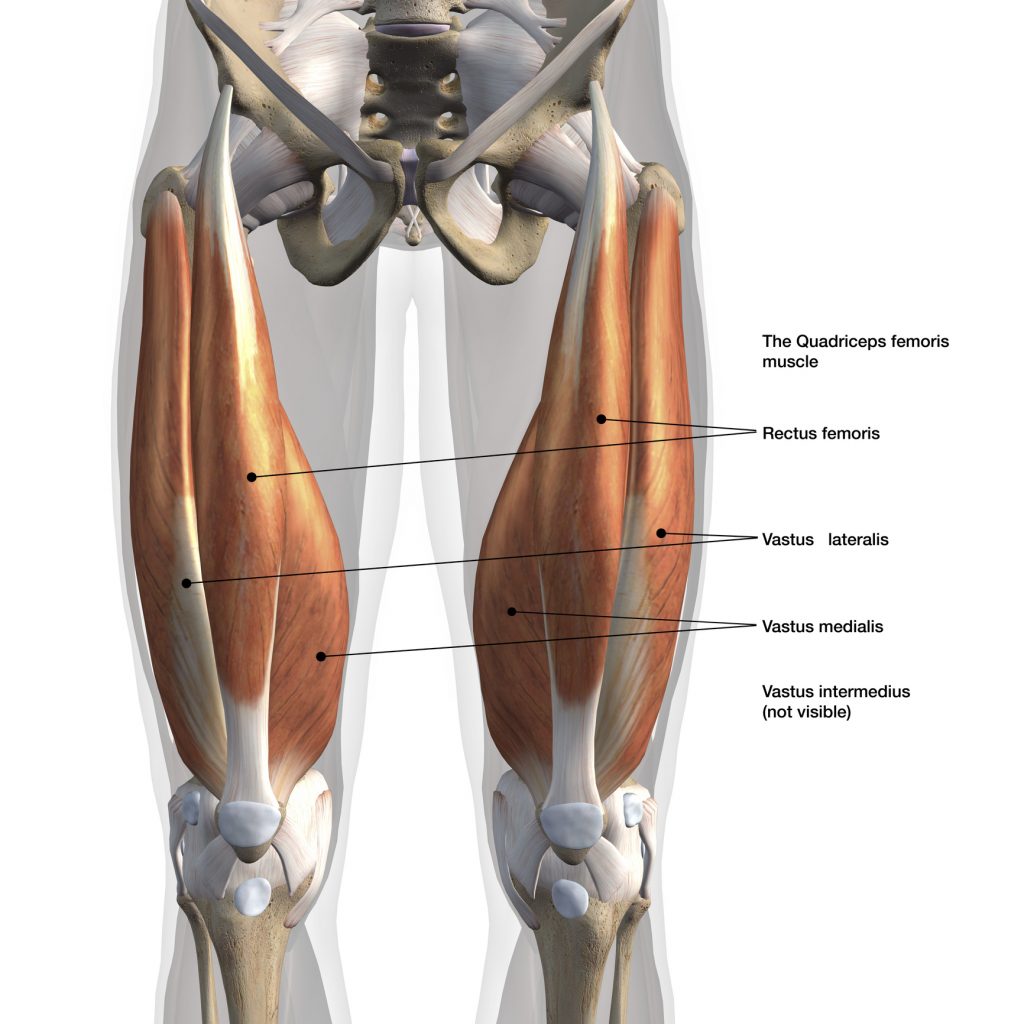
Unlike the three vasti, which sit deep and lateral/medial on the femur, the rectus femoris runs almost straight down the front of the thigh, superficial to the vastus intermedius, and is the only one of the four visible as a distinct bulge when the hip is flexed. To see exactly where it sits relative to the rest of your leg musculature, our interactive muscle anatomy tool lets you explore it alongside the other three heads.
The rectus femoris is a bipennate (fusiform with two internal fiber angles) muscle with a distinctive dual origin on the ilium — a detail worth exploring further using our interactive human skeleton tool and our full guide to the pelvis.
Origin, Insertion, Innervation & Blood Supply
| Origin (direct head) | Anterior inferior iliac spine (AIIS) of the ilium |
|---|---|
| Origin (indirect/reflected head) | Groove above the acetabulum (supra-acetabular groove) |
| Insertion | Base of the patella via the quadriceps tendon, continuing as the patellar ligament to the tibial tuberosity |
| Innervation | Femoral nerve (L2–L4) |
| Blood supply | Descending branch of the lateral circumflex femoral artery, with contributions from the femoral artery |
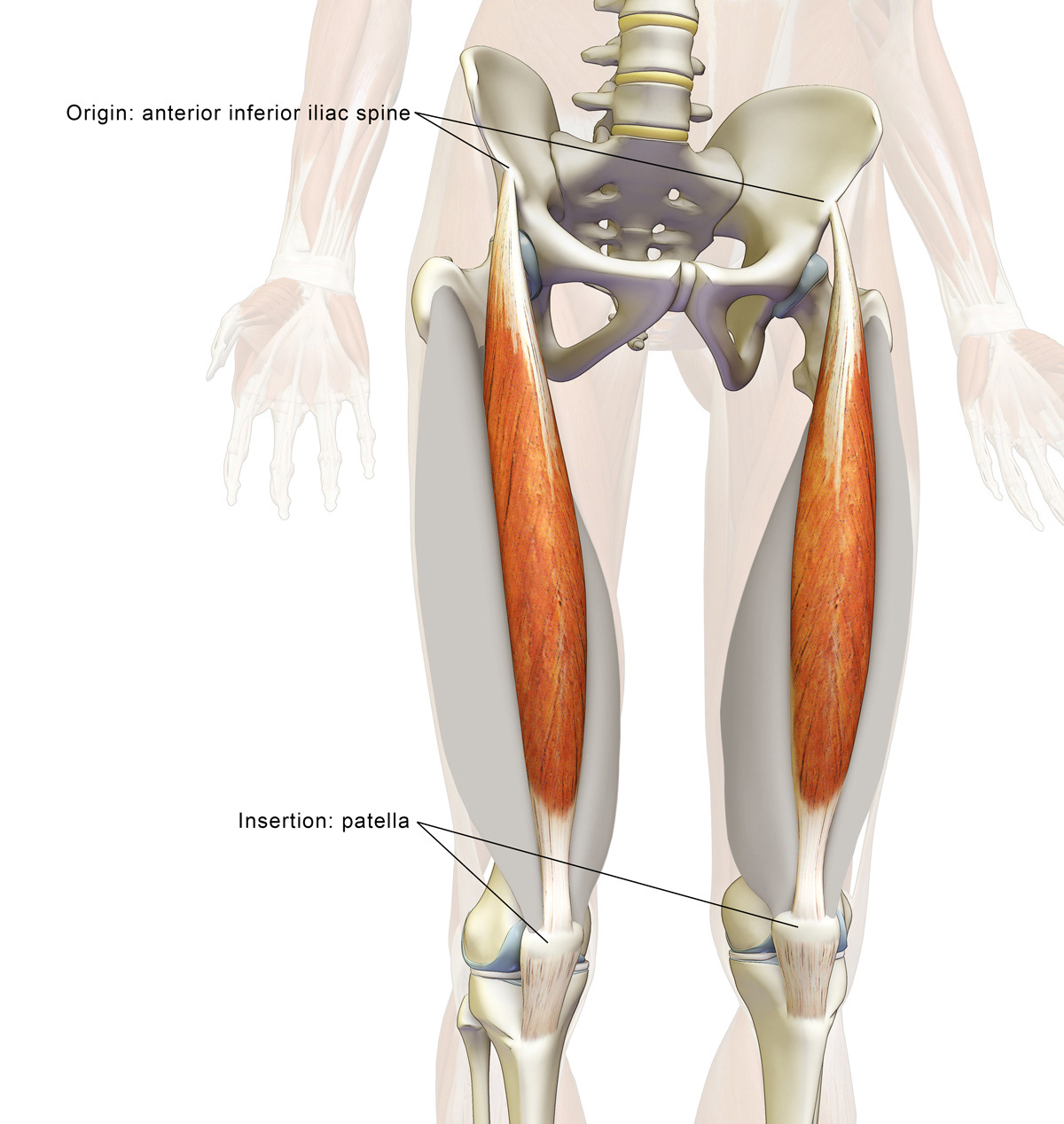
The two heads converge distally at an acute angle into a common tendon, which is part of why the rectus femoris is sometimes described as having a “V-shaped” internal architecture rather than a simple straight one. This dual-head, dual-tendon structure isn’t just anatomical trivia — it’s directly relevant to how the muscle gets injured, covered further down.
For a refresher on what terms like origin, insertion, and innervation actually describe, see our guide to muscle anatomy basics.
Rectus Femoris Structure & Muscle Architecture
The rectus femoris isn’t built like a simple pennate muscle with fibers running in one consistent direction — it has a mixed architecture. The superficial fibers are arranged in a bipennate pattern, angling toward a central structure like the two sides of a feather, while the deep fibers run more vertically, closer to the muscle’s long axis. This combination gives the rectus femoris a fusiform (spindle-shaped) overall outline despite its internally complex fiber arrangement.
What makes this architecture clinically distinctive is an internal tendon plate that runs deep within the muscle belly, onto which the superficial bipennate fibers attach. This intramuscular tendon is a direct continuation of the proximal tendinous complex (the point where the direct and indirect heads converge) and extends well down into the muscle rather than staying confined to the surface. This internal structure is part of why rectus femoris tears can occur deep inside the muscle belly rather than only at the visible surface — a pattern seen in a rare injury called intramuscular degloving, where the outer muscle layer separates from this internal tendon.
Fiber type also matters here: the rectus femoris has an unusually high proportion of fast-twitch (type II) fibers, reported at around 65% in the injury literature — notably higher than the more slow-twitch-dominant vastus muscles beneath it. That fast-twitch bias supports its role in explosive, high-velocity actions like sprinting and kicking, but it’s also part of why the muscle is more injury-prone than its neighbors: fast-twitch fibers generate force quickly but are more susceptible to strain under rapid eccentric loading.
Functions of the Rectus Femoris
Because it crosses both the hip and the knee, the rectus femoris is genuinely biarticular in a way none of the other three quad heads are: it flexes the hip and extends the knee, and — unlike many two-joint muscles — it can perform both actions at the same time, which is exactly what happens during a kicking motion. This is also why it’s nicknamed the “kicking muscle” in clinical literature.
This dual role has a counterintuitive practical consequence, as confirmed by controlled hypertrophy trials: compound exercises that simultaneously extend the hip and knee — squats, leg presses, lunges — consistently fail to meaningfully grow the rectus femoris, even though they build the other three quad heads well. The likely mechanism is that, during simultaneous hip and knee extension, the rectus femoris’s hip-flexion torque opposes the hip-extension demand of the movement, so the nervous system downregulates its activation to avoid fighting itself at the hip. By contrast, single-joint knee extension exercises — where the hip stays flexed and static, like the leg extension machine — allow the rectus femoris to contract at full effort without that conflict and have consistently been shown to preferentially hypertrophy the rectus femoris.
Rectus Femoris Synergists & Antagonists
Synergists (muscles that work alongside the rectus femoris to help produce the same movement):
For knee extension: Vastus lateralis, vastus medialis, vastus intermedius — all three assist knee extension without the added hip-flexion role.
For hip flexion: Iliopsoas, sartorius, tensor fasciae latae.
Antagonists (muscles that oppose the rectus femoris’s action, working in the opposite direction):
The hamstrings oppose the rectus femoris at both joints — extending the hip while the rectus femoris flexes it, and flexing the knee while the rectus femoris extends it.
Common Rectus Femoris Exercises

| Exercise | Role of the Rectus Femoris |
|---|---|
| Leg extension | Most effective for rectus femoris hypertrophy specifically — the static hip position lets it contract at full effort without competing torque demands |
| Sissy squat | Strong contributor — loads the rectus femoris in a lengthened position with the hip kept relatively neutral |
| Reverse Nordic curl | Strong eccentric contributor — same lengthened-position principle as the sissy squat; not yet covered by its own guide on this site |
| Sprinting | Near-maximal contributor — the combination of extreme hip flexion during the swing phase and rapid knee extension just before ground contact loads the rectus femoris more than almost any lift, which is also why it’s the most commonly strained muscle in sprinters |
| High-knee running drills | Strong functional contributor — trains the same rapid hip-flexion-into-knee-extension pattern as sprinting, at a more controllable intensity |
| Front squat | Trains the vasti heavily but contributes little to rectus femoris growth specifically, despite the upright, hip-flexed position |
| Bulgarian split squat | Same limitation as other compound hip-and-knee-extension movements — builds the vasti more than the rectus femoris |
For a complete breakdown of quad training options, see our full guide: Best Quadriceps Exercises.
Bodybuilder’s Take
“Why do leg extensions leave my quads sore in a spot squats never seem to reach?” This isn’t in your head — controlled studies confirm that squats and other compound hip-and-knee movements largely bypass the rectus femoris, while the leg extension is one of the few exercises proven to reliably grow it. If rectus femoris development matters to you specifically, don’t skip leg extensions in favor of “more functional” compound work.
“I always assumed front squats would hit my rectus femoris harder than back squats because of the more upright torso — was I wrong?” Yes, and it’s a genuinely common assumption. More hip flexion in the position doesn’t translate to greater rectus femoris growth because the muscle’s hip-flexion torque opposes the lift’s hip-extension effort, so its activation is downregulated regardless of squat style. Both squat variants train the vasti well; neither is a strong builder of the rectus femoris.
“I strained my rectus femoris kicking/sprinting — why did it take so long to heal compared to other quad strains?” The rectus femoris is the most frequently injured of the four quadriceps muscles, largely because its dual role means it undergoes rapid, high-force length changes at two joints simultaneously during kicking and sprinting — a mechanism the other three quad heads simply aren’t exposed to in the same way.
Common Rectus Femoris Conditions
This section is educational and should not replace professional medical advice.
Rectus femoris strain — the most common quadriceps strain, typically from a sudden, forceful eccentric contraction during sprinting or kicking. Acute strains tend to occur more distally in the muscle belly, while chronic or repetitive strains tend to occur closer to the origin near the hip.
Anterior inferior iliac spine (AIIS) avulsion — in adolescent athletes whose growth plates haven’t fully fused, a forceful contraction can pull a fragment of bone away from the AIIS at the direct head’s origin, rather than tearing the muscle tissue itself.
Persistent anterior hip or thigh pain, a sudden sharp pain during sprinting or kicking, or a palpable lump in the thigh should be evaluated by a healthcare professional rather than trained through.
Common Rectus Femoris Myths
Myth: A more upright, hip-flexed squat position (like the front squat) trains the rectus femoris harder. Multiple controlled hypertrophy studies find the opposite — squats of any style largely fail to grow the rectus femoris, because its hip-flexion torque works against the hip-extension demand of the lift. The leg extension, not any squat variation, is the exercise most consistently shown to grow it.
Myth: All quad exercises train the rectus femoris equally. Because of its unique two-joint role, exercises that extend the knee (leg extensions) or flex the hip (leg raises) each train only part of its function — a complete program needs both types of movement, plus compound exercises that combine them.
Myth: The rectus femoris is just “part of the quad” with no special significance. It’s anatomically and functionally distinct from the other three heads — it’s the only biarticular quad muscle and the most frequently injured of the four in athletic populations.
Complete your anatomy knowledge with the muscles of the chest, shoulders, back, arms, core, and neck.
Explore Upper Body MusclesKey Takeaways
- The rectus femoris is the only one of the four quadriceps muscles that crosses both the hip and knee joints.
- It originates from two sites on the ilium (direct and indirect heads) and inserts via the patella onto the tibial tuberosity.
- It can flex the hip and extend the knee simultaneously, which is why it’s nicknamed the “kicking muscle.”
- Squats and other compound hip-and-knee movements largely fail to grow it — the leg extension is the exercise most consistently shown to hypertrophy it.
- It’s the most frequently strained of the four quadriceps muscles, especially in kicking and sprinting sports.
Frequently Asked Questions
What makes the rectus femoris different from the other quad muscles?
It’s the only one of the four quadriceps muscles that crosses both the hip and knee joints, allowing it to flex the hip and extend the knee, sometimes at the same time.
Why is the rectus femoris called the “kicking muscle”?
Because kicking requires simultaneous hip flexion and knee extension, which is exactly the combined action the rectus femoris is uniquely built to perform.
Does the leg extension machine train the rectus femoris well?
Yes — better than most other exercises, in fact. Because the hip stays flexed and static, the rectus femoris can contract without the competing hip-extension demand it faces in squats, which is why controlled studies consistently find leg extensions grow it more than compound lifts.
Why is the rectus femoris injured so often in sports?
Its dual role at the hip and knee means it undergoes rapid, high-force length changes at two joints simultaneously during kicking and sprinting, a mechanism the other quad muscles aren’t exposed to.
Do squats train the rectus femoris well?
Not particularly. Controlled studies show squats and other compound hip-and-knee extension exercises build the other three quad heads well but largely fail to grow the rectus femoris, regardless of squat variation.
Can you isolate the rectus femoris?
Not perfectly, but the leg extension machine comes closest — with the hip kept static and flexed, the rectus femoris contracts without the competing hip-extension demand that limits its involvement in squats and other compound lifts.
Sources & References
Every claim in this guide is grounded in anatomical references and published research.
- StatPearls / NCBI Bookshelf — Anatomy, Abdomen and Pelvis, Rectus Femoris Muscle
- StatPearls / NCBI Bookshelf — Anatomy, Bony Pelvis and Lower Limb: Thigh Quadriceps Muscle
- Bogwasi et al. — Management of Proximal Rectus Femoris Injuries: Do We Know What We’re Doing? A Systematic Review
- Intramuscular Degloving Injury of the Rectus Femoris From Kickball: A Case Report and Review
- Effects of Hip Flexion Angle on Quadriceps Femoris Muscle Hypertrophy in the Leg Extension Exercise (citing Zabaleta-Korta et al., 2021)
- Maeo et al. — Single-Joint Eccentric Knee Extension Training Preferentially Trains the Rectus Femoris Within the Quadriceps Muscles
