
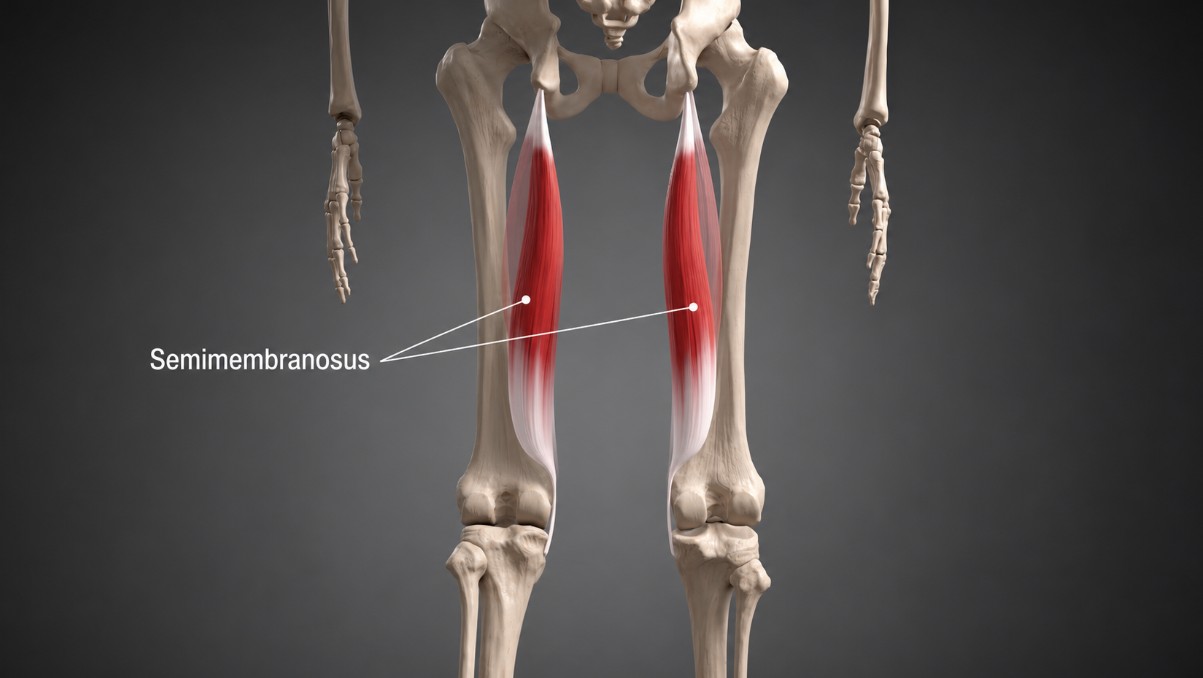
Most muscles simply attach to bone and stop there. The semimembranosus muscle does something stranger — part of its tendon doesn’t insert onto bone at all, but instead continues on to become an entirely separate, named ligament of the knee. It’s the broadest, deepest, and anatomically most complicated of the three hamstrings, and almost none of that complexity ever gets mentioned outside of orthopedic literature.
Key Facts
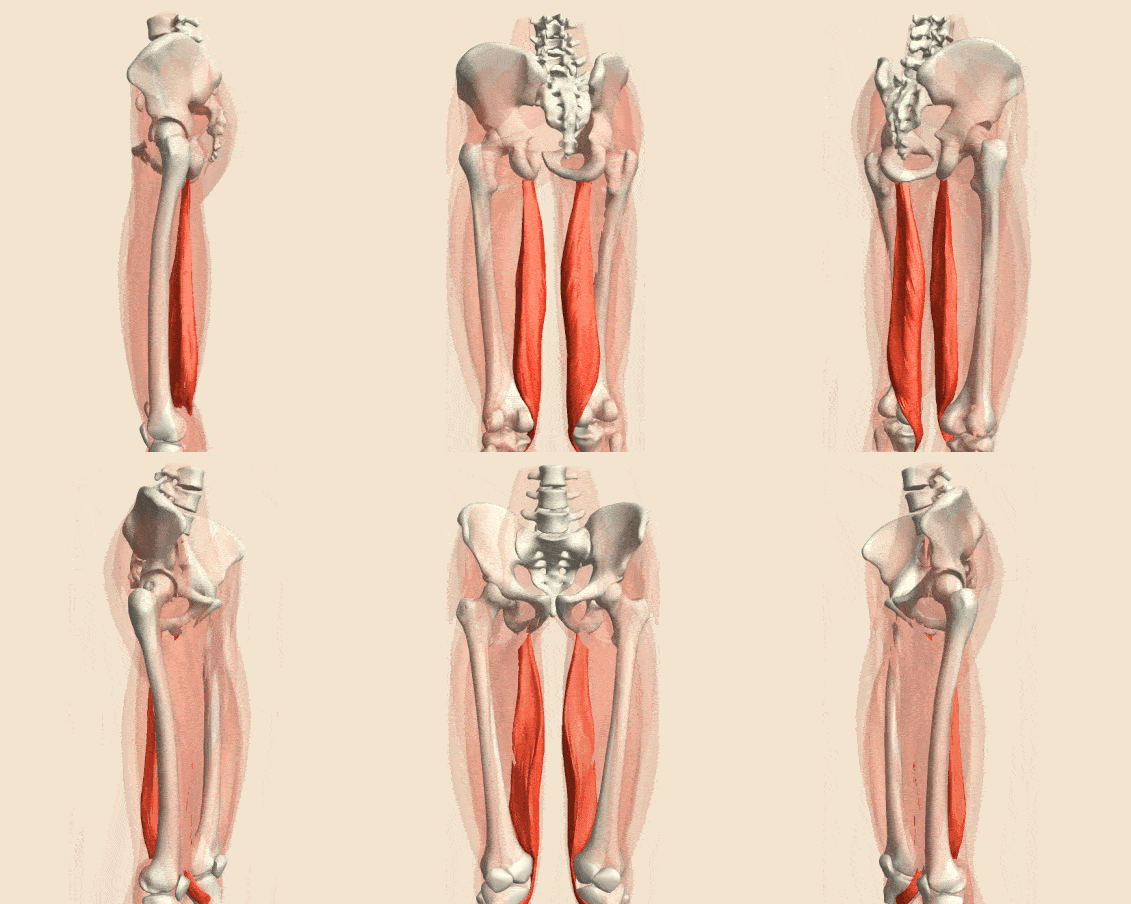
The semimembranosus is the broadest of the three hamstring muscles, lying deep to the semitendinosus on the inner-posterior thigh. It extends the hip, flexes the knee, and internally rotates the tibia, but its most distinctive feature is a genuinely complex tendon that splits into multiple expansions at the knee — one of which becomes the oblique popliteal ligament, a structure that reinforces the back of the knee joint itself.
| Muscle type | One of three hamstring muscles; the broadest at its origin |
|---|---|
| Primary functions | Hip extension, knee flexion, internal rotation of the tibia (when the knee is flexed) |
| Unique feature | Its tendon splits into several expansions at the knee, one of which forms the oblique popliteal ligament |
| Innervation | Tibial division of the sciatic nerve |
| Blood supply | Perforating branches of the profunda femoris artery, with contributions from the popliteal artery |
| Common exercises | Romanian deadlift, Nordic curl, seated leg curl |
| Main bodybuilding role | Inner hamstring thickness, hip-hinge strength, and posterior knee stability |
Semimembranosus Anatomy & Location
The semimembranosus is one of three muscles that make up the hamstring group, alongside:
- Biceps femoris — the most lateral hamstring, with two heads and a unique external-rotation role
- Semitendinosus — named for its unusually long tendon, and the muscle lying directly superficial to the semimembranosus
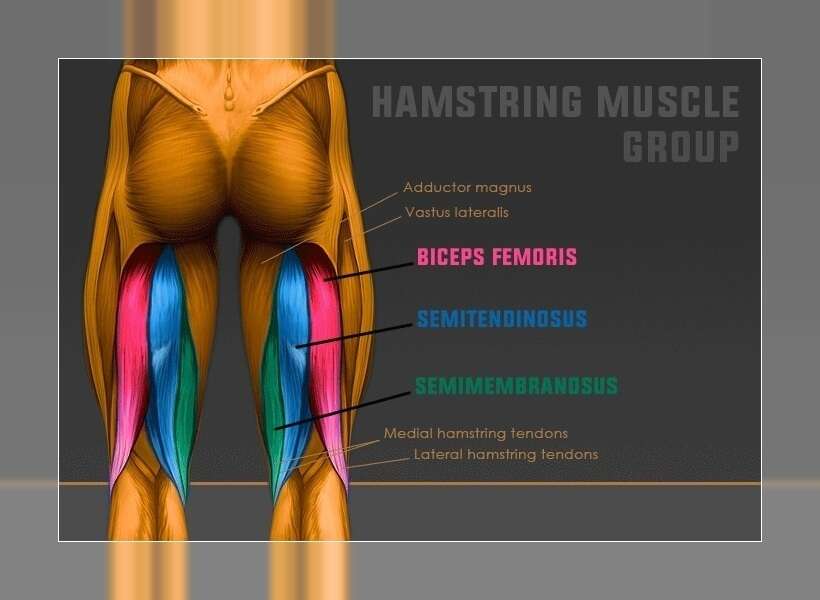
The semimembranosus muscle sits deep to the semitendinosus and medial to the biceps femoris, making it the hardest of the three hamstrings to palpate directly — you’re really feeling the semitendinosus tendon lying over top of it. According to StatPearls’ anatomical reference on the hamstring group, together with the semitendinosus, it forms the superomedial border of the popliteal fossa behind the knee. To see exactly how it fits within the posterior thigh musculature, our interactive muscle anatomy tool lets you explore it alongside the other two hamstrings. If terms like origin, insertion, and innervation aren’t yet fully familiar, our muscle anatomy basics guide covers what they mean and why they matter for training.
Origin, Insertion, Innervation & Blood Supply
| Origin | Superolateral aspect (upper outer quadrant) of the ischial tuberosity of the pelvis |
|---|---|
| Insertion | Posteromedial condyle of the tibia (direct arm), with additional tendinous expansions forming the oblique popliteal ligament, blending into the popliteus fascia, and attaching to the posterior horn of the medial meniscus |
| Innervation | Tibial division of the sciatic nerve |
| Blood supply | Perforating branches of the profunda femoris artery, with contributions from the popliteal artery |
Semimembranosus Structure & the Oblique Popliteal Ligament
Where the biceps femoris and semitendinosus both terminate in a relatively straightforward tendon-to-bone insertion, the semimembranosus does something anatomically unusual: its tendon divides into multiple separate expansions near the knee, most commonly described as three to five distinct arms. The main (“direct”) arm inserts into the posteromedial tibial condyle, but the others don’t simply attach to bone — they blend into surrounding soft tissue structures instead.
The most striking of these is the arm that travels superolaterally and, rather than inserting anywhere, effectively becomes a completely separate structure: the oblique popliteal ligament, a broad fibrous band that reinforces the back of the knee joint capsule. Because this ligament is a direct extension of the semimembranosus tendon rather than a separate structure entirely, the muscle can actively tension it — cadaveric and biomechanical research has found the capsular arm of the semimembranosus dynamically tightens the posterior knee capsule during running, cutting, and pivoting, contributing to knee stability well beyond simple knee flexion. Other expansions from the same tendon blend into the fascia over the popliteus muscle and attach to the posterior horn of the medial meniscus, meaning a single muscle’s tendon touches at least three functionally distinct structures at the knee.
This complexity also connects to the semitendinosus’s unusual regenerative story discussed in our semitendinosus guide: in cases where the harvested semitendinosus tendon fails to regenerate after ACL reconstruction, MRI studies have found the semimembranosus can undergo compensatory hypertrophy, increasing in size to help make up for the deficit.
Functions of the Semimembranosus
Like the other hamstrings, the semimembranosus extends the hip and flexes the knee. Together with the semitendinosus, it internally rotates the tibia when the knee is bent — the opposite of the external rotation produced by the biceps femoris. Its more unusual contribution is dynamic: through its oblique popliteal ligament extension, it actively helps stabilize the posterior knee capsule and resists excessive hyperextension and external rotation of the knee during athletic movement, a role none of the other hamstrings share so directly.
Semimembranosus Synergists & Antagonists
Synergists (muscles that work alongside the semimembranosus to help produce the same movement):
For knee flexion: semitendinosus, biceps femoris, and the gastrocnemius (secondary role). For hip extension: gluteus maximus. Finally. for internal tibial rotation specifically: semitendinosus, sartorius, and gracilis.
Antagonists (muscles that oppose the semimembranosus’s action, working in the opposite direction):
The quadriceps femoris directly opposes knee flexion by performing knee extension. At the knee’s rotational axis, the biceps femoris acts as a functional antagonist, producing external rather than internal rotation.
Common Semimembranosus Exercises

| Exercise | Role of the Semimembranosus |
|---|---|
| Romanian deadlift | Prime mover, hip-dominant bias |
| Nordic hamstring curl | Prime mover, alongside the semitendinosus, at long muscle length |
| Seated leg curl | Prime mover, knee-dominant bias |
| Glute-ham raise | Major contributor, combining hip and knee-dominant demand |
For a complete breakdown of hamstring training options, see our full guide: Best Hamstring Exercises.
Stretching & Mobility
For hamstring stretching progressions that address the semimembranosus alongside the rest of the group, see our guide: Top 10 Hamstring Stretching Exercises. For general tightness, foam rolling can also help — see our guide: Foam Roller Hamstring Roll. If you experience cramping specifically during leg curls, see our dedicated guide: Why Hamstrings Cramp During Leg Curls.
Bodybuilder’s Take
“I can’t seem to feel my semimembranosus working the way I can feel my biceps femoris — is that normal?” Yes. Since it sits deep to the semitendinosus, it’s genuinely harder to isolate by feel than the more superficial, laterally positioned biceps femoris. Most hamstring exercises train the medial hamstrings (semitendinosus and semimembranosus) together as a pair rather than distinguishing between them.
“I’ve heard hamstring exercises don’t really matter for knee stability, only for size — is that accurate?” Not for this particular muscle. The semimembranosus’s connection to the oblique popliteal ligament gives it a genuine dynamic role in posterior knee stability during cutting and pivoting movements, separate from its size or strength contribution to hip-hinge and knee-flexion lifts.
“Why does deep posterior knee pain sometimes get blamed on the semimembranosus specifically?” Because its direct tendon insertion near the posterior tibial tubercle is a documented site of tendinitis, more common in men and typically presenting around the early thirties — a distinct clinical entity from a general hamstring strain higher up in the thigh.
Common Semimembranosus Conditions
This section is educational and should not replace professional medical advice.
Semimembranosus tendinitis — inflammation at the tendon’s insertion near the posterior tibial tubercle, causing deep posteromedial knee pain; it’s an often-overlooked cause of knee pain distinct from more commonly discussed conditions in that region.
Proximal hamstring strain — like the other two hamstrings, the semimembranosus can be strained near its shared origin at the ischial tuberosity, typically from sudden hip-hinge loading or high-speed running.
Persistent posterior or posteromedial knee pain, or hamstring pain that doesn’t improve with rest, should be evaluated by a healthcare professional rather than trained through.
Common Semimembranosus Myths
Myth: All three hamstrings just flex the knee — the details don’t matter much. The semimembranosus’s tendon literally becomes a named knee ligament (the oblique popliteal ligament), giving it a structural role in knee stability that goes well beyond simple knee flexion.
Myth: You can easily feel and isolate each individual hamstring by touch. The semimembranosus lies deep to the semitendinosus, so what most people feel when they palpate the inner hamstring is largely the semitendinosus tendon, not the semimembranosus itself.
Complete your anatomy knowledge with the muscles of the chest, shoulders, back, arms, core, and neck.
Explore Upper Body MusclesKey Takeaways
- The semimembranosus is the broadest hamstring at its origin and sits deep to the semitendinosus.
- Its tendon splits into multiple expansions at the knee, one of which becomes the oblique popliteal ligament, a distinct knee-stabilizing structure.
- Together with the semitendinosus, it internally rotates the tibia when the knee is bent, opposite the biceps femoris.
- It can undergo compensatory hypertrophy when a harvested semitendinosus tendon fails to regenerate after ACL surgery.
- Because it lies deep to the semitendinosus, it’s the hardest of the three hamstrings to isolate by feel.
Frequently Asked Questions
What makes the semimembranosus different from the other hamstrings?
Its tendon splits into several expansions at the knee rather than inserting simply onto bone, and one of these expansions becomes the oblique popliteal ligament, a separate structure that reinforces the back of the knee joint.
What is the oblique popliteal ligament?
A broad fibrous band on the back of the knee that reinforces the posterior joint capsule, formed as a direct extension of the semimembranosus tendon rather than as a separate structure.
Can you feel the semimembranosus by touch?
Not easily. It lies deep to the semitendinosus, so what’s typically felt when palpating the inner hamstring is largely the semitendinosus tendon rather than the semimembranosus itself.
Does the semimembranosus rotate the knee?
Yes — together with the semitendinosus, it internally rotates the tibia when the knee is flexed, the opposite of the external rotation produced by the biceps femoris.
What is semimembranosus tendinitis?
Inflammation at the tendon’s insertion near the posterior tibial tubercle, causing deep posteromedial knee pain, more common in men and typically presenting around the early thirties.
Sources & References
Every claim in this guide is grounded in anatomical references and published research.
