


Introduction
Few things can ruin a hamstring workout faster than a sudden cramp during leg curls.
One moment you’re performing a controlled repetition, and the next your hamstring tightens painfully, forcing you to stop the set immediately. For many lifters, the sensation can be intense enough to make them wonder whether they’ve injured themselves.
If your hamstrings cramp during leg curls, you’re not alone.
As a coach working with lifters and athletes, I’ve found that hamstring cramping during leg curls is one of the most common training complaints—especially among beginners, individuals returning after a training break, and people who rarely train their hamstrings directly.
The good news is that in most cases, these cramps are not a sign of a serious injury.
Instead, they usually occur because the hamstrings are being asked to perform a movement they’re not fully prepared for. Muscle weakness, fatigue, poor warm-ups, inadequate recovery, dehydration, and even exercise technique can all contribute to the problem.
Understanding why the cramp happens is the first step toward preventing it.
In this article, we’ll break down the most common reasons hamstring cramps occur during leg curls and explain exactly what you can do to stop them from disrupting your workouts.
Why Your Hamstrings Cramp During Leg Curls (Quick Answer)
Why Hamstring Cramps During Leg Curls Are So Common
Hamstring cramps can occur during many exercises, but they seem particularly common during leg curls.
If you’ve ever experienced a sudden hamstring cramp during a seated or lying leg curl, you may have wondered why this exercise triggers the problem so often while other lower-body exercises do not.
The answer lies in the unique way leg curls challenge the hamstrings.
Unlike compound exercises such as squats, lunges, or leg presses, leg curls isolate the hamstrings and place them under continuous tension throughout the movement. As the weight is curled toward the body, the hamstrings contract into a highly shortened position, forcing the muscle fibers to generate force in a range where many people are relatively weak and untrained.
For some individuals, this intense contraction can overwhelm the muscle’s ability to coordinate and relax properly, resulting in an involuntary cramp.

Another factor is that many lifters unknowingly neglect direct hamstring training. While they regularly train their quadriceps through squats, leg presses, and other lower-body exercises, the hamstrings often receive less focused attention. When these undertrained muscles are suddenly exposed to isolated work, cramping becomes much more likely.
As a coach working with lifters and athletes, I’ve noticed that hamstring cramps during leg curls are especially common among beginners, people returning after a long training break, and individuals who have recently increased their training volume or intensity.
The encouraging news is that these cramps are usually temporary. In most cases, they decrease or disappear completely as hamstring strength, endurance, neuromuscular coordination, and exercise familiarity improve.
That’s why experiencing a hamstring cramp during leg curls doesn’t automatically mean something is wrong. More often, it’s a sign that the muscle needs time, practice, and appropriate training to adapt to the demands being placed upon it.
10 Key Causes of Hamstrings Cramps

Reason #1: Your Hamstrings Are Simply Too Weak
One of the most common reasons hamstrings cramp during leg curls is surprisingly simple: the muscles are not strong enough to meet the demands placed on them.
This doesn’t necessarily mean your hamstrings are weak in everyday life. In fact, many people who squat respectable weights, deadlift regularly, and have well-developed legs still experience hamstring cramps during leg curls.
The reason is that leg curls challenge the hamstrings in a very specific way.
Unlike compound exercises where multiple muscle groups share the workload, leg curls isolate the hamstrings and force them to produce force almost entirely on their own. This can expose weaknesses that may not be obvious during other lower-body exercises.
When a muscle is asked to generate more force than it can comfortably handle, the nervous system may respond with an involuntary contraction—a cramp.
This is especially common among beginners, people returning after time away from training, and individuals who have historically focused more on quad-dominant exercises than direct hamstring work.
As a coach working with lifters and athletes, I’ve often seen hamstring cramps disappear after just a few weeks of consistent hamstring training. In many cases, the muscle simply becomes stronger and better able to handle the exercise.
The encouraging news is that this type of cramping is usually temporary. As strength improves, the hamstrings become more efficient at producing force, and cramping episodes often become less frequent.
How To Fix It
If hamstring weakness is contributing to your cramps:
- Reduce the weight and focus on perfect technique.
- Gradually increase resistance over time instead of making large jumps.
- Include direct hamstring exercises consistently each week.
- Prioritize controlled repetitions rather than rushing through sets.
- Give your hamstrings time to adapt before pushing maximum effort.
In many cases, the solution isn’t to avoid leg curls—it’s to allow your hamstrings to become strong enough to perform them comfortably.
Reason #2: You Didn’t Warm Up Properly
A proper warm-up is one of the simplest ways to reduce the risk of hamstring cramps, yet it’s also one of the most commonly skipped parts of a workout.
Many people walk into the gym, perform a few quick warm-up sets—or sometimes none at all—and jump straight into their working sets. While this might not always cause problems during larger compound exercises, it can become an issue when performing an isolation exercise like the leg curl.
During a leg curl, the hamstrings are required to contract forcefully through a large range of motion. If the muscles are cold, stiff, or not fully prepared for that level of activation, cramping becomes much more likely.
A good warm-up does more than simply increase body temperature. It improves blood flow, enhances neuromuscular coordination, and prepares the hamstrings to contract efficiently. In other words, it helps the muscles perform the movement they’re about to be asked to do.
As a coach working with lifters and athletes, I’ve noticed that hamstring cramps often occur during the first few working sets. Interestingly, once the muscles are fully warmed up, the problem frequently disappears. This is a strong indication that inadequate preparation may be contributing to the issue.
The good news is that this is one of the easiest causes to fix.
How To Fix It
Before performing leg curls:
- Spend 5–10 minutes increasing your core body temperature with light activity.
- Perform a few lighter warm-up sets before your first working set.
- Gradually increase the load instead of jumping straight to your heaviest weight.
- Include dynamic lower-body movements to prepare the hamstrings.
- Focus on controlled repetitions during the first few sets.
A proper warm-up takes only a few minutes but can dramatically improve performance and significantly reduce the likelihood of hamstring cramps during leg curls.
Reason #3: You’re Using Too Much Weight
Sometimes the cause of hamstring cramping is not muscle weakness, poor hydration, or a lack of warming up.
Sometimes you’re simply using more weight than your hamstrings can properly control.
This is particularly common among lifters who approach leg curls the same way they approach larger compound exercises. They continue adding weight to the machine because they assume heavier always means better.
However, hamstrings often respond differently.
Unlike exercises such as squats or leg presses, leg curls place the hamstrings under direct isolation. As the weight becomes excessively heavy, the muscles may struggle to maintain proper control throughout the movement. Instead of producing a smooth contraction, the nervous system may respond with an involuntary cramp.
The problem becomes even more likely when lifters sacrifice technique in order to move heavier loads. Using momentum, shortening the range of motion, or jerking the weight through the hardest portion of the exercise can dramatically increase stress on the hamstrings.
As a coach working with lifters and athletes, I’ve often seen hamstring cramps disappear simply by reducing the weight and improving execution. In many cases, the muscle wasn’t lacking effort—it was lacking control.
Remember, the goal of a leg curl is not to move the maximum amount of weight possible. The goal is to effectively train the hamstrings.
If excessive weight is preventing that from happening, it may be doing more harm than good.
How To Fix It
If you frequently experience cramps during leg curls:
- Reduce the weight and focus on smooth, controlled repetitions.
- Use a full range of motion whenever possible.
- Avoid swinging or using momentum to move the weight.
- Prioritize muscle tension rather than chasing heavier loads.
- Increase resistance gradually as strength and control improve.
In many cases, slightly lowering the weight can improve hamstring activation, reduce cramping, and produce better long-term results.
Reason #4: Your Hamstrings Fatigue Quickly
Not all hamstring cramps are caused by weakness.
In some cases, the muscles are strong enough to perform the exercise but fatigue faster than expected.
This is an important distinction because strength and muscular endurance are not the same thing. A person may be capable of performing a heavy set of leg curls, yet still experience cramping after several repetitions or multiple sets because the hamstrings lack the endurance to sustain repeated contractions.
As fatigue accumulates, the nervous system becomes less efficient at coordinating muscle contractions. The hamstrings must work harder to maintain force production, increasing the likelihood of involuntary cramping.
This is especially common during high-volume workouts, higher-repetition sets, or training sessions where the hamstrings have already been heavily involved in exercises such as Romanian deadlifts, deadlifts, glute-ham raises, or sprinting.
The situation can worsen if recovery between sets is inadequate. When the muscles haven’t had sufficient time to recover, fatigue accumulates more rapidly, and cramping becomes more likely.
As a coach working with lifters and athletes, I’ve frequently seen hamstring cramps occur toward the end of a workout rather than at the beginning. This often suggests that muscular fatigue—not a lack of strength—is the primary issue.
Fortunately, muscular endurance can be improved with consistent training.
As the hamstrings adapt to greater workloads, they become more resistant to fatigue and less prone to cramping.
How To Fix It
If your hamstrings fatigue quickly during leg curls:
- Gradually increase your hamstring training volume over time.
- Allow adequate recovery between challenging sets.
- Avoid performing excessive hamstring work in a single session.
- Build muscular endurance through moderate-repetition training.
- Monitor overall training fatigue throughout the week.
In many cases, hamstring cramps become far less common once the muscles develop the endurance necessary to handle the workload being placed upon them.
Reason #5: Poor Neuromuscular Coordination
Sometimes hamstring cramps occur not because the muscles are weak or fatigued, but because your nervous system has not yet learned how to efficiently control the movement.
This is known as neuromuscular coordination—the ability of your brain and nervous system to communicate effectively with your muscles during exercise.
When you perform a leg curl, your hamstrings must contract forcefully while other muscles remain relatively relaxed. If this coordination is not well developed, the nervous system may struggle to regulate the contraction properly, increasing the likelihood of cramping.
This is one reason why hamstring cramps are particularly common among beginners and individuals returning to training after a long break.
The muscles may be capable of performing the movement, but the nervous system is still learning how to recruit and control them efficiently.
In many cases, the hamstrings simply aren’t accustomed to working in isolation.
Compound exercises such as squats, lunges, and leg presses involve multiple muscle groups sharing the workload. Leg curls are different. They place almost the entire responsibility on the hamstrings, exposing weaknesses in motor control that may never become apparent during larger movements.
As a coach working with lifters and athletes, I’ve often seen hamstring cramps disappear after just a few weeks of consistent leg curl training. Nothing else changed—hydration, nutrition, and exercise selection remained the same. The nervous system simply became more efficient at coordinating the movement.
This is one reason why cramping often becomes less frequent as training experience increases.
How To Fix It
If poor neuromuscular coordination is contributing to your cramps:
- Practice leg curls consistently rather than sporadically.
- Use lighter weights until movement quality improves.
- Focus on slow, controlled repetitions.
- Pause briefly at the peak contraction to improve muscle awareness.
- Concentrate on actively squeezing the hamstrings throughout the movement.
In many cases, the solution is simply repetition and practice. As your nervous system becomes more efficient at controlling the exercise, hamstring cramps often become far less common.
Reason #6: Dehydration or Electrolyte Imbalance
When people experience muscle cramps, dehydration is often the first explanation that comes to mind.
While dehydration and electrolyte imbalances can contribute to cramping, the relationship is not always as straightforward as many people believe.
Muscle contractions depend on a complex interaction between nerves, muscles, and minerals such as sodium, potassium, calcium, and magnesium. If fluid balance or electrolyte levels become significantly disrupted, normal muscle function can be affected, increasing the likelihood of cramps.
This is why cramps are more common during situations involving excessive sweating, prolonged exercise, hot environments, or inadequate fluid intake.
However, it’s important not to assume that every hamstring cramp is caused by dehydration or a magnesium deficiency.
As a coach working with lifters and athletes, I’ve seen many people immediately reach for a magnesium supplement after experiencing a hamstring cramp during leg curls. In reality, the cause is often poor conditioning, muscle fatigue, inadequate warm-ups, or excessive training loads rather than a nutritional deficiency.
That said, hydration still matters.
Even mild dehydration can negatively affect exercise performance and increase the stress placed on working muscles. If several contributing factors are already present, dehydration may be the factor that pushes the muscle over the edge and triggers a cramp.
The goal is not to obsess over electrolytes but to ensure that your body is properly prepared to perform.
How To Fix It
If dehydration or electrolyte imbalance may be contributing to your cramps:
- Drink fluids consistently throughout the day rather than only during workouts.
- Replace fluids lost through excessive sweating.
- Consume a balanced diet that provides adequate electrolytes.
- Pay particular attention to hydration during hot weather and intense training periods.
- Avoid assuming that every cramp automatically means you need a magnesium supplement.
For most healthy lifters, good hydration habits and a well-balanced diet are usually sufficient to support normal muscle function and reduce the likelihood of exercise-related cramps.
Reason #7: You Rarely Train Through Full Knee Flexion
Another common reason hamstrings cramp during leg curls is that the muscles are not accustomed to producing force in a fully shortened position.
Many lower-body exercises train the hamstrings through hip extension rather than deep knee flexion. Movements such as Romanian deadlifts, deadlifts, good mornings, and hip hinges place significant load on the hamstrings, but they do not challenge the muscles in the same way as a leg curl.
During a leg curl, the hamstrings shorten dramatically as the heel approaches the glutes. This peak contraction is often the exact point where cramps occur.
For individuals who rarely perform exercises involving full knee flexion, this position may feel unfamiliar and demanding. The hamstrings simply aren’t used to generating force when fully shortened, which increases the likelihood of an involuntary cramp.
This is particularly common among lifters who rely heavily on hip-dominant hamstring exercises and perform little direct hamstring isolation work.
As a coach working with lifters and athletes, I’ve frequently noticed that cramps occur near the top of the movement, where the hamstrings are maximally contracted. In many cases, the issue gradually disappears once the muscles become more comfortable and stronger in this position.
The good news is that the body adapts remarkably well when exposed to new training demands.
With consistent practice, the hamstrings typically become more tolerant of full knee flexion and less prone to cramping.
How To Fix It
If cramps occur near the top of the leg curl:
- Use lighter weights while focusing on a full range of motion.
- Gradually expose the hamstrings to deeper knee flexion positions.
- Avoid cutting repetitions short to escape the difficult portion of the movement.
- Include leg curls consistently in your training program.
- Pause briefly at the top of the movement as your tolerance improves.
Over time, the hamstrings become stronger and more coordinated in shortened positions, making cramps far less likely during leg curls.
Reason #8: Previous Hamstring Injury or Tightness
If you’ve experienced a previous hamstring strain, pull, or recurring tightness, that history may be contributing to your cramping during leg curls.
Even after an injury has healed, the hamstrings do not always return to their previous level of function immediately. Residual weakness, reduced flexibility, scar tissue formation, altered movement patterns, and lingering neuromuscular deficits can all affect muscle performance during exercise.
As a result, the hamstrings may become more prone to cramping when placed under significant tension.
Leg curls can be particularly challenging because they isolate the hamstrings and require them to contract forcefully through a large range of motion. If one area of the muscle is not functioning optimally, the nervous system may respond with a protective cramp.
Tightness can produce a similar effect.
Although muscle tightness does not automatically cause cramps, restricted mobility can make it more difficult for the hamstrings to move comfortably through the exercise. This may increase muscle tension and contribute to cramping in susceptible individuals.
As a coach working with lifters and athletes, I’ve often seen people repeatedly experience hamstring cramps on the same side where they previously suffered an injury. In many cases, addressing strength imbalances and gradually rebuilding confidence in the muscle significantly reduces the problem.
The key is not to avoid hamstring training but to help them regain normal function.
How To Fix It
If you have a history of hamstring injury or persistent tightness:
- Gradually increase training intensity instead of rushing back to previous loads.
- Prioritize proper exercise technique and control.
- Include mobility and flexibility work when appropriate.
- Address strength imbalances between the left and right legs.
- Consult a qualified healthcare professional if symptoms persist or worsen.
In many cases, hamstring cramps become less frequent as strength, mobility, and confidence in the injured muscle improve.
Reason #9: You’re Training Hamstrings After Exhausting Compound Lifts
The order of your exercises may be contributing to your hamstring cramps more than you realize.
Many lifters perform demanding compound movements such as Romanian deadlifts, conventional deadlifts, good mornings, lunges, or heavy squats before moving on to leg curls. By the time they reach the leg curl machine, their hamstrings are already fatigued.
At that point, even a moderate amount of additional work can become difficult for the muscles to handle.
The challenge is that fatigue isn’t always obvious.
Your hamstrings may still feel capable of training, but internally they have already done a great deal of work. When you then ask them to produce force in an isolated movement—particularly in a shortened position near the top of a leg curl—the likelihood of cramping increases.
This is especially common during high-volume leg workouts where multiple hamstring-dominant exercises are performed in the same session.
As fatigue accumulates, muscle coordination becomes less efficient, and force production becomes more difficult to maintain. The nervous system may respond by triggering an involuntary cramp.
As a coach working with lifters and athletes, I’ve frequently seen cramps disappear simply by adjusting exercise order. In some cases, moving leg curls earlier in the workout or reducing overall hamstring volume was enough to solve the problem completely.
The goal isn’t to avoid compound lifts—they remain some of the best exercises for hamstring development. The goal is to understand how accumulated fatigue affects performance later in the workout.
How To Fix It
If your hamstrings frequently cramp after compound exercises:
- Consider performing leg curls earlier in your workout.
- Reduce total hamstring volume if recovery is becoming an issue.
- Monitor how your hamstrings feel after demanding compound lifts.
- Avoid pushing every hamstring exercise to absolute failure.
- Allow adequate recovery between hard sets and training sessions.
Sometimes the solution isn’t improving the leg curl itself—it’s managing the fatigue that exists before you even reach the machine.
Reason #10: You’re Returning After a Long Break
If you’ve recently returned to training after weeks, months, or even years away from the gym, your hamstring cramps may simply be part of the reconditioning process.
This is one of the most common scenarios in which hamstring cramps occur.
Many people assume that because they were strong in the past, they should be able to immediately resume training at their previous level. Unfortunately, muscles don’t always cooperate with that plan.
After a prolonged break, strength, muscular endurance, neuromuscular coordination, and exercise tolerance all decline to some extent. Even if the loss isn’t obvious during everyday activities, it often becomes apparent during demanding exercises such as leg curls.
The hamstrings are particularly susceptible because they are frequently neglected outside of structured training. As a result, when they are suddenly exposed to isolated contractions and direct loading again, they may respond with cramping.
This doesn’t necessarily indicate an injury or a serious problem.
More often, it reflects the fact that the muscles are temporarily deconditioned and need time to adapt.
As a coach working with lifters and athletes, I’ve seen this happen countless times. Someone returns to training after a long break, experiences hamstring cramps during their first few workouts, and becomes concerned that something is wrong. In most cases, the cramps gradually disappear as the hamstrings rebuild strength and endurance and become more familiar with the movement.
The key is to respect the adaptation process rather than trying to rush it.
Your muscles may remember how to perform the exercise, but they still need time to regain their previous conditioning.
How To Fix It
If you’ve recently returned to training:
- Start with lighter weights than you think you need.
- Gradually increase training volume over several weeks.
- Focus on movement quality before intensity.
- Allow sufficient recovery between hamstring workouts.
- Be patient and give your muscles time to readapt.
In many cases, hamstring cramps disappear naturally once the body adjusts to training again. The solution is rarely to stop training—it’s usually to progress more gradually and allow the adaptation process to take place.
How to Prevent Hamstring Cramps During Leg Curls
Although we’ve already discussed solutions for each reason your hamstrings may cramp during leg curls, it’s helpful to review the most important principles in one place. Hamstring cramps rarely result from a single problem—they’re usually the result of several contributing factors working together.
If your hamstrings consistently cramp during leg curls, the solution is rarely a magic stretch, supplement, or quick fix.
In most cases, preventing cramps comes down to improving your hamstrings’ readiness for the demands of training. The good news is that once you understand the factors that contribute to cramping, the problem often becomes much easier to solve.
As a coach working with lifters and athletes, I’ve found that people make the fastest progress when they stop looking for a single cause and start focusing on the habits that improve hamstring function as a whole.
Here are the most important steps.
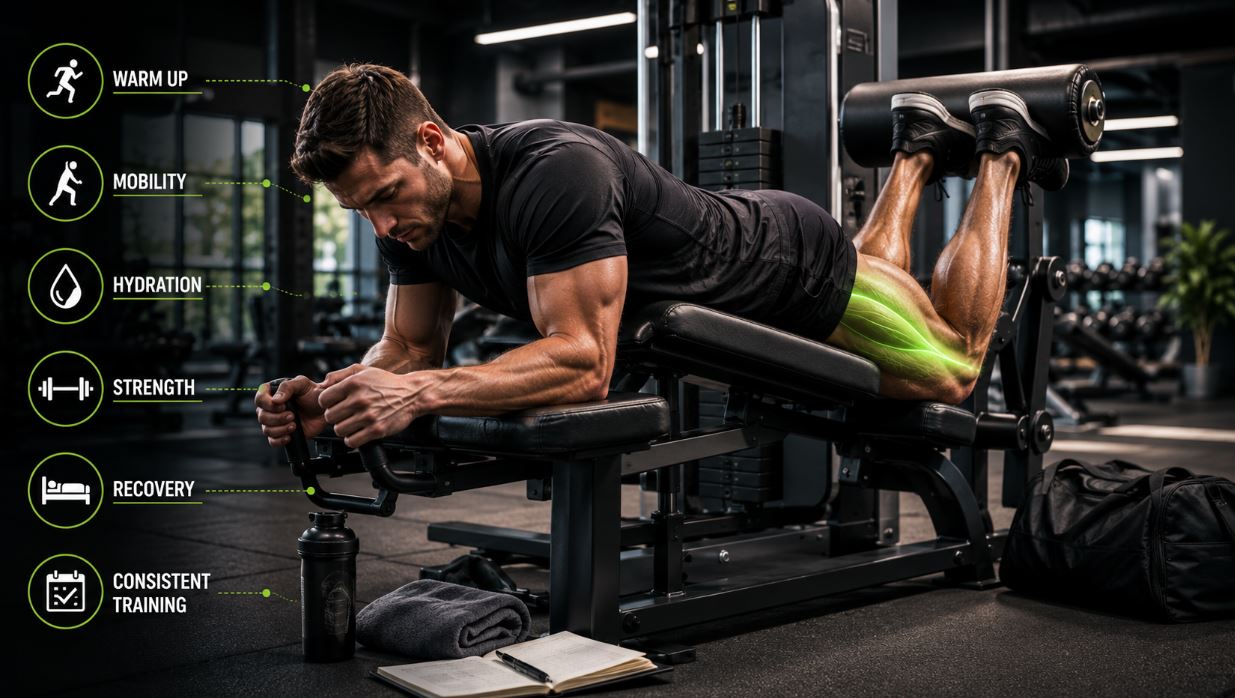
1. Build Hamstring Strength Gradually
Weak hamstrings are more likely to cramp during demanding exercises such as leg curls.
Rather than jumping straight to heavy loads, focus on gradually increasing strength over time. Consistent progression allows the muscles to adapt safely and reduces the likelihood of involuntary cramping.
2. Never Skip Your Warm-Up
A proper warm-up prepares the hamstrings for forceful contractions.
Increasing blood flow, raising muscle temperature, and performing a few lighter sets before your working sets can significantly reduce the risk of cramping.
Many lifters discover that a better warm-up solves the problem entirely.
3. Use Appropriate Training Loads
Leg curls are not an ego lift.
Using more weight than your hamstrings can properly control often increases the likelihood of cramping while reducing exercise quality.
Focus on controlled repetitions and proper technique rather than chasing heavier numbers.
4. Improve Hamstring Endurance
Strong muscles can still cramp if they fatigue too quickly.
Building muscular endurance through consistent training helps the hamstrings tolerate higher workloads and reduces the likelihood of cramping later in a workout.
5. Practice the Movement Consistently
The nervous system becomes more efficient when a movement is performed regularly.
For many people, hamstring cramps decrease simply because their body becomes more familiar with leg curls and better able to coordinate the movement.
6. Stay Hydrated and Support Recovery
Hydration, sleep, nutrition, and recovery all influence muscle function.
While dehydration is not always the primary cause of cramping, maintaining good recovery habits helps create an environment where muscles can perform optimally.
7. Manage Training Fatigue
If your hamstrings are already exhausted from deadlifts, Romanian deadlifts, sprinting, or other demanding exercises, leg curls may become much more challenging.
Pay attention to exercise order, training volume, and overall recovery throughout the week.
8. Address Previous Injuries and Mobility Restrictions
A history of hamstring injury or chronic tightness may increase the risk of cramping.
Improving mobility, rebuilding strength, and correcting imbalances can often reduce recurring problems.
9. Progress Patiently After Time Away From Training
Many hamstring cramps occur when people return to training and attempt to do too much too soon.
Allow your muscles time to rebuild strength, endurance, and coordination before pushing maximum effort.
The goal isn’t simply to prevent cramps.
The goal is to develop stronger, more resilient hamstrings that can perform demanding exercises without interruption.
When you consistently apply these principles, hamstring cramps often become less frequent—or disappear entirely.
Coach’s Note — Cramping Doesn’t Always Mean Something Is Wrong
As a coach working with lifters and athletes, I’ve found that many people become alarmed the first time their hamstrings cramp during leg curls. Their immediate assumption is often that they’ve injured themselves or that something is seriously wrong.
In reality, hamstring cramps are often a sign that the muscle isn’t fully prepared for the demand being placed on it. Weakness, fatigue, inadequate warm-ups, poor coordination, and sudden increases in training volume are usually far more common causes than injury.
While recurring cramps shouldn’t be ignored, an occasional cramp during leg curls is usually part of the learning and adaptation process. In most cases, stronger hamstrings, better preparation, and more consistent training gradually solve the problem without requiring anything complicated.
Final Thoughts
Hamstring cramps during leg curls can be frustrating, painful, and sometimes alarming—especially if they occur repeatedly or force you to stop your workout.
The good news is that in most cases, they’re not a sign of a serious injury.
More often, hamstring cramps occur because the muscles are being asked to perform a task they’re not yet fully prepared for. Weakness, fatigue, poor warm-ups, inadequate recovery, excessive loading, and lack of exercise familiarity can all contribute to the problem.
That’s why simply treating the symptom rarely provides a long-term solution.
Instead, the most effective approach is to improve the factors that influence hamstring performance overall. Stronger muscles, better preparation, appropriate training loads, consistent practice, and adequate recovery often reduce cramping far more effectively than any quick fix.
As a coach working with lifters and athletes, I’ve found that most people eventually overcome hamstring cramps once they become more patient with the adaptation process. The body is remarkably good at adapting when training stress is applied progressively and consistently.
Remember, occasional cramping doesn’t necessarily mean something is wrong.
In many cases, it’s simply feedback from your body that your hamstrings need more strength, more conditioning, or more time to adapt.
Stay consistent, train intelligently, and focus on long-term progress. As your hamstrings become stronger, more resilient, and better conditioned, those frustrating cramps often become less frequent—or disappear entirely.
Hawke F, Sadler SG, Katzberg HD, Pourkazemi F, Chuter V, Burns J.
Miller KC, Stone MS, Huxel KC, Edwards JE.
Maeo S, Huang M, Wu Y, Sakurai H, Kusagawa Y, Sugiyama T, Kanehisa H, Isaka T.
Vigotsky A, Tumminello N.
Schwellnus MP, Drew N, Collins M.
Ohno M, Lavender AP, Sawai A.
