


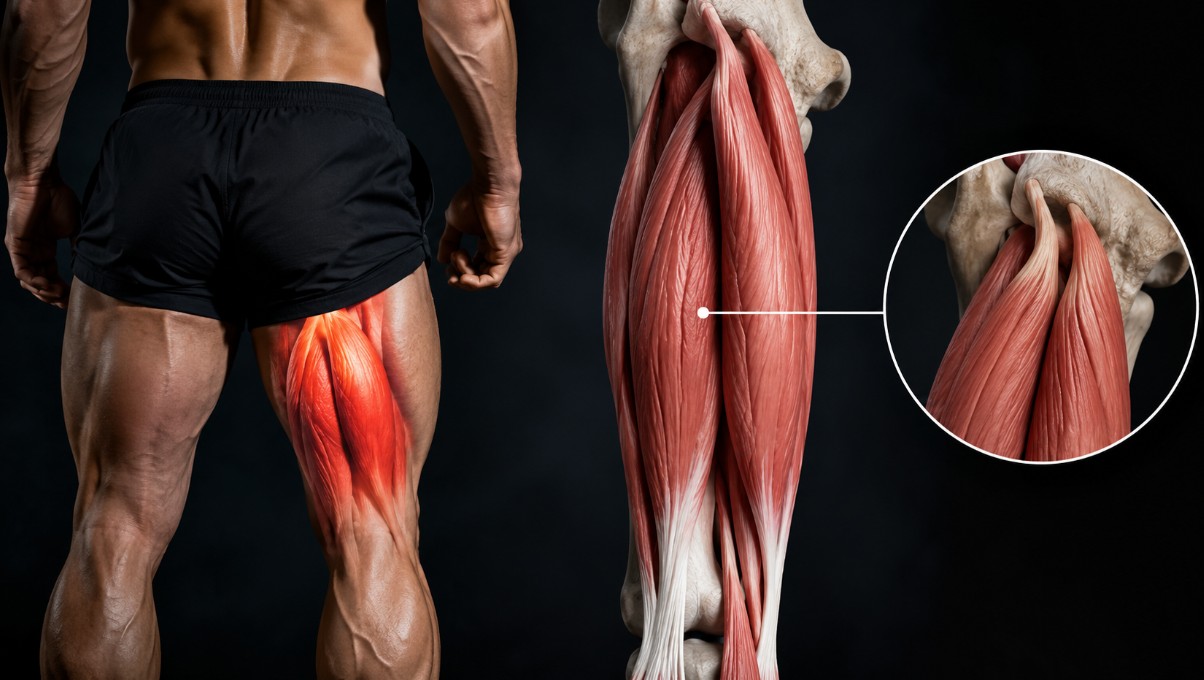
The biceps femoris is the only hamstring muscle with two separate heads that don’t even share the same nerve supply — a genuine anatomical oddity that explains both its unique rotational function and why it’s the single most frequently strained muscle in sprinters and kickers.

Key Facts
The biceps femoris is the most lateral of the three hamstring muscles, made up of a long head and a short head that share a common insertion but have different origins and, unusually, different nerve supplies. Together they flex the knee and, uniquely among the hamstrings, produce external rotation of the leg when the knee is bent.
| Muscle type | One of three hamstring muscles; the only one with two heads |
|---|---|
| Primary functions | Knee flexion, external rotation of the knee (when flexed); the long head also extends the hip |
| Unique feature | Its two heads are innervated by two different nerves |
| Innervation | Long head: tibial division of the sciatic nerve. Short head: common fibular (peroneal) division of the sciatic nerve |
| Blood supply | Perforating branches of the profunda femoris artery |
| Common exercises | Nordic curl, Romanian deadlift, and more |
| Main bodybuilding role | Outer hamstring shape, athletic performance, and injury resilience |
Biceps Femoris Anatomy & Location
The biceps femoris is one of three muscles that make up the hamstring group, alongside:
- Semitendinosus — a long, slender muscle with an unusually long tendon of insertion, running along the inner side of the thigh
- Semimembranosus — the broadest of the three hamstrings at its origin, lying partly beneath the semitendinosus+
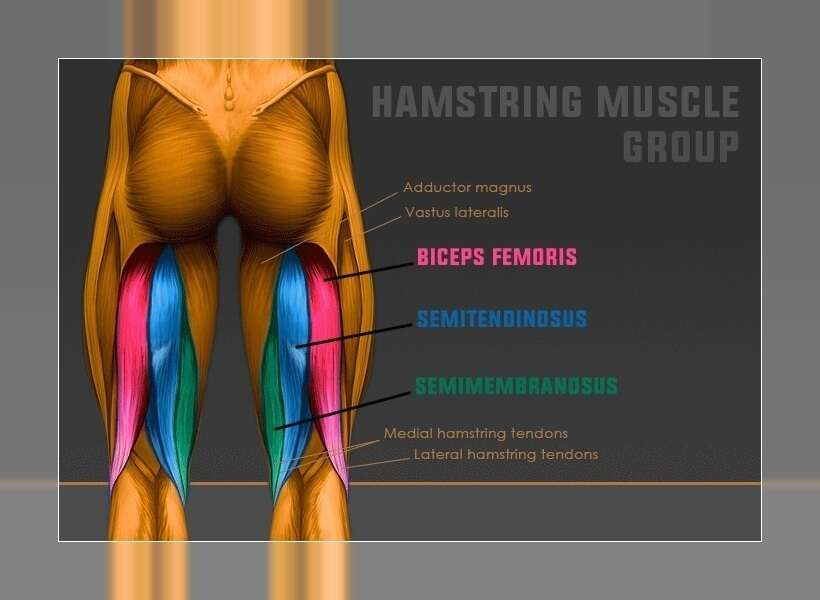
The biceps femoris runs along the outer (lateral) side of the back of the thigh, making it the easiest of the three hamstrings to distinguish by feel — bend your knee against resistance, and you can trace its tendon down toward the outer side of the knee. According to StatPearls’ anatomical reference on the hamstring muscle group, the biceps femoris forms the upper-lateral border of the popliteal fossa, the diamond-shaped space behind the knee. To see exactly how it fits within the posterior thigh musculature, our interactive muscle anatomy tool lets you explore it alongside the other two hamstrings. If terms like origin, insertion, and innervation aren’t yet fully familiar, our muscle anatomy basics guide covers what they mean and why they matter for training.
Origin, Insertion, Innervation & Blood Supply
| Origin (long head) | Ischial tuberosity, sharing a common tendon with the semitendinosus and the sacrotuberous ligament |
|---|---|
| Origin (short head) | Lateral lip of the linea aspera and the lateral supracondylar line of the femur |
| Insertion | Head of the fibula, with a smaller attachment onto the lateral condyle of the tibia |
| Innervation | Long head: tibial division of the sciatic nerve. Short head: common fibular (peroneal) division of the sciatic nerve |
| Blood supply | Perforating branches of the profunda femoris (deep femoral) artery |
Biceps Femoris Structure & Muscle Architecture
The dual innervation of the biceps femoris isn’t just a trivia point — it reflects a genuine developmental difference between the two heads. The short head actually develops within a different embryonic compartment than the long head, which is why anatomists sometimes describe the biceps femoris as a “composite muscle”: two separate developmental origins that fuse into one functional unit sharing a common distal tendon. This is part of why the short head can occasionally be affected independently of the long head in strain injuries.
The long head’s origin overlaps directly with the semitendinosus at the ischial tuberosity, with both tendons sharing a connection to the sacrotuberous ligament before running down the thigh together for a distance and eventually separating.
Functions of the Biceps Femoris
Like the other hamstrings, the biceps femoris flexes the knee, and its long head also extends the hip. But it has one function the other two hamstrings don’t share: because of its lateral position and fiber orientation, it’s the primary external rotator of the leg at the knee when the knee is bent — the semitendinosus and semimembranosus instead perform internal rotation in that same position. This rotational tug-of-war between the lateral and medial hamstrings helps keep the knee stable during rotation in activities like cutting and changing direction.
Biceps Femoris Synergists & Antagonists
Synergists (muscles that work alongside the biceps femoris to help produce the same movement):
For knee flexion: semitendinosus, semimembranosus, and the gastrocnemius (secondary role). For hip extension: gluteus maximus, the primary mover in hip-dominant lifts.
Antagonists (muscles that oppose the biceps femoris’s action, working in the opposite direction):
The quadriceps femoris directly opposes knee flexion by performing knee extension. At the knee’s rotational axis specifically, the semitendinosus and semimembranosus act as functional antagonists to the biceps femoris, producing internal rather than external rotation.
Common Biceps Femoris Exercises

| Exercise | Role of the Biceps Femoris |
|---|---|
| Romanian deadlift | Prime mover, hip-dominant bias via the long head’s hip-extension role |
| Nordic hamstring curl | Prime mover — eccentric loading at long muscle length, where biceps femoris strains typically occur |
| Lying leg curl | Prime mover — research comparing hamstring exercises has found prone-lying leg curls tend to bias the biceps femoris more than the medial hamstrings |
| Glute-ham raise | Major contributor, combining hip and knee-dominant demand |
| Single-leg Romanian deadlift | Strong contributor, with added demand on rotational stability since the biceps femoris also controls external rotation unilaterally |
For a complete breakdown of hamstring training options, see our full guide: Best Hamstring Exercises.
Stretching & Mobility
For hamstring stretching progressions that address the biceps femoris alongside the rest of the group, see our guide: Top 10 Hamstring Stretching Exercises. For general tightness, foam rolling can also help — see our guide: Foam Roller Hamstring Roll.
Bodybuilder’s Take
“Why is the biceps femoris always the hamstring that gets strained in sprinters?” Its dual-joint role, combined with its unique fiber architecture and the rapid stretch of its short head during high-speed running, makes it disproportionately vulnerable to strain compared with the semitendinosus and semimembranosus. It’s consistently identified as the most frequently injured hamstring in sprinting and kicking sports.
“Does it matter that the two heads have different nerves?” For general training purposes, not much — both heads are recruited together during almost every hamstring exercise. It matters more clinically, since an injury or nerve issue can occasionally affect one head without the other, which is useful diagnostic information even if it doesn’t change how you train.
“My hamstrings cramp specifically during leg curls — is that a biceps femoris issue?” Not necessarily specific to this muscle — cramping during isolated knee flexion is common and usually related to training in a shortened position, hydration, or unfamiliar volume rather than a problem with any one hamstring in particular. We cover this in detail in the article on why hamstrings cramp during leg curls.
Common Biceps Femoris Conditions
This section is educational and should not replace professional medical advice.
Biceps femoris strain — the most frequently injured of the three hamstring muscles, most often affecting the long head near the myotendinous junction during high-speed running or kicking.
Post-surgical relevance in ACL reconstruction — the semitendinosus is one of the most commonly harvested tendons for ACL graft surgery. Interestingly, research using functional MRI has found that the biceps femoris shows measurably increased activation after this type of graft harvest, appearing to partially compensate for the reduced size and function of the semitendinosus — a good example of how interconnected the three hamstring muscles are, even though they can be trained somewhat independently.
Persistent posterior thigh pain, a sudden sharp pain during a sprint, or bruising along the outer back of the thigh should be evaluated by a healthcare professional rather than trained through.
Common Biceps Femoris Myths
Myth: All hamstring exercises train the biceps femoris the same way as the rest of the hamstrings. Research shows real differences between exercises — lying leg curls tend to bias the biceps femoris more, while Nordic curls tend to bias the semitendinosus more, meaning a complete hamstring program benefits from including more than one movement pattern.
Myth: The “hamstrings” are basically one muscle that works as a unit. The biceps femoris has a distinct nerve supply for each of its two heads, a different rotational function from the other two hamstrings, and a different injury profile — treating all three hamstring muscles as interchangeable overlooks real anatomical and functional differences.
Complete your anatomy knowledge with the muscles of the chest, shoulders, back, arms, core, and neck.
Explore Upper Body MusclesKey Takeaways
- The biceps femoris is the only hamstring muscle with two heads, and the only one where each head has a different nerve supply.
- It’s the primary external rotator of the knee among the hamstrings, opposite the internal rotation role of the semitendinosus and semimembranosus.
- It’s the most frequently strained of the three hamstring muscles, especially in sprinting and kicking sports.
- Lying leg curls tend to bias the biceps femoris more, while Nordic curls tend to bias the semitendinosus more — a complete program benefits from both.
- The short head develops separately from the long head embryologically, which is part of why the two can occasionally be injured independently.
Frequently Asked Questions
What makes the biceps femoris different from the other hamstrings?
It’s the only hamstring with two heads, and the only one that has different nerve supplies for each head — the long head is innervated by the tibial nerve, the short head by the common fibular nerve.
Why is the biceps femoris the most commonly injured hamstring?
Its unique fiber architecture and the rapid stretch it undergoes during high-speed running make it disproportionately vulnerable to strain compared to the semitendinosus and semimembranosus.
Does the biceps femoris rotate the knee?
Yes — uniquely among the hamstrings, it externally rotates the leg at the knee when the knee is bent, while the semitendinosus and semimembranosus produce internal rotation instead.
Which exercise best targets the biceps femoris?
Research suggests lying leg curls tend to bias the biceps femoris more than the medial hamstrings, while Nordic curls tend to bias the semitendinosus more, so combining both is more complete than relying on one.
Can the two heads of the biceps femoris be injured independently?
Occasionally, yes — because they have separate nerve supplies and slightly different developmental origins, one head can in some cases be affected without the other.
Sources & References
Every claim in this guide is grounded in anatomical references and published research.
- StatPearls / NCBI Bookshelf — Anatomy, Bony Pelvis and Lower Limb, Hamstring Muscle
- Differences in Activation Amplitude Between Semitendinosus and Biceps Femoris During Hamstring Exercises: A Systematic Review and Meta-Analysis
- Tampere et al. — Biceps Femoris Compensates for Semitendinosus After Anterior Cruciate Ligament Reconstruction With a Hamstring Autograft
