


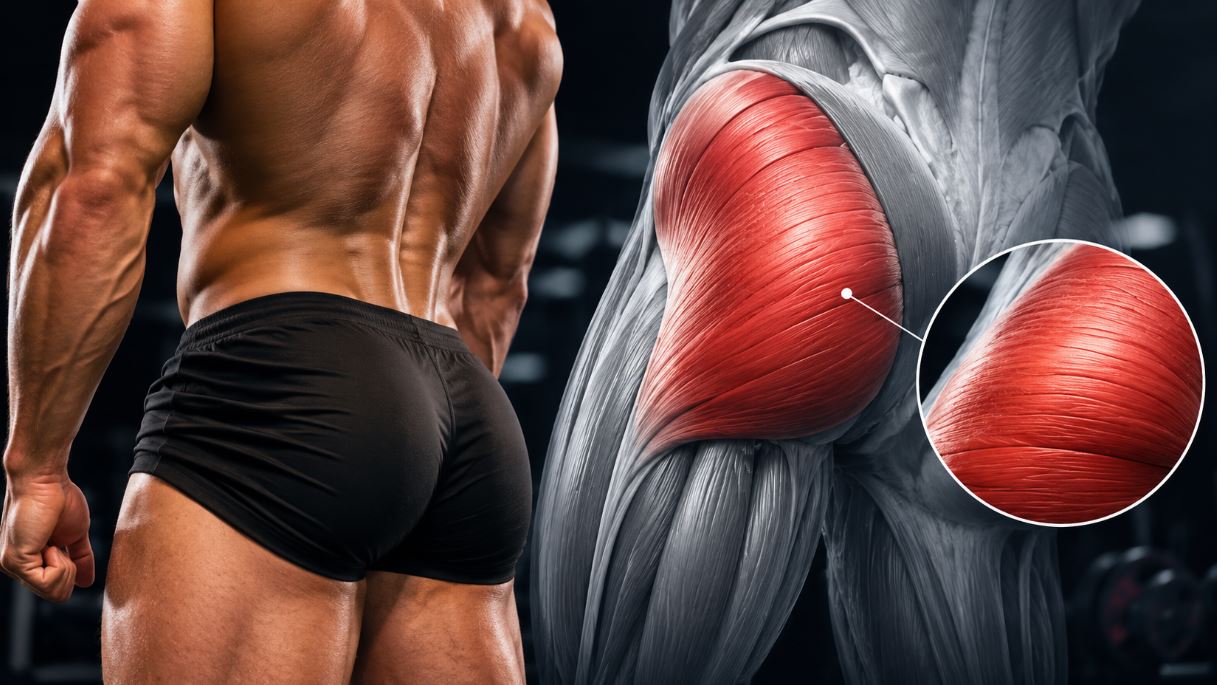
The gluteus maximus is the single strongest muscle in the human body by most measures, yet it’s also one of the most frequently “switched off” muscles in people who spend their days sitting. Most lifters know it as “the muscle squats and deadlifts train,” but few realize it actually has two functionally distinct regions — an upper portion that behaves almost like a hip abductor, and a lower portion that’s a pure, powerful hip extensor. Understanding gluteus maximus functional anatomy is what separates lifters who just “do leg day” from those who train this muscle with genuine precision.
Quick Answer
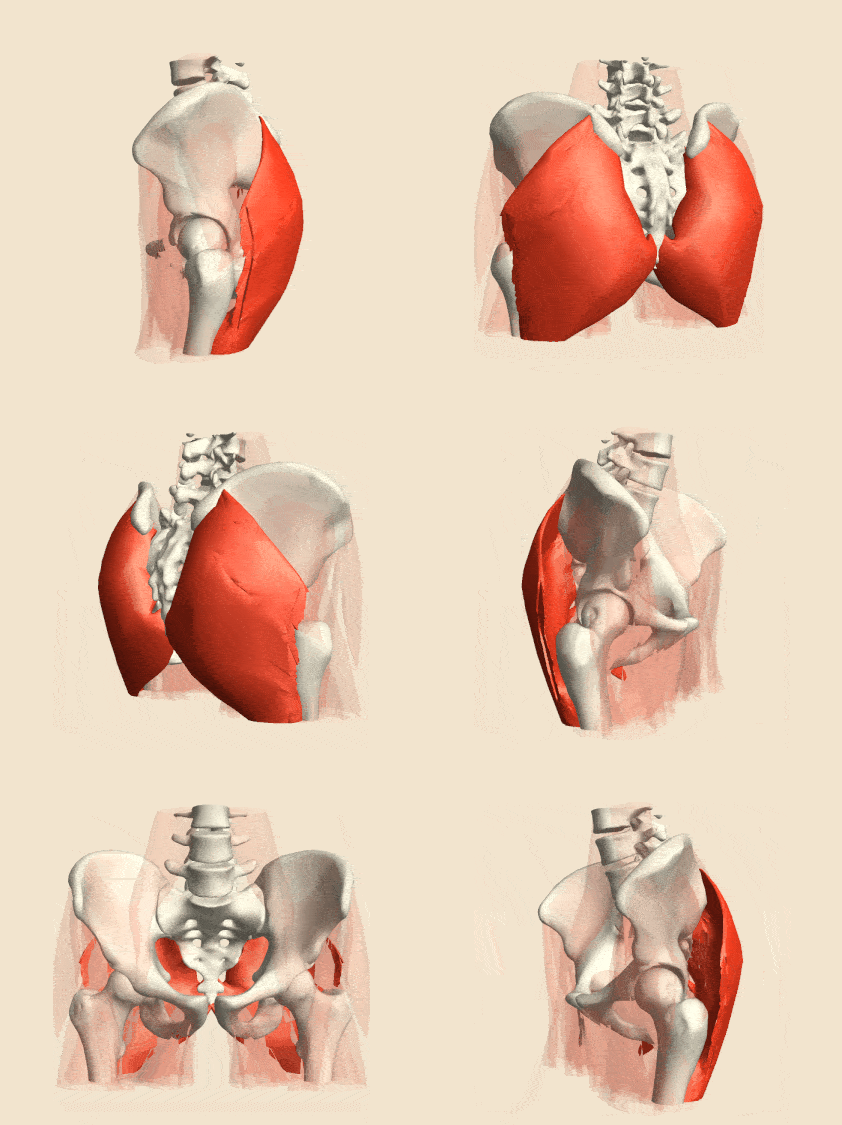
The gluteus maximus is the largest, most superficial muscle of the buttock and the primary extensor of the hip joint. It’s widely considered the single most powerful muscle in the human body by cross-sectional area and force output. While it’s often treated as one uniform muscle, its upper and lower fibers behave somewhat differently — the upper fibers contribute meaningfully to hip abduction, while the lower fibers are a more dedicated, powerful hip extensor with a stronger role in athletic movements like sprinting and jumping.
| Muscle type | Large, superficial muscle of the posterior hip |
|---|---|
| Primary functions | Hip extension, external rotation |
| Secondary functions | Hip abduction (upper fibers), pelvic and trunk stabilization |
| Innervation | Inferior gluteal nerve (L5, S1, S2) |
| Blood supply | Superior and inferior gluteal arteries |
| Common exercises | Hip thrusts, squats, deadlifts, step-ups |
| Main bodybuilding role | Overall glute size, hip extension power, and athletic performance |
Overview
Why Is the Gluteus Maximus Important?
The gluteus maximus is the primary engine behind nearly every powerful lower-body movement — sprinting, jumping, climbing stairs, and standing up from a deep squat — and it’s widely regarded as the strongest single muscle in the human body based on its size and force-generating capacity. Beyond raw power, it plays a major stabilizing role for the pelvis and lower back during heavy lifting, which is part of why weak glutes are so often linked to compensatory lower back strain. For lifters, it’s one of the highest-leverage muscles for both athletic performance and aesthetics, and understanding its two functionally distinct regions is genuinely useful for programming, not just anatomical trivia. This muscle is part of a larger three-muscle group — see our complete guide to the Muscles of the Gluteal Region for how it relates to the gluteus medius and minimus.
Gluteus Maximus Functional Anatomy & Location
The gluteus maximus covers most of the buttock, making it the largest and most visible of the three gluteal muscles. A solid grasp of gluteus maximus functional anatomy starts with recognizing that, despite looking like one uniform muscle, it behaves as two functionally distinct regions — the upper (superior) fibers and the lower (inferior) fibers — which differ in both fiber type and joint action.
Finding Your Gluteus Maximus: Surface Anatomy
Squeeze your buttocks together, and you’ll feel the gluteus maximus contract across the widest part of the hip. Standing up from a deep squat or driving out of a sprint start makes the muscle’s role in powerful hip extension obvious, especially in its lower portion.
Characteristics at a Glance
| Characteristic | Value |
|---|---|
| Shape | Large, broad, quadrilateral |
| Muscle group | Superficial posterior hip |
| Number | Pair (left and right); functionally two regions per side (upper and lower) |
| Fiber direction | Diagonal, coarse, converging toward the femur and iliotibial tract |
| Crosses | Hip joint |
Origin, Insertion, Innervation & Blood Supply
| Attribute | Detail |
|---|---|
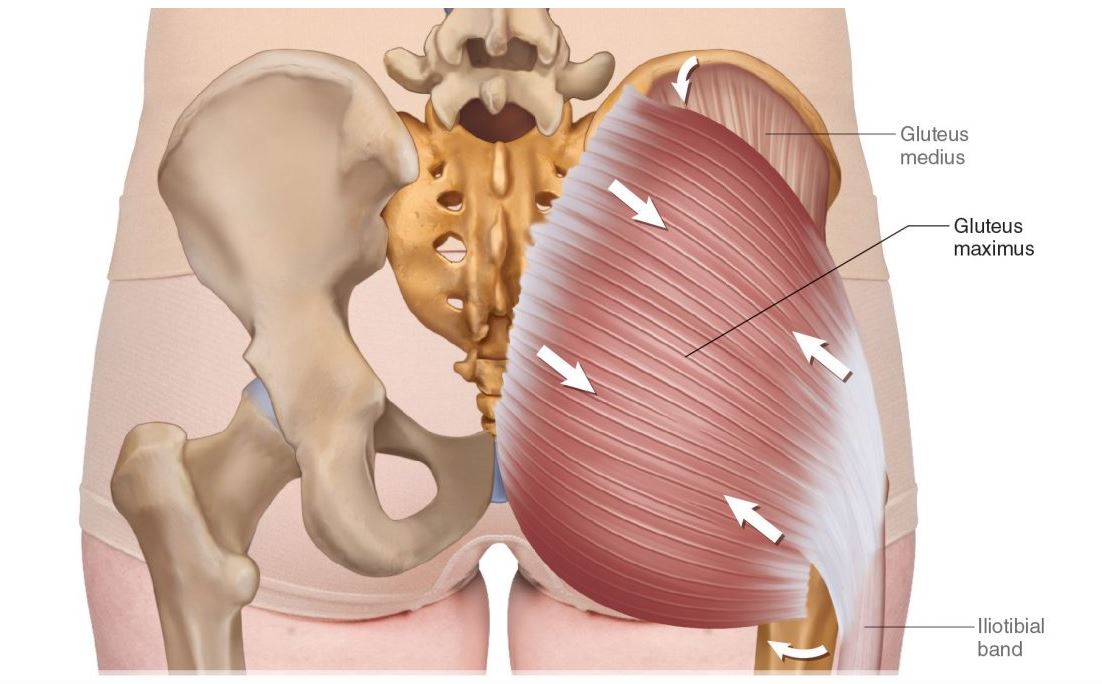
| Origin | Posterior ilium (behind the posterior gluteal line), sacrum, coccyx, sacrotuberous ligament, and thoracolumbar fascia |
| Insertion | Approximately three-quarters of the muscle inserts into the iliotibial tract; the remaining deeper fibers insert directly onto the gluteal tuberosity of the femur |
| Innervation | Inferior gluteal nerve (L5, S1, S2) |
| Blood supply | Superior and inferior gluteal arteries, branches of the internal iliac artery |
Most of the gluteus maximus’s fibers don’t actually attach directly to the femur — according to Kenhub’s anatomical reference on the gluteus maximus, roughly three-quarters of the muscle inserts into the iliotibial (IT) tract rather than the bone itself, which is part of why the muscle has such a strong influence on knee stability during standing and walking, not just hip movement.
Anatomical Variations
The gluteus maximus is relatively consistent in overall structure across individuals, but there is genuine, research-documented variation in the ratio of muscle fiber types between its upper and lower regions. The upper fibers tend to contain a higher proportion of slow-twitch fibers, consistent with a more postural, stabilizing role, while the lower fibers tend to contain more fast-twitch fibers, consistent with a more explosive, athletic role. This isn’t an anomaly found in only some people — it’s a normal structural feature of the muscle, though the exact ratio can vary between individuals.
Clinical Relevance
The gluteus maximus is directly relevant to hip surgery: the standard posterior surgical approach to the hip joint requires cutting through part of the muscle, and surgeons take care to work around the inferior gluteal nerve and vessels during this approach. The muscle is also clinically significant in gait and posture — because roughly three-quarters of it inserts into the IT band rather than the femur, gluteus maximus weakness can contribute to IT band-related knee pain, in addition to its more commonly discussed role in low back and hip dysfunction.
An Evolutionary Note
The human gluteus maximus is proportionally far larger than in other primates, and researchers studying human evolution have specifically linked this to the demands of endurance running and walking upright over long distances — a role the muscle plays only a minor part in for chimpanzees and other apes, whose locomotion doesn’t rely on sustained upright running in the same way. This is one of the better-supported examples in comparative anatomy of a specific human movement pattern directly shaping a muscle’s size and structure.
Actions
Primary Actions
- Hip extension — driving the thigh backward; the muscle’s dominant, most powerful action, particularly from the lower fibers
- External rotation — rotating the thigh outward
Secondary Functions
- Hip abduction (upper fibers only) — the upper portion of the muscle contributes meaningfully to moving the leg out to the side, especially as the hip becomes more flexed, while the lower fibers contribute little to this action
- Pelvic and trunk stabilization — helping control pelvic position and resisting forward trunk lean during heavy lifting and single-leg stance
Regions of the Gluteus Maximus
Although it’s usually treated as a single muscle, research using EMG and muscle fiber analysis has identified genuine functional differences between the upper and lower regions of the gluteus maximus.
| Region | Fiber Type Tendency | Primary Role | Best Trained By |
|---|---|---|---|
| Upper (superior) fibers | More slow-twitch, postural | Hip extension, meaningful hip abduction contribution | Seated or standing hip abduction, high-rep hip extension work |
| Lower (inferior) fibers | More fast-twitch, athletic | Pure, powerful hip extension | Heavy hip thrusts, squats, sprinting, jumping |
The upper fibers sit closer to the iliac crest and, in addition to assisting hip extension, function similarly to a hip abductor — a role that increases as the hip moves into more flexion. This is part of why exercises like seated hip abduction machines and band work can meaningfully involve the upper glute max, not just the gluteus medius and minimus. The lower fibers are more dedicated to hip extension and have a greater proportion of fast-twitch fibers, making them the primary drivers of explosive, powerful movements like sprinting starts, jumping, and heavy hip thrusts.
Synergists, Antagonists & Stabilizers
Synergists (muscles that assist different gluteus maximus functions):
- Hamstrings — assist hip extension
- Gluteus medius (upper/anterior fibers) — assists hip abduction alongside the upper gluteus maximus fibers
- Deep lateral rotators (piriformis and others) — assist external rotation
Antagonist (the muscle that opposes hip extension):
- Iliopsoas (hip flexor group) — directly opposes the gluteus maximus’s primary action
Stabilizers (muscles that support the hip and pelvis while the gluteus maximus works):
- Erector spinae (trunk stabilization during heavy hip-hinge movements)
- Deep core musculature (pelvic control under load)
Role During Common Exercises
| Exercise | Role of the Gluteus Maximus |
|---|---|
| Barbell hip thrust | Prime mover, strongest contracted-position loading |
| Back squat (full depth) | Prime mover |
| Back squat (partial depth) | Major contributor, meaningfully less activation than full depth |
| Romanian deadlift | Major contributor |
| Step-up | Major contributor |
| Sprinting | Prime mover (propulsive phase) |
| Standing/seated hip abduction | Contributor (upper fibers specifically) |
Bodybuilder’s Take
This is where understanding the two regions actually changes your training.
“Does squat depth really matter for glute activation, or is that overstated?” It’s genuinely well-supported by research, not just gym folklore. A frequently cited study measuring gluteus maximus EMG across partial, parallel, and full-depth squats found that activation increased substantially at each depth — roughly 17% at partial depth, 28% at parallel, and 35% at full depth during the concentric phase — a statistically significant progression. Later hypertrophy research has also found greater long-term gluteus maximus growth with deeper squats than with shallower squats. If you’re squatting specifically for glute development, depth is one of the more evidence-backed variables you can control.
“Should I train hip abduction directly, or do squats and hip thrusts cover it?” Given that the upper gluteus maximus fibers do contribute to hip abduction, heavy hip-extension work isn’t completely neglecting this function — but it’s still a secondary role for those fibers, not their primary job. For anyone chasing complete glute development (not just the gluteus medius, but the abduction-related fibers of the maximus itself), dedicated abduction work still adds value on top of squats and hip thrusts. For a full breakdown of common gaps in typical glute training, see The Most Common Glute Training Mistakes.
“My glutes still aren’t growing despite heavy squats and hip thrusts — what am I missing?” This is common, and it’s rarely about effort — it’s more often about depth, range of motion, or insufficient direct volume relative to how much the muscle group needs to grow. See our full breakdown in Why Your Glutes Aren’t Growing: Common Mistakes and Fixes and our complete exercise guide, Best Glute & Hip Exercises.
Common beginner mistakes:
- Cutting squat depth short, which the research suggests meaningfully reduces glute activation compared to full depth
- Relying exclusively on hip-extension exercises while assuming they fully cover the muscle’s abduction-related upper fibers
- Using excessive lumbar hyperextension during hip thrusts instead of driving the movement through the glutes
Best Exercises
| Exercise | Main Function Trained | Main Benefit | Best For |
|---|---|---|---|
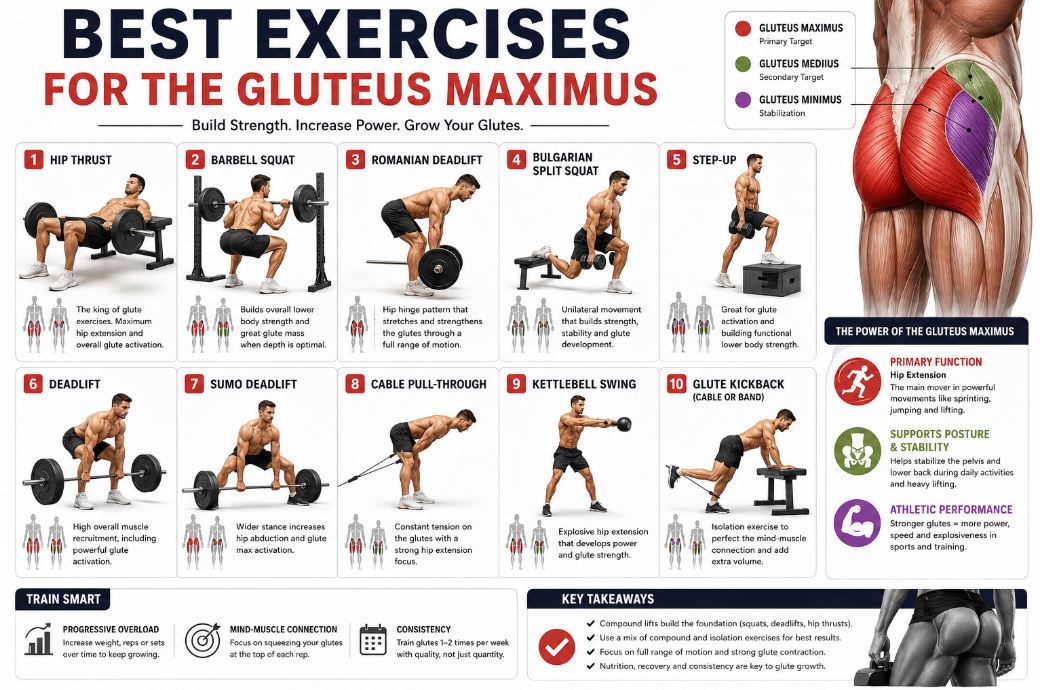
| Barbell hip thrust | Hip extension | Loads the glute at its strongest, most contracted position | Overall mass and strength |
| Full-depth back squat | Hip extension | Substantially higher glute EMG than partial-depth squats | Depth-dependent glute development |
| Single-leg Romanian deadlift | Hip extension | Combines strength with balance and stability demand | Unilateral development |
| Cable hip abduction | Hip abduction | Directly targets the upper fiber abduction function | Complete upper-fiber development |
| Walking lunge | Hip extension | High volume, functional carryover | Athletic performance and endurance |
For a full breakdown of exercise selection across the entire gluteal group, see our guide: Best Glute & Hip Exercises.
Stretching & Mobility
- Figure-four stretch — lie on your back, cross one ankle over the opposite knee, and pull the thigh toward your chest to stretch the gluteus maximus.
- Pigeon pose — a deeper hip-opening stretch that targets the gluteus maximus and surrounding deep hip rotators.
- Standing glute stretch — pulling one knee toward the opposite shoulder while standing provides a convenient stretch without needing to get on the floor.
What Does Research Say?
EMG Findings
A well-known study measuring gluteus maximus activation across partial, parallel, and full-depth squats found a statistically significant, stepwise increase in activation with depth — roughly 17% at partial depth, 28% at parallel, and 35% at full depth during the concentric phase — while other muscles tested (vastus medialis, vastus lateralis, biceps femoris) showed no significant difference across depths. This is one of the more direct pieces of evidence that squat depth specifically matters for glute activation, more so than for some of the surrounding thigh muscles.
Research using detailed regional EMG and fiber-type analysis has also found meaningful functional differences between the upper and lower gluteus maximus, with the upper region showing greater involvement in hip abduction (particularly as hip flexion increases) and a higher proportion of slow-twitch fibers, while the lower region behaves as a more dedicated, fast-twitch-dominant hip extensor.
Biomechanical Findings
Where dedicated EMG comparisons are more limited — for example, comparing hip thrusts performed with different foot positions or band resistance added at the knees — the reasoning generally comes down to loading position and moment arm. The hip thrust is generally considered biomechanically favorable for the gluteus maximus specifically because it loads the muscle near full hip extension, its strongest and most mechanically favorable position, unlike the squat, where resistance is greatest near the bottom of the movement, a comparatively weaker position for the glutes specifically.
Common Conditions Affecting the Gluteus Maximus
This section is educational and should not replace professional medical advice.
- Gluteus maximus strain — an overstretch or tear of the muscle, though less common than hamstring or quadriceps strains due to the muscle’s size and typically lower stretch demands during most sport movements.
- “Gluteal amnesia” / underactivation — not a formal injury, but a commonly described pattern of reduced voluntary activation associated with prolonged sitting and general underuse, which can contribute to compensatory strain elsewhere (particularly the lower back and hamstrings).
- IT band-related knee pain — since roughly three-quarters of the gluteus maximus inserts into the IT band, weakness or dysfunction here is sometimes associated with IT band tightness and related lateral knee pain.
- Referred lower back strain — chronic gluteus maximus underactivation is frequently associated with compensatory overuse of the lower back and hamstrings during hip-hinge movements.
Risk Factors
- Prolonged sitting and general underuse — commonly associated with reduced glute activation and compensatory movement patterns.
- Sudden increases in sprinting or jumping volume — a contributor to strain risk given the muscle’s explosive role in these movements.
- Consistently cutting squat depth short under heavy load — while not directly injurious, this may limit the training stimulus the muscle receives over time.
- Poor hip thrust technique — relying on lumbar hyperextension instead of hip extension shifts stress away from the glutes and onto the lower back.
Persistent hip or lower back pain, sudden weakness, or a noticeable change in gait should be evaluated by a healthcare professional rather than trained through.
Common Myths
A clear picture of the gluteus maximus’s functional anatomy dispels most persistent training myths surrounding this muscle.
Myth: The gluteus maximus is one uniform muscle with a single function. Research shows the upper and lower fibers behave differently — the upper fibers contribute to hip abduction and contain more slow-twitch fibers, while the lower fibers are a more dedicated, fast-twitch-dominant hip extensor.
Myth: Squat depth doesn’t really matter for glute activation. This is contradicted by direct EMG evidence. Research has found a statistically significant, stepwise increase in gluteus maximus activation from partial to parallel to full-depth squats.
Myth: The gluteus maximus only matters for hip extension. While hip extension is its dominant role, the upper fibers make a genuine contribution to hip abduction, particularly as the hip moves into flexion — a secondary function often overlooked.
Myth: You can’t overwork or need to worry about the glute max the way you do smaller muscles. Like any large muscle, the gluteus maximus needs proper progressive overload and recovery. Chronic underactivation (not overuse) is actually the more common issue in modern lifters.
Myth: Glute size is mostly about genetics and can’t be changed much. Like any other muscle, the gluteus maximus responds strongly to progressive overload, adequate range of motion, and consistent training — genetics affects shape more than overall growth potential.
Complete your anatomy knowledge with the muscles of the chest, shoulders, back, arms, core, and neck.
Explore Upper Body MusclesKey Takeaways
- The gluteus maximus is widely considered the strongest single muscle in the human body, primarily responsible for hip extension.
- The upper and lower fibers behave differently — upper fibers assist hip abduction, lower fibers are a dedicated, fast-twitch hip extensor.
- EMG research shows squat depth significantly affects glute activation, roughly doubling from partial to full depth.
- Roughly three-quarters of the muscle inserts into the IT band rather than the femur directly, linking it to knee stability.
- Prolonged sitting and general underuse, not overuse, is the more common issue affecting this muscle in modern lifters.
- Like any muscle, the gluteus maximus grows best through progressive overload, adequate range of motion, and consistent recovery.
Frequently Asked Questions
What is the main function of the gluteus maximus?
Its main job is hip extension, driving the thigh backward, which makes it the primary mover in squats, deadlifts, hip thrusts, and sprinting.
Does squat depth actually affect glute activation?
Yes, research shows a statistically significant, stepwise increase in gluteus maximus activation from partial to parallel to full-depth squats, unlike some of the surrounding thigh muscles which show little change across depths.
Does the gluteus maximus do anything besides hip extension?
Yes. Its upper fibers make a meaningful contribution to hip abduction, especially as the hip moves into flexion, in addition to assisting external rotation of the thigh.
Why aren’t my glutes growing even though I squat and thrust heavy?
This usually comes down to squat depth, exercise variety, or overall training volume rather than lack of effort. See our full guide on why your glutes aren’t growing for a detailed breakdown.
What are the most common glute training mistakes?
Common issues include cutting squat depth short, relying only on hip-extension exercises, and using lumbar hyperextension instead of hip drive during hip thrusts. See our full guide on the most common glute training mistakes for a complete breakdown.
How often should I train the gluteus maximus for growth?
Most lifters see good results training glutes directly two to three times per week, combined with adequate recovery between sessions and progressive overload over time.
Sources & References
Every claim in this guide is grounded in anatomical references and published research. Explore the primary sources below.
