



Overview (Introduction)
The walking lunge is a dynamic lower-body exercise that builds strength, muscle, balance, and coordination, all while moving forward with each repetition. Unlike stationary lunges, this variation adds a continuous stepping pattern, making it more challenging and functional.
As a coach working with lifters and athletes, I often use walking lunges to develop real-world strength and athletic movement patterns. Because you are constantly shifting your body forward, the exercise demands greater stability, coordination, and control compared to static variations.
The most common and effective variation is the dumbbell walking lunge, which allows for controlled loading while maintaining balance. It targets the quadriceps, glutes, and hamstrings, while also engaging the core and stabilizer muscles.
Like other lunge variations, the emphasis can shift depending on step length and technique. A shorter step targets the quadriceps, while a longer step increases activation of the glutes and hamstrings.
When performed correctly, the walking lunge becomes one of the most effective exercises for building strong, athletic, and well-balanced legs.
Equipment Needed
The walking lunge is a simple yet highly effective exercise that requires minimal equipment, making it suitable for both gym and home workouts. However, because it involves continuous forward movement, you’ll need enough space and control to perform it safely.
As a coach working with lifters and athletes, I often point out that walking lunges feel easy at first—but quickly become challenging due to the constant movement and the demands on balance.
- Dumbbells: The most common option, held at your sides for controlled resistance.
- Body weight: Ideal for beginners learning coordination and movement.
- Barbell (optional): Allows for heavier loading but increases balance difficulty.
- Open space: Essential to move forward safely with each step.
- Flat, stable surface: Helps maintain balance and proper alignment.
- Proper footwear: Ensures stability and efficient force transfer.
In practice, the biggest challenge isn’t the weight—it’s maintaining balance, rhythm, and control across multiple steps.
Step-by-Step Instructions for the Walking Lunge
Executing the walking lunge correctly requires balance, coordination, and rhythm, as you continuously move forward with each repetition. Unlike stationary lunges, you must maintain control not just within a rep but also between reps.
As a coach working with lifters and athletes, I always emphasize that walking lunges should feel smooth and controlled, not rushed or unstable.
A. Starting Position (Setup)
- Stand upright with your feet about shoulder-width apart.
- Hold a dumbbell in each hand at your sides (or perform bodyweight).
- Keep your chest up, shoulders back, and spine neutral.
- Engage your core to stabilize your torso.
- Keep your head neutral and look forward.
- Ensure you feel balanced before initiating the first step.
Key coaching cue: “Tall posture, tight core, controlled first step”—this sets the tone for the entire set.
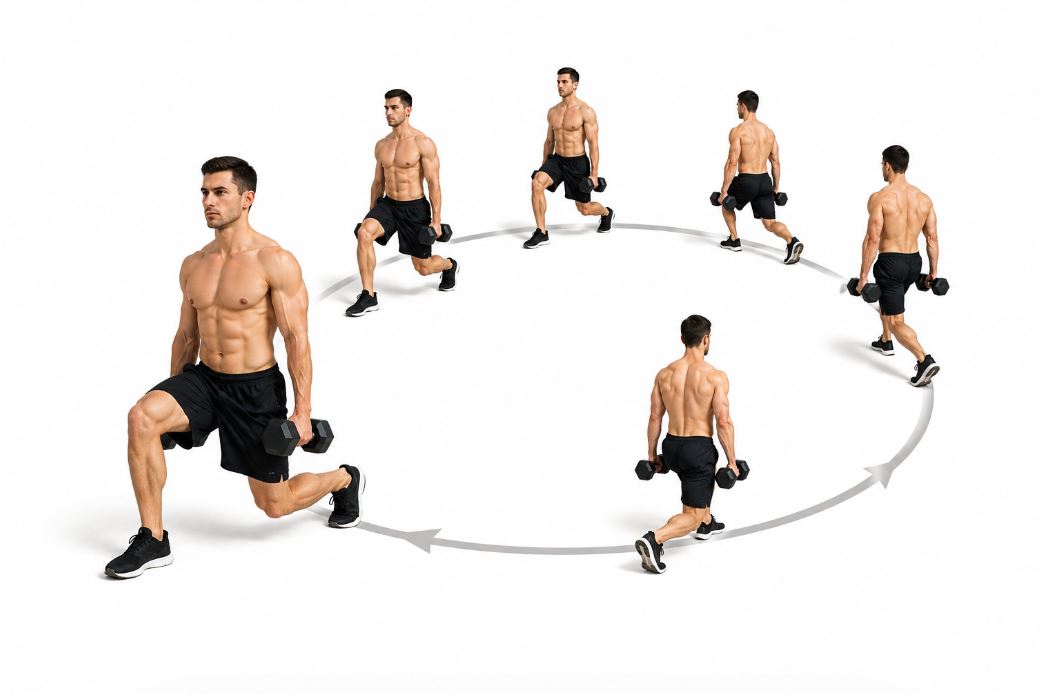
B. Movement (Execution)
Once you’re set, the goal of the walking lunge is to move forward with control, rhythm, and stability, maintaining proper alignment throughout each step.
As a coach, I always stress that this is not just a strength exercise—it’s also a coordination and movement-quality exercise.
- Inhale and brace your core before stepping forward.
- Take a controlled step forward with one leg.
- Lower your body by bending both knees simultaneously.
- Keep your torso upright and your back neutral.
- Descend until both knees reach approximately a 90-degree angle.
- Your rear knee should be just above the floor.
- Ensure your front knee tracks in line with your toes.
- Keep your front foot flat and stable.
- Push through your front heel and mid-foot to drive your body forward.
- Bring your back leg forward into the next step.
- Continue alternating legs as you move forward.
- Exhale as you rise and transition into the next rep.
Resistance & Step Length Insight
Even in walking lunges, step length matters:
- Short step: More knee flexion → greater quadriceps activation
- Long step: More hip involvement → greater glute and hamstring activation
Because the movement is continuous, controlling step length is key to maintaining consistent muscle activation throughout the set.
Muscles Worked in the Walking Lunge
The walking lunge is a dynamic unilateral exercise that targets multiple lower-body muscles while also challenging balance, coordination, and stability. Because you are constantly moving forward, the muscles must work not only to produce force but also to control and stabilize each step.
As a coach working with lifters and athletes, I often use walking lunges to develop functional strength and athletic movement patterns, since they closely mimic real-life locomotion.
Primary Muscles
- Quadriceps (vastus lateralis, vastus medialis, vastus intermedius, rectus femoris): Control the descent and extend the knee, especially with shorter steps.
- Gluteus maximus: Drives hip extension, particularly when using longer steps.
Secondary Muscles
- Hamstrings: Assist in hip extension and help stabilize the knee.
- Adductors: Contribute to hip stability and assist in force production.
Stabilizers
- Core musculature: Maintains torso stability during continuous movement.
- Calves (gastrocnemius and soleus): Help stabilize the ankle and assist with forward movement.
- Hip stabilizers (glute medius and minimus): Prevent knee collapse and maintain alignment.
One thing I often notice is that walking lunges expose weaknesses very quickly. Because there’s no reset between reps, any loss of balance or control becomes immediately obvious—making this exercise extremely effective for improving coordination and movement quality.
Technical Emphasis & Targeting Adjustments
The walking lunge may look simple, but small adjustments in step length, torso position, and movement control can significantly change how the exercise feels and which muscles are emphasized. Because the movement is continuous, consistency becomes even more important.
As a coach, I often use these adjustments to shift focus between quadriceps and glutes/hamstrings, while also improving overall movement quality.
Step Length & Muscle Emphasis
| Step Length | Muscle Emphasis / Training Effect |
|---|---|
| Short step | More knee flexion → greater emphasis on quadriceps |
| Moderate step | Balanced activation of quads and glutes |
| Long step | More hip involvement → increased glute and hamstring activation |
Torso Position
| Position | Effect |
|---|---|
| Upright torso | Increases quadriceps activation |
| Slight forward lean | Increases glute involvement |
Movement Control
| Technique | Effect |
|---|---|
| Controlled descent | Improves muscle activation and stability |
| Explosive drive forward | Enhances athletic performance |
| Slow eccentric | Increases time under tension for hypertrophy |
Because walking lunges are continuous, small inconsistencies in technique can quickly accumulate. Staying consistent with your step length, rhythm, and posture is key to maintaining proper muscle activation and control throughout the set.
Performance Optimization Tips (Coach’s Cues)
To get the most out of the walking lunge, you need to focus on control, rhythm, and consistency. Because the movement is continuous, small mistakes can compound quickly, so precision matters more than speed or weight.
- Establish a steady rhythm: Move at a controlled, repeatable pace from rep to rep.
- Keep step length consistent: This ensures even muscle activation and balance.
- Drive through the front leg: The working leg should generate most of the force.
- Stay upright: Maintain a neutral spine and avoid excessive forward lean.
- Control the descent: A slower eccentric improves stability and muscle engagement.
- Keep your front foot flat: Ensure proper force transfer and balance.
- Engage your core: Helps stabilize your torso during forward movement.
- Look forward, not down: Maintains posture and improves coordination.
- Progress gradually: Increase weight only after mastering movement flow and control.
Walking Lunge Variations (Dumbbell, Barbell, Bodyweight, Overhead)
The walking lunge can be performed in several variations, each offering a different stimulus for strength, stability, coordination, and core engagement. As a coach, I use these variations to adjust difficulty and target specific training goals.
1) Barbell Walking Lunge
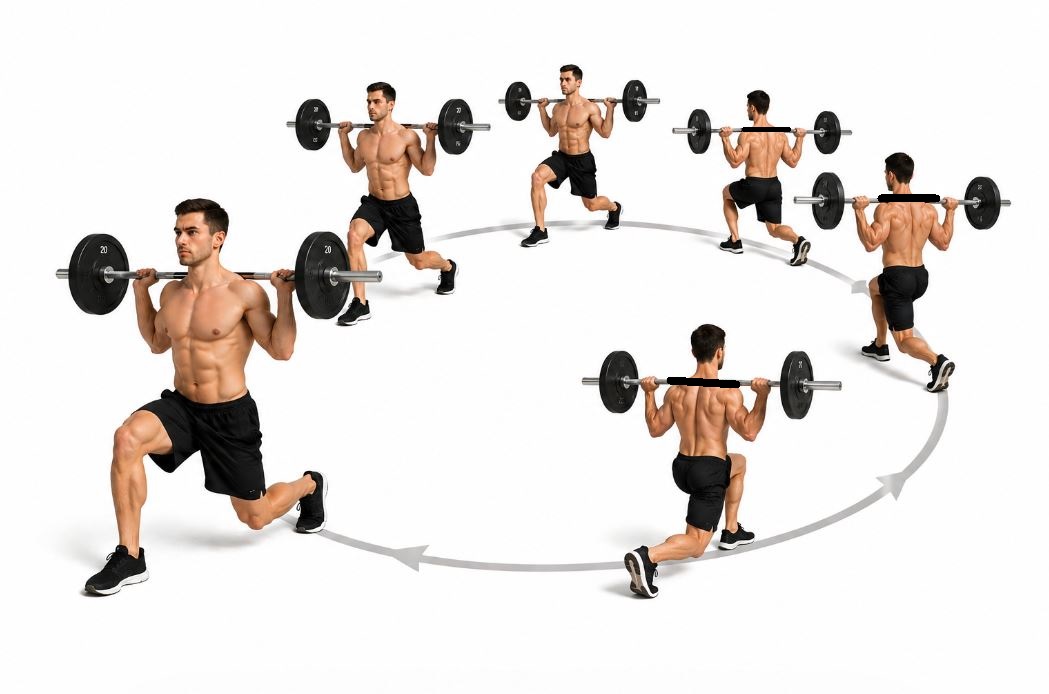
How to perform:
- Place a barbell across your upper back (like a squat).
- Perform walking lunges with controlled steps.
Why it works:
Allows for heavier loading, increasing strength and hypertrophy potential—but requires more balance and control.
2) Bodyweight Walking Lunge
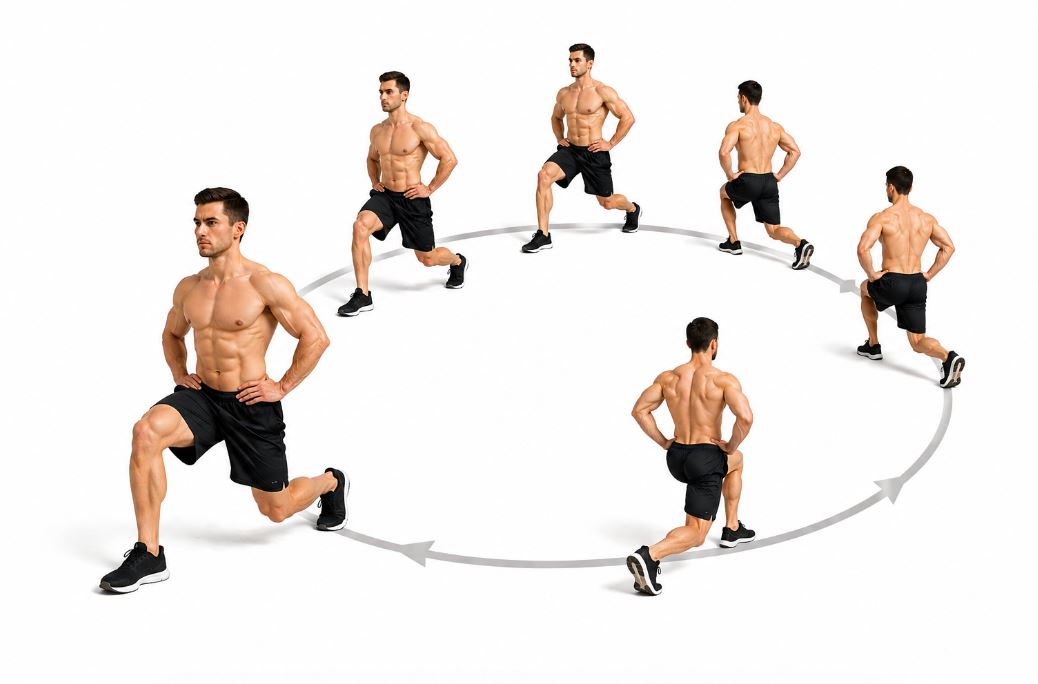
How to perform:
- Perform the movement without external resistance.
Why it works:
Perfect for beginners or for improving coordination and movement quality.
3) Overhead Walking Lunge

How to perform:
- Hold a weight (dumbbell or plate) overhead while performing walking lunges.
Why it works:
Greatly increases the demands on core and shoulder stability, making it a more advanced variation.
Alternative / Replacement Exercises for the Walking Lunge
While the walking lunge is an excellent exercise for building strength, coordination, and endurance, there are several effective alternatives you can use depending on your goals, space, or equipment. As a coach, I often rotate these movements to maintain progress while targeting similar muscle groups.
- Dumbbell Lunge (Stationary): A more controlled version that allows you to focus on technique and muscle targeting.
- Reverse Lunge: A more joint-friendly option with better control and reduced knee stress.
- Barbell Lunge: Allows for heavier loading and greater strength development.
- Bulgarian Split Squat: A stable unilateral exercise ideal for strength and hypertrophy.
- Step-Up Exercise: A functional movement that improves balance and single-leg strength.
- Hack Squat: A machine-based alternative for controlled quad-focused training.
- Leg Press: A bilateral option for building overall leg strength with less balance demand.
This is one of many effective movements—discover the rest in our guide to the best quadriceps exercises.
Walking lunges are extremely effective, but they can also be fatiguing due to their continuous nature. Rotating them with more stable exercises can help maintain intensity while reducing fatigue and improving recovery.
The key is to match the exercise to your training goal—whether it’s strength, hypertrophy, or coordination.
Key Benefits of the Walking Lunge
The walking lunge is one of the most effective exercises for developing strength, coordination, and endurance in the lower body. Its continuous movement pattern makes it especially valuable for improving real-world and athletic performance.
As a coach working with lifters and athletes, I often use walking lunges to build functional strength and movement efficiency, while also challenging balance and stability.
- Builds unilateral leg strength: Each leg works independently, helping correct muscle imbalances.
- Targets multiple muscle groups: Effectively trains the quadriceps, glutes, and hamstrings.
- Improves coordination and balance: Continuous movement requires control and stability.
- Enhances core engagement: Stabilizing the torso activates core muscles throughout the set.
- Develops endurance: The repeated stepping pattern increases the demands on the muscles and cardiovascular system.
- Highly functional movement: Mimics walking, running, and athletic locomotion patterns.
- Versatile and scalable: Can be performed with bodyweight, dumbbells, or a barbell.
Who Should Use This Exercise?
The walking lunge is a highly versatile exercise that benefits a wide range of individuals—from beginners to advanced athletes. Because it combines strength, coordination, balance, and endurance, it’s especially useful for improving both performance and overall movement quality.
As a coach working with lifters and athletes, I often include walking lunges to develop functional strength and real-world movement patterns.
- Beginners: Can start with bodyweight to learn coordination and balance.
- Athletes: Ideal for improving movement efficiency, coordination, and unilateral strength.
- Bodybuilders: Effective for targeting quads, glutes, and hamstrings with added time under tension.
- Individuals with muscle imbalances: Helps correct asymmetries by training each leg independently.
- Home trainees: Requires minimal equipment and space (adjustable based on setup).
- Intermediate and advanced lifters: Great for adding volume, improving endurance, and enhancing movement quality.
Walking Lunge vs Stationary Lunge: Which Is Better?
The walking lunge and stationary lunge are closely related exercises, but they differ in movement style, coordination demands, and overall training effect. Both are highly effective, but each serves a different purpose depending on your goal.
As a coach working with lifters and athletes, I use both variations—but for different reasons.
| Criteria | Walking Lunge | Stationary Lunge |
|---|---|---|
| Movement Pattern | Continuous forward movement | Step forward and return to start |
| Coordination Demand | High | Moderate |
| Balance Requirement | High | Moderate |
| Muscle Activation | Dynamic and variable | Controlled and consistent |
| Endurance Demand | High | Moderate |
| Ease of Learning | More challenging | Easier |
If your goal is to improve coordination, endurance, and athletic movement, the walking lunge is the better choice. The continuous stepping pattern makes it more dynamic and functional.
If your goal is to focus on control, technique, and targeted muscle activation, the stationary lunge is often the better option. It allows for more precise execution and easier balance.
In practice, the best results come from using both:
- Walking lunges for dynamic strength and conditioning
- Stationary lunges for control, technique, and muscle targeting
Where This Exercise Fits in a Workout
The walking lunge is a highly versatile exercise that can serve as a primary movement, an accessory lift, or a conditioning tool, depending on your training goal. Because it combines strength with continuous movement, it’s especially effective for improving endurance, coordination, and overall work capacity.
As a coach working with lifters and athletes, I typically program walking lunges to develop functional strength and movement efficiency, especially when I want to challenge both muscles and cardiovascular capacity.
Recommended Placement
- As a primary unilateral exercise: Perform early in the workout to focus on coordination and strength.
- After squats or leg presses: Use it as an accessory movement to add volume and improve balance.
- For hypertrophy training: Ideal for moderate reps with controlled tempo.
- In conditioning workouts: Excellent for circuits and metabolic training.
Sets & Reps Guidelines
- Hypertrophy (muscle growth): 3–4 sets of 10–20 steps per leg
- Strength & coordination: 3–4 sets of 8–12 steps per leg
- Endurance/conditioning: 2–3 sets of 15–25 steps per leg
Walking lunges work best when you maintain a steady rhythm and consistent technique. Because the movement is continuous, staying controlled and balanced is more important than moving fast or using heavier weights.
If you perform glute exercises consistently but still struggle to see noticeable lower-body development, the issue may come from poor execution, limited hip extension, or weak progression strategies. Read more in Why Your Glutes Aren’t Growing.
Conclusion
The walking lunge is one of the most effective exercises for building strong, balanced, and athletic legs. Its continuous movement pattern makes it more challenging than stationary variations, while also improving coordination, endurance, and movement quality.
What sets this exercise apart is its ability to combine strength and functionality. By progressing through each step, the walking lunge closely mimics real-life and athletic movements, making it a powerful tool for overall lower-body development.
As a coach, I’ve seen that walking lunges consistently deliver results when performed with control, consistency, and proper technique. Mastering this exercise will not only improve muscle development but also enhance your balance, coordination, and performance.
What is the walking lunge?
The walking lunge is a dynamic lower-body exercise performed by stepping forward continuously into a lunge position with each repetition.
What muscles does the walking lunge work?
It primarily targets the quadriceps, glutes, and hamstrings, while also engaging the core and stabilizer muscles.
Are walking lunges better than stationary lunges?
Walking lunges are better for coordination and endurance, while stationary lunges are better for control and targeted muscle activation.
How does step length affect walking lunges?
A short step emphasizes the quadriceps, while a long step increases activation of the glutes and hamstrings.
Are walking lunges good for building muscle?
Yes, they are very effective for building muscle, especially when performed with proper form and progressive overload.
Are walking lunges good for beginners?
They can be challenging at first, but beginners can start with bodyweight and focus on control and balance.
Should my knee go past my toes during walking lunges?
A slight forward movement is natural, but your knee should stay aligned with your toes and under control.
What is the best weight for walking lunges?
Use a weight that allows you to maintain balance, control, and proper technique throughout the movement.
Can walking lunges improve balance?
Yes, they are excellent for improving balance and coordination due to the continuous stepping pattern.
How many steps should I do for walking lunges?
Most people benefit from 10–20 steps per leg, depending on their training goal.
