



Introduction
The cable glute kickback is one of the most popular glute isolation exercises for developing the gluteus maximus, improving hip extension strength, and enhancing lower-body muscle control. Unlike larger compound exercises such as squats or lunges, the cable variation places direct tension on the glutes through a controlled single-leg movement pattern with relatively minimal involvement from other muscle groups.
In recent years, glute-focused strength training has become especially popular among women looking to improve lower-body shape, glute development, and hip stability. As a result, exercises like the cable glute kickback are now commonly included in strength training for women, glute hypertrophy workouts, and lower-body shaping programs because they allow direct glute isolation with adjustable resistance and controlled movement mechanics.
In practical training situations, the cable glute kickback is commonly used to improve glute activation, strengthen hip extension mechanics, and add targeted glute volume without placing excessive stress on the knees or lower back. In my experience as a coach, this exercise works especially well as a finishing movement after heavier compound lower-body exercises because it allows lifters to focus almost entirely on glute contraction and muscular tension.
One of the biggest advantages of the cable version is constant tension. Unlike some bodyweight or machine variations, the cable keeps resistance on the glutes throughout most of the movement, which can improve muscular engagement and overall training quality when proper technique is maintained.
At the same time, execution quality matters significantly. Excessive momentum, lower-back hyperextension, or swinging the leg too aggressively can quickly reduce glute involvement and shift stress away from the intended muscles. When performed correctly, the cable glute kickback can be an excellent tool for glute hypertrophy, hip stability, and balanced lower-body development.
Other Names for the Cable Glute Kickback
The cable glute kickback may be called by several names depending on the gym, coach, or exercise variation used. While the terminology can vary slightly, all versions refer to the same hip-extension movement pattern performed against cable resistance.
- Cable glute kickback
- Cable kickback
- Cable donkey kick
- Cable hip extension
- Glute cable kickback
- Single-leg cable kickback
In most gyms, the movement is simply called a “cable kickback” because it involves kicking the leg backward against resistance to target the glutes.
Required Equipment for the Cable Glute Kickback
The cable glute kickback requires a low cable pulley setup and an ankle attachment to perform the movement correctly and comfortably.
Essential Equipment
- Low cable pulley machine
- Ankle strap attachment
- Weight stack or adjustable cable resistance
Optional (but helpful)
- Flat training shoes – improve lower-body stability
- Resistance band warm-up – useful for glute activation before heavier sets
- Exercise mat – may improve comfort and stability for some setups
Because the movement is highly adjustable and beginner-friendly, it is commonly included in:
- Glute hypertrophy workouts
- Strength training for women
- Lower-body accessory sessions
- Glute activation routines
- Hip-focused hypertrophy training programs
One reason the cable glute kickback has become so popular in glute-focused strength training for women is that the cable provides continuous tension on the glutes throughout the movement, making it easier to maintain strong muscular engagement with relatively low joint stress.
How to Perform the Cable Glute Kickback with Proper Form
The cable glute kickback is mechanically simple, but maintaining proper posture and controlled movement is essential for maximizing glute activation. In my experience, the biggest mistakes usually happen when lifters swing the leg aggressively or hyperextend the lower back instead of driving the movement from the glutes.
Starting Position (Setup)
A proper setup helps place tension directly on the gluteus maximus while maintaining stable pelvic alignment throughout the exercise.
- Attach an ankle strap to a low cable pulley
- Secure the strap around one ankle
- Stand facing the cable machine
- Hold the machine or support structure lightly for balance
- Keep the supporting leg slightly bent
- Maintain neutral spinal alignment
- Brace your core gently throughout the movement
- Position the working leg slightly behind the body before starting

Movement (Execution)
The goal is to extend the hip by driving the leg backward while maintaining stable posture and controlled glute contraction.
- Push the working leg backward in a controlled arc
- Focus on driving the movement from the glutes rather than the lower back
- Keep the torso stable throughout the repetition
- Extend the hip until a strong glute contraction is achieved
- Pause briefly in the contracted position
- Slowly return the leg to the starting position
- Maintain continuous tension on the glutes throughout the set
- Repeat for the desired number of repetitions before switching sides
The biggest mistake I see with cable glute kickbacks is excessive lower-back extension. If the torso starts arching aggressively to move the leg farther backward, the glutes usually lose much of the intended workload.
Video Demonstration
Watching a proper demonstration is especially useful for the cable glute kickback because many lifters unknowingly compensate with momentum or spinal movement instead of controlled hip extension. Pay attention to the stable torso position, smooth backward leg path, and continuous glute tension throughout each repetition.
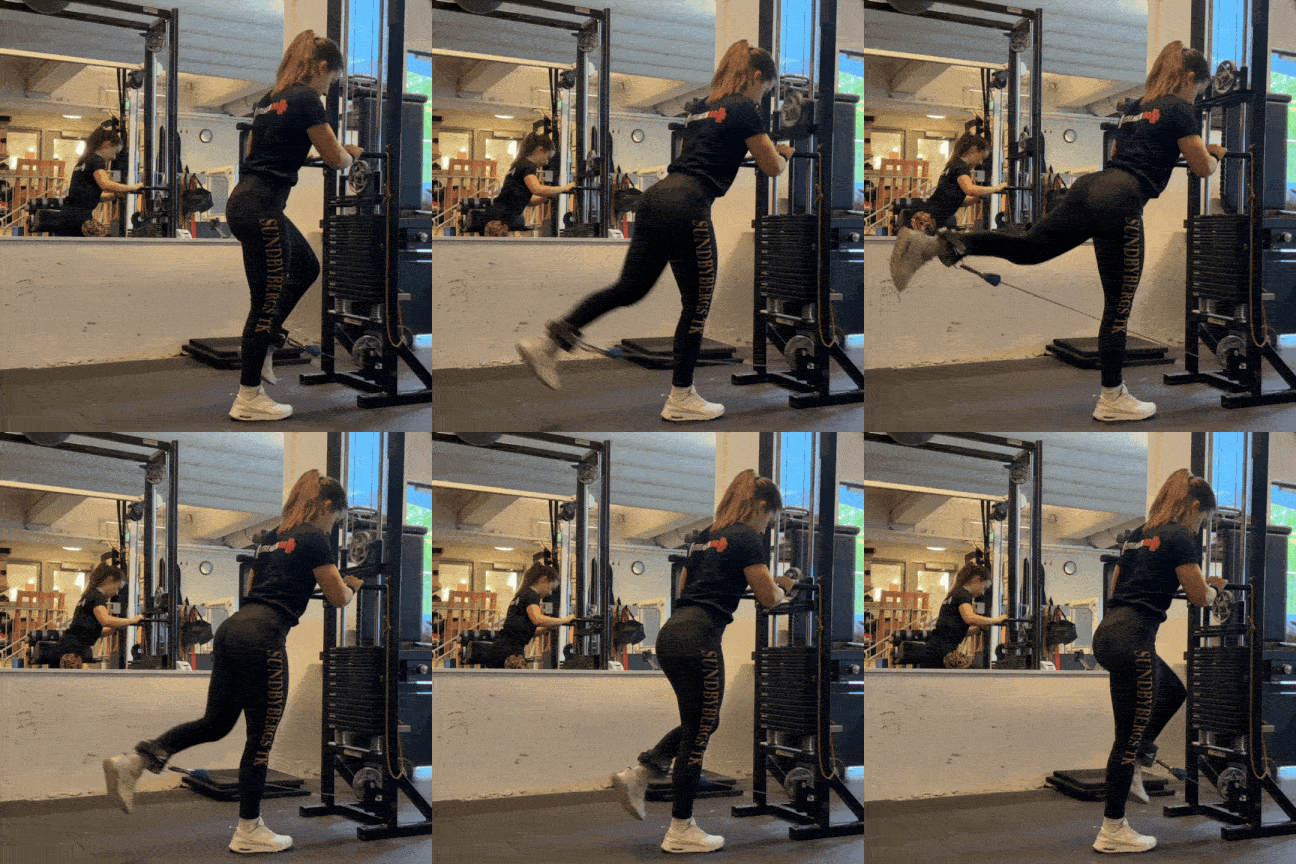
Cable kickbacks are extremely popular in glute-focused strength training for women because they allow lifters to isolate the glutes directly while using moderate resistance and maintaining relatively low stress on the knees and spine.
Muscles Worked in the Cable Glute Kickback
Primary Muscles
The primary muscle responsible for the movement is the gluteus maximus, whose main function is hip extension.
The primary muscles include:
Secondary Muscles
Several surrounding muscles assist the movement and contribute to stabilization during the exercise.
These include:
Stabilizing Muscles
Stabilizing muscles help maintain posture, pelvic alignment, and balance throughout the movement.
These include:
- Core stabilizers
- Obliques
- Lower back stabilizers
- Supporting-leg glutes
- Deep pelvic stabilizers
Antagonist Muscles
The muscles opposing hip extension are primarily the hip flexors.
These include:
- Iliopsoas
- Rectus femoris
- Tensor fasciae latae
- Sartorius
How the Cable Glute Kickback Works: Biomechanics & Mechanics
The cable glute kickback is a single-joint isolation exercise driven primarily by hip extension. Unlike larger compound lower-body movements, the exercise focuses almost entirely on controlled glute contraction with relatively limited involvement from other major muscle groups.
Key Joint Action
- Hip extension – the working leg moves backward behind the body
Unilateral Stability Demand
- The exercise is performed one leg at a time
- The supporting leg and pelvis must remain stable throughout the movement
- This increases stabilizer involvement and pelvic control demands
Constant Cable Tension
- One of the biggest advantages of the cable variation is continuous resistance
- The glutes remain under tension throughout most of the repetition
- This can improve muscular engagement and hypertrophy-focused training quality
Pelvic Position Importance
- Stable pelvic positioning is critical for proper glute recruitment
- Excessive lower-back arching reduces effective glute loading
- Controlled posture helps maintain clean movement mechanics
Range of Motion Considerations
- The leg should move backward only as far as stable hip mechanics can be maintained
- Excessive backward swing often shifts tension away from the glutes
- Quality of movement matters more than maximal range of motion
Muscle Recruitment Pattern
- The gluteus maximus remains highly active throughout the movement
- The hamstrings assist hip extension secondarily
- Stabilizing muscles contribute significantly to posture and balance control
Common Mechanical Errors
- Hyperextending the lower back during the kickback
- Swinging the leg using momentum
- Rotating the hips excessively
- Losing pelvic stability during repetitions
- Performing rushed repetitions with minimal muscular control
The most important factor is maintaining a stable posture and controlled glute-driven movement rather than simply kicking the leg farther backward.
Technique Optimization Tips
The cable glute kickback becomes significantly more effective when movement quality and glute tension remain the priority. Small adjustments in positioning and execution can noticeably improve glute activation and overall exercise effectiveness.
- Keep the pelvis stable throughout the movement. Avoid excessive torso rotation.
- Focus on driving the movement from the glutes rather than the lower back.
- Use controlled tempo. Smooth repetitions improve muscular tension and the quality of activation.
- Maintain a slight bend in the supporting leg for better balance and stability.
- Pause briefly at peak contraction. This often improves glute recruitment.
- Slow down the eccentric phase. Controlled lowering increases muscular tension.
- Avoid excessive backward swing. A larger range of motion is not always better.
- Use moderate resistance that allows a stable posture and clean mechanics.
The cable glute kickback usually becomes far more effective when you focus on controlled hip extension, stable pelvic positioning, and continuous glute tension instead of simply swinging the leg backward as high as possible.
Weak glute activation is one of the most overlooked reasons lower-body progress stalls, especially during glute-focused movements like this one. Learn the most common mistakes in Why Your Glutes Aren’t Growing
Technical Emphasis & Targeting Adjustments
Although the cable glute kickback is mechanically simple, small adjustments in body positioning and movement direction can noticeably influence muscle recruitment and the overall feel of the exercise. In practical training situations, these modifications are often useful for improving glute activation and maintaining continuous muscular tension.
- Keep the movement slightly diagonal rather than perfectly straight backward. This often improves glute contraction for some lifters.
- Maintain stable pelvic positioning. Excessive hip rotation reduces effective glute loading.
- Use controlled tempo throughout the set. Smooth repetitions improve muscular tension and the quality of activation.
- Pause briefly at peak contraction. Holding the top position can improve glute recruitment.
- Slow down the eccentric phase. Controlled lowering increases muscular tension and movement quality.
- Avoid excessive backward swing. Overextending often shifts tension into the lower back.
- Keep the supporting leg stable. Strong balance improves overall movement control.
- Use moderate-to-higher repetitions when appropriate. The glutes often respond well to longer time under tension.
The main takeaway is that controlled movement quality and continuous glute tension usually matter far more than simply using heavier resistance or kicking the leg farther backward.
Cable Glute Kickback Benefits and Drawbacks
The cable glute kickback is one of the most effective isolation exercises for directly targeting the gluteus maximus while maintaining continuous tension throughout the movement. However, like any isolation exercise, it also has limitations. In my experience, it works best as a supplemental movement rather than a primary lower-body strength exercise.
Benefits
- Directly targets the gluteus maximus with minimal knee stress.
- Provides continuous cable tension throughout most of the movement.
- Excellent for glute hypertrophy-focused training.
- Beginner-friendly and relatively easy to learn.
- Useful as a finishing exercise after compound lower-body movements.
- Commonly included in glute-focused strength training for women.
Drawbacks
- Limited overall lower-body strength development.
- Easy to perform incorrectly with momentum or lower-back compensation.
- Requires cable equipment and ankle attachments.
- Excessive loading can quickly reduce movement quality.
- Does not replace compound glute exercises for maximal strength development.
The cable glute kickback usually works best when you prioritize continuous glute tension, controlled hip extension, and stable posture rather than trying to use heavy weight or exaggerated range of motion.
Cable Glute Kickback Variations
While the standard cable glute kickback is already highly effective for glute isolation and hip extension training, several variations can slightly change the resistance profile, stabilization demand, and overall training feel. In practice, these options are often useful for adding variety or emphasizing different aspects of glute development.
Standard Cable Glute Kickback
This is the classic standing variation performed using a low cable pulley and ankle attachment.
Bent-Over Cable Glute Kickback
A variation performed with greater torso lean that can slightly increase glute loading for some lifters.

Cable Glute Kickback with Knee Bent
A variation that may reduce hamstring involvement slightly and place more emphasis on the glutes.
Resistance Band Glute Kickback
A portable variation commonly used for glute activation and home workouts.
Machine Glute Kickback
A machine-based version that provides greater stability and guided movement mechanics.
Donkey Kick Variation
A bodyweight or resistance-band variation commonly used in glute-focused workouts and activation routines.

Smith Machine Kickback
A less common variation that combines machine stability with controlled hip extension mechanics.

The best cable glute kickback variation is usually the one that allows you to maintain stable pelvic positioning, strong glute contraction, and smooth movement mechanics without relying on momentum or spinal compensation.
Replacement Exercises for the Cable Glute Kickback
If the cable glute kickback setup is unavailable or if you want more variety in your training, several other exercises can effectively target the glutes and surrounding hip musculature using different mechanics and resistance profiles.
- Standing Hip Extension
- Barbell Hip Thrust
- Machine Hip Thrust
- Basic Glute Bridge
- Reverse Hyperextension
- Walking Lunge
- Reverse Lunge
- High Box Step-Ups with Knee Raise
- Cable Pull-Through
- Butt Blaster Machine Exercise
For a complete overview of all recommended movements and variations, explore our full glute & hip exercise database, where you can find the best exercises for glute hypertrophy, hip stability, and lower-body development.
Who Should Use This Exercise?
The cable glute kickback can be useful for a wide range of trainees because it combines direct glute isolation with relatively low joint stress and adjustable resistance. In practical training situations, it works especially well for glute-focused hypertrophy programs and lower-body accessory work.
- Women following glute-focused strength training programs
- Bodybuilders focused on glute hypertrophy
- Lifters wanting additional glute isolation work
- Beginners learning proper glute activation
- Individuals seeking lower-impact glute exercises
- Athletes looking to improve hip extension and mechanics
- Trainees wanting extra glute volume without heavy spinal loading
Who Should Avoid or Modify It?
Although the cable glute kickback is generally safe and beginner-friendly, some individuals may still need to modify the movement or reduce resistance depending on mobility, posture control, or injury history.
- People experiencing lower-back pain during hip extension movements
- Individuals unable to maintain stable pelvic positioning
- Lifters compensating with excessive spinal arching
- People using momentum instead of controlled glute contraction
- Anyone forcing an excessive range of motion
- Trainees using resistance that compromises movement quality
Where This Exercise Fits in a Workout
The cable glute kickback is best used as an accessory isolation exercise within a glute-focused, lower-body, or hypertrophy-oriented training session. In most practical situations, it works especially well later in the workout after heavier compound exercises have already been completed.
- After squats, lunges, deadlifts, or hip thrusts
- As a finishing exercise for the glutes
- Within glute-focused strength training for women
- During lower-body hypertrophy workouts
- As part of glute activation and accessory circuits
- Alongside unilateral lower-body exercises for balanced development
The main takeaway is that the cable glute kickback works best as a controlled glute-isolation movement, emphasizing muscular tension and hip-extension quality over maximal loading.
Sets and Reps Recommendations
The cable glute kickback generally responds well to moderate-to-high repetition ranges, with a controlled tempo and continuous muscular tension. In my experience as a coach, the best results usually come from movement quality and consistent glute contraction rather than simply increasing cable resistance.
- Sets: 2–4 per workout
- Reps: 10–20 reps per side
- Tempo: Controlled concentric phase with slower eccentric lowering
- Rest time: 45–75 seconds between sets
Additional Programming Tips
- Focus on stable pelvic positioning during each repetition
- Avoid excessive lower-back extension during the kickback
- Keep continuous tension on the glutes throughout the set
- Use moderate resistance with strict form
- Pause briefly at peak contraction for improved glute recruitment
- Pair kickbacks with hip thrusts, lunges, or glute bridges for balanced glute development
What usually produces the best results is controlled glute activation and consistent muscular tension rather than exaggerated range of motion or excessive loading.
Cable Glute Kickback vs. Donkey Kick
The cable glute kickback and donkey kick both target the glutes through hip extension, but they differ significantly in resistance profile, stability demands, and overall movement mechanics. In practice, cable kickbacks provide more continuous resistance, while donkey kicks are often used for lighter activation-focused training.
| Training Factor | Cable Glute Kickback | Donkey Kick |
|---|---|---|
| Resistance Type | Cable resistance | Bodyweight/bands |
| Tension Profile | Continuous | Variable |
| Stability Demand | Moderate | Low–Moderate |
| Equipment Required | Cable machine | Minimal |
| Glute Isolation | Very high | Moderate |
| Progression Potential | High | Moderate |
| Beginner Accessibility | Moderate | Very high |
| Best Use | Hypertrophy and glute isolation | Activation and warm-up work |
Conclusion: The cable glute kickback is generally the better option for glute hypertrophy and continuous muscular tension, while donkey kicks work especially well for activation-focused training and beginner-friendly glute work.
For most lifters, both exercises can complement each other effectively within a complete glute-training program.
Closing Thoughts
The cable glute kickback is one of the most effective isolation exercises for directly targeting the gluteus maximus while maintaining continuous muscular tension throughout the movement. Although it may not replace larger compound lower-body exercises for maximal strength development, it still plays an important role in glute-focused hypertrophy training.
In my experience, the biggest difference comes from execution quality. Stable pelvic positioning, controlled tempo, and strong glute contraction usually produce far better results than simply using heavier resistance or swinging the leg aggressively backward.
This movement can be especially useful for improving glute activation, reinforcing proper hip extension mechanics, and adding targeted glute volume without excessive spinal or knee stress.
Ultimately, the goal is simple: use the cable glute kickback to safely, consistently, and with controlled movement quality strengthen the glutes over the long term.
Frequently Asked Questions
Are cable glute kickbacks good for glute growth?
Yes. Cable glute kickbacks are excellent for glute growth because they isolate the gluteus maximus and keep tension on the muscle throughout the movement.
What muscles do cable glute kickbacks work?
Cable glute kickbacks mainly work the gluteus maximus. The hamstrings, gluteus medius, core, and hip stabilizers assist during the movement.
Why do I feel cable glute kickbacks in my lower back?
This usually happens when you arch your lower back, swing the leg too high, or lose pelvic control. Keep the spine neutral and drive the movement from the glutes.
Should cable glute kickbacks be heavy or light?
Moderate weight with strict form is usually best. Too much weight often leads to momentum, lower-back compensation, and less glute tension.
Are cable glute kickbacks better than donkey kicks?
Cable glute kickbacks are usually better for hypertrophy because the cable provides more consistent resistance. Donkey kicks are better for beginners, warm-ups, and activation work.
How many reps should I do for cable glute kickbacks?
Most lifters do best with 2–4 sets of 10–20 controlled reps per leg, focusing on smooth movement and a strong glute contraction.
