



If the gluteus maximus is the strongest muscle in the body by cross-sectional area, the erector spinae might be the hardest-working — it fires almost continuously every time you stand, sit upright, or bend forward, and it’s the muscle group most directly responsible for whether a deadlift ends in a personal record or an injury. Despite running the entire length of the spine, “the erector spinae” is actually three separate muscles working as a team, and understanding erector spinae functional anatomy is essential for anyone serious about both back strength and long-term spinal health.
Quick Answer
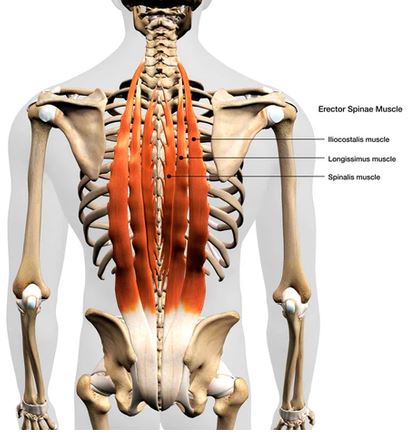
The erector spinae is a group of three muscles — the iliocostalis, longissimus, and spinalis — that run parallel to the spine from the pelvis to the base of the skull. Their primary function is spinal extension, straightening and holding the back upright, along with lateral flexion (bending to one side) when contracting unilaterally. As one of the primary muscle groups engaged in nearly every standing, bending, and lifting movement, the erector spinae is central to both athletic performance and everyday spinal health.
| Muscle type | Group of three parallel muscles running the length of the spine |
|---|---|
| Primary functions | Spinal extension, spinal stabilization |
| Secondary functions | Lateral flexion (unilateral contraction) |
| Innervation | Posterior rami of the spinal nerves (segmental) |
| Blood supply | Segmental branches of the vertebral, intercostal, and lumbar arteries |
| Common exercises | Deadlifts, good mornings, back extensions |
| Main bodybuilding role | Lower back strength, spinal stability, and injury resilience |
Overview
Why Is the Erector Spinae Important?
The erector spinae is the muscle group standing between an upright, stable spine and one that buckles under load — every deadlift, squat, and good morning relies on it to resist the forward-bending forces that would otherwise fold the torso over. Beyond the gym, it’s the muscle group quietly working every time you sit up straight, stand from a chair, or simply hold your posture throughout the day. For lifters, it’s one of the highest-stakes muscle groups to train correctly, since it plays a central role in both heavy compound lift performance and one of the most common health complaints worldwide: lower back pain. On a well-developed physique, the erector spinae also creates a visually striking pair of thick, columnar bands running up either side of the spine — a detail that’s hard to fake and directly reflects genuine posterior chain strength. To see how it fits into the rest of your muscular system, check out our interactive muscle anatomy tool.
Erector Spinae Functional Anatomy & Location
The erector spinae runs longitudinally along both sides of the spine, from the sacrum and pelvis at the bottom to the base of the skull at the top. A clear grasp of erector spinae functional anatomy starts with understanding that it isn’t one muscle but three, arranged in three parallel columns from the middle of the back outward: the spinalis (most medial, closest to the spine), the longissimus (in the middle, the largest and longest of the three), and the iliocostalis (most lateral, closest to the ribs). A commonly used memory device for their order — from lateral to medial — is the phrase “I Like Standing”: Iliocostalis, Longissimus, Spinalis.
Finding Your Erector Spinae: Surface Anatomy
Stand up and place your hands on either side of your lower spine, then arch your back slightly — you’ll feel the erector spinae contract as two firm, rope-like columns running vertically along the spine. On a lean, well-developed back, these muscles are visible even at rest, running from the lower back up toward the shoulder blades.

Characteristics at a Glance
| Characteristic | Value |
|---|---|
| Shape | Long, columnar, running parallel to the spine |
| Muscle group | Intermediate layer of the intrinsic (deep) back muscles |
| Number | Three muscles per side (iliocostalis, longissimus, spinalis), each further divided into regional segments |
| Fiber direction | Longitudinal, running roughly parallel to the spine |
| Crosses | Multiple spinal segments across the lumbar, thoracic, and cervical spine |
Origin, Insertion, Innervation & Blood Supply
For a broader explanation of these anatomical terms, see our guide to muscle anatomy basics: origin, insertion, and innervation.
| Attribute | Detail |
|---|---|
| Origin | Common tendinous origin (erector spinae aponeurosis) from the sacrum, iliac crest, and lumbar spinous processes |
| Insertion | Varies by muscle and region; ribs, transverse and spinous processes of the vertebrae, and the base of the skull |
| Innervation | Posterior rami of the cervical, thoracic, and lumbar spinal nerves (segmental) |
| Blood supply | Segmental branches of the vertebral, deep cervical, occipital, transverse cervical, intercostal, subcostal, and lumbar arteries |
According to StatPearls’ anatomical reference on the back muscles, the erector spinae forms the intermediate layer of the intrinsic back muscles, lying superficial to the deeper transversospinalis group (which includes the semispinalis and multifidus) and deep to the more superficial muscles such as the trapezius and latissimus dorsi. Unlike muscles supplied by a single named nerve, the erector spinae receives segmental innervation — meaning each spinal level innervates the corresponding section of muscle at that level, rather than a single nerve controlling the entire structure.
An Honest Anatomical Gap
Interestingly, not every detail of erector spinae function is fully settled science. The same StatPearls reference notes that while the lumbar and thoracic portions of these muscles have clearly defined actions, the specific actions of the cervical and capitis (head) sections of the longissimus and spinalis remain genuinely unclear in the anatomical literature — a reminder that even well-studied muscle groups can still have unresolved details.
Actions
Primary Actions
- Spinal extension — straightening the spine and controlling forward flexion against gravity; the erector spinae’s dominant, most heavily loaded action, particularly under bent-over positions like the deadlift and good morning
- Spinal stabilization — resisting unwanted movement of the vertebral column, working continuously during standing, walking, and virtually all loaded lifting
Secondary Functions
- Lateral flexion — bending the spine to one side, produced by unilateral (one-sided) contraction
- Postural support — maintaining an upright trunk position throughout normal daily activity, largely below conscious awareness
Regions of the Erector Spinae
Each of the three erector spinae muscles is itself subdivided into regional segments, and the group as a whole shows some functional differences by location.

| Muscle | Position | Primary Role | Best Trained By |
|---|---|---|---|
| Iliocostalis | Most lateral, attaches to the ribs | Spinal extension and lateral flexion; lateral rib/hip positioning | Deadlifts, good mornings, side bends |
| Longissimus | Middle column, largest and longest | Primary driver of spinal extension | Deadlifts, back extensions, good mornings |
| Spinalis | Most medial, closest to the spine | Spinal extension, least developed and most variable of the three | Back extensions, general extension work |
The iliocostalis sits furthest from the spine and attaches directly to the ribs, which means chronic tightness here can influence rib cage and hip positioning in ways the other two muscles don’t. The longissimus is the largest and longest of the three, generally considered the primary contributor to spinal extension strength. The spinalis is the smallest and most medial, and in some individuals it’s poorly differentiated from the surrounding muscle mass, making it the least distinct of the three columns.
Synergists, Antagonists & Stabilizers
Synergists (muscles that assist different erector spinae functions):
- Gluteus maximus and hamstrings — assist hip extension during hip-hinge movements like the deadlift, working alongside the erector spinae to control the torso
- Multifidus and the deeper transversospinalis muscles — assist spinal stabilization at individual vertebral segments
Antagonist (the muscle group that opposes spinal extension):
- Rectus abdominis — directly opposes the erector spinae’s primary extension action through spinal flexion
Stabilizers (muscles that support the trunk while the erector spinae works):
- Abdominal and oblique musculature — co-contracts with the erector spinae to stabilize the spine under load, particularly during heavy lifting
- Quadratus lumborum and deep core muscles — assist overall trunk stability during compound movements
Role During Common Exercises
| Exercise | Role of the Erector Spinae |
|---|---|
| Conventional deadlift | Prime mover, isometric stabilization |
| Good morning | Prime mover |
| Glute-ham raise | Major contributor, notably high activation |
| Back extension/hyperextension | Prime mover |
| Squat | Major contributor (stabilization) |
| Bird dog | Major contributor (stabilization) |
Bodybuilder’s Take
This is where understanding the erector spinae’s role actually changes how you train and protect your back.
“Which exercise activates the erector spinae the most?” Somewhat surprisingly, it isn’t the deadlift. A well-known EMG study comparing the leg curl, good morning, glute-ham raise, and Romanian deadlift found significantly greater erector spinae activation during the glute-ham raise compared to both the good morning and Romanian deadlift, with the difference roughly doubling in magnitude. If you’re specifically targeting erector spinae development in addition to your regular deadlifting, the glute-ham raise is a genuinely underused option worth adding.
“Is it true that deadlifts hit the erector spinae harder than squats?” Generally, yes. Research comparing deadlifts and squats has consistently found that the erector spinae and quadriceps show greater activation than the gluteus maximus and hamstrings during deadlifts specifically, reflecting how much more the deadlift relies on maintaining a rigid, extended spine against a forward-pulling load. If lower back soreness after training is your goal (within reason and with good technique), the deadlift is a more direct driver of that than most squat variations.
“Why does my lower back feel like it’s ‘giving out’ partway through a heavy deadlift?” This is common, and it’s not necessarily a sign that the erector spinae is weak — it’s often more about technique or bar path that allow the spine to round under load, which shifts stress away from a stable, braced position. If lower back discomfort is a recurring issue specifically after deadlifting, see our detailed breakdown: Lower Back Pain After Deadlifts: 10 Common Causes and How to Fix Them.
Common beginner mistakes:
- Allowing the lower back to round under heavy load during deadlifts and good mornings, which shifts stress onto the passive spinal structures instead of the erector spinae itself
- Relying exclusively on deadlifts for erector spinae development while ignoring higher-activation accessory movements like the glute-ham raise
- Assuming persistent lower back tightness always means the muscle needs more strengthening, when mobility and technique issues are just as often the real cause

Best Exercises
| Exercise | Main Function Trained | Main Benefit | Best For |
|---|---|---|---|
| Conventional deadlift | Spinal extension, stabilization | Full posterior chain strength and loading capacity | Overall strength and mass |
| Glute-ham raise | Spinal extension | Notably higher erector spinae EMG activation than good mornings or RDLs | Direct erector spinae development |
| Barbell good morning | Spinal extension | Deep hip hinge with direct lower back loading | Strength and hip hinge technique |
| 45-degree back extension | Spinal extension | Lower-risk, controlled loading pattern | Beginners and accessory volume |
| Bird dog | Spinal stabilization | Low-load anti-rotation and anti-extension control | Rehab, warm-ups, and stability work |
For a complete breakdown of exercise selection and programming, see our guide, “Top Erector Spinae (Lower Back) Strengthening Exercises.“
Stretching & Mobility
- Child’s pose — kneeling and reaching the arms forward while sitting back onto the heels gently stretches the erector spinae along its full length.
- Cat-cow stretch — alternating between spinal flexion and extension on hands and knees improves general mobility and can help relieve tightness.
- Standing forward fold — bending forward from the hips with a soft, controlled spine provides a gentle stretch, though this should be approached cautiously in anyone with existing lower back issues.
What Does Research Say?
EMG Findings
A well-cited EMG study comparing muscle activation during the leg curl, good morning, glute-ham raise, and Romanian deadlift found significantly greater erector spinae activation during the glute-ham raise than during either the good morning or the Romanian deadlift, a difference the researchers described as showing a large effect size. Separately, systematic reviews comparing muscle activation during the deadlift have consistently found the erector spinae and quadriceps show greater EMG activation than the gluteus maximus and biceps femoris during the standard deadlift, underscoring how central spinal extension and stabilization are to the lift.
Clinical & Biomechanical Findings
Research into lower back pain has identified a specific phenomenon relevant to how the erector spinae behaves under load. According to Physiopedia’s reference on the erector spinae, in healthy individuals without a history of lower back pain, the erector spinae typically relaxes as the spine approaches full forward flexion, since the passive spinal structures and the deeper multifidus muscle take over stabilization at that end range — a pattern known as the flexion-relaxation phenomenon. In people with chronic lower back pain, this relaxation response is frequently absent, with the erector spinae remaining active throughout the full range of flexion instead of yielding to the passive structures as expected. This is one of the better-documented findings linking erector spinae functional anatomy directly to lower back pain status, and some research suggests that restoring this normal flexion-relaxation pattern through targeted stabilization exercises may help reduce chronic lower back pain.
Common Conditions Affecting the Erector Spinae
This section is educational and should not replace professional medical advice.
- Muscle strain — an overstretch or partial tear of the erector spinae, often resulting from lifting with poor form, sudden movements, or exceeding the muscle’s current capacity under load.
- Chronic lower back pain — one of the most common musculoskeletal complaints worldwide — frequently involves the erector spinae, either as a direct source of discomfort or as part of a broader pattern of altered spinal muscle activation, such as the absence of the flexion-relaxation response described above.
- Muscle spasm — a sudden, involuntary, and often painful contraction of the erector spinae muscles, which can be debilitating in the short term, even without underlying structural damage.
- Postural overuse — prolonged sitting or standing in positions that keep the erector spinae under sustained low-level tension can contribute to chronic tightness and discomfort over time.
Risk Factors
- Poor lifting technique, particularly spinal rounding under load — one of the most significant contributors to acute erector spinae strain during heavy lifting.
- Sudden increases in training volume or load — a common contributor to overuse-related soreness and the risk of strain.
- Prolonged sitting or sedentary posture — associated with chronic tightness and reduced spinal mobility over time.
- Absent flexion-relaxation response — a pattern observed in people with chronic lower back pain, in which the erector spinae fails to relax appropriately during deep spinal flexion.
Persistent lower back pain, pain that radiates into the legs, or sudden sharp pain during lifting should be evaluated by a healthcare professional rather than treated through. For a specific breakdown of lower back pain following deadlifts, see our guide: Lower Back Pain After Deadlifts: 10 Common Causes and How to Fix Them.
Common Myths
Myth: The erector spinae is a single muscle running up the back. It’s actually three separate muscles — the iliocostalis, longissimus, and spinalis — arranged in parallel columns, each further divided into regional segments along the spine.
Myth: Deadlifts are the single best exercise for erector spinae development. Research shows the glute-ham raise produces significantly greater erector spinae EMG activation than either the good morning or the Romanian deadlift, making it a genuinely underused option for direct development.
Myth: A strong lower back means you’ll never experience back pain. While erector spinae strength is protective, research shows that lower back pain is also linked to specific movement patterns, such as an absent flexion-relaxation response, that aren’t simply resolved by adding more strength.
Myth: You should always keep your lower back completely rigid and never round it under any load. While spinal rounding under heavy load is a genuine risk factor for injury, controlled, low-load spinal flexion (as in many everyday movements) is a normal, safe part of how the spine functions.
Myth: Lower back tightness always means the erector spinae is weak and needs strengthening. Chronic tightness can also stem from prolonged sedentary posture, movement pattern issues, or an absent flexion-relaxation response — not simply insufficient strength.
Key Takeaways
- The erector spinae is three muscles (iliocostalis, longissimus, spinalis), not one, running parallel to the spine.
- Research shows the glute-ham raise produces significantly greater erector spinae activation than the good morning or Romanian deadlift.
- The deadlift shows greater erector spinae and quadriceps activation than gluteus maximus and hamstring activation.
- A documented “flexion-relaxation” pattern is often absent in people with chronic lower back pain.
- Even anatomists don’t fully understand every regional action of this muscle group, particularly in the neck and head sections.
- Proper technique under heavy load matters as much as raw strength for protecting the lower back during lifting.
Frequently Asked Questions
What is the main function of the erector spinae?
Its main jobs are spinal extension, straightening and holding the back upright, and spinal stabilization, resisting unwanted movement of the spine during everyday activity and heavy lifting.
Is the erector spinae one muscle or several?
It’s three separate muscles — the iliocostalis, longissimus, and spinalis — arranged in parallel columns along the spine, often remembered with the mnemonic “I Like Standing.”
What is the best exercise for the erector spinae?
Research shows the glute-ham raise produces significantly greater erector spinae activation than the good morning or Romanian deadlift, though the conventional deadlift remains a strong overall option.
Why does my lower back hurt after deadlifting?
This is often related to technique issues like spinal rounding under load, though it can have several causes. See our detailed guide on lower back pain after deadlifts for a full breakdown.
Can a weak erector spinae cause lower back pain?
It can be a contributing factor, but research also links chronic lower back pain to specific movement patterns, such as an absent “flexion-relaxation” response, that aren’t resolved by strength alone.
How often should I train the erector spinae?
Most lifters see good results training it two to three times per week through compound lifts like deadlifts and squats, combined with dedicated accessory work and adequate recovery between sessions.
Sources & References
Every claim in this guide is grounded in anatomical references and published research. Explore the primary sources below.
