


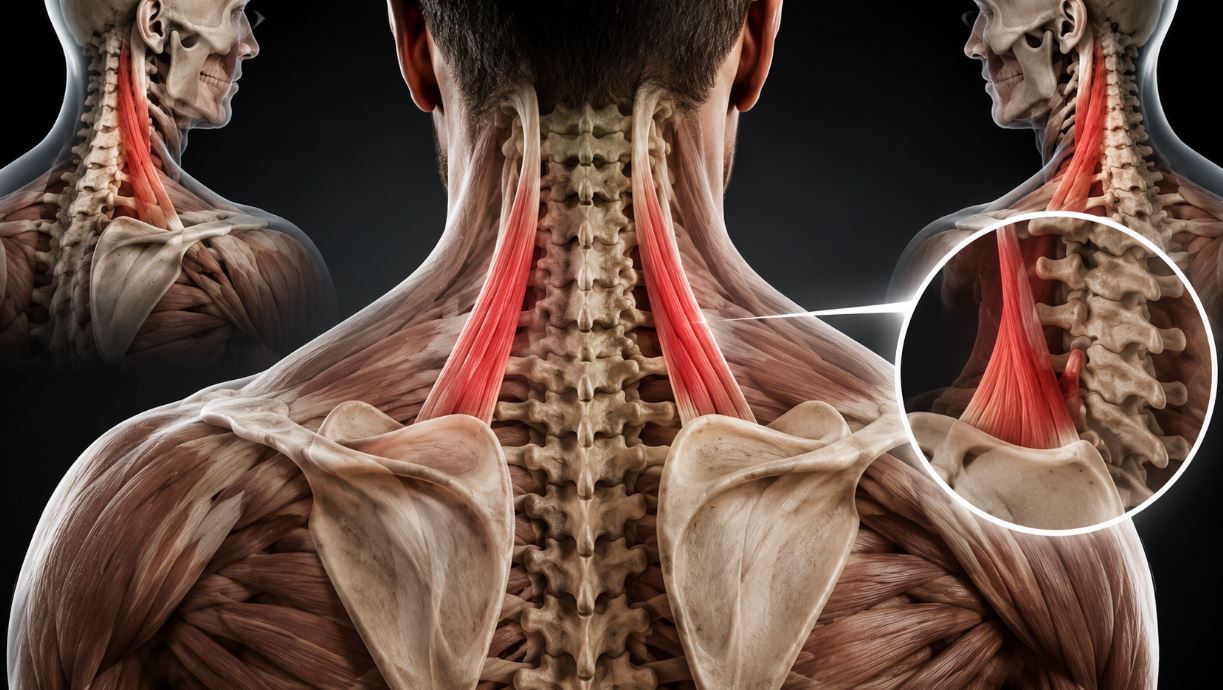
Named directly for what it does — “levator” means “raiser” and “scapulae” means “of the shoulder blade” — the levator scapulae is one of the most commonly tight, tension-holding muscles in the entire body, yet it’s almost never deliberately trained by lifters. Understanding the functional anatomy of the levator scapulae explains why this slender neck-to-shoulder muscle is so frequently the source of nagging tightness between the neck and shoulder, and why its relationship to posture matters more than its relationship to any specific exercise.
Quick Answer
The levator scapulae is a slender, strap-like muscle running from the upper cervical spine down to the shoulder blade. Its primary function is elevating the scapula, working alongside the upper trapezius, and when the scapula is fixed in place, it assists in bending and extending the neck. It’s one of the most common sites of chronic muscular tension in the body, closely linked to forward head posture, desk work, and stress-related tightness.
| Muscle type | Slender, strap-like muscle of the neck and upper back |
|---|---|
| Primary functions | Scapular elevation |
| Secondary functions | Neck lateral flexion and extension, downward rotation of the scapula |
| Innervation | Dorsal scapular nerve (C5) and direct branches of cervical nerves C3–C4 |
| Blood supply | Transverse and ascending cervical arteries, dorsal scapular artery |
| Common exercises | Shrugs, neck stretches, postural correction work |
| Main bodybuilding role | Neck and shoulder tension management, postural support |

Overview
The levator scapulae runs diagonally from the side of the neck down to the upper corner of the scapula, sitting partially beneath the sternocleidomastoid at the top and beneath the trapezius at the bottom — only its middle portion remains uncovered and directly palpable. Along with the rhomboids, it belongs to a small functional group of muscles responsible for scapular positioning and stabilization.
Unlike most muscles covered in a bodybuilding context, the levator scapulae isn’t really a muscle lifters train for size or strength — it’s a muscle they need to understand for tension management and postural health. To see how it fits into the rest of your muscular system, check out our interactive muscle anatomy tool.
Anatomy & Location: The Functional Anatomy of the Levator Scapulae
The levator scapulae is a long, slender, strap-like muscle located at the side and back of the neck. Its name is a direct description of its job: “levator” comes from the Latin for “raiser,” and “scapulae” refers to the shoulder blade — literally, the “raiser of the shoulder blade.”
Characteristics at a Glance
| Characteristic | Value |
|---|---|
| Shape | Long, slender, strap-like |
| Location | Side of the neck, running down to the upper shoulder blade |
| Visibility | Only the middle third is uncovered; the rest lies beneath the sternocleidomastoid and trapezius |
| Crosses | Cervical spine, scapulothoracic joint |

Origin, Insertion, Innervation & Blood Supply
For a broader explanation of these anatomical terms, see our guide to muscle anatomy basics: origin, insertion, and innervation.
| Attribute | Detail |
|---|---|
| Origin | Posterior tubercles of the transverse processes of the C1–C4 vertebrae |
| Insertion | Superior angle and upper medial border of the scapula |
| Innervation | Dorsal scapular nerve (C5) and direct branches from cervical nerves C3–C4 |
| Blood supply | Transverse and ascending cervical arteries, with contributions from the dorsal scapular artery |
According to StatPearls’ anatomical reference on the levator scapulae, this muscle shares its dorsal scapular nerve supply with the rhomboid major and minor, and together these three muscles are considered periscapular stabilizing muscles that work dynamically as a group. Notably, the levator scapulae has a more complex nerve supply than the rhomboids alone: Kenhub’s anatomical reference on the levator scapulae confirms it also receives direct branches from the C3 and C4 spinal nerves in addition to the dorsal scapular nerve, meaning it doesn’t rely on a single nerve pathway the way some neighboring muscles do.
Function
The levator scapulae’s primary role is scapular elevation — lifting the shoulder blade upward, the same basic motion trained by a shrug, working alongside the upper trapezius to perform this action. It also contributes to downward rotation of the scapula. When the scapula is fixed in place (rather than the neck), the muscle’s action reverses: unilateral contraction produces lateral flexion of the neck to the same side, while bilateral contraction assists in neck extension. The muscle also plays a stabilizing role in preventing the shoulder girdle from being pulled downward when carrying a heavy load, such as a suitcase or a loaded backpack.
This dual role — moving the scapula when the neck is fixed and moving the neck when the scapula is fixed — is a key part of the levator scapulae’s functional anatomy, making it relevant to so many everyday postures and movements, not just deliberate exercise.
Synergists & Antagonists
Synergists (muscles that work alongside the levator scapulae to help produce the same movement):
- Trapezius (upper fibers) — the primary partner in scapular elevation
- Rhomboid muscles — assist in scapular stabilization and share part of the same nerve supply
Antagonist (the muscle group that opposes the levator scapulae’s action, working in the opposite direction):
- Serratus anterior and trapezius (lower fibers) — perform scapular depression and upward rotation, directly opposing the levator scapulae’s elevation and downward rotation actions

Common Exercises
Because the levator scapulae is rarely a muscle lifters train directly, most of its relevant “exercises” fall into two categories: shrug variations that train scapular elevation alongside the upper traps, and stretching or mobility work aimed at managing chronic tightness.
| Exercise | Role of the Levator Scapulae |
|---|---|
| Barbell shrug | Major contributor |
| Dumbbell shrug | Major contributor |
| Cable shrug | Major contributor |
| Levator scapulae stretch | Direct mobility target |
Bodybuilder’s Take
“Why does this muscle feel tight almost all the time, even on days I don’t train?” This is extremely common, and it usually has little to do with training volume at all. According to Physiopedia’s reference on the levator scapulae, research has linked forward head posture — the kind associated with prolonged desk work and phone use — to increased co-contraction of the levator scapulae as it works to control neck extension from an already lengthened position. Over time, this chronic low-level demand is exactly the kind of pattern that produces the persistent tightness so many people feel at the base of the neck.
“Is it worth doing dedicated exercises for this muscle?” Not really, at least not in the traditional strength-training sense. The levator scapulae gets meaningful indirect work from shrug variations already common in most back and trap routines. Where it genuinely benefits from dedicated attention is in mobility and tension management — gentle stretching, posture awareness, and addressing the habits (like prolonged forward-head posture) that keep it chronically overworked.
“Can tightness here actually cause headaches?” Yes, and this connection is worth taking seriously if you experience recurring tension-type headaches. Research has associated increased levator scapulae tightness from forward head posture with cervicogenic headaches — headaches originating from neck-related musculoskeletal dysfunction rather than a primary headache disorder.
“What actually helps besides stretching?” Beyond direct stretching, addressing underlying postural habits tends to produce more lasting relief than stretching alone. This means paying attention to screen height and desk setup, taking regular breaks from prolonged forward-head positions, and being mindful of habits like cradling a phone between the ear and shoulder, which places sustained, asymmetric demands directly on this muscle.
Common beginner mistakes:
- Assuming persistent neck-shoulder tightness requires more strengthening, when posture correction and mobility work are usually the more relevant interventions
- Ignoring forward head posture during long periods of desk work or phone use, allowing chronic low-level tension to build up over time
- Carrying heavy bags consistently on one shoulder, which places asymmetric, sustained demand on the muscle
Common Conditions
This section is educational and should not replace professional medical advice.
The levator scapulae is one of the most common sites of chronic muscular tension and trigger points in the body, frequently linked to habitual causes like carrying heavy shoulder bags, prolonged shoulder-hiking while sitting at a desk, and sleeping without adequate head and neck support. Because the dorsal scapular nerve also innervates this muscle, entrapment of the nerve (typically at the middle scalene muscle in the neck) can contribute to neck and shoulder discomfort in the same region. Chronic tightness here has also been associated with cervicogenic headaches, particularly in people with pronounced forward head posture. Persistent neck or shoulder pain, especially pain accompanied by headaches or radiating symptoms, should be evaluated by a healthcare professional rather than treated on your own.
Common Myths
A clear grasp of the functional anatomy of the levator scapulae helps clarify most of the confusion about why this muscle feels the way it does and what actually helps it.
Myth: The levator scapulae needs dedicated strengthening exercises like any other muscle. For most lifters, shrug variations already provide adequate indirect training. This muscle more often needs mobility and tension management than additional strengthening.
Myth: Neck and shoulder tightness always means the muscle is weak. Chronic levator scapulae tightness is frequently a response to sustained postural demand, such as forward head posture, rather than a sign of insufficient strength.
Myth: The levator scapulae is only relevant to physical therapy, not general fitness. Because it’s so frequently implicated in posture-related tightness and even headaches, understanding this muscle is genuinely useful for anyone who spends significant time at a desk, regardless of their training goals.
Key Takeaways
- The levator scapulae’s main job is scapular elevation, working alongside the upper trapezius.
- It has a dual nerve supply — the dorsal scapular nerve plus direct branches from C3–C4.
- Chronic tightness here is strongly linked to forward head posture, not muscle weakness.
- Research links levator scapulae tightness from forward head posture to cervicogenic headaches.
- Most lifters benefit more from stretching and posture correction here than from added strengthening.
Frequently Asked Questions
What is the main function of the levator scapulae?
Its main job is elevating the scapula, working alongside the upper trapezius, along with assisting neck lateral flexion and extension when the scapula is fixed in place.
Why does my levator scapulae always feel tight?
This is often related to forward head posture, which forces the muscle to work harder to control neck extension from an already lengthened position, leading to chronic tension over time.
Do I need to train the levator scapulae directly?
Usually not for strength. Shrug variations already provide adequate indirect training, and this muscle typically benefits more from stretching and posture correction than additional strengthening.
Can levator scapulae tightness cause headaches?
Yes, research has associated levator scapulae tightness related to forward head posture with cervicogenic headaches, which originate from neck-related musculoskeletal dysfunction.
Is the levator scapulae part of the rotator cuff?
No. It’s part of a separate group of scapular positioning muscles alongside the rhomboids and trapezius, unrelated to the four rotator cuff muscles.
Sources & References
Every claim in this guide is grounded in anatomical references and published research. Explore the primary sources below.
