



Introduction
Bones and muscles work together every time you walk, lift, jump, or simply stand. Yet they are two completely different types of living tissue, with distinct structures, functions, and ways of responding to exercise. Muscles generate force and movement; bones provide the rigid framework that supports the body and withstands those forces.
Many people wonder whether bone is stronger than muscle, which tissue grows faster, or whether lifting weights benefits only muscle. The answers are more interesting than most realize, because bone and muscle constantly communicate and adapt to each other.
This guide compares bone and muscle anatomy and function, explores how each responds to resistance training, and answers common questions about strength, growth, healing, and long-term health. For more, see our guides on the human skeletal system, bone remodeling, and bone adaptation to training.
Bone vs Muscle: Quick Comparison
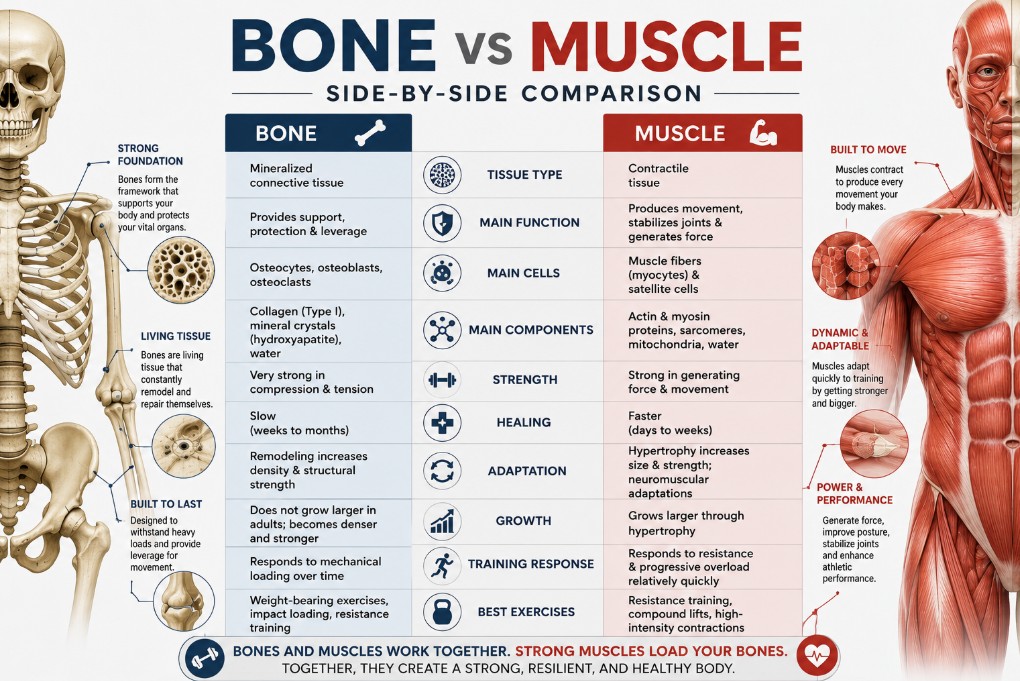
Bones and muscles are both essential for movement, but they play very different roles. The table below summarizes their key differences.
| Feature | Bone | Muscle |
|---|---|---|
| Tissue Type | Connective tissue | Contractile tissue |
| Primary Function | Support, protection, mineral storage, blood cell production | Produce movement and generate force |
| Main Components | Collagen, calcium phosphate, living bone cells | Muscle fibers, actin and myosin, connective tissue |
| Main Cells | Osteocytes, osteoblasts, osteoclasts | Muscle fibers (myocytes), satellite cells |
| Can It Adapt to Training? | Yes, through bone remodeling and increased density | Yes, through hypertrophy and neural adaptations |
| How Fast Does It Adapt? | Months to years | Days to weeks |
| Can It Repair Itself? | Yes, but slowly | Yes, usually faster than bone |
| Blood Supply | Rich blood supply | Rich blood supply |
| Storage Function | Stores calcium and phosphorus | Stores glycogen |
| Primary Role During Exercise | Provides leverage, withstands loading | Generates force to move the skeleton |
What Is Bone?
Bone is a specialized living connective tissue that forms the body’s structural framework. Far from being inert, it’s a dynamic tissue constantly broken down and rebuilt through bone remodeling, maintaining strength and adapting to mechanical demands.
Beyond support, bones protect vital organs, provide attachment points for muscles, store calcium and phosphorus, and house the marrow that produces blood cells, making the skeleton an active organ system.
Bone tissue combines a collagen-rich matrix with calcium phosphate crystals, giving it both strength and flexibility. Three cell types maintain it: osteoblasts, which build bone; osteoclasts, which break it down; and osteocytes, the skeleton’s primary mechanosensors, detecting strain and coordinating adaptation.
Unlike muscle, bone doesn’t contract — it’s rigid, designed to withstand compressive, tensile, and bending forces while serving as a lever for muscle action. Its ability to adapt to repeated loading is exactly why resistance training improves bone strength and density.
What Is Muscle?
Muscle is a specialized contractile tissue that produces movement by generating force. Unlike bone, muscle actively contracts to move the skeleton, maintain posture, stabilize joints, and produce heat, working closely with bones, tendons, and the nervous system.
The body contains more than 600 skeletal muscles, roughly 40% of total body weight in healthy adults. Each muscle is built from thousands of fibers (myocytes) containing the contractile proteins actin and myosin, which slide past each other when stimulated by nerve impulses, shortening the muscle and transmitting force to bone through tendons.
Skeletal muscle also contains satellite cells — stem cells that activate after resistance training to repair damaged fibers and support hypertrophy, the increase in muscle size from consistent strength training.
Where bone adapts mainly by becoming denser through remodeling, muscle adapts by growing in cross-sectional area, improving neuromuscular coordination, and producing more force. These changes happen fast, which is why noticeable strength and size gains often appear within weeks, while meaningful bone changes take months.
Which Is Stronger: Bone or Muscle?
It depends on what you mean by “stronger.” Bone and muscle are built for different jobs, so comparing them directly is like comparing steel beams to hydraulic engines. Therefore, bone resists external forces exceptionally well; muscle is specialized for generating force and movement.
Bone is one of the strongest materials in the body. Its mineralized structure gives cortical bone a compressive strength in the range of roughly 70–200 MPa, letting the skeleton support body weight, absorb impact, and protect organs during everyday life and intense exercise.
Muscle isn’t built to resist external loads the same way. Instead, it generates force through the interaction of actin and myosin. During sprinting, jumping, or lifting, skeletal muscle produces the forces that move bones, stabilize joints, and control body position. Without muscle, bone would be motionless.
Rather than competing, the two function as one system. Strong muscles place greater loads on bone, stimulating remodeling and increasing bone strength over time, while strong bones give muscles a stable base to generate force from. Together, they’re the foundation of movement, performance, and lifelong musculoskeletal health.
Key Point: Bone is stronger at resisting mechanical loads; muscle is stronger at generating force. Each performs a unique role, and optimal performance depends on both working together.
How Do Bones and Muscles Adapt to Training?
Both tissues respond to resistance training, but very differently. Muscle adapts by growing larger and more efficient through hypertrophy and neural improvements; bone adapts by increasing strength through remodeling, a process that optimizes structure in response to repeated loading.
Muscle adaptation is fast. Early strength gains, even in the first few weeks, come mostly from better brain-muscle coordination. As training continues, fibers grow through hypertrophy, generating more force — changes that can become noticeable within six to eight weeks depending on experience, nutrition, and recovery.
Bone adaptation is far slower. Every heavy squat, deadlift, or jump creates small strains in the skeleton. Osteocytes detect these strains and signal osteoblasts and osteoclasts to remodel the bone. Over months of consistent loading, this raises bone mineral density and improves resistance to future stress — which is why meaningful bone gains typically require several months of training.
One of the biggest differences is speed: muscle can grow and shrink relatively quickly, while bone changes much more slowly but often holds its adaptations longer. That’s why consistent, long-term training matters for both.
Though their mechanisms differ, the two tissues constantly influence each other. Stronger muscles generate greater force during movement, increasing the load on bone; stronger bones, in turn, give muscles a more stable base to work from. This relationship keeps both developing together with progressive training.
Key Point: Muscle adapts within weeks by growing stronger and larger; bone adapts over months through remodeling that gradually improves density and structure. Both are essential for performance, injury prevention, and healthy aging.
Bone Growth vs Muscle Growth
Both tissues get stronger with resistance training, but through fundamentally different processes. Muscle grows through hypertrophy; bone strengthens through remodeling and structural adaptation, explaining why muscle changes faster and why both need consistent loading to stay healthy.
Hypertrophy occurs when training stresses muscle fibers enough to cause microscopic damage that stimulates repair and growth. During recovery, satellite cells repair the fibers and new contractile proteins are added, increasing cross-sectional area and force capacity. With progressive overload, adequate protein, and recovery, noticeable size increases can appear within weeks.
Bone responds very differently. Adult bones generally don’t get larger the way muscles do — instead, they continuously replace old tissue through remodeling. Mechanical loading from lifting, jumping, or resistance training triggers osteocytes to detect strain, prompting osteoblasts to build new bone where needed and osteoclasts to clear damaged tissue. Over time, this improves mineral density and internal architecture without dramatically changing the bone’s external size.
The rate of adaptation also differs sharply. Muscle hypertrophy can happen relatively quickly with optimized training and nutrition, while measurable bone density improvements often take several months. The reverse is also true: muscle can shrink quickly with inactivity, while bone loss is usually more gradual, though it can accelerate with aging, immobilization, or certain conditions.
Both tissues remain highly adaptable throughout life. Muscle lets you produce more force; stronger bone provides the framework to transmit that force safely. Long-term resistance training benefits both simultaneously.
Key Point: Muscle grows primarily through hypertrophy, increasing fiber size; bone strengthens through continuous remodeling that improves density and internal structure. Bone adaptation is slower, but essential for long-term skeletal health.
Which Heals Faster: Bone or Muscle?
Both tissues repair themselves impressively after injury, but the process differs considerably. In general, muscle heals faster than bone, mainly due to its richer blood supply and different repair mechanism. Injury severity, age, nutrition, and overall health also affect recovery time.
Minor muscle strains often heal within days to weeks; severe tears may need months of rehab. Repair begins almost immediately, as inflammatory cells clear damaged tissue and satellite cells activate to regenerate fibers. With proper rest, nutrition, and rehab, muscle usually recovers well, though severe injuries can leave scar tissue that affects function.
Bone healing is slower and more structured. After a fracture, a blood clot forms and is gradually replaced by a soft callus, then a hard bony callus, which remodeling then reshapes over months until it resembles the original bone. Depending on the fracture, full healing can take six weeks to several months, with remodeling continuing well after basic stability returns.
Although muscle usually recovers faster, both tissues depend on similar factors: adequate protein, sufficient calories, calcium and vitamin D, quality sleep, and appropriate activity. Smoking, excess alcohol, and prolonged inactivity can significantly delay healing in both.
Key Point: Muscle generally heals faster than bone due to its richer blood supply and faster regeneration. Bone healing is a longer, multi-stage process built around callus formation and remodeling, so patience and proper rehab matter for both.
How Bones and Muscles Work Together
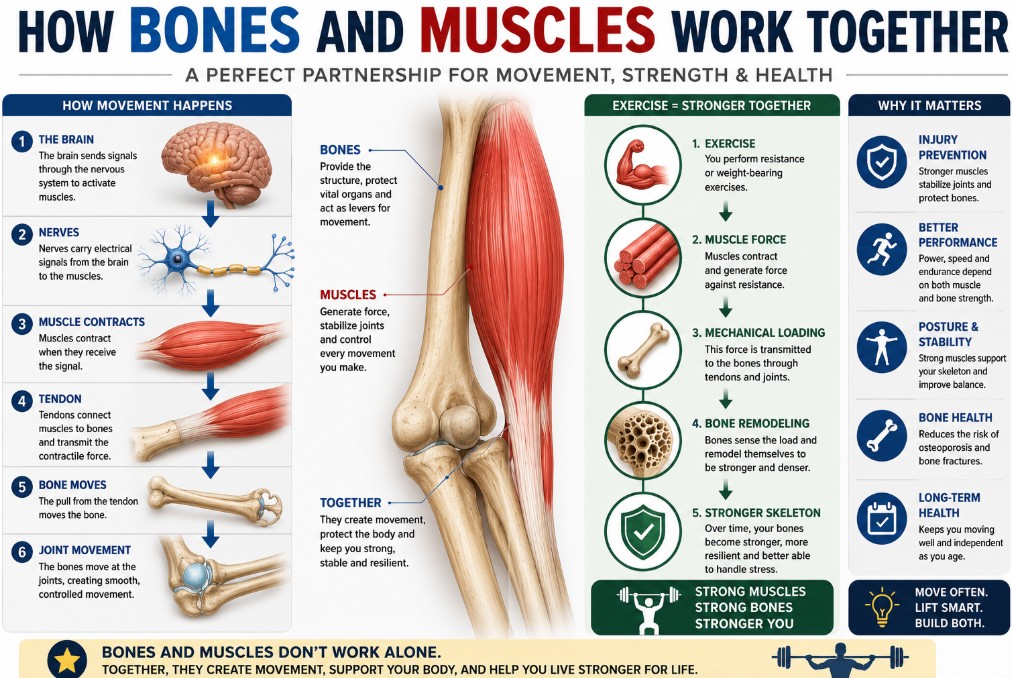
Bone and muscle are often discussed separately, but they function as one integrated musculoskeletal system. Neither works well without the other: bone provides the rigid levers; muscle generates the force to move them. Tendons connect the two, transmitting muscle force directly into bone.
Every voluntary movement, from walking to a heavy squat or deadlift, depends on this partnership. A contracting muscle pulls on a tendon, which pulls on bone, producing movement around a joint. Bone, in turn, provides the stable attachment points muscle needs to generate force efficiently.
The relationship goes beyond movement. Strong muscles increase mechanical loading on bone, stimulating remodeling and greater density; stronger bone, in turn, provides a more resilient framework capable of handling heavier training loads over time.
Research also shows the two communicate biochemically. Bone releases signaling molecules called osteokines, while muscle produces myokines during contraction, molecules that influence each other’s growth, metabolism, and repair — meaning bone and muscle function as interconnected endocrine tissues, not just mechanical partners.
This is why resistance training is one of the most effective ways to improve both systems at once. Compound lifts like squats, deadlifts, overhead presses, and loaded carries strengthen muscle while providing the mechanical stimulus bone needs. Combined with adequate protein, calcium, and vitamin D, these adaptations support lifelong mobility and reduced injury risk.
Key Point: Bone and muscle form an inseparable partnership — muscle generates force, bone provides support and leverage, tendons connect the two, and biochemical signaling lets both adapt together. Training one benefits the other.
Can You Build Strong Bones and Muscles at the Same Time?
Yes. Resistance training is one of the few exercise forms that improves muscle strength and bone health simultaneously. Though they adapt through different mechanisms, the same stimulus — progressive mechanical loading — benefits both.
When you lift, muscles contract to move the load while those same contractions stress bone through tendons and joints. This loading stimulates muscle protein synthesis (driving hypertrophy) while activating bone remodeling, gradually building density and strength.
Compound exercises are especially effective because they recruit large muscle groups while exposing the skeleton to substantial load. Squats, deadlifts, lunges, overhead presses, and loaded carries create ideal conditions for adaptation in both tissues, and impact activities like jumping add extra osteogenic stimulus.
Nutrition matters equally for both. Muscle needs adequate protein to repair and grow; bone needs calcium, vitamin D, phosphorus, magnesium, and protein to maintain structure and mineral content. Without proper nutrition, recovery and adaptation both suffer.
Age doesn’t eliminate this ability. Adaptation slows with time, but research consistently shows children, adults, and older individuals can all build muscle and stimulate bone with appropriately designed resistance training. Consistency, progressive overload, and recovery remain the key factors at any age.
Key Point: Resistance training strengthens muscle and bone simultaneously. Muscle adapts through hypertrophy, bone through remodeling, but both depend on progressive loading, nutrition, and consistent training.
Common Myths About Bones and Muscles
Plenty of misconceptions surround how bone and muscle function, grow, and respond to exercise. Knowing the facts helps you train more effectively and make better long-term decisions.
Myth 1: Bones Are Dead Tissue
False. Bone is a living, active tissue with specialized cells, blood vessels, and nerves. It continuously undergoes remodeling, replacing old tissue with new to maintain strength and adapt to loading.
Myth 2: Only Muscles Benefit From Strength Training
False. Resistance training is known for building muscle, but it also strengthens bone by stimulating remodeling. Heavy, weight-bearing exercise increases mechanical stress on the skeleton, making bone denser and more fracture-resistant over time.
Myth 3: Bones Stop Changing After Adulthood
False. Bones stop growing in length once growth plates close, but they keep remodeling for life. Regular resistance training, impact exercise, and good nutrition can improve bone strength well into older adulthood.
Myth 4: Bigger Muscles Always Mean Stronger Bones
Not necessarily. Muscle size and bone strength are related but don’t always increase at the same rate. Bone adapts more slowly, and nutrition, hormones, genetics, and exercise type all influence outcomes.
Myth 5: If You Stop Training, Only Your Muscles Get Weaker
False. Both tissues gradually lose their adaptations when loading decreases. Muscle mass typically declines faster, while bone density drops more gradually — but staying active matters for preserving both.
Myth 6: Calcium Alone Is Enough for Strong Bones
False. Calcium is essential, but bone also needs adequate vitamin D, protein, magnesium, phosphorus, and vitamin K, along with regular weight-bearing exercise. Nutrition alone, without loading, can’t maximize bone strength.
Myth 7: Cardio Is Just as Effective as Resistance Training for Bone Health
Not always. Running and jumping can benefit bone, but resistance training generally provides a stronger osteogenic stimulus because it places greater mechanical loads on the skeleton. Non-weight-bearing activities like swimming and cycling offer real cardiovascular benefits but do far less for bone density.
Key Point: Bone and muscle are living tissues that continuously adapt to how they’re used. Regular resistance training, proper nutrition, and lifelong activity remain the most effective strategies for keeping both strong.
Interesting Facts About Bones and Muscles
- Bone is remarkably strong for its weight. Its compressive strength allows it to support the body and withstand the forces generated during running, jumping, and lifting.
- Skeletal muscle makes up about 40% of body weight. In healthy adults, it’s the largest tissue system involved in movement and a major contributor to energy expenditure.
- Bones are living organs, not lifeless structures. They contain blood vessels, nerves, and specialized cells that continuously remove old bone and replace it with new tissue.
- Muscles can get stronger before they get bigger. In the first few weeks of training, most strength gains come from improved nervous system efficiency rather than real hypertrophy.
- Bone constantly responds to the forces placed on it. Weight-bearing and resistance exercise stimulate remodeling, increasing density and strength over time.
- The skeleton renews itself over time. Individual bones stay in place, but old tissue is continuously replaced through remodeling, meaning much of your skeleton is gradually rebuilt across your lifetime.
- Muscle and bone communicate chemically, not just mechanically. Muscle releases myokines; bone produces osteokines — allowing the two to influence each other’s growth, metabolism, and repair.
- Bone excels in compression; muscle excels at generating force. Bone resists external loads, while muscle creates the forces that move the skeleton and stabilize joints.
- Resistance training benefits both tissues at once. The same workout that triggers muscle hypertrophy also stresses bone enough to stimulate remodeling.
- Both tissues weaken without regular use. Prolonged inactivity, immobilization, or aging leads to muscle atrophy and gradual bone loss — a good reminder of why lifelong activity matters for both.
