
Introduction
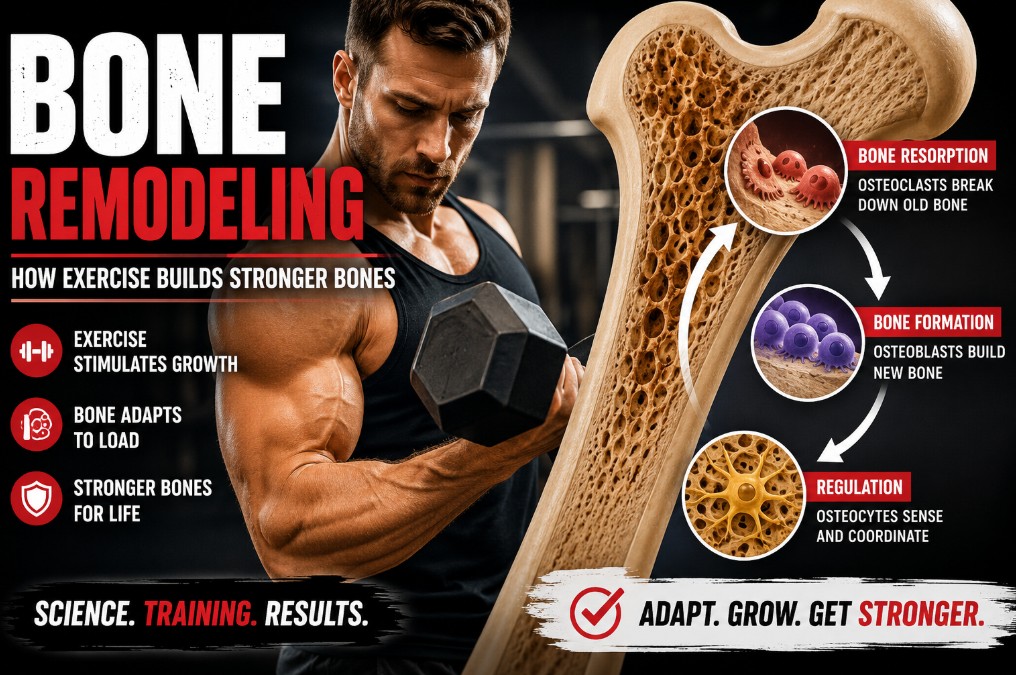
The bone you’re squatting on today isn’t quite the same bone you were squatting on a year ago. Bone tissue is constantly being broken down and rebuilt throughout your entire life, in a process called bone remodeling — and how you train has a direct, measurable effect on how that process unfolds.
Most lifters know that muscle adapts to training. Fewer realize that bone does too, through its own dedicated biological process that’s slower, more conservative, and governed by different rules than muscle growth. Understanding bone remodeling — what it actually is, how it works at the cellular level, and how long it realistically takes — changes how you think about training volume, recovery, injury risk, and long-term bone health.
This guide covers exactly that: what bone remodeling is, how it differs from the bone modeling that happens during childhood growth, the cells and cycle behind it, how mechanical loading from training triggers it, and what you can actually do to support it. For a broader look at how bones function as a complete system, see our guide to the human skeletal system, explore the types of bones that make up your skeleton, or click through our interactive human skeleton tool to see exactly where each bone sits.
What Is Bone Remodeling?
Bone remodeling is the lifelong process by which the body continuously removes old or damaged bone tissue and replaces it with new bone. It happens throughout your entire skeleton, all the time, whether you’re training or not — but the rate and location of remodeling is directly influenced by the mechanical stress your bones experience.
Two types of cells drive this process in opposite directions: osteoclasts break down old bone tissue, while osteoblasts rebuild it. In healthy adult bone, these two processes stay roughly balanced — for every bit of bone removed, a matching amount gets rebuilt. That balance is what keeps your skeleton strong and stable over time, and it’s also exactly the balance that shifts in your favor when you train consistently, and shifts against you when bone isn’t loaded enough, or when nutrition and hormones can’t support the rebuilding side of the equation.
This isn’t a niche biological curiosity. Bone remodeling and its response to mechanical loading underlie everything from why astronauts lose bone density in zero gravity to why resistance training is one of the most effective tools for maintaining bone health.
Modeling vs. Remodeling: What’s the Difference?
“Modeling” and “remodeling” sound like the same word, and plenty of articles online use them interchangeably. They’re not the same process, and the distinction actually matters.
Bone modeling happens primarily during childhood and adolescence. It’s the process responsible for bones growing longer, thicker, and changing shape as a person matures — osteoblasts and osteoclasts work independently, at different locations on the bone, actively sculpting its size and shape over time. Modeling is what allows a long bone to grow both longer and wider during growth, and it’s largely responsible for how much peak bone mass a person builds by early adulthood.
Bone remodeling, by contrast, is what happens for the rest of your life. It doesn’t change a bone’s size or shape — it replaces old bone tissue with new bone tissue on the same surface, in the same location, using coordinated teams of cells working in sequence rather than independently. This is the process responsible for repairing microscopic damage, maintaining mineral balance, and adapting bone density to the loads you place on it as an adult.
The practical takeaway: your window for building peak bone mass through modeling closes by early adulthood, but your ability to strengthen existing bone through remodeling never does. It just requires a different, more targeted approach — which is exactly what the rest of this guide covers.
The Cells Behind Bone Remodeling
Bone remodeling depends on three cell types working in careful coordination:
- Osteoclasts — large, multinucleated cells that break down (resorb) old or damaged bone tissue. The average osteoclast lives for about 12 days before it’s replaced, after completing its resorption work.
- Osteoblasts — bone-building cells that move in once osteoclasts finish resorbing, laying down new bone matrix and mineralizing it. Some osteoblasts eventually become embedded in the bone they’ve built and mature into osteocytes; most others undergo programmed cell death once their job is done.
- Osteocytes — mature bone cells embedded throughout the bone matrix that act as the system’s mechanosensors. They detect mechanical strain from training and send the signals that recruit osteoclasts and osteoblasts to the right locations in the first place.
These three cell types work together inside a structure called the Basic Multicellular Unit (BMU) — essentially a small, temporary construction crew that forms at a specific site on a bone, resorbs a defined area, rebuilds it, then disbands. There are millions of these BMUs active across your skeleton at any given time, each one at a different stage of the remodeling cycle.
The Bone Remodeling Cycle, Step by Step
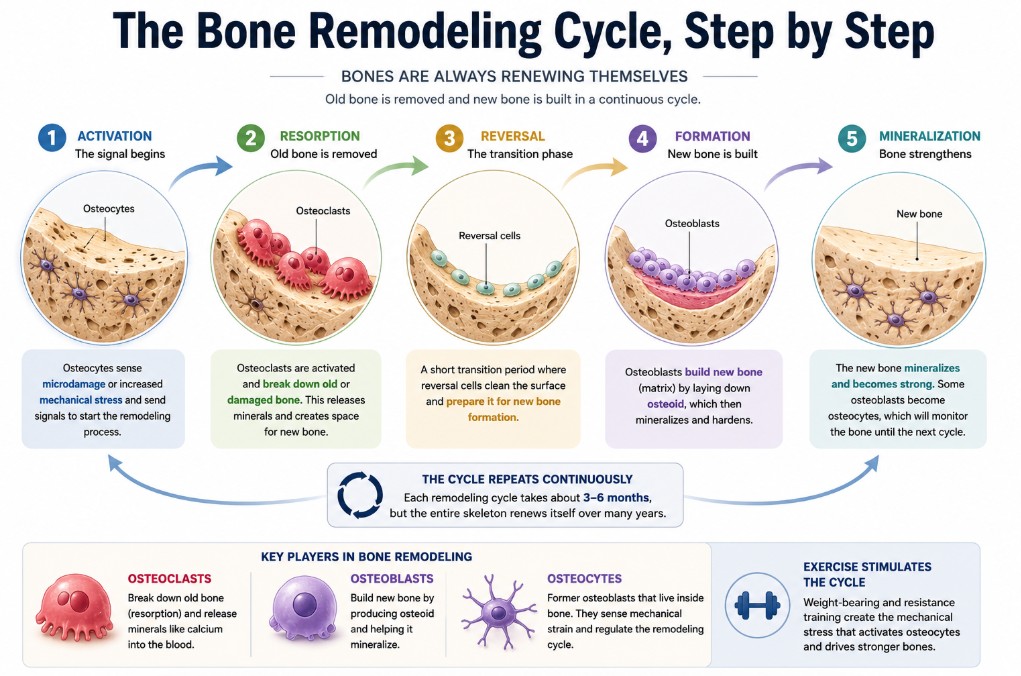
A single remodeling cycle at any one site on a bone follows six sequential phases:
- Quiescence — the resting state. Roughly 80–95% of bone surface sits in this inactive phase at any given moment.
- Activation — a signal, either direct mechanical strain detected by osteocytes or a hormonal trigger, initiates the remodeling process at a specific site.
- Resorption — osteoclasts arrive and begin breaking down old bone tissue, a process that typically takes two to four weeks.
- Reversal — a short transition period, roughly one to two weeks, during which resorption stops, and the site prepares for new bone formation.
- Formation — osteoblasts move in and rebuild the resorbed area with new bone matrix, a slower process that can take several months.
- Mineralization and termination — the newly formed bone matrix hardens as mineral is deposited, a process that can continue for months after the site returns to quiescence.
Put together, a single remodeling cycle at one site typically takes somewhere between three and six months from start to finish — dramatically slower than muscle protein turnover, which is a big part of why bone adaptations to training take so much longer to show up than strength or muscle gains do.
How Training Triggers Bone Remodeling
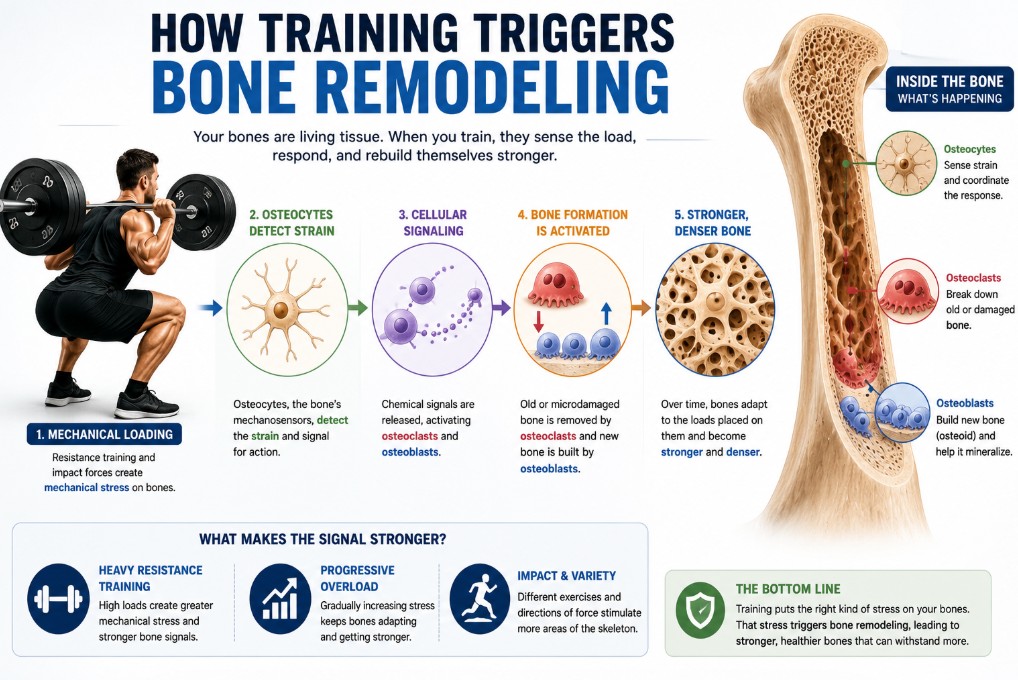
Bone remodeling isn’t random — it’s directed by the mechanical stress your skeleton actually experiences, a principle known as Wolff’s Law. Osteocytes act as strain sensors embedded throughout the bone matrix, detecting mechanical deformation and converting it into the biochemical signals that trigger targeted remodeling — a process called mechanotransduction.
In practical terms: when you load a bone above its accustomed baseline, through a heavy squat, a sprint, a jump, or any sufficiently forceful movement, the resulting strain signals osteocytes to recruit osteoblast activity specifically at that loading site. Do this consistently, and the bone responds by depositing additional mineral exactly where the stress occurred, gradually increasing density and structural strength in that specific region.
This is also why bone adaptation is highly site-specific. Loading your legs heavily doesn’t meaningfully strengthen the bones in your arms — the tissue only adapts to the demands it’s actually exposed to, which is the same underlying logic behind progressive overload for muscle: adaptation occurs only where the stimulus is applied.
How Long Does It Take for Bones to Adapt to Training?
Given that a single remodeling cycle takes three to six months, meaningful, measurable increases in bone mineral density from training don’t show up on the same timeline as strength gains. While you might notice an increase in strength within a few weeks of starting a new program, detectable improvements in bone mineral density from resistance training generally take several months to a year of consistent training to become measurable, with further gains accumulating over years of sustained training.
This mismatch in timelines is one of the most common reasons lifters underestimate how much resistance training benefits their skeleton. The biological signal appears at the cellular level almost immediately, but the measurable outcome takes far longer to catch up. It’s also part of why consistency over years, not intensity over weeks, is what actually builds denser bone meaningfully.
Best Types of Training for Bone Remodeling
Not all training stimulates bone remodeling equally. A few general patterns worth knowing:
- High-impact and high-force loading. Activities like jumping, sprinting, and heavy compound lifts (squats, deadlifts, presses) tend to produce the strongest osteogenic (bone-building) signal, because they create the largest, most rapid strain on bone.
- Progressive overload applies here too. The same principle that drives muscular adaptation applies to bone: a load that’s already familiar to the skeleton produces little additional remodeling signal. The load needs to progressively exceed what the bone has already adapted to.
- Novel loading patterns help. Bone tends to respond more strongly to loading it isn’t already accustomed to, which is part of why varying your training- different rep ranges, different movement patterns, occasional plyometric work- may provide an additional stimulus beyond simply adding more weight to the same lifts.
- Site-specific programming matters. Because remodeling is site-specific, a well-rounded program that loads the whole body (upper-body pressing and pulling, lower-body squatting and hinging, and some impact work) builds density more broadly than a program that neglects entire regions of the skeleton.
- Frequency and target areas matter. Resistance training performed at least twice weekly, targeting major muscle groups, the spine, and the hips, is specifically recommended by exercise physiology guidelines to maintain and improve bone health.
Low-impact steady-state cardio, by comparison, provides comparatively little osteogenic stimulus — useful for cardiovascular health, but not something to rely on as a primary strategy for bone density.
Best Exercises for Bone Remodeling
Since bone adaptation is site-specific, it helps to know which exercises load which bones actually. Here’s a quick reference:
| Exercise | Main Bones Loaded |
|---|---|
| Back Squat | Femur, pelvis, vertebral column |
| Deadlift | Vertebral column, pelvis, femur, tibia |
| Farmer’s Walk | Hand and wrist bones, humerus, vertebral column |
| Overhead Press | Humerus, scapula, clavicle |
| Jump Rope | Tibia, fibula, calcaneus |
| Walking | Femur, tibia, foot bones |
| Stair Climbing | Femur, tibia, patella |
Note that lower-impact activities like walking and stair climbing still provide a meaningful osteogenic signal, just a smaller one than heavy compound lifts or jumping — which is why they’re a reasonable addition to a program, but not a substitute for resistance training as the primary driver of bone density.
What Slows or Blocks Bone Remodeling
Several factors can shift the remodeling balance away from bone formation and toward net bone loss:
- Inactivity and bed rest. Without mechanical loading, osteocytes stop sending the signals that trigger bone formation, and resorption outpaces formation. This is the same mechanism behind the rapid bone loss seen in astronauts during spaceflight and in patients on extended bed rest.
- Low energy availability. Chronically under-fueling training, especially combined with high training volume, disrupts the hormonal environment bone formation depends on. This is formally recognized as Relative Energy Deficiency in Sport (RED-S), and bone health is among the most consistently affected systems.
- Overtraining. Programming that outpaces bone’s slower remodeling timeline (weeks for muscle vs. months for bone) is a common, preventable cause of stress fractures and other bone stress injuries. If this sounds familiar, our guide to signs and symptoms of overtraining covers this in more depth.
- Hormonal changes. Declining estrogen after menopause and low testosterone in men both shift the remodeling balance toward resorption, which is part of why age-related bone loss accelerates at these life stages.
- Aging in general. Bone remodeling becomes less efficient with age, even independent of hormonal changes, as formation gradually fails to keep pace with resorption.
- Nutrient deficiencies. Insufficient calcium, vitamin D, or protein, or chronic caloric restriction, all limit the raw materials and hormonal support that osteoblasts need to rebuild bone effectively.
How to Support Healthy Bone Remodeling
Supporting bone remodeling comes down to giving your body both the mechanical signal and the resources it needs to respond to that signal:
- Consistent resistance training — the single most controllable driver of the bone-building side of remodeling, particularly compound, weight-bearing movements.
- Adequate protein and calcium intake — bone matrix is roughly one-third collagen (a protein), and calcium is the primary mineral osteoblasts deposit during formation.
- Sufficient vitamin D — necessary for the body to actually absorb and use dietary calcium.
- Adequate energy availability — chronic under-eating relative to training demands undermines the hormonal environment remodeling depends on, regardless of how much you train.
- Sleep and recovery — much of the hormonal signaling that supports bone formation happens during sleep.
- Patience and consistency — given the three-to-six-month remodeling cycle, meaningful bone density changes are a long-term project, not something a few weeks of training will meaningfully move.
Why Bone Remodeling Matters for Lifters
Bone remodeling is the reason your skeleton can adapt to training. Every heavy squat, deadlift, jump, or loaded carry creates a mechanical signal that tells your bones to become stronger over time. The process is slow, but the results are long-lasting.
Stronger bones do more than reduce the risk of osteoporosis later in life. They also help your skeleton tolerate heavier loads, repair microscopic damage, and better withstand the repetitive stress of hard training. This lowers the risk of stress fractures and other overuse injuries that can interrupt progress.
Bone remodeling also becomes more important as you age. Muscle mass and bone density naturally decline over time, but regular resistance training helps slow both processes. You can’t stop aging, but you can influence how well your skeleton ages.
The key is consistency. Bone doesn’t adapt after a few workouts. It responds to months and years of progressive loading, adequate nutrition, and proper recovery. That’s why lifters who train intelligently for decades often maintain stronger bones than inactive people of the same age.
Think of bone remodeling as your skeleton’s version of muscle growth. Muscles become larger and stronger in response to training. Bones become denser, stronger, and better suited to the loads you place on them. Both adaptations work together to improve performance, reduce the risk of injury, and keep you training for years to come.
Interesting Facts About Bone Remodeling
- Your skeleton is constantly renewing itself. Although the exact timeline varies by bone, age, and health, much of the adult skeleton is replaced over roughly 10 years through continuous bone remodeling.
- Bone is living tissue. It may look solid and permanent, but your bones are constantly breaking down old tissue and building new bone throughout your life.
- Osteoclasts are unusual cells. Unlike most cells in the body, they contain multiple nuclei, allowing them to efficiently break down old bone tissue.
- Space causes rapid bone loss. Astronauts living in microgravity lose bone mineral density much faster than people on Earth because their skeletons are no longer exposed to normal mechanical loading.
- Heavy resistance training builds stronger bones. Research consistently shows that people who regularly perform weight-bearing and high-load exercises tend to have higher bone mineral density than sedentary individuals.
- Bones adapt only where they’re loaded. Heavy squats strengthen the bones of the hips, spine, and legs, while upper-body exercises primarily stimulate remodeling in the shoulders and arms.
- Bone adapts more slowly than muscle. You may notice strength gains within weeks, but measurable improvements in bone mineral density usually require several months of consistent training.
- Peak bone mass is built early in life. Most people reach their maximum bone mass by their late twenties or early thirties. After that, the goal shifts from building new bone to maintaining as much bone as possible through healthy lifestyle habits.
Conclusion
Bone remodeling never stops. It runs in the background every day, whether you train or not. Training just gives it a reason to build instead of merely maintain.
The process is slow. Think months, not weeks. Consistency matters more than intensity here.
Load your bones. Feed them well. Let them recover. Do this long enough, and your skeleton gets stronger right along with your muscles.
