
Introduction
The conventional deadlift is widely regarded as the most powerful strength-building exercise. Few movements challenge as many muscle groups simultaneously while demanding such high levels of coordination, stability, and force production. For bodybuilders, powerlifters, and serious strength athletes, the deadlift is more than an exercise — it is a structural foundation.
Although often labeled a “back exercise,” the conventional deadlift is, in fact, a full posterior chain movement. It integrates hip extension, knee extension, spinal stabilization, and grip strength into one coordinated lift. When performed correctly, it builds dense spinal erectors, thick glutes, powerful hamstrings, and a resilient upper back — making it a cornerstone of lower back development.
Other Names for the Conventional Deadlift
The conventional deadlift is sometimes referred to simply as the “regular deadlift” to distinguish it from sumo or Romanian variations. In powerlifting, it is commonly called the “competition deadlift” because it is one of the three official lifts. Some coaches also refer to it as the “floor pull” to emphasize its starting position from a dead stop.
Required Equipment
This exercise requires a precise setup because the bar path and stance width strongly influence mechanics. Small changes can significantly alter spinal stress and muscle recruitment.
- Olympic barbell
- Weight plates
- Flat lifting surface
- Optional lifting belt
- Optional chalk or straps
How to Perform the Conventional (Traditional) Deadlift
Proper execution is essential because this lift places substantial mechanical stress on the lumbar spine. Unlike isolation movements, technical errors here can quickly magnify spinal shear forces. Precision and control matter more than ego loading.
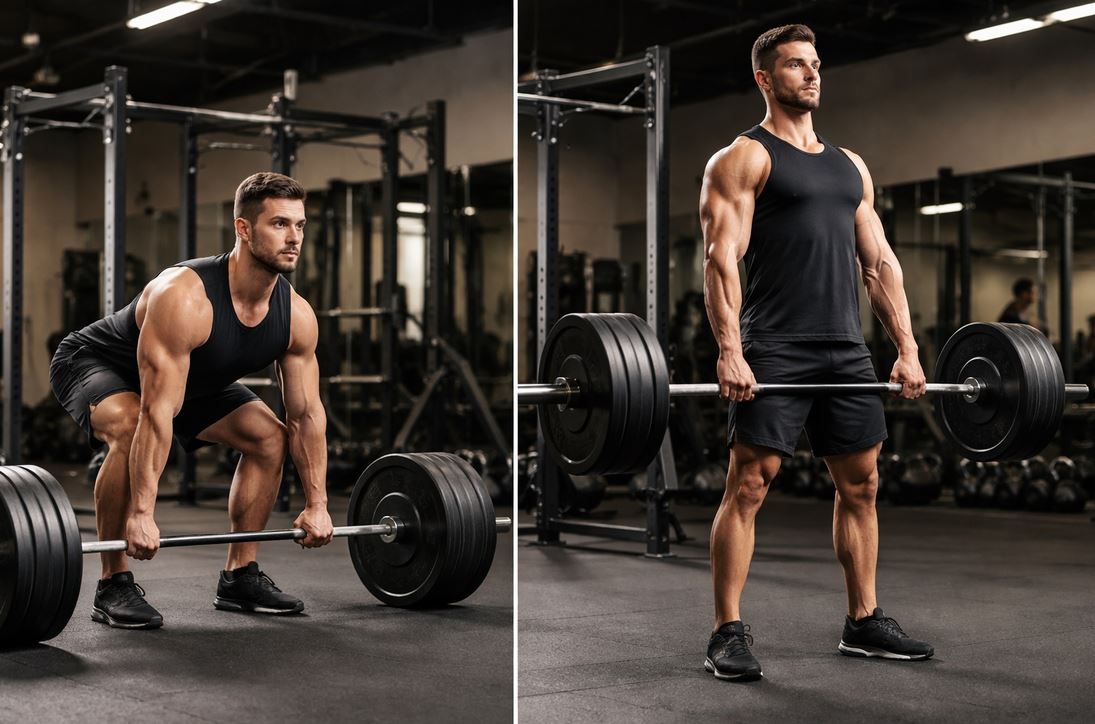
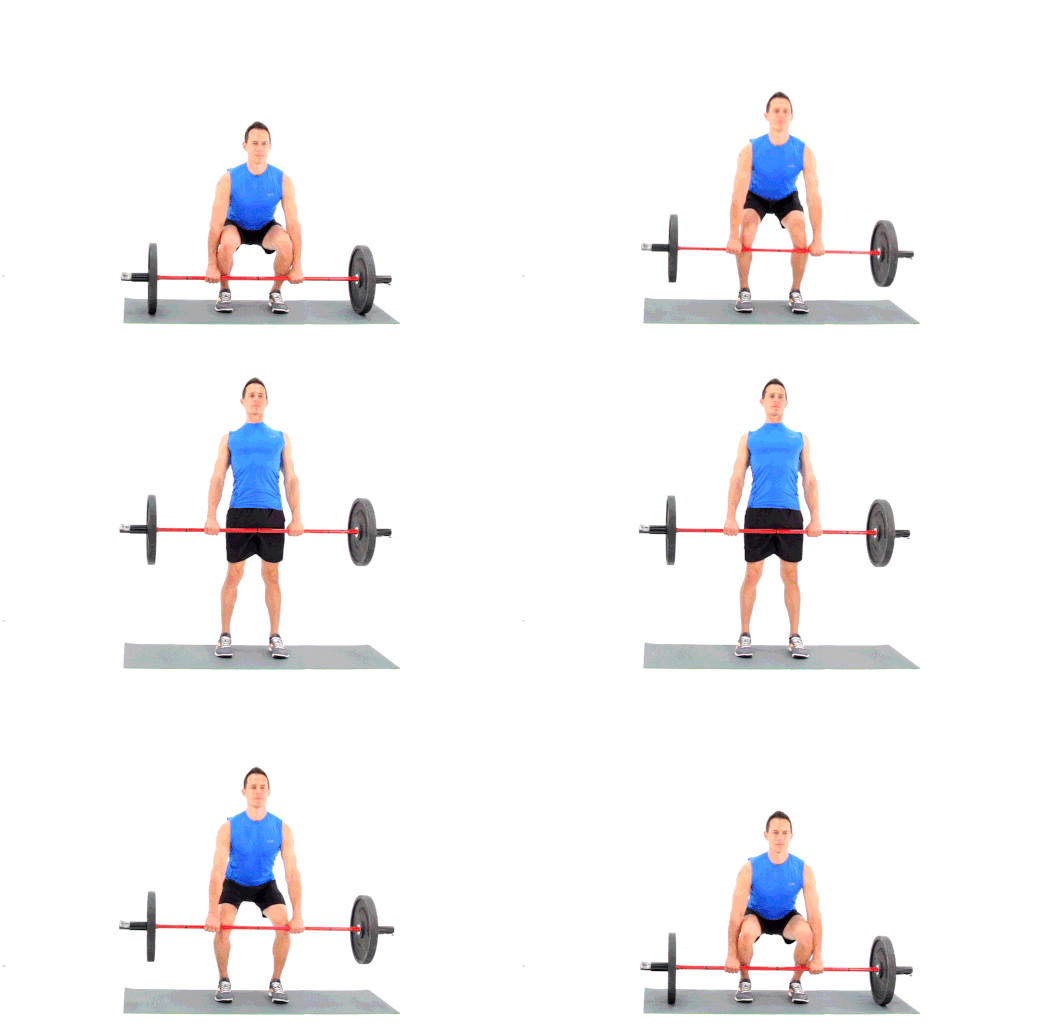
Starting Position
The setup determines the quality of the entire lift. A strong starting position minimizes unnecessary lumbar flexion and optimizes force transfer.
- Feet hip-width apart
- Bar positioned over the mid-foot
- Shins close to the bar
- Hips pushed back (hip hinge)
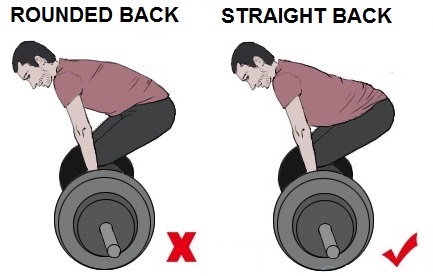
- Neutral spine maintained
- Shoulders slightly in front of the bar
- Chest lifted without overextending
Grip the bar just outside the knees using a double overhand, mixed, or hook grip. Before initiating the pull, create full-body tension by bracing the abdomen and engaging the lats.
Execution (Action Phase)
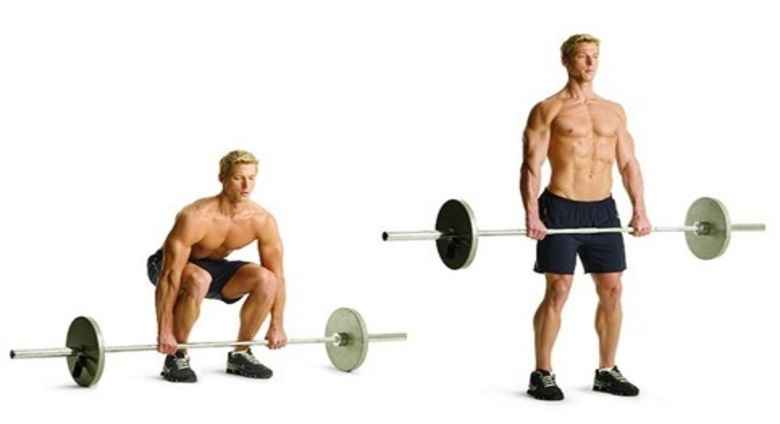
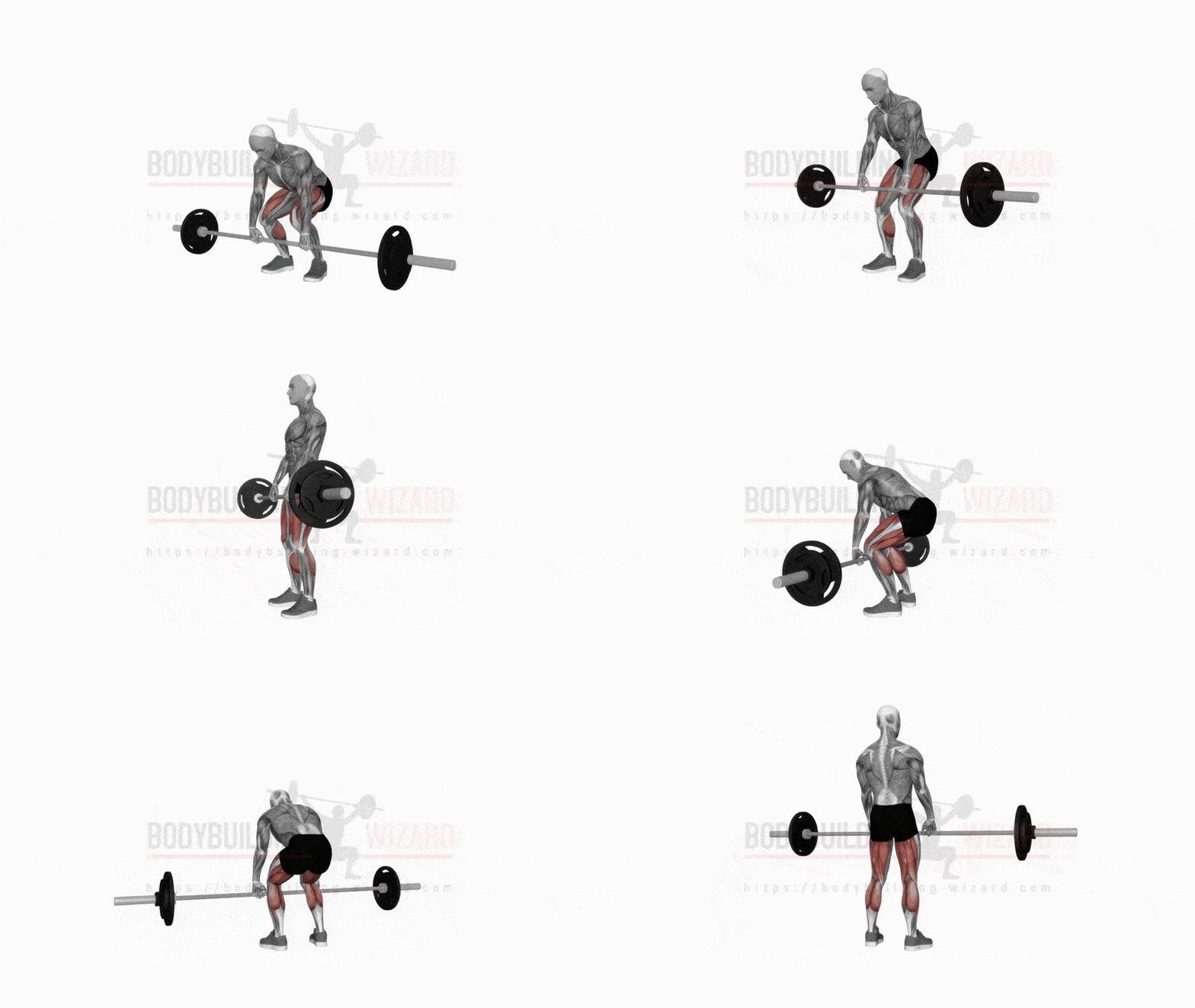
The deadlift begins from a dead stop on the floor, meaning there is no elastic rebound to assist the lift. This increases its strength-building potential but also demands maximal tension at initiation.
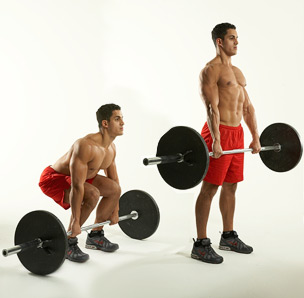
- Push the floor away with your legs
- Keep the bar close to your body
- Maintain a neutral lumbar spine
- Extend hips and knees simultaneously
- Finish with full hip extension (no hyperextension)
Once the bar passes the knees, hip extension becomes dominant. The glutes and spinal erectors complete the lockout while the upper back stabilizes the load. Lower the bar along the same path with control, hinging at the hips before bending the knees.
Technique Optimization Tips
Small refinements can drastically improve lower back safety and strength output. Because the conventional deadlift involves high spinal loading, technical discipline must be non-negotiable.
- Engage lats before lifting (imagine bending the bar)
- Keep the bar contact close to the shins and thighs
- Avoid jerking the bar from the floor
- Maintain controlled eccentric phase
- Use progressive overload conservatively
Quick Form Checklist
Before each working set, reviewing key cues improves consistency and reduces breakdown under fatigue.
- Neutral lumbar spine
- Bar over mid-foot
- Hips not too high or too low
- Chest proud but not overextended
- Controlled descent
Breathing & Bracing Mechanics
Breathing mechanics are critical in heavy deadlifting because intra-abdominal pressure stabilizes the lumbar spine. Without proper bracing, compressive and shear forces can increase significantly.
Before each repetition:
- Take a deep diaphragmatic breath
- Brace the abdominal wall 360°
- Maintain pressure through the pull
- Exhale only after passing the sticking point
This controlled Valsalva maneuver increases spinal rigidity and enhances force production.
Mechanical Considerations
The traditional deadlift generates significant compressive and shear forces on the lumbar spine. However, when executed with neutral alignment and strong bracing, the spine safely tolerates these loads.
The primary force pattern is hip extension, not spinal extension. The erector spinae function primarily as stabilizers rather than prime movers. When lifters mistakenly extend through the lumbar spine instead of the hips, spinal stress increases dramatically.
Muscles Involved in Conventional Deadlift
Understanding the contribution of the muscles improves the mind-muscle connection and safer execution.
- Main Muscles: Erector spinae, gluteus maximus, hamstrings
- Secondary Muscles: Quadriceps, trapezius, latissimus dorsi, forearms
- Stabilizers: Transverse abdominis, obliques, rhomboids
- Antagonists: Hip flexors, abdominal flexors
As a coach, I see the conventional deadlift as a true “core lift” for anyone who wants to take bodybuilding seriously — not because it’s trendy, but because it builds the kind of raw, transferable strength that shows up everywhere. When you deadlift properly, you’re not just training your lower back. You’re training your entire posterior chain, your bracing mechanics, your grip, and your ability to produce force from the ground up as one coordinated unit.
That’s why I call it a “whole-body strength audit.” Your glutes and hamstrings drive hip extension, your spinal erectors resist collapse, your lats lock the bar path in close, and your upper back stays rigid under load. Even your quads contribute off the floor, and your forearms get hammered every single rep. In a bodybuilding context, this matters because a stronger deadlift usually means a thicker back, denser erectors, and more development in the muscles that make a physique look powerful from every angle.
With that said, the deadlift isn’t an ego lift in my programs. I’d rather see you pull a clean, controlled set with perfect bracing and a tight bar path than chase numbers with a rounded spine. If you respect the mechanics and progress intelligently, the conventional deadlift becomes one of the best “foundation builders” you can do — the kind of exercise that upgrades your entire physique, not just your total.
Safety Considerations & Risk Awareness
Because of its high loading potential, the conventional deadlift demands respect. When performed improperly or progressed too aggressively, it can expose the lumbar spine to excessive shear stress.
Particular caution is required for:
- Individuals with an active disc herniation
- Those experiencing sciatic symptoms
- Lifters with poor hip mobility
- Beginners without hinge mastery
Muscular fatigue is normal. Sharp radiating pain is not. If neurological symptoms occur, training should stop immediately.
Who Should Avoid This Exercise?
Although extremely effective, this lift is not mandatory for everyone. Some individuals may achieve better results through lower-risk posterior chain exercises.
Those who should reconsider:
- Recent lumbar surgery patients
- Individuals with severe spinal degeneration
- Athletes in acute pain phases
- Complete beginners lacking foundational strength
Alternatives such as back extensions or Romanian deadlifts may offer safer progression.
Spinal Load & Recovery Demands
The conventional deadlift places high stress on the posterior chain and central nervous system. Because of this, recovery requirements are greater than most accessory movements.
General recommendations:
- 1–2 heavy sessions per week maximum
- Avoid maximal attempts too frequently
- Allow 48–72 hours of recovery
Excessive volume may lead to cumulative spinal fatigue rather than productive adaptation.
When I work with beginners, I always insist that they learn the conventional deadlift using an empty Olympic barbell — or even a very light load — before thinking about adding serious weight. The deadlift is a highly technical lift, and small positioning errors can multiply under heavier loads. Building perfect motor patterns from the start is far more important than chasing numbers.
I want my athletes to understand exactly how a proper hip hinge feels, how to brace the core, and how to keep the bar path close to the body without rounding the lumbar spine. Until you can consistently maintain a neutral spine, controlled tempo, and strong abdominal bracing on every repetition, increasing the load is simply premature.
In my coaching philosophy, technique earns the right to progress. Once your movement pattern is stable, repeatable, and technically sound, then — and only then — do we gradually increase the weight. Strength built on flawless mechanics lasts for years. Strength built on sloppy form eventually leads to setbacks.
Pros and Cons of the Conventional Deadlift
Advantages
- Full Posterior Chain Activation
The conventional deadlift simultaneously trains the glutes, hamstrings, and erector spinae under significant load. This coordinated activation promotes maximal structural strength and improves posterior chain integration. Few exercises challenge these muscle groups together with such intensity. - High Strength Carryover
Deadlifting improves performance in squats, rows, sprinting, jumping, and nearly every hip-dominant athletic movement. Because it enhances hip extension power and total-body tension, its transfer to other compound lifts is substantial. Stronger deadlifts often correlate with stronger overall lower-body performance. - Efficient Total-Body Stimulus
Very few exercises recruit as many muscle groups in a single repetition. The deadlift simultaneously challenges the lower body, upper back, grip, and core stabilizers. For athletes with limited training time, it provides a powerful return on investment. - Exceptional Lower Back Density Development
Heavy deadlifting builds thick, resilient spinal erectors through sustained isometric stabilization. The lumbar extensors must resist flexion under load, leading to structural adaptation over time. This contributes both to aesthetics and spinal robustness when the technique is sound. - Grip Strength Reinforcement
Pulling heavy weights from the floor places enormous demand on the forearm flexors and hand strength. Over time, this improves overall pulling performance and reduces dependency on lifting straps. A stronger grip enhances performance in rows, pull-ups, and carries as well. - High Neural Adaptation Potential
Because each repetition begins from a dead stop, the nervous system must generate force without elastic assistance. This improves motor unit recruitment and rate of force development. As a result, the deadlift is one of the most effective lifts for developing raw, explosive strength. - Structural Posture Benefits
When executed with strict mechanics, the deadlift strengthens the entire posterior chain responsible for maintaining upright posture. Stronger glutes and erectors help counteract the effects of prolonged sitting and anterior chain dominance. Over time, this can contribute to better spinal alignment under daily load. - Objective Strength Benchmark
The deadlift is one of the clearest indicators of total-body strength progression. Unlike many machine exercises, it is difficult to artificially inflate performance numbers. This makes it a reliable long-term metric of true strength development.
Potential Drawbacks
- High Injury Risk if Performed Incorrectly
Poor lumbar positioning, especially rounding under heavy load, significantly increases disc shear stress. Even small technical errors can be magnified when lifting maximal weight. For this reason, strict form discipline is essential. - High Recovery Demand
Heavy deadlifting places considerable stress on both the musculoskeletal system and the central nervous system. Recovery time is typically longer compared to isolation exercises. Poor programming can lead to accumulated fatigue rather than productive adaptation. - Technical Complexity
The conventional deadlift requires precise hip hinge mechanics, bracing control, and bar path awareness. Beginners often struggle with maintaining neutral spinal alignment under load. Without coaching or careful practice, technique breakdown is common. - High Lumbar Shear Potential Under Fatigue
As fatigue accumulates, the ability to maintain spinal rigidity decreases. This increases shear forces on the lumbar segments, particularly during high-repetition or near-failure sets. Fatigue management is therefore critical. - Limited Weekly Volume Tolerance
Unlike machine-based posterior chain exercises, the conventional deadlift does not tolerate very high weekly volume well. Excessive frequency can overload the lower back and compromise recovery for other lifts. Strategic programming is required to avoid overuse. - Not Ideal for Pure Isolation
While the erector spinae work intensely, they function primarily as stabilizers during the lift. Lifters seeking isolated lower-back hypertrophy may need supplementary exercises, such as back extensions. The deadlift alone may not maximize localized hypertrophy. - Mobility Constraints Can Limit Execution
Limited hamstring flexibility or hip mobility can compromise start position mechanics. This may lead to compensations such as excessive lumbar flexion. Proper mobility work is often necessary before progressing to heavier loads. - Psychological and Systemic Fatigue
Very heavy deadlifts can be mentally taxing due to the high perceived effort and full-body tension required. Over time, this psychological demand can influence motivation and the quality of sessions. Intelligent load cycling helps mitigate burnout.
Conventional Deadlift Variations
Trap Bar Deadlift
What is it?
The trap bar deadlift is performed using a hexagonal (trap) bar that allows you to stand inside the load rather than behind it. The handles are positioned at your sides instead of in front of your shins.
What does it look like in practice?
- You step inside the hex bar.
- Your hands grip neutral handles at your sides.
- The weight is distributed more centrally around your body.
Because the load is aligned closer to your center of mass, your torso remains more upright compared to a conventional deadlift.
Why is it used?
- It reduces stress on the lower back compared to a straight bar deadlift.
- It is generally easier to learn for beginners due to the more natural body alignment.
- It allows heavy loading with potentially lower risk to the spine.
Rack Pull
What is it?
A rack pull is a partial deadlift performed with the barbell elevated on safety pins in a power rack, rather than starting from the floor.
What does it look like in practice?
The bar is positioned:
- Just below the knees
- At knee height
- Or slightly above the knees
You’re essentially performing only the top half of the deadlift.
Why is it used?
- It reduces stress in the bottom position (the most demanding phase for the lower back).
- It allows heavier loading than a full-range deadlift.
- It emphasizes the glutes and upper back more than the initial leg drive.
Ideal for improving lockout strength or reducing lower-back strain during heavy phases.
Reverse Band Deadlift
What is it?
This variation uses resistance bands attached from the top of the rack down to the barbell.
How does it work?
- At the bottom of the lift, the bands are stretched the most and help lift part of the weight.
- As you rise, band tension decreases.
- At lockout, you’re lifting nearly the full weight.
So it’s easier at the bottom, harder at the top.
Why is it used?
- Helps break through sticking points off the floor.
- Allows overload training with reduced stress at the most vulnerable phase.
- Often used by advanced lifters in strength blocks.
This is generally not a beginner-friendly variation — it’s a performance tool.
Deficit Deadlift
What is it?
In a deficit deadlift, you stand on a raised platform (such as weight plates or a small box), while the barbell remains on the floor.
What changes biomechanically?
- You must hinge deeper at the hips.
- The range of motion increases.
- The starting position becomes more demanding.
It’s essentially a “longer” deadlift.
Why is it used?
- Improves strength off the floor.
- Enhances hip mobility and control of the starting position.
- Increases bracing and spinal stability demands.
However:
The increased range of motion also increases spinal stress.
It should only be used by lifters with excellent hinge mechanics.
Replacement Exercises
Although powerful, the conventional deadlift is not mandatory for lower back development. Several alternatives train the erector spinae with different spinal demands and loading profiles. The choice of substitute depends on experience level, mobility, injury history, and training goal.
Romanian Deadlift
This variation emphasizes hip hinge mechanics with less knee flexion and continuous tension on the hamstrings. It typically produces slightly lower spinal loading compared to heavy conventional pulls. Romanian deadlifts are excellent for posterior-chain hypertrophy and hinge-pattern reinforcement.
Back Extension
Performed on a hyperextension bench, this movement isolates lumbar extension with controlled spinal loading. It allows focused lower back strengthening with significantly reduced axial compression. Back extensions are particularly useful in rehabilitation or hypertrophy-focused phases.
Reverse Hyperextension
The reverse hyper shifts dynamic movement away from the spine while allowing traction-like decompression at the bottom position. It trains the glutes and erectors with lower shear stress than heavy barbell pulling. This makes it a popular accessory in powerlifting programs.
Good Morning
This barbell hinge variation increases eccentric loading on the posterior chain. It places substantial demand on spinal stabilizers and requires strong bracing mechanics. Due to higher shear potential, it should be used cautiously and with strict technique.
Cable Pull-Through
This cable-based hinge pattern allows continuous tension with minimal axial compression. It is beginner-friendly and reinforces proper hip hinge mechanics. Pull-throughs are excellent for learning glute engagement without heavy spinal loading.
Dumbbell Deadlift
Using dumbbells instead of a barbell changes the load distribution and allows a more natural arm position. This can reduce shoulder and wrist strain while still effectively training the hip hinge pattern. Dumbbell deadlifts are often easier for beginners to control and may slightly reduce spinal stress due to lower absolute loading potential.
Sumo Deadlift
The sumo stance widens the feet and reduces the torso’s forward lean compared to the conventional style. This typically decreases lumbar shear stress while increasing emphasis on the adductors and quadriceps. It can be a strong alternative for lifters with longer torsos or limited hip flexion mobility.
Conventional Deadlift vs Romanian Deadlift (Critical Comparison)
Although these exercises share similarities, their mechanics differ significantly. Understanding this distinction prevents programming mistakes.
The conventional deadlift begins from the floor with deeper knee flexion. It integrates both knee and hip extension, making it more total-body oriented.
The Romanian deadlift starts from a standing position and emphasizes hip hinge mechanics with minimal knee movement. It primarily places tension on the hamstrings and glutes while reducing knee involvement.
| Criteria | Conventional Deadlift | Romanian Deadlift |
|---|---|---|
| Starting Position | From the floor | From standing |
| Knee Bend | Moderate | Minimal |
| Primary Emphasis | Full posterior chain | Hamstrings & glutes |
| Spinal Load | Higher | Moderate |
| Learning Curve | More technical | Easier to master |
| Strength Focus | Maximal strength | Hypertrophy & control |
In essence, the conventional deadlift is a maximal-strength lift, while the Romanian deadlift is a controlled-hinge hypertrophy movement.
Where This Exercise Fits in a Workout
Because of its intensity, the conventional deadlift should be placed early in a workout. Performing it under fatigue increases the risk of injury.
Best programmed:
- At the start of lower-body sessions
- During strength-focused blocks
- As the primary posterior chain movement
Avoid pairing heavy deadlifts with excessive lower back isolation volume in the same session.
Final Thoughts
The conventional deadlift earns its reputation as the king of back exercises for good reason. It builds raw strength, dense spinal erectors, powerful glutes, and a resilient posterior chain.
However, this lift rewards precision and punishes negligence. When performed with strict hip hinge mechanics, controlled bracing, and intelligent programming, it becomes one of the most effective strength-building tools available.
Respect the load. Master the mechanics. Progress gradually. And the conventional deadlift will build a back that commands attention — not medical appointments.
Is the conventional deadlift safe for the lower back?
Yes, the conventional deadlift can be safe for the lower back when performed with proper hip hinge mechanics and a neutral spine. The erector spinae function primarily as stabilizers, not prime movers, when bracing is correct. Risk increases only when lumbar flexion occurs under heavy load or when fatigue compromises spinal alignment.
What muscles does the conventional deadlift work the most?
The primary muscles involved are the erector spinae, gluteus maximus, and hamstrings. Secondary contributors include the quadriceps, trapezius, latissimus dorsi, and forearm flexors. Because it is a compound lift, nearly the entire posterior chain is activated simultaneously.
How is the conventional deadlift different from the Romanian deadlift?
The conventional deadlift starts from the floor and involves more knee flexion, making it a full posterior chain strength movement. The Romanian deadlift starts from a standing position and emphasizes hip hinge mechanics with minimal knee movement. As a result, the conventional version typically produces higher total spinal load.
Should beginners perform conventional deadlifts?
Beginners can perform conventional deadlifts, but only after mastering proper hip hinge mechanics with light loads. Starting with an empty barbell helps develop bracing control and bar path awareness. Progressive overload should only occur once technique is stable and repeatable.
Why does my lower back feel sore after deadlifting?
Mild muscular soreness in the erector spinae is normal due to high isometric stabilization demand. However, sharp pain or radiating discomfort may indicate improper bracing or lumbar flexion under load. Persistent pain should be evaluated before continuing heavy pulling.
How often should I train the conventional deadlift?
Due to its high spinal and nervous system demand, heavy conventional deadlifts are typically programmed 1–2 times per week. Recovery time of 48–72 hours is often necessary between intense sessions. Excessive frequency can lead to accumulated fatigue rather than strength gains.
What is the correct spine position during a deadlift?
The spine should remain in a neutral position throughout the lift, maintaining its natural lumbar curve. Excessive rounding increases shear forces on spinal discs, while hyperextension can compress posterior structures. Proper abdominal bracing stabilizes the spine under load.
Is the conventional deadlift necessary for bodybuilding?
The conventional deadlift is not mandatory, but it is highly effective for building posterior chain thickness and overall strength. Many bodybuilders use it during off-season strength phases. However, lower back hypertrophy can also be achieved with variations and isolation movements.
Does the conventional deadlift build leg muscle?
Yes, the deadlift significantly activates the glutes and hamstrings, especially during hip extension. The quadriceps also contribute during the initial push from the floor. While not as quad-dominant as a squat, it remains a powerful lower-body developer.
What is the biggest mistake in conventional deadlifting?
The most common mistake is lumbar rounding under heavy load. This shifts stress from the hips to the spine and increases disc shear forces. Another frequent error is jerking the bar off the floor instead of generating controlled leg drive and tension before initiation.
