


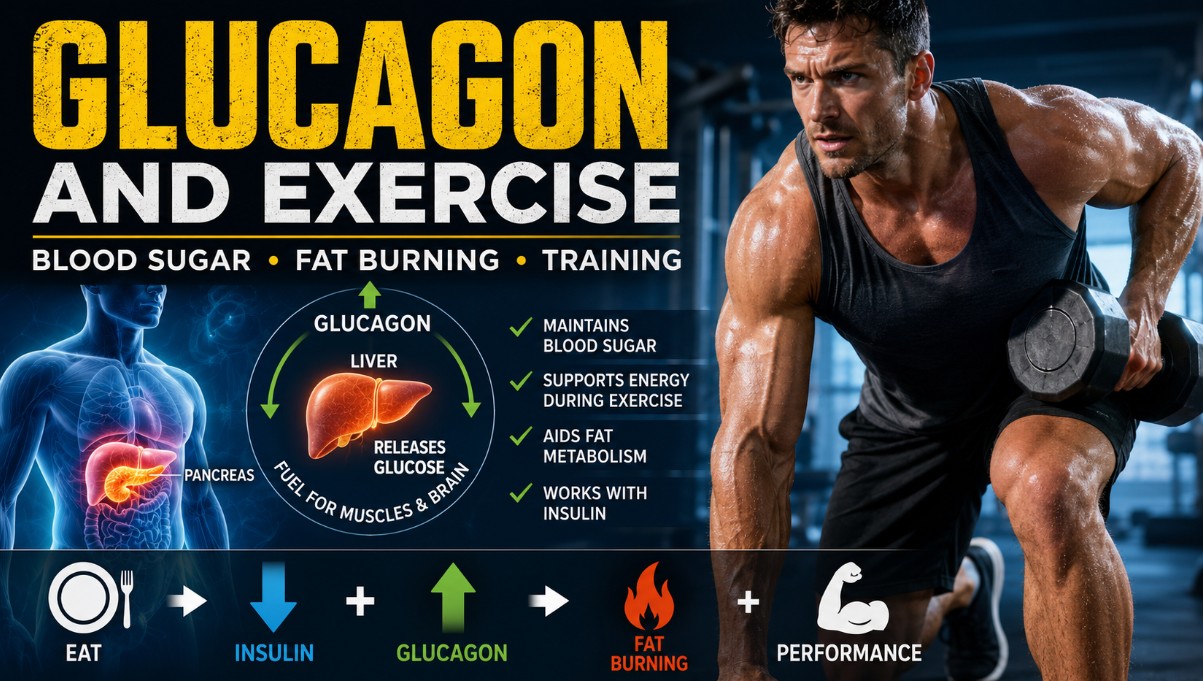
You finish a meal, insulin rises. Several hours later — or halfway through a hard workout — insulin falls, and another pancreatic hormone becomes increasingly important: glucagon. Bodybuilding nutrition often portrays the two as metabolic enemies, with insulin storing nutrients and glucagon “burning fat.” The real physiology is much more useful than that.
Here’s the thesis of this article: glucagon isn’t simply the “opposite of insulin” or a fat-burning hormone. Its primary job is to keep fuel available when you’re not eating or when energy demand rises—especially by regulating glucose output from the liver. Understanding that distinction matters directly for training, fasting, dieting, and how you think about the old “insulin bad, glucagon good” model this site used to repeat.
QUICK ANSWER: Glucagon is a pancreatic hormone that helps maintain blood glucose when food isn’t supplying enough fuel. During exercise — particularly longer-duration activity — glucagon can rise while insulin falls, stimulating the liver to release glucose through glycogenolysis and gluconeogenesis. This helps provide fuel for working muscle and the brain, but it doesn’t mean glucagon is a simple “fat-burning switch.”
What Is Glucagon?
Where Is Glucagon Produced?
Glucagon is produced by the alpha cells of the pancreatic islets — the counterpart to the beta cells that produce insulin. Same organ, same islets, opposite jobs: beta cells release insulin, alpha cells release glucagon.
What Triggers Glucagon Release?
Several things can trigger glucagon release: falling blood glucose, fasting, exercise, amino acids and protein intake, and broader autonomic and endocrine signals. That last one — protein — is particularly interesting, because a protein-rich meal can raise both insulin and glucagon at the same time. That single fact is enough to dismantle the idea that insulin and glucagon function as a simple on/off switch. We’ll come back later in this article to explain exactly why that happens.
How Does Glucagon Work?
Glucagon’s primary target is the liver. It binds to glucagon receptors on liver cells and drives up hepatic glucose output through two main mechanisms:
Glycogenolysis — breaking down stored liver glycogen into glucose.
Gluconeogenesis — building new glucose from substrates like lactate, glycerol, and amino acid-derived precursors.
Here’s an important nuance that much fitness content gets wrong: glucagon’s direct role is predominantly hepatic. It does not tell skeletal muscle to break down its own glycogen stores. Muscle glycogen stays primarily local fuel for the muscle that stores it — muscle cells lack the enzyme (glucose-6-phosphatase) needed to release glucose back into the bloodstream, glucagon or not. This is a good example of how carbohydrates and hormones interact in tissue-specific ways rather than as one uniform signal — think of it as glucagon’s mirror-image specificity to insulin: insulin’s most bodybuilding-relevant actions center on muscle and fat tissue, while glucagon’s central action is almost entirely about the liver.
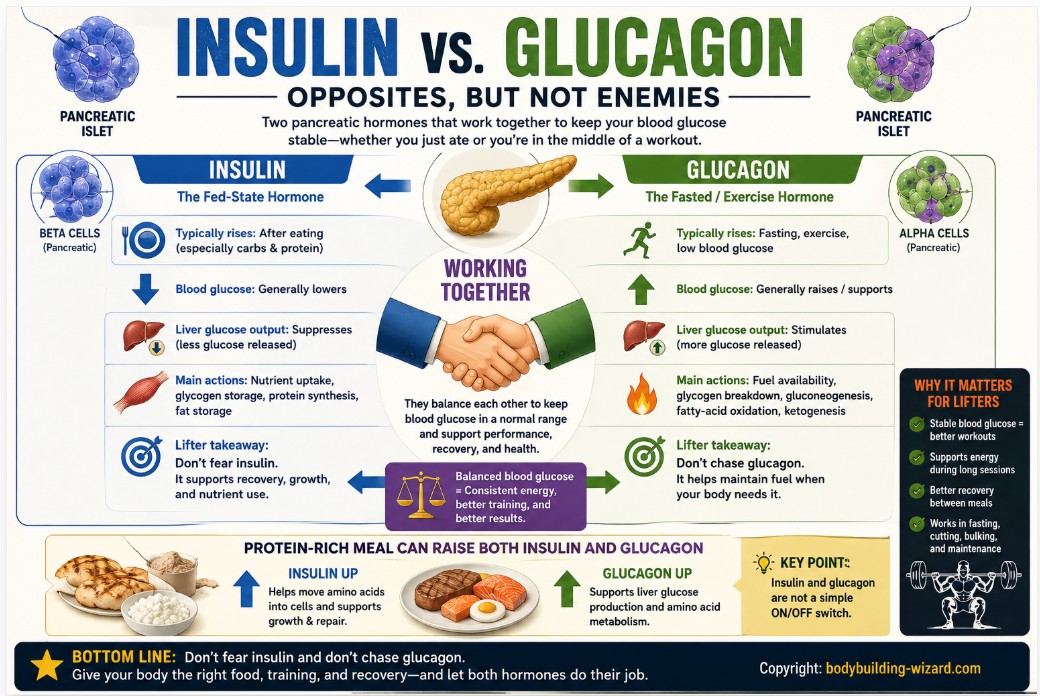
Glucagon vs. Insulin: Opposites — but Not Enemies
| Insulin | Glucagon | |
|---|---|---|
| Produced by | Pancreatic beta cells | Pancreatic alpha cells |
| Typically rises | Fed state | Fasting/exercise |
| Blood glucose | Generally lowers | Generally raises / supports |
| Liver glucose output | Suppresses | Stimulates |
| Nutrient context | Storage and use after feeding | Fuel availability during demand |
| Lifter takeaway | Don’t fear it | Don’t chase it |
Healthy metabolism needs both. They’re not rivals competing for control of your physique — they’re a coordinated system that keeps blood glucose stable whether you just ate a meal or you’re an hour into a training session.
The Insulin-to-Glucagon Ratio: Does It Matter?
You’ll see fitness content online talking about the “insulin-to-glucagon ratio” as something to optimize through food choices. The relative balance between these two hormones is genuinely physiologically relevant — particularly for hepatic metabolism, where the ratio between them helps determine whether the liver is in a net storage or net output mode. But it isn’t a fitness score you should be trying to engineer meal by meal. Content promising to help you “eat this food to maximize your glucagon-to-insulin ratio and burn fat” takes a real physiological concept and turns it into a metric that doesn’t correspond to a meaningful fat-loss lever.
What Happens to Glucagon During Exercise?
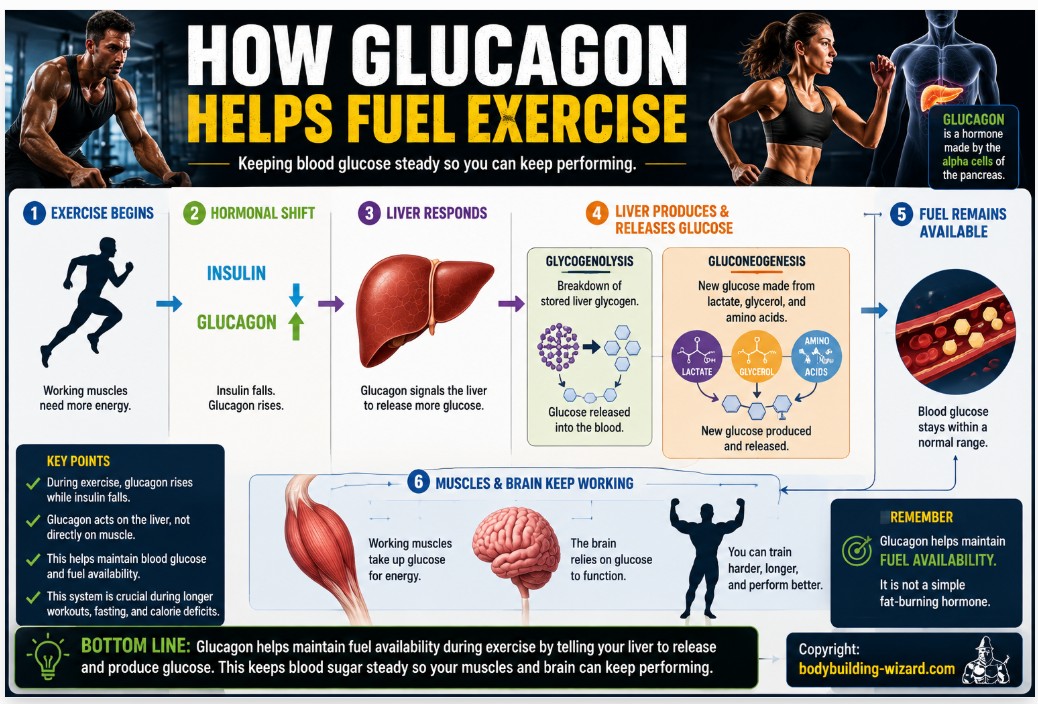
This is the central question this article answers, and the physiology is genuinely well supported. As working muscle increases its glucose demand during exercise, the liver responds by increasing glucose output. Insulin typically falls, and glucagon typically rises — together, this keeps blood glucose from crashing while your muscles are burning through fuel.
A systematic review and meta-analysis examining single bouts of continuous aerobic exercise (≥30 minutes) found that, across 5 studies measuring glucagon (47 participants), exercise significantly increased glucagon concentrations (mean difference: +24.6 ng/L, p<0.001) — and notably, all five included studies showed an increase, a consistent direction that’s rare in this kind of research. Over the same body of evidence, insulin concentrations significantly decreased (mean difference: −18.1 pmol/L, p=0.004). The number of studies specifically measuring glucagon was small, so read this as a consistent early signal rather than an exhaustively settled question—but the direction of the finding lines up exactly with what basic physiology would predict. For the fuller picture of how carbohydrates and exercise interact beyond just this one hormone, see our complete guide.
Why Doesn’t Your Blood Sugar Crash During Exercise?
Here’s a genuinely good question for a lifter to ask: your working muscles are pulling glucose out of the bloodstream the entire time you train — so why doesn’t your blood glucose simply run out?
The answer is that your liver ramps up output to match rising demand. As glucagon rises and insulin falls, hepatic glycogenolysis and gluconeogenesis both increase — supplemented by catecholamines (adrenaline and noradrenaline), which also promote glucose release. This coordinated response is genuinely elegant exercise physiology: demand goes up, and the liver’s supply goes up right alongside it, keeping circulating glucose relatively stable even during a hard, glucose-hungry training session. It’s also part of why training fasted doesn’t cause your blood sugar to collapse mid-session—the same liver-driven backup system is already primed to respond.
Glucagon During Resistance Training
Here’s where this article needs to be more careful than the exercise physiology literature typically is. Most research on glucagon and exercise—including the meta-analysis cited above—comes from continuous aerobic exercise protocols, not standard bodybuilding-style resistance training. It would be a mistake to lift a finding like “heavy squats massively boost glucagon” directly from aerobic exercise literature, because that specific claim hasn’t been established for resistance training.
What’s more accurate to say: glucagon responses depend on exercise duration, intensity, nutritional state, and metabolic demand, and the clearest evidence for rising glucagon exists during sustained exercise, where maintaining circulating glucose becomes increasingly important over time. A short, heavy resistance training session simply doesn’t create the same sustained glucose demand that a 45-60 minute continuous aerobic session does — nor does it necessarily match the metabolic demand profile of HIIT — so the glucagon response is likely to be smaller and less consistently documented, even if the same basic direction probably applies.
Coach’s Note: In practice, I don’t program diets or workouts around trying to “maximize glucagon.” That’s another example of taking a real physiological mechanism and turning it into the wrong coaching target. During a cut, I care about whether the athlete can sustain the calorie deficit, maintain training performance, consume enough protein, and recover — not whether a particular meal produces the theoretically ideal insulin-to-glucagon ratio.
Glucagon and Fat Burning
Does Glucagon Burn Fat?
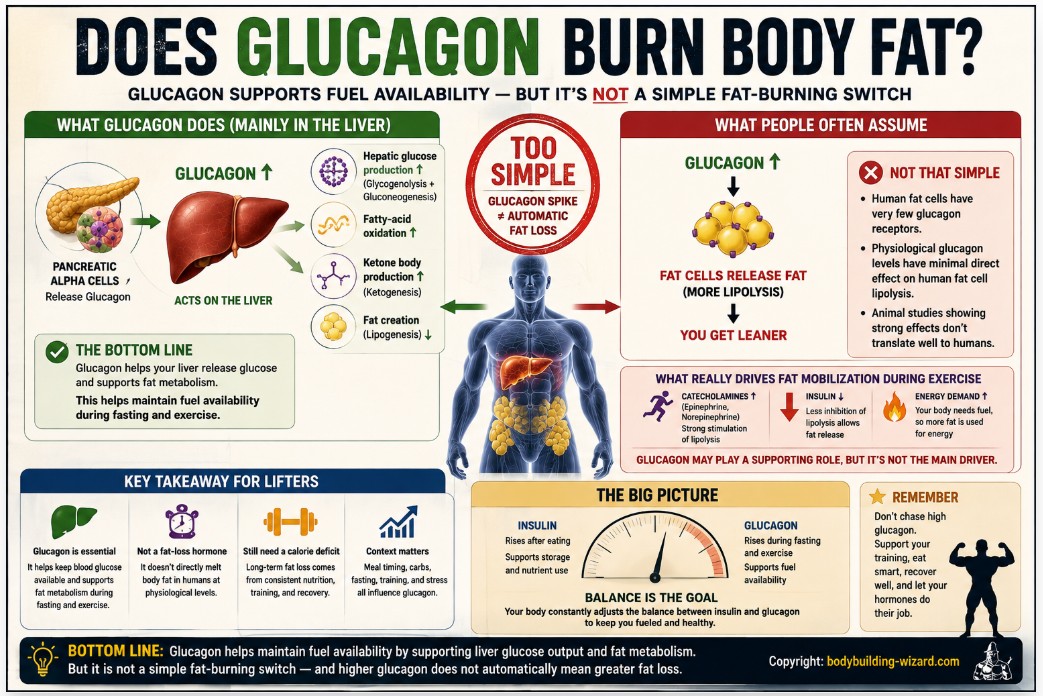
Sort of — but that phrase needs real context. Glucagon influences hepatic lipid metabolism: it affects beta-oxidation (fat breakdown for fuel), ketogenesis, and lipogenesis, primarily in the liver.
Does Glucagon Directly Release Fat From Human Fat Cells?
This is where a lot of classic fitness-textbook narrative overreaches. The idea that glucagon directly triggers human adipose tissue to release stored fat often comes from animal models—rodent fat cells respond to glucagon quite differently than human fat cells, and that difference often gets left out when the concept is simplified for a fitness audience. For actual human fat mobilization during exercise, the far more important drivers are catecholamines, the drop in insulin, and overall energy demand — not glucagon acting directly on your fat cells the way older bodybuilding content sometimes implies.
Does Higher Glucagon Mean More Fat Loss?
No — and this is the central myth-busting point of this half of the article. Just as we covered in our insulin piece that an insulin spike doesn’t automatically mean fat gain, the same logic applies in reverse here: a glucagon spike doesn’t automatically mean fat loss. Long-term fat loss still requires an appropriate energy balance sustained over time — glucagon rising during a workout or a fast doesn’t bypass that requirement.
Research Spotlight: Glucagon receptor agonism has become a genuinely interesting target in obesity pharmacotherapy, thanks to its effects on energy expenditure, hepatic lipid metabolism, and appetite. A systematic review and meta-analysis of acute glucagon administration in adults without diabetes examined its effects on energy intake, energy expenditure, and glucose homeostasis — but even this recent, focused research emphasizes that glucagon’s precise contribution to meaningful weight loss in humans isn’t yet fully worked out. This is an active area of pharmaceutical research, not a natural “glucagon hack” available through diet or training.
Glucagon During Fasting
As fasting begins, insulin falls, and glucagon’s relative influence rises, prompting the liver to draw down its glycogen stores to maintain blood glucose. As fasting continues longer, glycogen availability drops, gluconeogenesis becomes increasingly important, and ketogenesis increases as an alternative fuel pathway kicks in.
But the same caution applies here as everywhere else in this article: fasting-induced glucagon doesn’t automatically mean fasting burns more body fat over time. The hormonal shift is a genuine, well-documented adaptation to keep you fueled without food — it isn’t, by itself, a fat-loss accelerant, and it’s one more entry to add alongside our existing common myths about intermittent fasting. If you’re exploring fasting protocols more broadly, see our overview of intermittent fasting for the full picture beyond just the glucagon angle.
What Happens to Glucagon on a Low-Carb or Ketogenic Diet?
When carbohydrate availability drops, insulin generally falls, and relative glucagon signaling increases — which helps drive the increased hepatic ketogenesis that defines a ketogenic diet. This is genuine physiology. What isn’t accurate is the claim that “keto works because glucagon burns fat” — keto’s effects on body composition, when they occur, are still governed by the same total energy balance principles as any other approach; the shifted hormonal milieu is a mechanism behind how the diet operates metabolically, not evidence that it bypasses energy balance.
Protein Raises Both Insulin and Glucagon — Why?
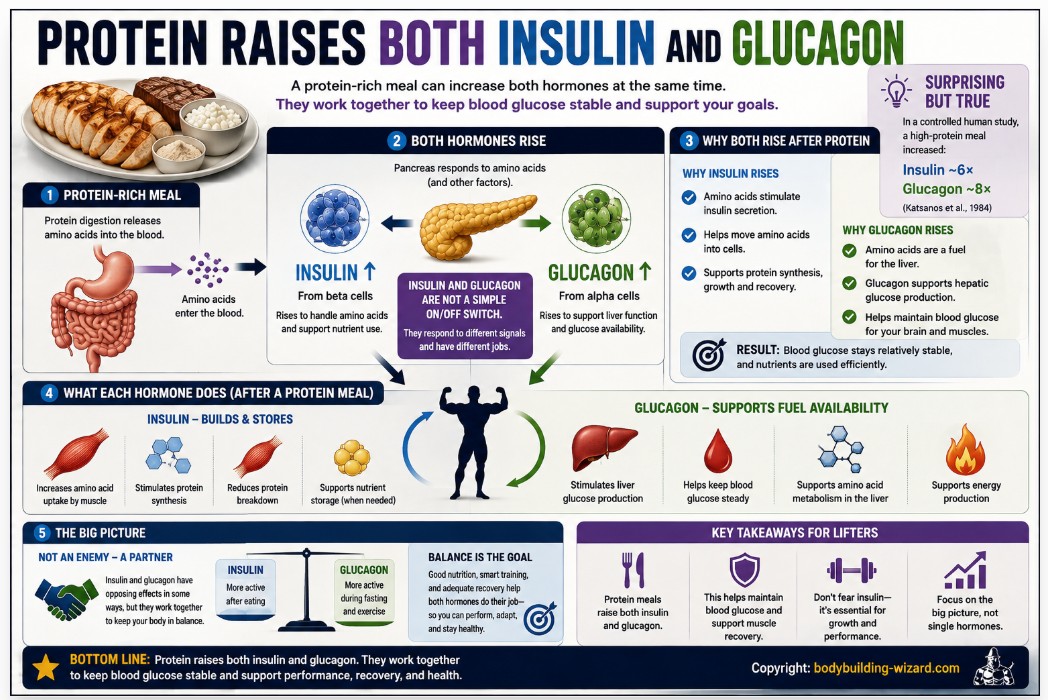
This is one of the more genuinely useful things to understand from this whole article, especially having just read our insulin piece, where you learned that protein raises insulin. Now here’s the part that seems contradictory at first: protein can also stimulate glucagon.
How can both go up from the same meal? A human study using stable isotope tracer methodology found that protein ingestion produced roughly a six-fold increase in insulin and an eight-fold increase in glucagon simultaneously—while blood glucose remained stable throughout. The explanation: insulin helps handle the incoming amino acids and nutrients, while glucagon helps prevent the unwanted blood glucose drop that a large, unopposed insulin response to protein could otherwise cause, and supports ongoing hepatic amino acid metabolism. The researchers behind that study even described glucagon as a genuine “postprandial hormone” that evolved to work synergistically with insulin—not against it.
This is a fantastic, concrete example of why “insulin = fed state signal” and “glucagon = fasted state signal” isn’t an absolute binary. Context and macronutrient composition matter more than a simple fed/fasted label.
Glucagon During Bulking vs. Cutting
| Bulking | Cutting | |
|---|---|---|
| Feeding pattern | More frequent feeding | Longer low-energy periods |
| Carbohydrate availability | Higher | Often lower |
| Insulin exposure | Often higher | Often lower |
| Relative glucagon influence | Not something to suppress | Often somewhat higher |
| Fat mobilization | Not a priority | Increased, driven mainly by the deficit |
| Should you chase glucagon? | No | No |
You don’t need to maximize glucagon to get lean. Just as with insulin, the deficit itself — combined with adequate protein and consistent training — is what actually determines your cutting results.
Can You Naturally Increase Glucagon?
Yes — fasting, exercise, protein and amino acid intake, and lower glucose availability can all measurably influence glucagon levels. But by now, the pattern in this article should be familiar: a higher glucagon level isn’t itself a fitness goal. It’s a normal physiological response to specific conditions, not a lever you should be pulling on purpose to chase a body composition outcome.
Glucagon vs. GLP-1: Don’t Confuse Them
This distinction has become genuinely important given the Ozempic, Wegovy, and Zepbound era of obesity pharmacotherapy — and the confusion around it is likely to grow, not shrink. Glucagon-like peptide-1 (GLP-1) is a completely different hormone from glucagon itself, despite the overlapping name. GLP-1 gets its name from its structural relationship to glucagon through shared proglucagon processing — both are derived from the same precursor protein, cleaved differently depending on the tissue — but the two hormones have very different physiological actions. Glucagon raises blood glucose via the liver; GLP-1 lowers blood glucose, slows gastric emptying, and suppresses appetite, which is exactly why it’s the basis for the current generation of weight-loss medications.
To add another layer, newer GLP-1/glucagon dual-agonist drugs are now in development and use specifically because combining glucagon receptor agonism with GLP-1 receptor agonism appears to add metabolic benefits—particularly around energy expenditure—beyond what GLP-1 alone provides. A 2026 review examining glucagon’s role in energy expenditure frames this directly: GLP-1-based therapy alone may not be enough to address the energy expenditure side of obesity treatment, and glucagon’s own metabolic actions are being actively investigated as a way to fill that gap. This whole area is moving quickly enough that it may deserve its own dedicated article on this site down the line — for now, the key takeaway is simple: glucagon and GLP-1 are not the same hormone, whatever headlines about “glucagon-based weight loss drugs” might suggest.
When Is Glucagon Used Medically?
Briefly, because this matters for a complete picture: glucagon has a genuine, well-established medical use — as an emergency treatment for severe hypoglycemia, typically in people with diabetes who use insulin. Injectable glucagon rapidly raises blood glucose in a dangerous low-blood-sugar emergency, exactly by triggering the same hepatic glycogenolysis mechanism described earlier in this article, just at a pharmacological dose.
This is worth being explicit about: medical glucagon use for emergency hypoglycemia has nothing to do with trying to manipulate your natural glucagon levels for fat loss. They’re different contexts entirely — one is a medical emergency intervention, the other is normal, everyday physiology that doesn’t need to be “hacked.”
Don’t fear insulin and don’t chase glucagon. Give your body the right nutritional and training environment, and let both hormones do the jobs they’re designed to do. This is the natural conclusion to this two-part hormone story: insulin isn’t your enemy when you’re bulking, and glucagon isn’t a fat-loss shortcut when you’re cutting. Both are working correctly in the background as long as your training, protein intake, and overall energy balance are dialed in.
Common Glucagon Myths
❌ Myth: Glucagon is simply the opposite of insulin.
✅ Reality: They’re counter-regulatory, but not simple opposites — a protein-rich meal can raise both hormones at once, which a pure “opposite” model can’t explain.
❌ Myth: Glucagon is a fat-burning hormone.
✅ Reality: Glucagon influences hepatic lipid metabolism, but calling it a fat-burning hormone oversimplifies its role — meaningful fat loss still requires a sustained energy deficit.
❌ Myth: Higher glucagon means faster fat loss.
✅ Reality: A glucagon spike, whether from exercise, fasting, or diet composition, doesn’t override the need for an appropriate energy balance over time.
❌ Myth: Low-carb diets work because glucagon stays high.
✅ Reality: Low-carb and ketogenic diets do shift glucagon signaling, but their effects on body composition still operate through total energy balance, not through glucagon acting as an independent fat-loss mechanism.
❌ Myth: Protein only raises glucagon, while carbs raise insulin.
✅ Reality: Protein raises both hormones simultaneously — often dramatically — while carbohydrate primarily raises insulin. It isn’t a clean macronutrient-to-hormone split.
❌ Myth: You should maximize the glucagon-to-insulin ratio.
✅ Reality: The ratio is physiologically relevant to hepatic metabolism, but it isn’t a practical fitness metric to optimize meal by meal.
❌ Myth: Glucagon and GLP-1 are basically the same hormone.
✅ Reality: They share a structural origin through proglucagon processing but have very different, sometimes opposite, physiological effects on blood glucose and appetite.
❌ Myth: Muscle glycogen is released into the bloodstream because of glucagon.
✅ Reality: Glucagon’s direct action is predominantly hepatic. Skeletal muscle lacks the enzyme needed to release stored glycogen back into the bloodstream at all, regardless of glucagon.
