Soy has had a strange reputation in male fitness culture for years. Eat tofu, drink soy milk, or switch your whey for soy protein and — according to the internet — your testosterone will drop, estrogen will rise, and your hard-earned muscle will somehow be put at risk. It’s repeated confidently enough in gym locker rooms and supplement marketing that many lifters avoid soy entirely, without ever checking whether the underlying claim holds up.
The concern isn’t completely invented. Soy really does contain compounds that can interact with estrogen receptors. The mistake is assuming that “estrogen-like” automatically means “raises estrogen in men” — or that whatever happens at extreme intakes tells you anything about a normal diet.
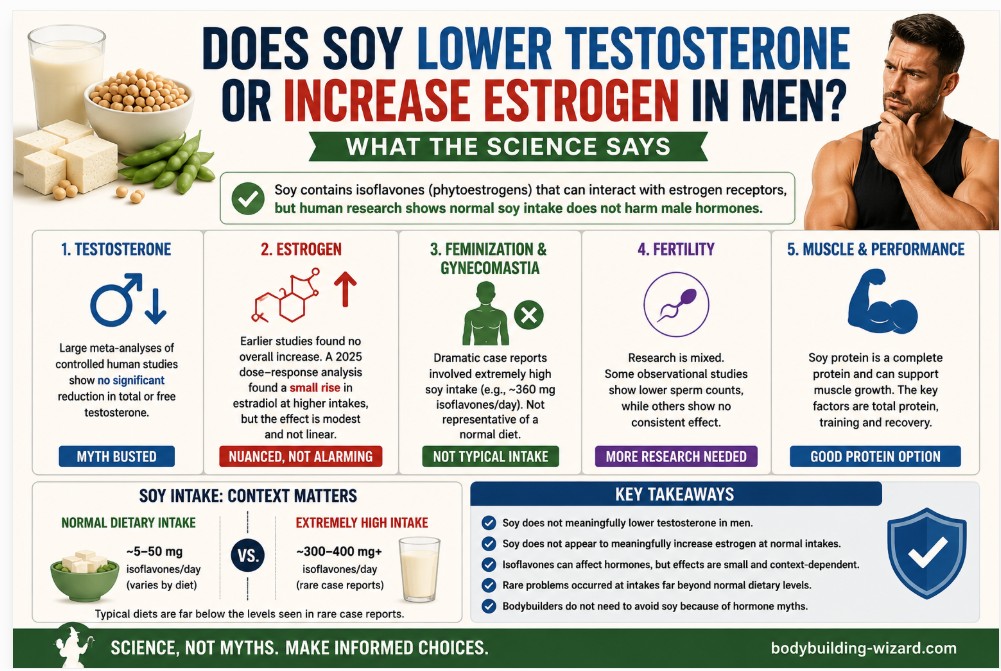
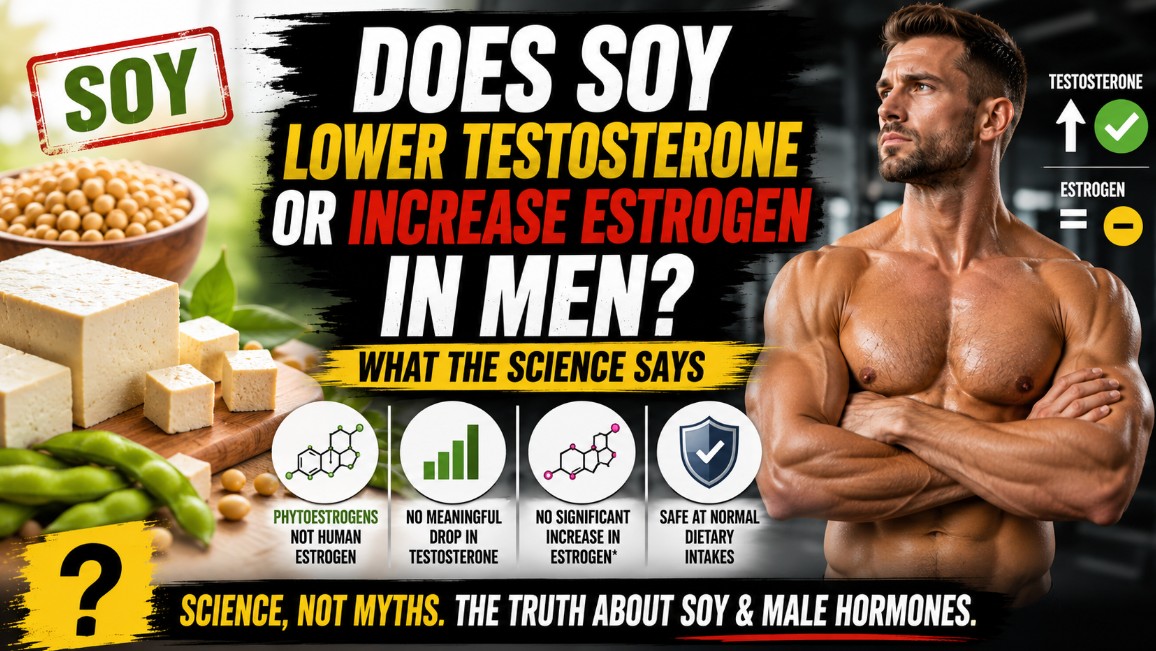
QUICK ANSWER: Normal soy intake does not appear to lower testosterone or meaningfully increase estrogen levels in men. Soy contains isoflavones — plant compounds classified as phytoestrogens because they can interact with estrogen receptors — but they are not the same thing as human estrogen. Meta-analyses of controlled human studies have found no significant effects of typical soy protein or isoflavone intake on total testosterone, free testosterone, estradiol, or estrone in men. Extremely high soy intakes have appeared in isolated case reports involving hormonal or feminizing symptoms, but these unusual exposures — often 7 to 9 times normal dietary levels — do not represent typical soy consumption.
Why Do Men Worry About Soy and Estrogen?
The logic behind the fear follows a chain, and every link in that chain needs its own evidence:
Soy contains genistein, daidzein, and glycitein — collectively known as isoflavones. People hear these classified as “phytoestrogens.” From there: “soy raises estrogen” → “higher estrogen lowers testosterone” → “soy feminizes men and hurts muscle growth.” Each step sounds plausible. None of them has been established just because the previous one sounds true.
What Are Phytoestrogens — and Are They Actually Estrogen?
This is the necessary starting point. A phytoestrogen is not simply “the plant version of human estrogen.” Isoflavones have some structural similarity to 17β-estradiol and can bind estrogen receptors, but their affinity, potency, and receptor preference are not the same as estradiol’s — isoflavones show a notable relative preference for the ERβ receptor subtype over ERα, a distinction that matters for how they actually behave in tissue. ERβ tends to be more prominent in tissues like bone, vasculature, and the immune system, while ERα dominates in tissues like breast and uterine tissue — meaning a compound that preferentially activates ERβ over ERα doesn’t produce a carbon copy of estradiol’s effects throughout the body, even where it does bind.
Being able to interact with an estrogen receptor does not mean a compound acts exactly like estrogen throughout the human body. For the fuller picture of how estrogen itself works in men and women, see our estrogen and exercise guide.
Does Soy Lower Testosterone in Men?
This deserves the strongest available evidence, not individual small studies. A 2010 meta-analysis pooling 15 placebo-controlled treatment groups (plus 32 additional reports covering 36 treatment groups in a broader model) found no significant effects of soy protein or isoflavone intake on total testosterone, free testosterone, SHBG, or free androgen index, regardless of age or health status. An expanded 2021 update of the same research, now covering 38 clinical studies, reached the same conclusion: no effect on testosterone or estrogen levels in men. For the fuller picture of what actually does and doesn’t move the needle on testosterone, see our testosterone and muscle growth guide.
Worth noting directly: several of the researchers behind both of these analyses are affiliated with the Soy Nutrition Institute, which is funded by the soybean industry — a real conflict of interest worth being transparent about, even though it doesn’t automatically invalidate the findings. Across controlled human studies at typical intakes, normal soy and isoflavone consumption has not been shown to meaningfully suppress testosterone in men. It’s also worth separating rodent and in vitro mechanistic concerns—where isoflavones can show more dramatic effects—from what human trials have actually shown, which is where this conclusion is grounded.
Does Soy Increase Estrogen in Men?
This is where the story gets more interesting than a flat “no.” The same large meta-analyses found no significant effect on estradiol or estrone at the intake levels typically studied. But a 2025 dose-response meta-analysis — the first of its kind, restricted specifically to healthy men — found something genuinely more precise: a nonlinear dose-response relationship between soy isoflavone intake and both estradiol and SHBG. Estradiol rose by roughly 6.5 pg/mL at 72.2 mg/day above a zero baseline, and SHBG rose by roughly 9 nmol/L at 120 mg/day above baseline (both statistically significant, p < 0.001 for nonlinearity).
That doesn’t contradict the “no effect” conclusion from earlier meta-analyses so much as refine it: the relationship isn’t flat, it’s dose-dependent — and the doses where earlier studies found nothing tend to sit below where this more precise analysis starts detecting a real, measurable shift. Soy containing phytoestrogens does not automatically mean eating a typical amount of soy increases your circulating estrogen — but at high enough doses, the evidence suggests it eventually can.
Does Soy Change the Testosterone-to-Estrogen Balance?
At normal dietary intakes, there’s no good evidence that soy meaningfully shifts a man toward some clinically relevant “high estrogen, low testosterone” state. It’s also worth challenging the premise some lifters carry into this question: the idea that a man should have sky-high testosterone and close to zero estrogen isn’t itself correct. As covered in our estrogen and exercise guide, men genuinely need estradiol for bone health, sexual function, and other normal physiology — estrogen isn’t a contaminant of male hormone physiology to be minimized.
Coach’s Note: I wouldn’t tell a male lifter to replace every protein source in his diet with soy, but I also wouldn’t tell him to avoid tofu, soy milk, or a protein product because he’s afraid his testosterone will collapse. When I look at a lifter’s diet, I’m much more interested in total protein intake, protein quality across the day, calories, food variety, and whether the diet is sustainable than whether a few meals contain soy.
Where Did the “Soy Feminizes Men” Story Come From?
This is worth examining directly, because a small number of case reports have done a lot of cultural work — repeated in fitness magazines, forums, and supplement marketing for well over a decade, often stripped of the context that made them unusual in the first place.
There’s an important distinction between a case report — one unusual person, an unusually high exposure, a clinical observation — and controlled human evidence — multiple participants, controlled intake, a comparison group, pooled results across studies. A case report can be genuinely useful medicine: it flags something worth investigating further. What it can’t do on its own is tell you what happens to the average person eating an average diet. The case reports behind this myth are interesting precisely because they’re unusual, not because they represent what typically happens when a man eats tofu or drinks a soy latte.
How Much Soy Were These Men Actually Consuming?
Context makes this section worth having, because “extreme intake” means nothing without a real number attached to it.
The most frequently cited case involved a 60-year-old man who developed gynecomastia after drinking 3 quarts (roughly 3 liters) of soy milk per day — estimated to provide about 360 mg of isoflavones daily, around 9 times typical Japanese dietary intake (which runs roughly 30-50 mg/day from traditional soy foods). His estrone and estradiol were four times above the normal reference range — but interestingly, his testosterone stayed completely normal throughout; this was an estrogen story, not a testosterone one.
A separate case involved a 19-year-old vegan with a nearly identical intake (also around 360 mg/day) who developed hypogonadism and erectile dysfunction. Even a smaller, shorter controlled study found a modest testosterone decrease (about a 6% drop) in men eating 120 mg/day of isoflavones from soy flour for six weeks — a dose that’s still roughly 2-3 times what a typical soy-based diet provides, in a study too small and brief to draw strong conclusions from on its own.
NORMAL DIETARY INTAKE: roughly 5-50 mg isoflavones per day from typical soy foods (a serving of tofu, a glass of soy milk, an occasional protein shake).
THE CASE REPORTS: 360 mg per day, sustained — 7 to 9 times higher, day after day, for months.
That gap is the entire story. It’s also worth knowing that other endocrinologists reviewing the most famous case later disputed whether phytoestrogen intake alone could even fully explain the magnitude of hormone elevation observed — a reminder that even the headline case behind this myth isn’t as scientifically clean as it gets repeated to be.
Can Soy Cause Gynecomastia?
Normal soy intake has not been shown to cause gynecomastia in men, though isolated case reports involving unusually high soy and isoflavone exposure have described feminizing symptoms, as covered above. Gynecomastia itself has many possible causes — medication side effects, other hormonal conditions, liver or kidney issues, and normal age-related hormonal shifts among them — and soy consumption at typical levels isn’t a well-supported explanation for it. A far more common cause in the bodybuilding world specifically is steroid-induced gynecomastia, an entirely different mechanism driven by exogenous hormone use rather than diet.
Does Soy Affect Male Fertility?
Briefly, since this question naturally follows from testosterone and estrogen concerns. The evidence on soy, isoflavones, and measures like sperm concentration and quality is mixed and considerably less settled than the testosterone data — some observational studies have reported associations with reduced sperm concentration, though these don’t establish that typical soy consumption causes fertility problems, since observational associations can’t rule out other dietary or lifestyle factors common among people who eat a lot of soy.
Other studies looking specifically at soy intake and semen quality in fertility-clinic populations have found no consistent, alarming pattern. This remains a genuinely more open question than the testosterone story, and worth flagging as an area with less consensus rather than a resolved myth in either direction — if fertility is a specific concern for you, that’s a conversation better had with a doctor working from your actual bloodwork and semen analysis than from general population data either way.
Does Soy Protein Hurt Muscle Growth?
If soy doesn’t destroy testosterone, is it still inferior for building muscle? This requires separating two genuinely different questions: does soy protein lower testosterone (covered above — not meaningfully, at normal intakes), and how effective is soy protein at stimulating hypertrophy compared to whey or animal protein — a protein-quality question with nothing to do with hormones.
Soy is a complete protein containing all essential amino acids, though its leucine content and digestibility profile differ somewhat from whey. If whey has an edge in some acute muscle protein synthesis conditions, that’s a separate mechanism entirely from any hormonal claim — it doesn’t mean soy is “feminizing” your gains; it just means the two proteins aren’t identical in every respect. Total daily protein intake and consistency matter far more than which specific complete protein source you’re using for any individual serving. See our protein intake guide and protein quality rating guide for the fuller framework.
Soy Protein vs. Whey: Which Is Better for Bodybuilders?
Whey is leucine-rich, digests quickly, and has a well-established track record for supporting hypertrophy — see our complete guide to whey protein types for the breakdown. Soy is a genuinely complete plant protein and a perfectly viable source on its own — there’s no hormonal evidence that it “estrogenizes” a bodybuilder at normal intakes. Total protein, dose, and overall dietary context matter more than which of these two you choose for any given meal.
What About Soy Protein Isolate?
A fair question, since soy shows up concentrated in protein powders, bars, and processed high-protein foods that make up a meaningful share of many lifters’ diets. The hormone evidence covered throughout this article applies broadly to soy protein and isoflavone intake, including isolate—the concern isn’t specific to whole soy foods versus processed soy protein. See our soy protein powder guide for the practical breakdown of that specific product category.
Should Bodybuilders Avoid Soy?
There’s no good hormonal reason to. If a lifter avoids soy because of an allergy, personal preference, GI tolerance, or general dietary choice — that’s entirely reasonable. But “I’m avoiding soy because it’ll raise my estrogen and crash my testosterone” isn’t well supported by the evidence at normal intake levels.
Common Myths
❌ Myth: Soy contains estrogen.
✅ Reality: Soy contains phytoestrogens called isoflavones; they are not human estrogen and don’t behave identically to it.
❌ Myth: Soy lowers testosterone in men.
✅ Reality: Controlled human evidence and pooled meta-analyses do not show a meaningful reduction in testosterone at typical studied intakes.
❌ Myth: Soy raises estrogen in men at any amount.
✅ Reality: The relationship is dose-dependent — typical dietary intake shows no meaningful effect, though the most rigorous recent analysis found a real, measurable rise at higher intakes.
❌ Myth: Soy causes gynecomastia.
✅ Reality: Rare case reports involve unusually high exposure — roughly 7 to 9 times typical dietary intake, sustained for months — not evidence that normal soy intake causes gynecomastia.
❌ Myth: Soy protein will ruin your gains.
✅ Reality: Soy is a complete protein that can support resistance-training adaptations; any protein-quality differences from whey are a separate issue from hormonal feminization.
Bodybuilder’s Take
Soy contains compounds that can interact with estrogen receptors. That’s the real source of the myth. What doesn’t follow is that eating normal amounts of soy raises estrogen, crashes testosterone, feminizes men, or sabotages muscle growth — the concerning findings only show up at intakes several times higher than anyone eats through a normal diet, tofu habit, or protein shake. For bodybuilders, soy is a protein source — not a hormonal threat.